 |
 |
 |
 |
 |
 |
 |
 |
 |
 |
 |
 |
 |
 |
 |
 |
 |
 |
 |
 |
| While not entirely within the geographical borders of Schuylkill Haven, the Union Cemetery is probably most often thought of as the "town cemetery". Located off of North Garfield Avenue, it partially lies within North Manheim Township. The grounds of the cemetery are adjacent to the Jerusalem Cemetery. On the northern edge lies Mount Nebo, a section of the cemetery generally known as the burial place of black residents of the area. A mausoleum is also located on the grounds. Information and graves on the Jerusalem Cemetery are also included here. |
| Many prominent residents of Schuylkill Haven have found their final resting place in the Union Cemetery. Below you will find pictures of their headstones and a brief description of who they are. |


| If you have any information or history on the Union Cemetery you would like to share, please send it to: unioncemetery@schuylkillhavenhistory.com |


| The headstones of Schuylkill Haven's two Civil War Medal of Honor recipients, Charles Brown on the left and Henry Hill on the right. |
| The mausoleum at the top of the hill in Union Cemetery is marked 1947 but was completed in 1949. |
| The veteran's plot at Union Cemetery with many Civil War and World War One veteran's graves. |
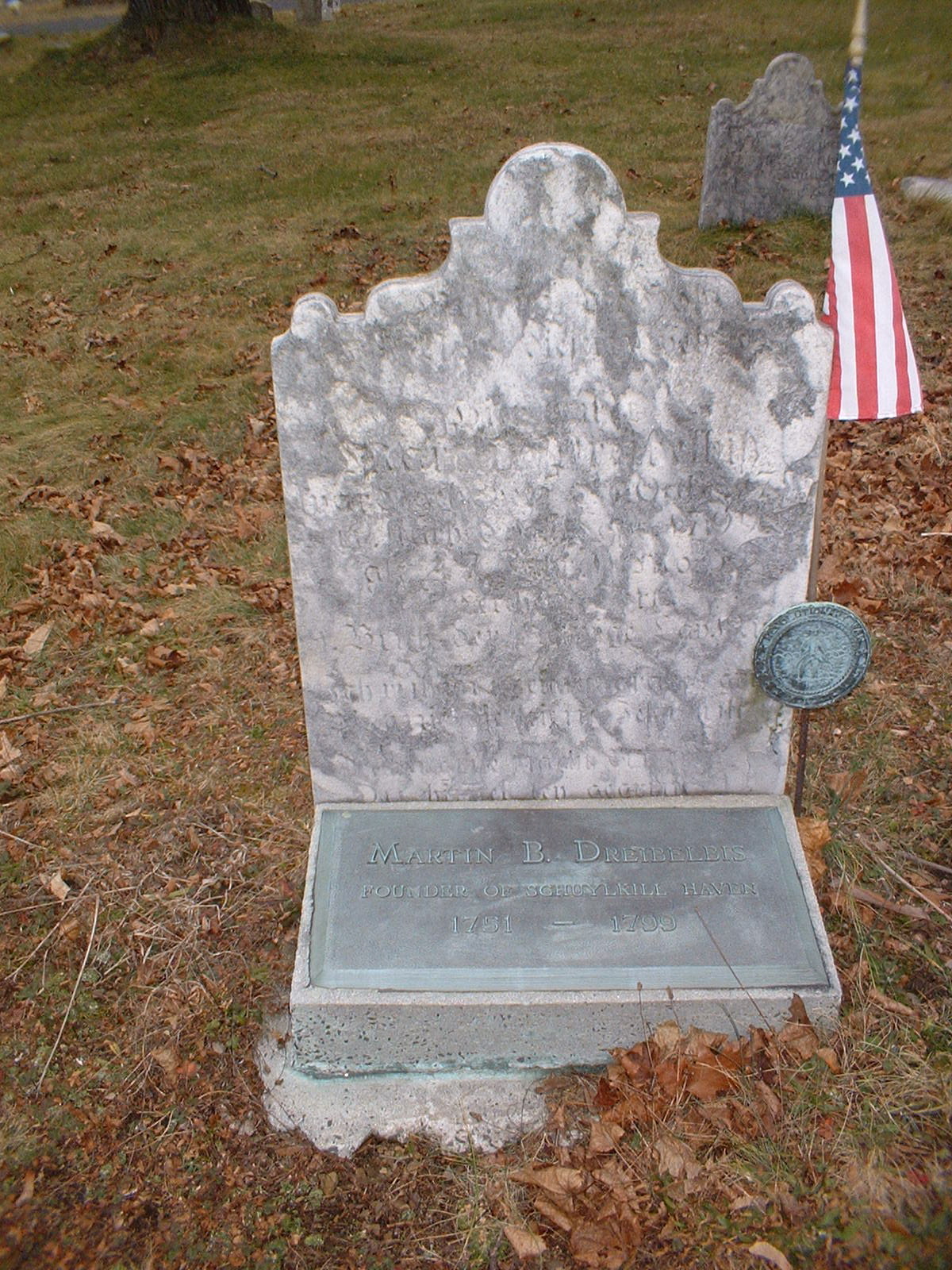

| Two prominent members of the Dreibelbis family. At left is Martin, the recognized founder of Schuylkill Haven and to the right his son Jacob who laid out the plan for the town. |


| Two men who gave their lives for their country in World War One are buried at Union Cemetery. On the left is the stone of Isaac Burkert who died in 1918. The stone is only a memorial as he is as the stone states "At rest in France". On the right is the grave of Lieutenant Ivan L. Lautenbacher who was killed in action in the Argonne Forest, also in 1918. |


| The Schuylkill Canal was important in the development of Schuylkill Haven. Lock keeper John Boussum at left and canal boat builder Abner High above both were involved with the canal. |

| Gideon Bast was an astute and wealthy businessman in Schuylkill Haven in the 1800s. His marker is on the left and is located in the family plot with it's impressive center stone on the right. |

| The tombstone of Charlie Lins is one of the more attractive stones in the cemetery with an angel perched atop the obelisk. |

| George Gangloff was a judge in Schuylkill County. His tombstone is seen above left and a campaign card is shown at right. |
| The Union Cemetery received it's charter from Pennsylvania on February 27, 1854. However, headstones indicate that burials had taken place there since at least 1837. The original cemetery was a part of the Gideon Bast farm. The farm house was located on Centre Avenue near where the former United Church of Christ parsonage now stands. He offered to sell eight acres of his farm on the hillside for $800. Gideon Bast, Charles Dengler, John D. Deebert, Benjamin Delong, Abraham Boyer, Isaac Kulp, Levi Schaeiff, William Fisher and Andrew Keefer were the original directors. In 1871, the board met with members of the local Grand Army of the Republic in regard to a plot of donated ground for the burial of deceased soldiers. This was later expanded upon when a plot was given to the American Legion for the burial of veterans. Over time the cemetery expanded from eight to twenty one acres. The first addition to the original plot was purchased from the Lehigh Valley Railroad. Another portion was later purchased from the Heinbach estate. The mausoleum, completed in 1949, is perched near the top of the hill in the cemetery. The cemetery is reminiscent of it's Victorian era roots with tree lined lanes, large family plots and steps and walls within it's confines. The large variety of tombstones and the presence of graves of many of Schuylkill Haven's well known citizens makes it well worth a stroll on a pleasant afternoon. |

| Louisa Heston Paxson, daughter of Revolutionary Soldier, Colonel Edward Heston was a charter member of the DAR. |

| Henry Stager was very involved in the Patriotic Order of Sons of America as can be observed by reading his impressive stone. |

| The stone of George Keller, well known local Boy Scout leader is adorned with the group's symbol. |

| This unusual stone marks the graves of Geiger family members. Zoom in to see the detailed stonework. |

| The impressive monument of Civil War Major S. A. Losch dominates those surrounding it. |

| Perhaps the heaviest stone in the cemetery, this monument to the Wiederhold/Hornickel families is adorned with a detailed anchor and cross. |
| All rights reserved. |
| James G. Anderson is one of two native sons that was killed in action during the Vietnam War. |


| Two of the men from Schuylkill Haven who gave their lives during World War Two are buried here. On the left is the stone of Russell Mengle and above is the stone of Sterling Knarr, his name inscribed on his parents stone. The stone notes that he is buried in Belgium. The grave of his father has a World War One service medal and the grave of his mother has a Gold Star Mother Medal. |
| The Union Cemetery contains other stones whose attraction lies in their unique design or their ornateness as seen below. |

| This beautifully cut stone with an open Bible on top for Mary Guldin was placed by an obviously loving husband a century and a half ago. |


| The grave stone of Ray Bressler, member of the famed 103 RD Engineers unit of World War One, is shaped like a book standing on end. |
| Another large monument in the cemetery marks the graves of William and Isabella Rudy |

| Captain James Helms was another Civil War veteran active in the Patriotic Order of Sons of America and also the GAR. See the Civil War page for more information on his life. |

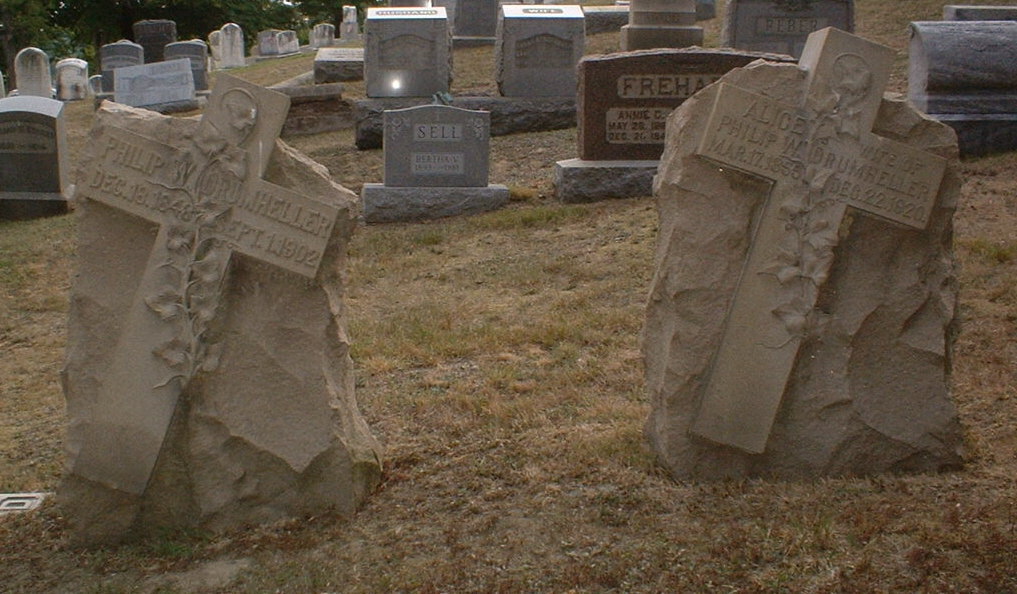
| On the left is the stone of Lieutenant S. B. Laubenstein, who died during the Civil War, but is not listed on the monument in town. He was born near Friedensburg, but later lived in Schuylkill Haven. His story is on the Civil War page of this site. Note the detailed sword carved into the upper segment. Above are the intricate stone crosses of Phillip and Alice Drumheller. |

| Many early businessmen and entrepreneurs are buried at the Union Cemetery. Below are two with more to be added in the near future. |
| On the right is the marker of Hugh N. Coxe, prominent area druggist who manufactured Wild Cherry and Seneca Tonic and Santorine Worm Syrup. On the left is town pharmacist Charles Commings and his wife. Both were well known in the immediate area for their concoctions. |
| Pottsville Republican of October 22, 1921 POS of A UNVEILS MONUMENT TO H. J. STAGER AT SCHUYLKILL HAVEN Prominent officers of the National and State Camps of the P.O.S. of A. from every section of the state, gathered at Schuylkill Haven this afternoon at two o’clock, for the purpose of paying tribute to the memory of Henry J. Stager, formerly of Schuylkill Haven, who died in 1919 after a career that marked him as the most prominent member and worker the order has ever had. The meeting today was held for the purpose of not only paying tribute to the distinguished member of the order, but for the purpose of dedicating in the Union cemetery the monument to his memory. The stone was erected through the contributions of every camp in the state. Mr. Stager who was born in Schuylkill Haven in 1842, and during his career of seven years was National president, State president, National secretary, State secretary, Past Commander in Chief of the Commandery General, and founder of the Camp Sews, the official organ of the order. The monument, a huge block of uncut stone on a double base of hewn marble, contains a facsimile of the Camp News engraved on the front, with the dates of birth and death engraved on the pages. The record of Mr. Stager is recorded on the base slab. Among the notables who attended the ceremony were: National president Gabriel H. Moyer of Lebanon, who delivered the dedicatory address; state president O. B. Wetherhold of Reading, chairman of the meeting; National secretary Herman G. Miller, of Easton; National treasurer J.W. Reese, of St. Clair; State vice president, A. D. Boyer, Pottsville; State master of forms, James Pyle, Lancaster; State Treasurer, I.S. Smith, Reading; State secretary C.B. Helms, Philadelphia; State guard, Philip Weist, Shamokin, State inspector, Clarence Silknitter, Huntingdon, Rev. T.J. Hacker, of Reading, state chaplain, officiated. The monument was unveiled by Miss Alice C. Stager, Pottsville, granddaughter of Mr. Stager. Mr. Stager in addition to his other activities, was also a member of the Valley Forge Memorial Commissions. The dedication was attended by probably the most representative gathering ever held by the P.O.S. of A. in the state. Seldom has there been a gathering where both the National and State Camps were so fully represented. The ceremonies were held in the Union cemetery following a parade which was formed at the Hotel Grand in charge of a committee consisting of Willis Kauterman, E.J. Scherer, H.A. Reber, George Keller, Llewellyn Fisher and Warren Lesser from Camp 47 of Sch. Haven under the chairmanship of Foster C. Fahl. Following the dedication the State and National officers planned to stay in Pottsville overnight, in order to attend the county rally to be held in the armory this evening. |


| Two other interesting tombstones are present at the cemetery. At left is the marker for Augusta Seitz. Note the huge cross. At right, a Levan family obelisk contains intricate stone carving. |
| This large plot marker is for the Coldren family, owner of the mill in town, and the Kerkeslager family, one member who owned a brewery at the corner of Saint John and Union Streets. |


| Here are three more obelisk style tombstones that grace the grounds of the cemetery. At left is a stone for the Fesler family. It has a very unusual top on it, almost like a roof. The center stone of the Maberry family has an ornate carving on the column. The stone on the right is for the Loose family and although rather plain, it towers over most in this section. |

| This Reed family stone is low to the ground but unusual with its scroll laying over a tree stump. |
| Elias Ziegenfus was one of the early undertakers, now known as funeral directors, to do business in town. |
| The stone of Adam Burket lies in the family plot. He was killed in the storage yards. His tale is on the Railroad page of this site. |
| The Call of November 18, 1893 The authorities of the Union Cemetery have cleared the trees that had remained on a portion of it and laid it out in lots. They are making a road to the left as you enter the cemetery to reach this portion. They desire to enlarge the cemetery and have sought to purchase some of the land adjoining it for that purpose but thus far they have been unable to come to satisfactory terms with the owners who desire very exorbitant prices for their land. They have received a very reasonable offer of a piece of land very suitable for a cemetery elsewhere and they have the offer in contemplation and may purchase the land and convert it into a cemetery. |
| The Call of December 30, 1893 We publish in another column the financial statement of the Schuylkill Haven Union Cemetery. The company consists of Messrs. Robert Sterner, Jacob S. Kline, C. V. B. Deibert, P. C. Detweiler, M. F. Pflueger, Cyrus Witman, Elijah Emerich, William F. Stitzer, Mahlon M. Saylor and Henry Fisher, with Robert Sterner, President, P. C. Detweiler, Secretary and Elijah Emerich, Treasurer. The report shows the company to be in very good financial condition which is brought about by the successful management of the affairs of the company by its efficient corps of officers and managers. They expended a considerable sum of money during the year. With this money they greatly improved the condition of the cemetery and have made it a very desirable burial ground. |

| The article below and the balance sheet at right appeared in the Call newspaper at the end of 1893. |
| The Call of November 17, 1916 GHOST ON UNION CEMETERY Taking advantage of the fine weather on Sunday evening last, about 8:30 o’clock, a half dozen or more people ventured to the Union Cemetery and climbed to the top of the team road. No sooner had they reached the top when they discovered what they thought was a ghost, a black ghost, with four legs, hopping from one tombstone to another and appearing first here and then some distance away. Just how these people managed to get to the bottom of the hill and then down Garfield Avenue to Centre Avenue they refuse to explain. One female of the party lost her hair, another her hat while several of the male members lost their breath and their religion. They never returned to investigate just what kind of a ghost it really was. Monday morning about nine o’clock the entire ghost story was cleared up. It appears that Sunday evening merchant John Freeman was leading his horse to water. The horse broke away and took to the hills. Efforts were made to locate the horse but were unsuccessful. Finally the search was given up until Monday morning when several children on their way to school stopped in the store and told John his horse was running loose in the cemetery. It was easily captured. Now John just can’t quite figure out why the horse went to the cemetery. The animal is only six years of age, entirely too young to think of dying and besides it has not been suffering with any disease that would cause it to think of an early grave. |

| This picture shows the gate at the Garfield Avenue entrance to the cemetery. It is the Clarence and Rosanna Snyder family who lived across the street. PICTURE COURTESY OF SUSAN DEIBLER |

| This self explanatory picture is shown courtesy of Susan Deibler. |
| In the Call of May 26, 1899, The following appeared in preparation for Memorial Day. |
| David Berger Lafayette Baker Joseph Edwards Daniel Moyer Henry Copeland George W. Burton John Hammis Michael Moyer Jacob Brininger George Berger Pat F Cooligan Fred W. Snyder William Leffler George Martz Milton Williams Daniel F. Burket Jacob Sheriff Levi Rubright Joseph Redkey George Boussum George Knarr Charles Hammis John D. Grim |
| Private Private Lieutenant Corporal Private Private Private Private Private Private Private Private Private Private Captain Private Private Private Private Private |
| 50th PVV 50th PVV 48th PVV 48th PVV 48th PVV 8th Pa Cav 58th Pa Vol 116th Pa Vol 69th Pa Vol 167th PDM 48th PVV 48th PVV 50th PVV 104th PVV 50th PVV 50th PVV 96th PVV 50th PVV 50th PVV 50th PVV 96th PVV |
| Co C Co C Co I Co K Co B Co K Co A Co G Co C Co B Co D Co K Co D Co D Co C Co C Co A Co C Co C Co C Co G |
| The following are the names of soldiers buried in Union Cemetery, Schuylkill Haven: |
Charles S. Leader William Fox John T. Hannum S. B. Laubenstein John Eckert Isaac Eckert Stoughton Kiehner Romandus Harner Peter Dilcamp William H. Koch Alpheus Combs William Koch Emanuel Bast Jacob Ebert William Feger William Reppard James Lash Franklin Burns John Weand John Wood William J. Hein Jackson Delong Jacob Honnicker Henry W. Guertler George Shreck John Katterman H. J. Bashore G. W. Frehafer Joshua Heiser Charles F. Kantner Albert W. Kantner James Delong Henry R. Quinter John Hill Daniel Yost Michael Kerkeslager Amos Paff Henry C. Freed Henry Wright B. F. Zimmerman Lewis Heisler John G. Kaufman John Fableau John Byerly Thomas Raber Edward Brown Alfred Streickler Adam Delong Daniel Small Jerome Hoffman John Bassler Augustus Mellon Clinton H. Koons Joseph Rupp Elias Berger Henry B. Christian James K. Helms John Meck Charles Jorden Charles R. Guertler OLD CEMETERY James Moyer Augustus Palsgrove Israel Dewald George W. Lloyd Andrew Krebs Frederick Scheck Frank Reed Jerome Coneycomb Lewis Smith Peter Barr Samuel Byerly John J. Palsgrove EPISCOPAL CEMETERY John Armstrong Samuel Shelenberger Thomas Robinson H. G. Robinson |
| The Call of May 6, 1932 BEAUTIFYING THE UNION CEMETERY Considerable improvement in appearances has been brought about at the Union Cemetery in Schuylkill Haven during the past week or two, by reason of the completion of some parts of quite a program that is to be followed for beautifying the largest of the town's burial places. On both sides of the gate or main entrance to the grounds from Garfield Avenue, the ground has been put on a sort of terrace and small trees have been planted. The sides of the hill along the driveway entrance are to be planted with small trees, some of them having already been placed. Around the entire cemetery is to be placed a hedge of barberry. Fences of wood that were in bad condition and would have had to be rebuilt have already been removed. The hedge may be in position by Memorial Day. Small trees are to be planted in different parts of the cemetery, particularly upon the newer or top of the hill section, where it is possible to put into effect a definite ideal cemetery layout before all lots are disposed of. Within a few months it is expected really marvelous improvements in appearances will have been brought about. Editor's Note: And in making improvements to the Union Cemetery, might it not be a good idea to rebuild the present dirt highways about this burial place or at least cover them with a coating of oil or give them a treatment of tar or some other dust laying material? On the occasion of a funeral, it is rather annoying to passengers in automobiles to be required to breathe in and be subjected to a thick coating of dust that is stirred up. Autoists, too, find it rather provoking to see their specially washed and polished car being thoroughly dusted while traveling over a very, very small section of the route which the funeral procession followed. If the Board has not as yet given consideration to this item as a part of cemetery improvement, may we urge that it do so? |
| The Call of May 10, 1935 SOLDIERS LOT TO BE REDEDICATED SUNDAY MAY 19TH Sunday afternoon, May 19th, will witness an impressive ceremony in Schuylkill Haven. It will be the rededication of the burial plot of the American Legion, this the 13th District. The plot is located on the Union Cemetery, on the top of the hill, a short distance above the Schuylkill Haven American Legion plot. This plot of ground was purchased several years ago by contributions received by all of the Legion Posts and Legion Auxiliaries in the county. Eleven soldiers are buried on this plot, several being World war veterans, Spanish-American War veterans, one Canadian soldier and several Civil war veterans, whose bodies were, through the efforts of the Legion boys, moved from the County Pauper lot a year or two ago. There had been many kinds of markers. Now all the markers are of standard style and uniform in size, furnished by the War Department. Four granite corner posts bearing the American Legion insignia, with granite steps, in which are imprinted the words "13th District American Legion", at the entrance, set off the plot. There is a forty foot flag pole planted on the plot. The grave markers are two feet in height. The plot is covered with sod that the recent rains have brought out in close and healthy growth. The ceremonies in connection with the rededication of the Legion plot will be participated in by the county. The program and rededication exercises on the cemetery will be preceded by a parade from the Legion home to the cemetery. The famous Mahanoy City Legion Band of sixty pieces, a musical organization that has won many prizes throughout the state and the organization that made a fine impression on its previous visit to Schuylkill Haven, will lead the parade column to the cemetery. The speaker of the afternoon will be Judge G. E. Gangloff. Charles R. Gebhart. Past State Commander of the American Legion, will also be a speaker. Prayer will be offered by Reverend Boyd. The plot will be presented by David Baird, District Vice Commander of the 13th District and will be accepted by James Donohue of Coaldale, County District Commander. |
| The Call of October 4, 1935 MANY IMPROVEMENTS BEING MADE TO UNION CEMETERY Improvements in appearance and added convenience are being continued at the Union cemetery. The weather permitted good progress to be made this week, to the plan adopted for the widening of a number of the roads on the cemetery and making them of a permanent nature. The road roller of the borough is being employed for the purpose and the method being followed is that laid down by Street Commissioner James Schucker. Curves are being widened and grades being changed. In addition to the improvements thus being brought about in the nature of roads on this cemetery, another program of work is to be started at once which will result in much improved appearance of the cemetery. The cooperation for this result, however, will be necessary from owners of burial lots. First of all, owners of burial lots who have the rail fences around the lots are requested to remove the same at once. This request is being made first of all for appearance sake. Burial lots seem to look much better without the rails that were popular and used some years ago quite extensively. Secondly for appearance sake also. Water falling on the rails drips off at a point where the plate is attached in the center of the rail. He water is impregnated with rust and the space underneath the rail where the water falls is bare of grass, the rusty water having killed the grass and preventing new grass from growing. Examination of the rails around a number of lots will prove the statement. At every spot where the water drops from the rails, grass will not grow. Open or bare spaces on a lot that would otherwise be completely covered with grass, therefore, results. All corners and footstones are also to be removed from lots. These made it very difficult to cut the grass evenly and also prevent the burial lot from being kept at an even level and detracts from appearances. Pathways are to be filled up even with the lots wherever this is possible. Concrete curbing has been placed at some points and more will be placed to prevent the breaking down of the roads at points where they are above the level of the burial lots. Curves have been widened. Up at the speaker's stand there will be a triangle plot of grass provided between roads that merge at this point. The roads have been cut down several inches and will be covered with amesite top dressing and stone chips. The assessment of two dollars on all burial lots that are not under perpetual care is now due and the collector will call for the same shortly. |
| The Call of July 7, 1939 WILL GO HARD WITH CEMETERY THIEVES Someone or some persons, sooner or later, are going to much regret their actions as petty thieves, for the Union Cemetery Association of Schuylkill Haven has decided to prosecute to the very limit of the law anyone who is found guilty of the practice of thieving on the Union Cemetery. For some time there have been complaints from lot owners of the theft of various articles. Not only have newly placed flowers and baskets been stolen, but people have stooped to the trick of actually cutting off the bulbs of the early spring flowers. They remove the same from the flower pots, cut off the bulbs and stick the flowers back into the crocks or pots again. Various containers such as vases, pans, and boxes, all especially for cemetery use, have been stolen. Another trick practiced is the removal of the ribbons from floral bouquets and designs placed on newly made graves. The Cemetery Association regrets these occurrences very much and from the fact that the practice seems to be gaining in occurrence, drastic measures are to be taken to put a stop to it. |
| The Call of November 14, 1947 MAUSOLEUM EXTERIOR IS COMPLETED The beautiful Haven Mausoleum, begun in October 1946, now has the exterior completed and work is being continued on the interior so that the entire building may be completed this winter. Albert Ferrar, of the Atlantic Mausoleum Company, builders of the impressive granite structure states that the mausoleum in the Union Cemetery will be the finest and most beautiful mausoleum in the state. He expects construction to be finished some time this winter and the landscaping and finishing touches completed in time for dedication ceremonies on Memorial day. A few crypts are still available. Any person interested may secure information regarding the mausoleum crypts from William R. Bittle. |
| The Call of November 26, 1948 BEAUTIFUL MAUSOLEUM IS COMPLETED; DEDICATION PLANNED FOR DECEMBER 12 Two years after the start of construction, the Haven Mausoleum on top of Union Cemetery hill has been completed and plans are being prepared for an appropriate dedication ceremony to be held on Sunday afternoon, December 12th. At this time the building will be open for inspection by the public. The imposing structure presents a picture of beauty atop the hill overlooking the town and gives the impression of a sacred shrine that by its very construction will last forever. Constructed with North Carolina granite upon foundation walls of reinforced concrete thirty three inches thick, the 98 by 60 foot building, although modern, is conservative in design. Albert Ferrar, who as head of the Atlantic Mausoleum Company of Scranton, personally supervised and aided in the construction of the Haven Mausoleum, stated that the building is the most beautiful of its kind in Pennsylvania. Entrance is made at the very center of the building through two wide doors. Directly opposite is a chapel which will be available to those owning crypts. A comfortable temperature will be maintained by means of a hot air heating system installed in the basement. In the center of the chapel is a large stained glass window depicting Christ praying in the garden of Gethsemane. The entire interior is made of Tennessee marble, with gate sections of bronze. Cathedral windows permit sunlight to enter providing a soft light to the interior. There is concealed lighting illuminating the interior without detracting from its sacred appearance. Along the corridors there are 110 companion and forty single crypts with eighty smaller spaces to be used for the placing of ashes from cremation. The companion crypts are for husband and wife, while the single crypts are for individuals. For those desiring to have the family group remain together in death, four private family rooms and six family memorial sections have been built. Each crypt is well ventilated, although completely sealed in concrete on all sides. Air entering ducts in the foundation circulates through vents in the walls around all crypts and escapes through the top of the building. The marble covering of the crypts is held in place until ready to be used by small metal pins which can be removed to permit the crypt to be opened. After the crypt has been filled, and the concrete covering sealed, the outer marble piece is put in place and sealed permanently. On each of the companion crypts is a carved wreath. At a recent meeting of the Union Cemetery board, the members decided that uniform initialing and lettering would be used throughout the mausoleum on the crypts. The family initial will be placed inside the wreath and beneath this will be carved the family name. On each side will be placed the name of the deceased with the dates of birth and death. Individual crypts and places for cremation urns will contain the name and birth and death of the deceased. In the family sections and rooms the family name appears in bronze in the bronze gate. Names and dates will appear in the marble coverings of the crypts as they are used. Maroon broadloom carpeting is used from the entrance through the corridors and in the chapel section. The mausoleum is complete except for furniture, including a lectern and six chairs, which has been ordered and is expected to arrive in time for the dedication. The mausoleum was erected after final plans and specifications had been submitted to the Union Cemetery board for its inspection and approval. To assure proper upkeep of the structure, a permanent endowment fund is set aside. This is included in the cost of the crypt and involves no further payments of any kind. D. Willis Deibert, secretary of the Schuylkill Haven Union Cemetery, commended the builder, Mr. Ferrar, very highly for the remarkable job he has done in constructing this beautiful building in the face of the shortages and steady increases in cost of material and labor. |
| The Call of May 27, 1954 UNION CEMETERY MARKING ITS 100TH YEAR The Schuylkill Haven Union Cemetery is marking its 100th anniversary this year. The charter, issued by the commonwealth and signed by the speaker of the House of Representatives and the speaker of the Senate is dated February 27, 1854. As a burial place, however, the Union Cemetery dates back at least another seventeen years. No records are available before the date of the charter but there are graves in the cemetery with headstones as far back as 1837. The original cemetery was a part of the Gideon Bast farm. The White Church parsonage, which was razed only a few years ago when the new First Reformed parsonage was built, was the Bast farmhouse. Gideon Bast was one of the first directors and offered to sell eight acres of his farm on the hillside to the newly chartered organization for $800. The purchase was made. The original directors were: Bast, Charles Dengler, John D. Deebert, Benjamin Delong, Abraham Boyer, Isaac Kulp, Levi Schaieff, Andrew Keefer and William Fisher. Dengler and Delong were appointed "to locate and divide and layout said lot into burial lots" at the April 1854 meeting of the board. According to the minutes found in the first minute book which is now in the possession of the present secretary, D. Willis Deibert, the board met with Grand Army of the Republic members Holmes, Helms and Losch on 1871 with reference to a lot of ground donated for the burial of the deceased soldiers. This precedent was followed by later directors of the cemetery when a large plot was given to the American Legion for the burial of veterans. The passing years have seen a big change in expenses for the cemetery. In 1886 the sexton was paid $2.75 for digging a small or child's grave and $4.50 for an adult's grave. For extra work or enlargement of the grave both parties were to agree on the extra charge. Today the charge for digging a grave is $60.00. In the early days the sexton was paid $1.25 a day. He now receives $1.25 an hour. Up to 1892 no permits were required for burial and it wasn't until 1907 that a system of perpetual care for the graves was inaugurated. Prior to this time the well to do families spent thousands of dollars for granite and marble monuments and the graves were cared for by surviving members of the family. But when the immediate families died, the grave became neglected and received no care. Today of the 1,800 lots in the cemetery, 1,100 are in perpetual care. The original eight acres for burial purposes has been increased to a total of about twenty one acres. The original plot is now known as Division A. The first addition to the cemetery was made when ground along the Lehigh Valley Railroad was purchased and became known as Division B. Some time later a large plot known as Division C was purchased from the Heinbach estate. The GAR burial plot is in the original eight acres, while the newer American Legion plot is in Division C. Another special lot is one owned by the county for burial of soldier dead. The most recent and certainly most beautiful addition to the cemetery was the erection of a 200 crypt mausoleum in 1948 and 1949. With the mausoleum and the additional plots, the Union Cemetery is adequate for many years to come as a final resting place for the dead. The Union Cemetery has between 500 and 600 lots for sale. Among the estimated 7500 persons buried in Union Cemetery are many outstanding personages from the past. Among them are: Major S. A. Losch, former State Senator; H. J. Stager, national president of P. O. S. of A. and one of the organizers of the Grand Army of the Republic. His monument was also erected by the P. O. S. of A. Another noted personage was Thomas Zulick, who was at one time governor of Arizona. Harry Zulick, former head of Schuylkill Navigation Company also is buried in Union Cemetery. Captain Charles Brown, said to be the only Civil War veteran of this community to receive the Legion of Honor award, was buried in the cemetery. A more recent outstanding man given Union Cemetery as a final resting place was Charles E. Berger, a judge of the Court of Common Pleas of Schuylkill County. One of the most costly and striking stones is that of John Weiderhold and his niece, Mollie Hornicle. The couple lived on High Street for many years practically as recluses, rarely associating with any of their neighbors. He died in 1910 and his niece in 1920. The monument on their burial lot is one of the largest and most beautifully carved of any in Union Cemetery. The granite marker has carved in it a large anchor and a large cross. The reason for the anchor is not known, as those who knew Mr. Weiderhold did not know of any association with the sea. Anyone walking through the cemetery will find many quaint and interesting epitaphs. Hours can be spent in looking at the old monuments and reading the inscriptions on them. The old practice of holding an election of directors every year on the cemetery on the Fourth of July has long been discontinued But the present day directors, who serve without pay, continue the active interest of the earlier directors who saw that the nonprofit organization, the Union Cemetery, kept pace with the times. The present officers are as follows: G. I. Bensinger, president; D. M. Bittle, treasurer; Roy Wagner, Howard Kimmel, Willis Reed, Charles Lechner, John I. C. Smith, Ivan Quinter and William T. Schlappich, directors and managers. The sexton is Roy Moyer who is assisted by Clinton Fidler. |
| UNION CEMETERY |


| This is the stone for Samuel Spindler, Schuylkill Haven's only death during the Spanish American War. |
| This stone is for John Bolton, a Schuylkill Haven doughboy killed in World War One in the Battle of the Marne. |
| Henry Voute, whose building on Main and Dock once housed The Call newspaper, rests under this stone. |
| This impressive obelisk marks the grave of George Maberry |
| This family plot headstone at left and individual stone at right are for James A. Noecker, long time borough solicitor and well known attorney. |
| One of Schuylkill Haven's first doctors, B. F. Shannon rests beneath this tablet stone. |
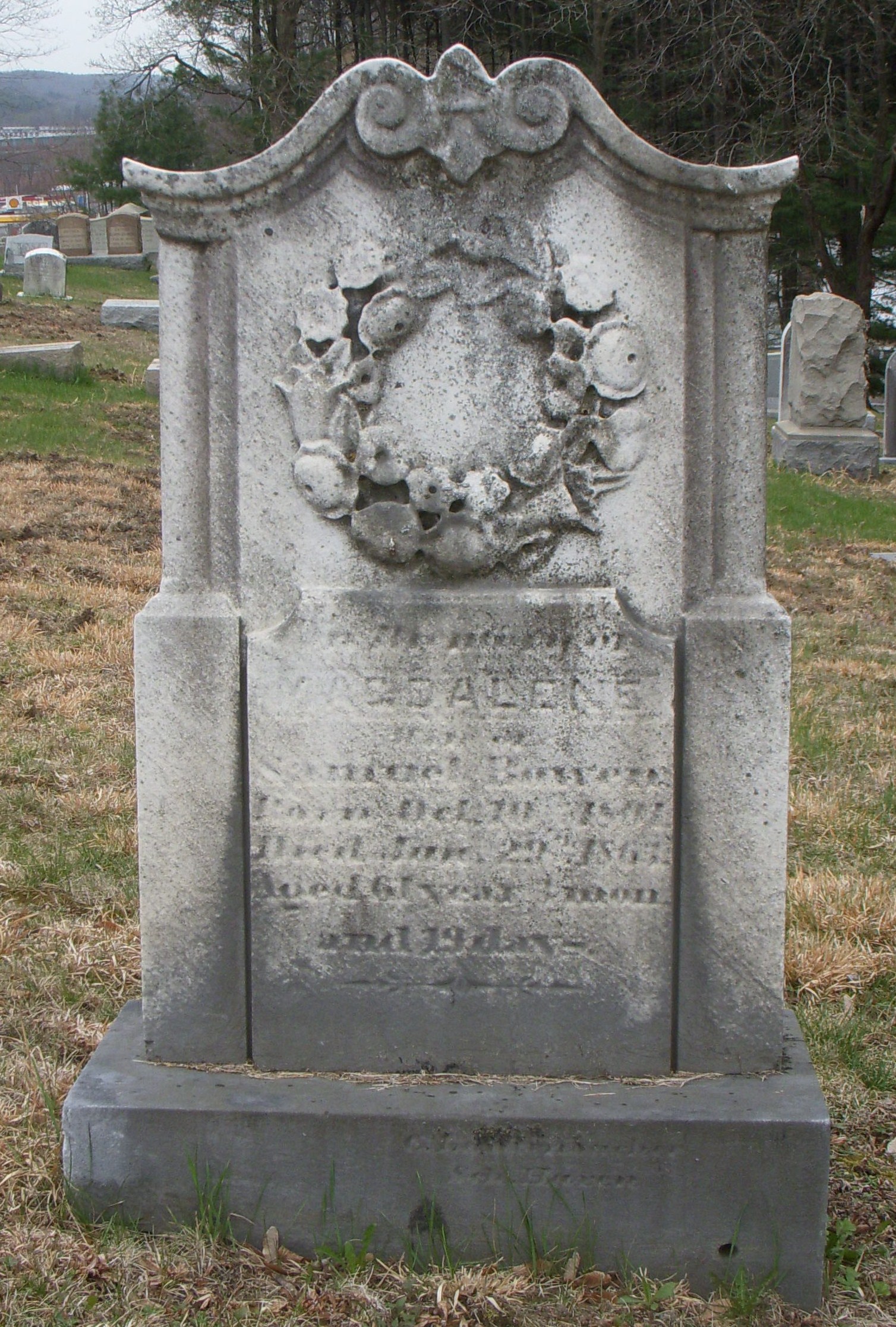
| Magdalene Bowen's grave is marked with this decorated stone. |
| New articles added including: enlargement of Jerusalem Cemetery, improvements at the Union Cemetery and the cemetery observes the 85th anniversary of its formation. |

| Please note that I have a copy of the burial records for the Union Cemetery for any interments up to and including the year 1996. If you are seeking an ancestor, contact me and I will try to assist you. |
| The Call of June 2, 1911 TOOL HOUSE DESTROYED The tool house on the Union cemetery was totally destroyed by fire Wednesday afternoon about 5:15 o'clock. During the electrical storm a bolt of lightning struck the building and tore a large corner of it off and buried it into the driveway. The bolt also set fire to the balance of the building. The flames spread rapidly and in a short time it was a total wreck. The alarm was sent in and the entire fire department responded but by the time the companies reached the scene the building had been destroyed. |
| The Call of February 20, 1920 GRAVES MUST BE KEPT IN ORDER The Union Cemetery Association will this spring inaugurate a policy which will have a tendency to keep in better appearance all the lots and graves on this burial place. Heretofore owners of graves could at their own option engage someone to keep their burial plot in good condition and clean appearance. A number of owners followed this method. Other owners did the work themselves. The majority of lot owners failed to employ someone to attend to the matter and also failed to give the lot their own attention. As a result the sight of many of the lots was very unbecoming a place for the dead. The Cemetery Association has decided to attend to this matter itself. For this purpose two sextons have been engaged, namely Henry Frey and George Moyer. It will be the duty of these men to keep all lots in first class condition, unless the owners attend to this work themselves. Persons who wish the board to look after the condition of the lot will pay the board a nominal sum for this purpose. Every lot owner will be expected to either give proper attention to his or her lot themselves or have the matter attended to by the Cemetery Board. The board will hereafter not permit any lot owner to allow his or her lot to become overrun with high grass or weeds, thereby detracting from the appearance of the particular section of the cemetery. It will be a bound duty of every lot owner to either keep in proper repair and condition his burial plot or have the matter attended to by the Union Cemetery Association. |
| The Call of October 26, 1945 MAUSOLEUM WILL BE ERECTED HERE A stately granite mausoleum estimated to cost approximately $95,000 will be erected in Union Cemetery on the hill above Garfield Avenue. An agreement was entered into by the Union Cemetery Association with the Atlantic Mausoleum Company of Harrisburg for the construction of such a building. The plans, which have already been drawn up, call for an impressive granite exterior, with the interior in marble and doors and window frames in bronze. The interior will include a chapel, private rooms and individual crypts. Private rooms and crypts will be offered for sale within the next few weeks. Work on the building is expected to begin early next summer and the structure completed by fall. Mausoleums of a similar nature but not quite as modern in design have been erected by the Atlantic Mausoleum Company in Sunbury, Mechanicsburg, Red Lion and Lebanon. |
| NEWEST ADDITIONS |


| Dr. George Moore built a hospital in town and also served as a county coroner. At right, Charles "Bags" Graeff was very active in civic affairs and was a member of the 103rd Engineers, Company C. |
| Above are matching, beautiful headstones for Isaac and Sabina Strauch and at right a castle like stone marks the grave of John Deivert. |
| At left and center is the stone for well known and long serving Reverend Edwin Smoll. At right is an interesting brother, sister stone with the unusual inscription, "Blind Ellen." |
| The Call of January 13, 1933 NEW BUILDING ON CEMETERY The contract for the construction of a 24 by 24 frame building on the Union Cemetery was recently awarded by the Cemetery Association to George Moyer of Mildred Street. This new building is to be used as a tool house and garage and will occupy the site of the present frame building. The old building is to be moved about two hundred yards and will be used as an office and rest room. The association intends to purchase a light auto truck shortly to be used in work at the cemetery. The association also has in mind numerous plans for beautifying the cemetery and providing conveniences for the many persons who daily visit the last resting place of their loved ones. |
| The Call of May 26, 1933 CEMETERY LOOKS VERY PRETTY Visitors to the Union Cemetery in Schuylkill Haven express approval and a great deal of appreciation for the very pretty appearance that it shows. This is not alone due to more attention and time being taken by the caretakers but also to the individual lot owners, who, this spring have been interested in having their property look equally as well as the other persons lot. Considerable work has been done by individuals. However, as a great many lots are in perpetual care, the work of the men employed by the Cemetery Association is also responsible for the pretty appearance. There are, however, a number of lots that as yet have not received attention from anyone and it is doubtful if they will be given a cleanup. In most cases this is due to one of two things; either all relatives or members of the particular family have passed on or else the living relatives reside in towns other than Schuylkill Haven. Some new shrubbery has been planted at the entrance to the cemetery to replace that which did not grow last year. Whitewashing has been done during the week of tree trunks, etc. On the old cemetery, perhaps, the greatest change has been made. Perhaps one of the improvements on this cemetery came about in an unexpected manner. It was while a lot owner was desirous of cleaning out the briar and brush about his lot that he had set fire to the brush he had gathered. The fire spread rapidly and fortunately burned off the briars that for years had covered a great part of the cemetery. The Cemetery Association has straightened out many of the tombstones that had fallen over. Walks between the lots have, in the last several years, been kept considerably cleaner than in years gone by. The flowering shrubs located in different parts of the cemetery, together with large plants now in bloom add a pretty touch of color and are brought out in bold relief against the vivid green of the grass plots. Especially is this true when viewed from a high part in the cemetery. |
| The Call of December 29, 1933 MANY GRAVES DECORATED OVER CHRISTMAS DAY A visit to the Union cemetery in Schuylkill Haven on Christmas Day showed a very large number of graves and burial lots decorated with Christmas wreaths of various hues, holly wreaths, poinsettia plants, creeping pine, laurel, etc. Beginning on Sunday and continuing throughout the day and on Christmas Day, the cemetery was visited by a goodly number of persons who placed the Christmas wreaths, etc., on the graves. By noon on Christmas day the scene viewed from a high part of the cemetery was an unusual one, the bright green and red of the different decorations standing out against in contrast to the drab color of the grass plots and the white of the grave markers. Faded and frozen flowers marked the point of several very newly made graves while upturned earth at different points marked graves in preparation. A peaceful quiet, not even a twitter or note from a bird pervaded. And with it all, a sharp and penetrating cold wind. A view of the distant mountains and valleys attired in winter garb; a view of a large portion of the town itself; steam arising from the borough light plant and county institutions, a few autos passing on the white ribbon of a highway nearby - Christmas Day on the cemetery. |
| The Call of May 27, 1954 COMPLETES WORK ON CEMETERY Work on the old Jerusalem Cemetery plot was completed this week by the American Legion. All stones are replaced according to the plans drawn up in 1950 by Calvin Landsidle, who at the time was a member of the Legion and an engineer at the Anthracite Laboratpry. He surveyed the land and directed the removal of the stones but has since been transferred. The project has been completed with the best possible results, with recourses available, by members of the board, Edward Hummel, Harold Fisher, Harold Geschwindt, and several others. Fertilizer is still needed and donations are still needed to cover the cost. Donations can be sent to the Legion Post 38 c/o the Cemetery Fund. A total of $826.43 has been taken in from all spuirces. Donations from individuals and business places amlunted to $335 and the remaonder came from Legion sponsored events. Most of the money was used for tractor work and replacement of stonmes. Huge trees and rooted weeds made work difficult and it rewquired somne two hundred hours of plowing and tractor work plus seed and other labor. About two thousand hours of free labor were also donated. |
| LAST UPDATED: JANUARY 5 |
| The Call of May 18, 1934 JERUSALEM CEMETERY IS BEING ENLARGED Work is well underway on the enlargement or development of a new section of the Jerusalem Cemetery in Schuylkill haven. Two plots, one on top of the hill and one on the lower side of the hill, facing Centre Avenue, have been plowed and harrowed. Burial lots of a size, ten by twenty feet, are now being laid out. Wide pathways are also being provided between most of the sections. The Jerusalem Cemetery is a separate and distinct burial plot but adjoins the Union Cemetery and what has always been known as "The Old Cemetery," or one of the first burial plots in the town. It has been in use for quite a number of years and, by reason of its ideal location and uniform plan on which lots have been laid out, has been considered an exceptional portion of the cemetery. It is owned and controlled by the Christ Lutheran Church of Schuylkill Haven. At least one thousand persons have been buried on this particular cemetery. |
| The Call of April 24, 1936 IMPROVING APPEARANCE AT UNION CEMETERY A very marked improvement to appearance to the entrance at the Union Cemetery in Schuylkill Haven is being bright about by reducing the size of the high stone and concrete walls along the Garfield Avenue side or entrance to the cemetery. At least two and one half feet was cut from the wall on the upper side of the entrance and a similar amount will be taken from the wall on the lower side of the entranceway. As a result, it is now quite possible to see the shrubbery, etc., inside. A new coping has been placed on top of the wall. A considerable part of the upper section of the wall had to be rebuilt, as it had been washed out by the heavy rains of some months ago. |
| The Call of August 7, 1936 CEMETERY TO BE CLEARED OF WEEDS For the past few weeks, a number of men have been employed by the Union Cemetery Association in removing weeds from the Union Cemetery. Already they have made good progress and one entire section has been gone over and looks mighty fine. Weeds always have a habit of growing faster and spreading over a greater area than even the most expensive grass or creeping plants. There has been an unusual number of larger weeds of various species that have been permitted to grow on this cemetery. They have had their own way almost entirely, excepting for frequent cutting by sickles or scythes. Now they are being pulled out by the roots and in this way it is hoped to get the better of them and improve the appearance of the cemetery very much. Due to the unusually dry weather and the heat of the summer, grass on the burial lots has been almost completely burned up. It has been destroyed almost completely and it is doubtful if rain will restore it again this year. Nevertheless, little effect seems to have been made by the weather in weeds. They have thrived and seem to grow all faster and spread form one plot to another all the more rapidly. Their day is at hand and out they will go. |
| The Call of January 29, 1937 CEMETERY ASSOCIATION NOW IN 85TH YEAR At a recent meeting of the Board of Directors of the Union Cemetery Association at Schuylkill Haven, reports for the year 1936 were read and officers for the ensuing year chosen. The officers are: President W.C. Kline, Secretary D. Willis Deibert, treasurer J. L. Stauffer. E. B. Hill was elected to fill the vacancy caused by the death of Mr. Luke Fisher, a member of the board. During the year 1936, 86 graves were opened on the Union Cemetery. A number of these received bodies brought from points outside of Schuylkill Haven. Plans for the further development and beautification of the cemetery were discussed but no definite action taken. Late last fall, fifty trees were planted on the cemetery and another fifty will be planted early in the fall of this year. The entire area of the Union Cemetery is now kept clean and in repair by the Cemetery Association. With the improvements that have been made ion the way of roads to all parts of the cemetery, plantings of shrubs, evergreens, shade trees and resodding of many lots and plots, this cemetery is rapidly taking on a most remarkable change in appearance. There are sixteen hundred burial plots or lots privately owned on the entire Union Cemetery, which is composed of several different sections. There are at least another four hundred available burial lots. The number of burial plots that are under perpetual care is 425, which number is a very considerable increase over the number that had previously been in perpetual care. It is desired that all owners place their plots in perpetual care so that a more uniform system of keeping them in repair and more uniform results be obtained. The Board of Directors of the Union Cemetery Association is composed of: W. C. Kline, J. L. Stauffer, D. W. Deibert, H. A. Reber, D. M. Bittle, W. M. Bast, G. I. Bensinger, W. E. Reed, E. B. Hill and H. F. Loy. It may be interesting to know that the Union Cemetery Association at Schuylkill Haven is 85 years old, having been chartered in the year 1852. The first officers and directors were: President Gideon Bast, Secretary Charles Dengler, Treasurer John D. Deibert; Directors Benjamin DeLong, Andrew Keefer, Isaac Rupp and William Fisher. |