 |
 |
 |
 |
 |
 |
 |
 |
 |
 |
 |
 |
 |
 |
 |
 |
 |
 |
 |
 |
| RAILROADS |


| This page contains information and pictures on the railroads that served and were so important to the town of Schuylkill Haven. The railroads were economically influential from the late nineteenth century until their collective demise by the 1970s. The trolley system will also be featured. |

| Top row, left to right: Reading freight train at the Union Street crossing in 1957. Note the signal tower at the right. Reading Company freight station in 1958, directly across the tracks from the passenger station. The "J" office in the Schuylkill Haven yards in the 1950s. Bottom row, left to right: A diesel pulling cars through the Schuylkill Haven yards in 1953. A Reading steam engine passes through the Schuylkill Haven-Cressona yard in 1951. Note the bridge to the car shops in the background. At right, diesels pull into Schuylkill Haven at William Street crossing in 1960. |


| This engine, at right, was receiving service in the shops at Schuylkill Haven in 1926. The engine is now part of the collection of the Franklin Institute in Philadelphia. At right, is an early image at the Mine Hill Crossing. |


| All color photos above were reproduced through the kindness of the late Bruce Kantner of Cressona. |
| LAST UPDATED: OCTOBER 23 |


| Pottsville Republican December 3,1891 COAL STORAGE CHUTES The Philadelphia and Reading Coal and Iron Company have erected and are using coal storage chutes below Schuylkill Haven. Considerable of the unloading of coal is done at night and to make it more convenient and to afford plenty of light and facility for the performance of the work, the company proposes erecting an entire new electric light plant for that purpose. The machinery and fixtures are now under construction and will in the near future be in full operation. The storage house is located about one mile below the Schuylkill Haven borough line and are about four to five hundred yards in length. The day and night employees have to walk this mile, very frequently in the dark, and it has been suggested that the whole distance from Schuylkill Haven to the storage chutes should be lighted which would no doubt be an immense benefit to the crews on trains who have to wait along the line. In conversation with an officer of the company he stated that for the present only a sufficient number of lamps would be erected to throw sufficient light around the coal chutes. |
| Pottsville Republican February 9, 1894 At about 7:58 o'clock last evening the jig house at the Philadelphia and Reading Company Coal Storage Yard at Schuylkill Haven was completely destroyed by fire and the coal stored near by, 6000 tons in one pile, was only saved by the hard work of the men employed by the company and neighbors. The jig house is a complete wreck and all the breaker machinery, including the engines and the 50 arc light electric machine, was ruined. The loss will reach $30,000. By 8:05 the flames had burst through the siding and the interior was a mass of flames. Crowds of people began to gather from Schuylkill Haven and Landing ville shortly after and above the roar of the flames could be heard the shouts of men who were endeavoring to confine the fire and prevent it's spread to the trestle and immense piles of coal that lay along the mountainside within a few yards of the building. At 8:10, amid a shower of sparks that resembled some gigantic pyrotechnic display and rose straight up in a column high above the surrounding hills, the roof fell with a crash distinctly heard a mile away. As soon as the fire was discovered H. B. Zulick, the superintendent of the yards sent word to Pottsville, and from that time until they left on a special, General Superintendent Luther was kept posted on the progress of the flames. His first thought was for the coal stored in the yard and he sent word that every effort should be made to prevent it from catching. The yards have a capacity of 200,000 tons, but they have been shipping from that point recently and there are only about 100,000 tons in stock. Of this all but a pile of 6000 tons was at a safe distance from the fire. This small pile was less then twenty five yards from the jig house and if the shipping wharf had burned this coal would have been a total loss. SAVING THE COAL Supt. Zulick and his men, with the assistance of the people living in the vicinity, worked hard. They could not save the jig house so they turned their attention to the office, the boiler house, the wharf and the coal pile. They had large pumps there that supplied better streams then fire engines, but the hose gave out and this left them helpless with the fire eating its way toward the coal. Mr. Luther was notified of this and he immediately sent word for the Humane steamer. A special train was prepared and Chief Engineer John Bushar ordered out the Good Intent instead of the Humane. This engine was promptly placed on board of a flat car together with a lot of hose. About twenty five members of the company went down, the train had a passenger coach and General Superintendent Luther was accompanied by Master Mechanic Mulhoff, Repair Shop Foremen Hoopes, Boss Machinist Frank Leib, Electrician John Sterner, Inspector Edward Cake and Trainmaster Gallus. THE FIRE EXTINGUISHED The train left shortly after 10 o'clock and on it's arrival in Landingville, the closest station, it was found that the people had succeeded in getting the fire under control and there was no more danger. The special returned home at 12:30 o'clock. The jig house is located nearer Landingville then Schuylkill Haven. It is on the west side of the railroad against the hill. Here the coal is screened and washed before it is sent to market. The coal is stored here to relieve the shipping points and the markets. The works were very complete and at night the building and yards were well lighted by a splendid Thompson-Houston plant. This plant like all the rest of the machinery is destroyed. The origin of the fire is a mystery but it is possible that a defective electric light wire caused it. The yard employs thirty men. It is more then likely that the jig house will be rebuilt as soon as possible as this is an important shipping point. There was great excitement in the central portion of Pottsville when the word of the fire reached town and the steamer was ordered out and hundreds of men hurried to Union Street to see the apparatus off and see the special pull out of the yards. Everybody was interested and wanted to help the company save its property. |

| This pictures captures the employees at the Reading Car Shops in Schuylkill Haven circa 1900. My great grandfather, Dorie Nagle, is one of these hard working men. Perhaps one of your ancestors is here too. |
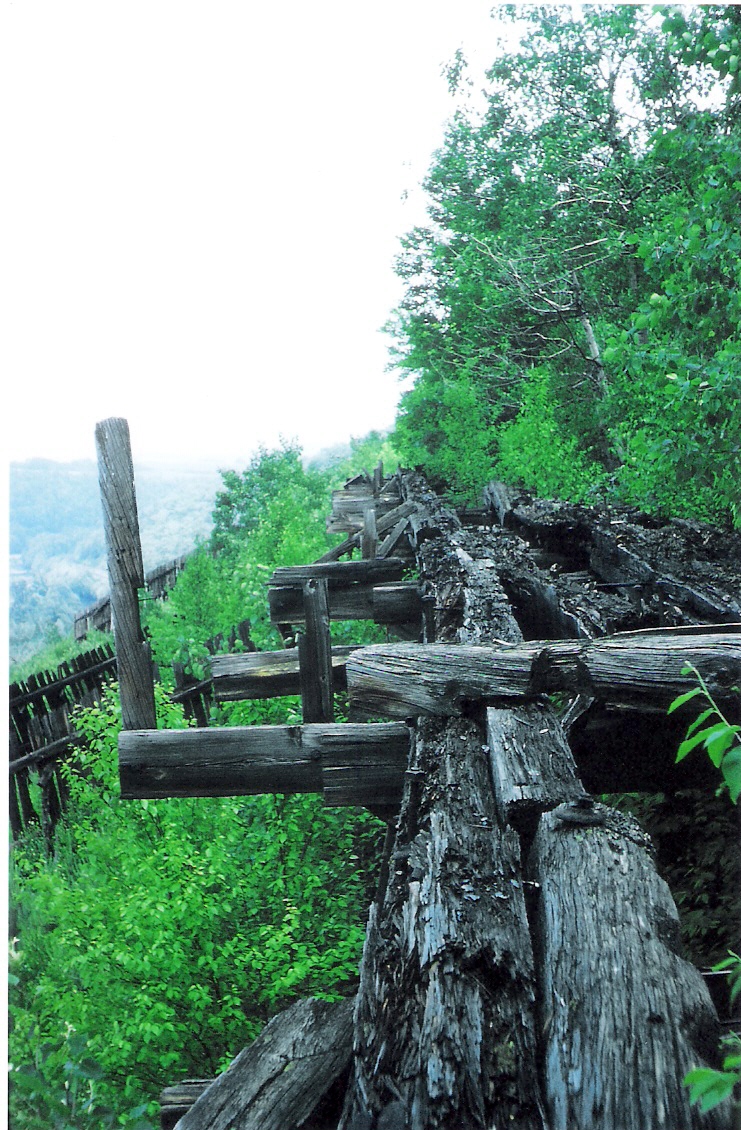
| This set of twelve pictures was taken in June 1964. They show the remains of the once massive coal storage yards located just southeast of Schuylkill Haven. |




| Two aerial shots of unknown date show the Reading Railroad yards at the northern edge of Schuylkill Haven towards Cressona with the Alcoa plant on the right. |
| Pottsville Republican of March 22, 1906 HE MET DEATH IN THE ENGINE CAB Two engines sideswiping each other at the Mine Hill crossing at Cressona last night resulted in the death of William Stauffer, engineer on the storage yard engine No. 718 which was running on the main line. Uninjured and the engineer and fireman of the engine on the Mine Hill road also escaped without injury. When taken from the cab of his engine, Stauffer was unconscious and was removed to his home on Chestnut Street in Cressona, where he died about two o'clock this morning. The main line and the Mine Hill tracks meet at the crossing where the accident occurred and about 8:30 last night the two engines came along at the usual rate of speed and were unable to stop when the danger was noticed. The cab on the engineer's side of the main line engine was crushed in like an egg shell and valves broken permitting the steam to pour in volumes into the cab. Stauffer was caught in the wreckage and badly injured, his leg being crushed and he being rendered unconscious. With difficulty he was taken from the bath of scalding steam. The scalding he received was the cause of his death. Had he lived it would have been necessary to amputate the leg. Deceased was 48 years of age and is survived by a wife and two sons, William and Henry. He was a member of the Masons, the Odd Fellows and the Jr. O.U.A.M. and one of the best engineers in the employ of the Reading Company. Mr. Stauffer was very highly respected and esteemed by Cressona people. |
| A series of new articles just added to the TROLLEYS page involving: the famous Christmas wreck of 1911 and in 1920, a blizzard closes the line, new "pay as you enter" cars are ordered, motorman gets burned, a passenger falls off the car and improvements to the cars and line are made. |


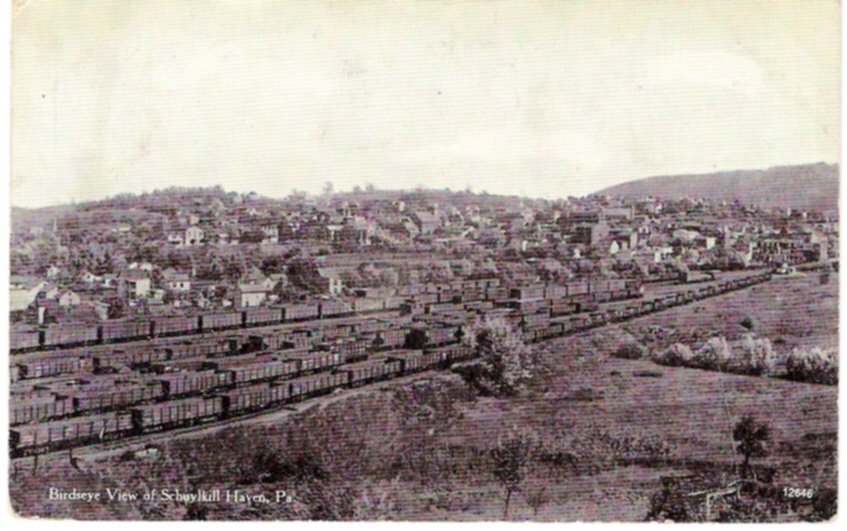


| When one thinks of railroads in Schuylkill Haven, the Reading Railroad is most prominent. Officially called the Philadelphia and Reading Railroad, it had a passenger station, freight station, yards and shops located in town. Below are some images of its presence. |
| The two pictures above at left show the car shops located in the northern area of town. The center two images are of the rail yards located along the edge of the Island area. At right are two views of the passenger station on Main Street. |

| At left is the original passenger station on Main Street. Two bridges of the Reading Railroad in town were the stone arch bridge near Main Street and the Red Bridge behind the Liberty Street area. |

| Pottsville Republican of February 24, 1923 PINE GROVE BUS HIT BY ENGINE AT SCHUYLKILL HAVEN, ONE KILLED, TWO HURT Clyde Mars, aged 17, of Pine Grove, was killed and Roy Shollenberger, Pine Grove mail carrier, and Curtis Moyer, driver of the Pine Grove bus, were injured and burned shortly after ten o'clock Friday night when a fast freight train struck the Pine Grove bus at the intersection of the railroad and Union Street, Schuylkill Haven. The crossing watchman at this crossing of the P and R is off duty after seven o'clock and there is a slight hill leading to the railroad. It is necessary for autoists to get up speed to make the grade and there is no view of the railroad until the tracks have practically been reached. Schuylkill Haven residents have been trying to have this crossing better protected for several years as a number of accidents have happened at this point. Moyer, the driver of the bus, says that he did not see the freight approaching, as his view of the racks was obscured until he was right in the middle of them. He says that he knew nothing until the train hit him and then the gas tank exploded. He received a bad cut over the left eye and body bruises and was taken to the office of Dr. Lenker where his injuries were dressed and then removed to his home in Pine Grove. He is a son of Edward Moyer, of Pine Grove, who has been making his home with Mrs. Daniel Phillips, of Schuylkill Haven, a sister, for several months. The fact that Moyer turned the bus to one side saved him from death as the engine pushed it aside instead of it being thrown underneath, in which case it would have been ground to pieces before the engineer was able to stop. The engine struck the bus almost squarely in the center and the car, a Dodge equipped to carry fourteen passengers, was hurled against the side of a loaded freight car near the crossing. Moyer and Shollenberger were thrown clear of the wreckage by the impact but they were caught by the flames which burst from the machine as the gasoline tank blew up. The blaze spread to the freight car which was loaded with autos and it was necessary to call out the fire department to prevent the flames from spreading to the depot and starting a conflagration. The freight train consignment of autos for Harrison Berger, Schuylkill Haven, and the cars were badly damaged by the fire in the freight car. The exact amount of damage to the freight is not yet known. James Knarr, a railroader of Schuylkill Haven, who was standing on the corner waiting to catch a train, said the accident happened so quickly that it was all over before he knew what had occurred. Charles Guertler, the engineer, said that the first he knew of the auto was when he saw a light flash. He immediately applied the brakes, but felt the engine strike the bus a minute later. He got off his train and went to see what had happened and found Moyer, the driver, on the engine. He and his crew helped him down, but were unable to get any information from him as to whether there were others on the bus. They went to search and could find only Shollenberger, who was removed to the home of George Schaeffer for treatment. Shollenberger was burned about the face and neck and also sustained injury to his leg. He was taken to the Pottsville Hospital for treatment while Moyer who was not so badly injured was removed to his home in Pine Grove. The presence of a third man on the bus was learned after they had been taken away and a search was started for him. As soon as the fire department had extinguished the flames an examination of the car was started and Mars' body was found underneath. He was found under the right mudguard of the blazing bus. He had evidently been eating an apple when the accident occurred as the apple was tightly clutched in one hand. One leg and an arm were practically burned off and he was horribly burned about the body. He was taken first into the P and R depot and then removed to Bittle's undertaking establishment. Dr. Santee gave out the crew of the train as Charles Guertler, engineman, Francis Heffner, fireman, George Kanes, conductor, John Mease, brakeman and Frank Benseman, flagman. James Cantwell of Pottsville, proprietor of the bus line put on another bus on Saturday morning and is maintaining his schedule. The bus which was struck was a wreck. Word was received from Pine Grove shortly after midnight that Mars, a seventeen year old orphan who was living with W. H. Daubert, his guardian appointed at the death of his parents, went along with Moyer for a ride. He had asked Mr. Daubert if he could go along with Moyer on the bus but Mr. Daubert refused to let him go, but when he went out, he met Shollenberger who was of his own age and the two went off with the driver, thinking they would be back shortly. He is survived by two sisters, Mrs. Charles Sweigert, of Pine Grove, and Mrs. Argall Sweigert of Cressona. |
| Pottsville Republican of May 30, 1899 SCHUYLKILL HAVEN SHOPS FINISHED The Schuylkill Haven Philadelphia and Reading car shops were finished on Monday and turned over to the company. The tracks are now being ballasted by Supervisor J. E. Turk. The shops are located on the old Schuylkill Navigation landing, which allows plenty of room for repairs and new work. Three thousand cars are to be equipped with air as soon as the shops are underway, which in itself is considerable of a job. It is expected that work will commence here in a couple of weeks. David Runkle will be the foreman. He holds the same position now at the old shops. |
| Pottsville Republican of July 3, 1899 A FLAG RAISING - Old Glory Hoisted Over the New P & R Shops at Schuylkill Haven The citizens of Schuylkill Haven and Cressona and their vicinities have additional cause to celebrate at the anniversary of our nation. The new P & R shops recently erected were formally dedicated this afternoon at three o'clock. One of the exercises upon that occasion was the unfurling of Old Glory to the breeze above the buildings. Speeches were made by C. E. Berger, Dr. Daniel Dechert, Dr. Charles Lenker, A. A. Hesser, superintendent of the Mine Hill Division of the Reading and Isaac Paxson, another official of that company. The Schuylkill Haven band was present to render music appropriate to the occasion. The many patriotic sentiments expressed by the speakers and the patriotic strains of the band were vociferously applauded. But when the folds of the emblem of the free were unfurled and its beautiful colors, which signify so much, were displayed, the cheers of the assembled throng filled the air. The exercises were given under the auspices of the employees of the Reading headed by David Runkle and C. V. B. Deibert, foremen. Prominent officials of the company were present to witness the ceremonies. Refreshments were subsequently served. This shop is a structure covering an area 400 by 30 feet. It is of frame and is two stories high. Work was begun on the excavations early last spring and the work of erection was rapidly pushed to a completion. Here repairs will be made to cars and engines in the future. The shops will give employment to hundreds of men in their several departments. It is located at a point near the Mine Hill crossing and runs parallel with the main line. Everything is now completed and its early operation is expected. |
| Pottsville Republican of July 11, 1895 ONE MAN KILLED - And Two Probably Fatally Injured at Schuylkill Haven Daniel Dailey, aged sixty years, was instantly killed, Frank Schwartz, aged sixty, had two legs crushed and George Berger, aged forty five years, had one leg mangled by an accident at the P & R railroad shops, Schuylkill Haven this afternoon at three o'clock. They were putting in a draw dead when a draft of cars, being pushed on another track, jumped the track, striking the car upon which the men were working, with the above result. |
| Pottsville Republican of December 1, 1919 KILLED AT LANDINGVILLE STORAGE YARDS Adam Burkert, a highly esteemed and well known resident of Schuylkill Haven, was instantly killed this morning at the Landingville storage yards of the P and R Company. How the accident occurred is not definitely known, but it is thought that Mr. Burkert attempted to board a draft of moving cars, fell under the wheels and was crushed to death. He was foreman at the yards and his lifeless body was found by other workmen. Mr. Burkert was respected by all who knew him. He was a consistent member of Grace U. E. Church, having been treasurer of both the church and Sunday school. He lived on Saint John Street and was sixty five years of age. He had three sons and one grandson, in the recent war, one son Isaac, having been killed in France. His wife died a number of years ago. He is survived by the following children: Mrs. Frank Batdorf, Reading, Mrs. George Downs, Philadelphia, Mrs. Harry Becker, Mrs. Ralph Jacoby, Charles, Harry, Frederick, Warren and Miss Eva, all of Schuylkill Haven. He had been in the employ of the P & R Company for many years. |
| Pottsville Republican of May 7, 1919 BOY KILLED IN COSTLY WRECK AT SCHUYLKILL HAVEN A boy, about fourteen years of age, believed to be from Virginia, and who had come to Saint Clair for the purpose of seeing the coal regions, was killed when a disastrous wreck occurred Wednesday evening about five o'clock below the Williams Street crossing in Schuylkill Haven. Engine 1605, with a Port Richmond crew on it, coming from Saint Clair with a loaded train of sixty five cars for Bridgeport, while rounding the curve below the crossing, burst a wheel on one car, derailing the car and eleven or so other cars behind it, scattering them all over the railroad. The ties on the north and southbound tracks were torn up for a considerable distance. A number of the loaded cars were thrown bodily on the opposite track and dumped the contents of the cars on the railroad. The boy who was riding on the train between the cars was caught and badly mangled. The body had the appearance of being crushed and he must have been killed instantly when the cars left the rails. There was nothing found upon the body that would lead to his identity, nothing but a small Sunday school paper, with large letters, "Jesus Saves". Coroner G. H. Moore of town was summoned to view the remains of the boy and O. A. Bittle, undertaker, removed it to his establishment on Main Street. The boy seemed to be a stranger in this part of the country and it is said that some of the railroad men asked him where he was going when he was discovered riding on the train. He gave the name of his home somewhere in Maryland. The Reading and Mahanoy Railroad wreck crews were called to the scene of the accident, but the work of clearing the tracks was very slow and difficult on account of the position some of the cars were strewn into. The big steam derricks broke several heavy chains trying to throw the cars from one track to the other making it very dangerous to be in close proximity of the wreck. The Pottsville express trains came up the line as far as the wreck and transferred their passengers to a train waiting for them at Williams street crossing. The 9:34 passenger train also came up the line as far as the wreck and transferred their passengers, having Company H on board. While the transfer of Company H was being made, and the Pottsville boys were marching up the street, they were instantly recognized by the large crowd of people looking at the wreck and a general rush was made for the boys to shake hands with them and give them a royal welcome, but the time was limited. They were entrained and on their way to Pottsville in a few minutes after leaving the local station. Both tracks being blocked by the wreck, the midnight trains, called "The Buffaloes" had to be detoured and got around by way of Little Schuylkill and Tamaqua to get to Pottsville. |

| Pottsville Republican of February 14, 1916 PETITION FOR OLD EMPLOYEES Preparations are being made in Schuylkill Haven to have a petition issued in that town to ask Superintendent Keffer, of the Reading Company, to provide work for the old employees at the car shops and also to have some work for those at work at the present time there who are in poor circumstances. It is said that there are a number of men now employed at the car shops who have large families depending on them, and even though they were to secure work at the Saint Clair shops, where the largest part of the work on repairing cars is to be done hereafter, their salaries would be comparatively small after the car fare and other expenses were deducted. It is expected that the petition will be issued some time during the early part of the week, and every merchant and resident of that town for any length of time will be asked to sign the petition. The merchants and general public in Schuylkill Haven and Cressona understand the conditions as explained to Superintendent Keffer, that there is not the proper equipment at the Schuylkill Haven car shops for the repairing of steel cars and as the greatest number of the cars are now steel, it is admitted that the only thing left for the company to do is to move a part of the work to the Saint Clair shops. But it is asked that those employed for so long a time at the Schuylkill Haven shops and known as veteran employees be given some work there, and that the company establish as large a plant there as they can possibly do under the conditions. A great deal of sympathy is expressed for the residents of Schuylkill Haven who were employed at the shops. It is a hard blow for many of them who know no other trade. Many, some years ago, purchased their own homes in that town and have been for years and are at the present time paying off amounts each month in an effort to a clear title in a few years. The car shops, when they are on full working time, are a great boon to the town and the cutting off of even part of the shops will be a severe jolt to Schuylkill Haven. |
| Pottsville Republican of February 19, 1914 WATCHMAN SMOTHERED BY GAS IN SCHUYLKILL HAVEN BOX Chief Burgess Terrence Goulden, of Mount Carbon, employed as an extra crossing watchman by the P and R Railroad Company, was found dead in the watch box at the Main Street crossing in Schuylkill Haven at 5:50 o'clock Thursday morning by Watchman Petery of Connors Crossing, who happened to be passing at the time on his way home and was attracted by the smell of gas apparently coming from the watch box. Opening the door, he saw watchman Goulden in a lifeless condition, not responding to the efforts made to arouse him. The day watchman, also an extra man, arriving at this time, Watchman Petery turned the body over to him and going to the office of ex-Burgess Hartman, nearby gave the alarm Coroner Moore, who lives in Schuylkill Haven, was notified and quickly responded at the same time as Dr. Lessig. The small structure is about eight feet square and the same height. Investigation led to a statement that gas entered the watch box from beneath the floor and that it came from a break in the gas main which was discovered only Wednesday, and the belief of some at Schuylkill Haven, Thursday morning was that the gas worked its way underground to the watch box with the fatal result to the watchman, while a few adhere to the stove coal gas theory. Not only that but it is said the gas was responsible for the illness of the two regular crossing watchmen, both of whom are off duty. The coroner fixed upon Friday evening as a time for an inquest, after selecting a jury and he determined to hold an autopsy for the purpose of ascertaining whether death was due to natural causes. Terrence Goulden was about thirty five years of age, and had been a railroader for some years before he was caught in a storm and cripples by the freezing of his feet. He was unmarried and an agreeable, popular man, who had many friends. He made his home with his sisters, Miss Annie and Miss Catherine Goulden, of 948 South Centre Street, Mount Carbon, in the Goulden homestead, where their parents, the late John and Annie Goulden lived for many years. The father was a railroad engineer for years. The body was brought to Pottsville on the passenger train and was taken in charge at the Reading station by undertaker Heiken who removed it to the home of the Misses Goulden, from where the funeral will take place with requiem high mass in Saint Patrick's church, Terrence having been a member of that congregation and the Holy Name Society. Those who adhere to the theory that death was caused by illuminating gas say that when the old hotel building which stood at the southwest corner of the crossing was torn down to make way for the new coal yard, one of the gas pipes was plugged after being cut and that this plug probably became loosened through the hammering of constantly passing trains and that the gas in escaping found an entrance into the watch box, the flow probably increasing as the plug became more and more loosened. Wednesday evening was the first shift that Goulden worked. The other two watchmen, one by day and the other by night, were taken off on Wednesday and Goulden was sent to take the place of the night man. It took the call boy several hours to locate Goulden and it was only a short time before regular working time that he was located. In the last election in the borough of Mount Carbon, Goulden was elected Chief Burgess. A brother John met death through a railroad accident on the P and R several years ago. Coroner Moore went to the Heiken morgue, to which place the body had been taken instead of to his late home and that of his sisters in Mount Carbon. The coroner and Dr. J. A. Lessig of Schuylkill Haven, examined the body and according to outward indications, Goulden had been a robust healthy man aside from the fact that he had lost both feet some years ago in the manner described. Dr. Lessig performed an autopsy on the body and will submit his report at the inquest to be held at the coroners Schuylkill Haven office on Friday evening. At the inquest, the evidence of Petery, the man who found the body, that of G. W. Kramer, the extra crossing watchman, who was one of the first to see the body, he having arrived at the crossing shortly before six o'clock to relieve Goulden, the night watchman, and the testimony of a man named Bittle, Raymond McKeon, Frank Heim, William Brennan, Ralph Mayberry and Edward Kear, all of whom were among the first to arrive on the scene, will be heard along with that of Dr. Lessig and the stories of other witnesses who may clear up the mystery of the alleged gas leak. Dr. Moore, on opening the watch box door to enter at 6:30 o'clock, detected the odor of what he believed to be illuminating gas, and others noticed the same scent. The body of Goulden was seated on a chair and his hands were gloved as if he was ready to leave the box on the approach of a train or locomotive. There was vomit on the floor and on one shoulder of his coat indicating that he suffered from nausea. The body of the victim was taken home after the autopsy. A sister and another relative had gone to Schuylkill Haven on receiving the sad news of his death and they accompanied the body on the way to Pottsville and until it was turned over to the undertaker. |
| Pottsville Republican of October 29, 1921 GIRL, RUN OVER BY TRAIN, GETS UP RUNS AWAY A little girl from Berne Street, Schuylkill Haven, daughter of W. Webber, crossed the P and R tracks after a coal train had passed stepping directly in front of the Mine Hill passenger train. She was knocked down and the engine and two cars passed over her. A number of men, who were loitering at the P and R depot, and who had turned their eyes away from the sight, then hurried to pick her up and to their amazement the child jumped up and ran away unhurt. At the time her name could not even be gotten as she sped across the bridge toward her home. Railroad men say her escape was miraculous. |
| Pottsville Republican of April 15, 1938 FIND THREE TOTS ON ENGINE PILOT Just after the P and R shuttle passenger train which plies between Pottsville and Port Clinton, pulled out of Schuylkill Haven early last evening, it was discovered that three children ranging in age from two to four years of age were on the pilot of the engine. It was the train Number 96 due here at 7:09. The children clambered to their dangerous perch just before the train left the Union Street crossing. The engineer saw them in time and brought the train to a standstill. The youngsters scampered away. Their identity was not learned. The train was in charge of Conductor George M. Stephenson and Engineer George Steck of this city. |
| The Call of April 15, 1927 HAVEN YOUTH BADLY HURT When his head was caught between the flywheel and the brake on the elevator at the Landingville Storage Yard, on Thursday afternoon, Joseph Kehoe, a popular young man of Schuylkill Haven, was severely injured, an X-ray showing that he had a fracture at the base of the skull. Kehoe is employed inside the building at the yards and was operating the elevator. The rope broke and although the machinery automatically stopped, the weight of the coal was sufficient to cause it to run back and Kehoe was caught. His condition is serious but it is expected that he will recover, his condition on Friday being good. He makes his home with an aunt and uncle, Mr. and Mrs. Heidenway, of Dock Street, Schuylkill Haven. About a year ago, his father Joseph Kehoe Sr., had his foot crushed while performing his duties as a brakeman on the shop crew and had to have his toes amputated. He is presently preparing to return to work, his injury having now healed properly. |
| This page is structured by grouping all pictures and articles by railroad. The Reading Railroad is first including the storage yards south of town. The Pennsylvania Railroad and Lehigh Valley Railroads then follow. Trolley pictures and news is then presented as it related to Schuylkill Haven. |
| READING RAILROAD |

| The Philadelphia and Reading Railroad operated a large coal storage yard just south of Schuylkill Haven near Landingville. Today the remnants of the yard can be seen if one looks closely. The history of that operation follows in pictures and articles. |
| READING RAILROAD STORAGE YARDS |


| This early image at left shows a crew unloading coal from a railroad car at the coal storage yard on the Schuylkill Mountain . |
| At right a view from a coal storage pile showing the yard office to the left and scale house to the right with Sculp’s Hill in the background. |
| In 1921, a conspiracy trial was held at the county courthouse involving the Schuylkill Haven lodge of the Brotherhood of Railroad Trainmen. These articles unveil the trial and the verdict. |
| Pottsville Republican of June 22, 1921 SCHUYLKILL HAVEN BROTHERHOOD CASE AGAIN GOES ON TRIAL The most important case of the week was called shortly before noon Wednesday, when the Brotherhood case of Schuylkill Haven, in which Jeremiah Casey and Daniel Reilly are charged with conspiring to reverse the returns of the election of that lodge, was called. The case was started last term but met an early end when objections were raised to statements made by the attorney for the Commonwealth. The men on trial were tellers at the election and they are charged with reversing the returns, it being alleged that a 17-11 vote out of 28 was completely turned around. Over a score of witnesses have been subpoenaed in the case to testify in the proceedings both during and after the election. The first break in the vote as returned came when Howard C. Herman swore he voted for Wolfe, making the eleventh vote. The return of the vote by the tellers showed ten for Wolfe. He stated he spelt the name "Wolf". The defense offered to show there was a slate and that the voting was done prior to the treasurership and that his man was defeated. John Honicker, who made the first objection to the vote, swore he voted for Wolfe. Mr. Honicker testified he was in the room when the voting was going on. He said the secretary announced the vote 10-18 in favor of Monaghan. Charles Blacker stated he voted for Wolfe. "I vote it Wolfe", he answered in reply to a query. Blacker stated the ballots were still on the altar when he left. Mr. Blacker also stated that he did not hear Reilly say anything. He stated he kept tally of votes as the record was kept. It was produced in court. It was objected to being offered and the court sustained the objection. Mr. Blacker also testified regarding the same incident of Casey laying the one ballot aside as related by Mr. Connors. Raymond Carl, the next witness, stated he voted for Wolfe. Maurice Connors, president of the Brotherhood, who presided at the meeting in question, testified that he appointed Casey and Reilly tellers and that Casey took the ballots out of the box and read a name off, Reilly later verifying the count. W. A. Wolfe was M. J. Monaghan's opponent for the office of treasurer and it was on this office that the claim was made the shifting was done. Another member in the room at the time, Earl Delker, testified that he kept a tally of the votes as they were called off in his note book, but that he did not have the note book with him. He testified that he saw Casey lay one ballot aside because he could not read the name and that after the balance of the votes were counted, he picked the ballot up and with little hesitation called it off for Monaghan. Both Connors and Delker testified that the ballots which were laid on the altar during the count were later thrown in the waste basket. At the opening of court this afternoon, Mr. Knittle, after announcing that the Commonwealth was unable to produce the ballots asked leave to offer secondary evidence by offering the evidence of the members. The defense objected on the grounds that no attempt was made to follow the ballots further than the waste basket. The court overruled the objection at this time without prejudice, announcing that it would suggest that the disposition of the waste basket be shown. The defense argued that this should be shown first, but the court announced it would not lay down the rule. Roy Jones, the witness on the stand, stated he did not remember who he voted for. Mr. Jones also denied hearing Reilly remarking, "Well count them if you want to", when objection was made to the vote. Earl Delker was asked how he voted. Delker swore he voted for Wolfe. He wrote the name "Wolfe" on the ballot. He also stated he voted for Mr. Kelly. He was on your slate, wasn't he, asked the defense. I had no slate replied Delker. Hulet, outside guard, also voted Wolfe. Hulet was asked to write the name on a slip which he did. Louis Delker swore he voted "Wolfe. It was the sixth vote for Wolfe sworn to. Delker stated there were two candidate for each office, president, secretary, treasure and three or four physicians. He testified he saw the ballots on the altar the last he saw them. Charles M. Chattin stated he voted for Wolfe. He testified he did not remember the tally on the president and secretary vote but that he kept one which he had at home. He said he did not remember whether the vote for president was 20-8 or not. He said he thought that vice president was 19-9. He also stated he believed the secretary vote was 17-11. Chattin also testified he did not promise to vote for Wolfe before the election. I did not know who the candidates were until I got to the meeting, Mr. Chattin stated. Clarence J. Beaver, the next witness, testified he voted for Wolfe. |
| Pottsville Republican of June 23, 1921 BROTHERHOOD CASE READY FOR THE JURY The taking of testimony in the conspiracy case brought against the tellers of the Schuylkill Haven lodge of the Brotherhood of Railroad Trainmen was practically completed when the court adjourned at noon and it was finished at 3:30 o'clock when it went to the jury. The efforts of the counsel for the defense to have the indictment quashed were denied by the court at the opening of the morning session and the testimony of the defendants and number of the character witnesses was then taken. Charging that no evidence had been produced to show that Reilly and Casey had an agreement to defraud Wolfe of the election, the attorneys for the defense applied for the quashing of the bill. Mr. Burke arguing for the quashing of the bill, claimed that no unlawful conspiracy had been shown or any prearrangement or conference disclosed. The bill charging the offense, however, charged the men with conspiracy between themselves and other diverse persons unknown. The court also inquired if Casey called off the names incorrectly what was Reilly's duty. We will concede, said Mr. Burke, that it was Reilly's duty to call attention to a mistake but that in itself is no evidence of conspiracy. You claim, said the court, that the Commonwealth must prove prearrangement. Yes, replied Mr. Burke. I will permit you to argue that point, said the court, but I do not feel that is the law. The court overruled the motion to quash. The Commonwealth closed its taking of testimony on Thursday morning after hearing testimony from George W. Zeh, in charge of the K of M rooms here, to the effect that the waste basket used by the organizations were emptied each Friday afternoon and that the probabilities were that the ballots used at the election were thrown into the general garbage can. Zeh's testimony followed that of eighteen witnesses who were called in support of the contention that Walter A. Wolfe had received eighteen votes at the election instead of Monaghan, who was declared elected, precipitating the legal fight. Roy Jones, the first witness called, testified that he did not remember how he voted but when the poll had been completed on Wednesday evening, seventeen men had sworn they had voted for Wolfe. They were examined in detail regarding the vote. The list of witnesses who stated they voted for Wolfe were Harry C. Schrodding, William Huy, John L. Geiger, Michael Zelinsky, John W. Hoy, George E. Sheriff, in addition to the eleven brought out in Wednesday's testimony as published by the "Republican". Dr. James C. Gray, of Cressona, was the first witness called for the defense. He testified as to the good character of Mr. Casey. William Berger, Justice John Springer, Walter Grieff, George Berger, David Bittle, Constable Frank Reiger were called on Mr. Casey's behalf. Mr Reiger denied ever knowing of a brawl in which Casey was stabbed. Mr. Moyer, with whom Casey had worked a score of years ago, Albert Sterner and Elmer Butz completed Casey's character witnesses. John Cantwell, of Port Carbon, was the first witness called on Reilly's behalf. Robert Jones, Edward Dewitt, Thomas Collins, George Schumacher and M. P. McLaughlin were called for on Reilly's behalf. Jeremiah Casey then took the stand. He stated he started to work on the railroad in 1901. He stated he got to the meeting at two o'clock in the afternoon. The meeting was for the annual election of officers and Maurice Connors presided. When we came to the election of officers, myself and Daniel Reilly were selected as tellers, the announcement occurring in open meeting. The first officer elected was president. The nominations were made all at one time. Casey denied there was any arrangement for the appointment of Reilly and himself as tellers. I had not spoken to Reilly for a year declared Casey. I distributed the blank ballots and then I collected them. I read them off and handed them to Reilly. We got the slips from the treasurer's desk. Some of the members had their own. The men wrote the names of the men they voted for on the slip and put them in the hat. This was the method used from 1907 and the election was conducted in the usual way. Reilly denied any arrangement to be appointed as teller. Did you have any arrangement with Casey as to how the ballots were to be read and counted, asked Mr. Burke. No, replied Mr. Reilly. Reilly denied having any conference or talk with Casey prior to the meeting. It was almost a year since I had been there stated Reilly. We had no conference before we were appointed. On cross examination Reilly admitted Honicker had alleged the election was wrong and that he had seen Connors send him away. Yet you saw those ballots put away and in the waste basket and didn't make any effort to preserve them. No sir. You knew the ballots were right, didn't you, asked the defense. I did replied Reilly. No one else tried to get them out, did they? No sir. Mr. Honicker was recalled and asked who nominated Kelly for secretary. I don't remember stated Mr. Honicker. Who nominated Jones? I do not know. Earl Delker was recalled and he stated he nominated Mr. Kelly. He stated he did not know who nominated Jones. He said he heard the result on Jones and Kelly, which was announced 17-11. Was there any protest about that election? No sir, replied Delker. |
| Pottsville Republican of June 24, 1921 FRONT PAGE TOP HEADLINE: JUROR APPROACHED IN RAILROAD BROTHERHOOD CASE, COURT IS TOLD - NOT GUILTY VERDICT IS ANNOUNCED The jury returned a verdict of not guilty but pay the costs. The jury was out less then a quarter of an hour, the second time after having reported to the court efforts to approach a juryman. The jury in the case in which Daniel Reilly and Jeremiah Casey are charged with conspiracy to deprive Walter A. Wolfe of the election as treasurer in the Schuylkill Haven lodge of the Brotherhood of Railroad Trainmen threw a bombshell into court room number three this morning when they sent a communication to the court stating "we are unable to come to a verdict on the grounds of a member of the jury being approached" and we ask the court to give us legal advice on the matter. Arthur Roman, juror number six after the jury had been brought into court and informed that it was the duty of the jurors to tell all they know of the matter, providing it did not have anything to do with influencing their verdict, took the witness stand and swore that Frank Chywski of Saint Clair had approached him on Wednesday evening at his place of business and endeavored to talk to him about the case, but that he refused to have anything to say to him, finally walking away. The court ordered the communication of the jury and the testimony of Roman put on the record and then instructed the jury to return to their room. Attorneys for the defense after the jury left the room objected to the placing of the communication from the jury on the record alleging that they did not have the proper opportunity to examine it before it was read in open court. I did not mean that you should have, replied the court. The defense then moved for the withdrawal of a juror and the continuance of the case. This the court refused to do reciting the decision in the Fifth Ward murder case in Philadelphia, where testimony regarding embracery had been taken during the trial of the case and in which the Supreme and Superior courts upheld the procedure. Hereafter declared the court, in every case of this kind that comes up we will proceed publicly and openly. The jury went out at 3:30 Thursday afternoon and reports at the courthouse this morning were that they had a stormy session of it at frequent intervals during the night. The jury when it came in was somewhat bedraggled and the court informed the members of the jury that he had received a communication. Passing the paper over to the foreman, Thomas Bevan, through Mr. Burke the court asked Mr. Bevan if he had written it. Mr. Bevan replied that he had. Mark it as an exhibit ordered the court. The court then proceeded to read the communication. We do not want any names mentioned the court cautioned the jury in the preliminary questions. Mr. Bevan informed the court that the matter was one that did not involve any coercion of the jury as far as the evidence or the legal advice was concerned and then the court announced that if anyone spoke to anybody regarding this case it is your duty under your oaths to rise in your place and take the stand and tell what you know. Arthur Roman then took the stand and was sworn. Did anyone speak to you regarding the case, asked the court. Yes replied Roman, on Wednesday night. Was that after you had been sworn, asked the court. Yes, replied Roman. A man came into my place of business and said that he understood that I was on the case but he said nothing further. Later another man came in to me and said, I understand you are on such and such a case. I understand you are a juror. I replied yes, stated Roman, and then he attempted to talk to me about it. He said, I want to speak to you about it, but I replied, "nothing doing". He then attempted to speak to me again but I walked away from him to the other end of the room and then he went out. There was nothing said further. Who was the man, asked the court. Frank Chywski, replied Roman. Spell it, instructed the court and Roman did so. The jury was then instructed that it was their duty to reach a verdict if they could do so without having the incident prejudice their minds and they retired to their room. The discussion over the withdrawal of the juror and the placing of the communication on the record then occurred. |

| This membership card is for the Brotherhood of Railroad Trainmen issued in 1918. It belonged to Adam Omlor, a member of the Schuylkill Haven Lodge. It was this lodge that was involved in the court case mentioned above. |
They Were not Needed - Hard Work to Keep the Fire From Eating Up Thousands of Tons of Coal - The Loss

JIG HOUSE DESTROYED ! Big Fire at Schuylkill Haven Coal Storage Yards THE POTTSVILLE FIREMEN CALLED
| The Call of March 19, 1892 A FATAL ACCIDENT On Saturday evening, while Harry Freiler, a P and R brakeman, was standing on the tender of engine Number 838 which was shifting at the Schuylkill Haven storage yard, he lost his footing and fell across the track, the tender passing over his body and killing him almost instantly. He was a former Minersvillian and boarded with his wife at Samuel Reber's of Cressona. On Sunday morning Deputy Coroner Dr. H. G. Weist empanelled a jury who rendered a verdict of accidental death, with no blame attached to anyone. |
| The Call of July 4, 1913 CROSSING WATCHMAN SAVES CHILD George W. Freehafer, P and R crossing watchman at Williams Street, Friday morning of last week proved himself a hero, when at the risk of losing his own life, he saved that of a six year old girl. The escape from being ground to death beneath the wheels of the swiftly moving northbound passenger train, due here at 10:53 a. m. was miraculous. Katie Bowen, daughter of Samuel Bowen, on her way to her home on Market Street, from the home of her aunt Mrs. William Deibler, was compelled to wait several minutes at the Williams Street crossing until a southbound coal train passed. As the caboose passed, the girl stepped out and not hearing the approaching passenger train, stepped directly in its path. Watchman Freehafer, who was on the east side of the crossing, guarding the northbound track, having seen the child waiting on the other side of the track, was on the alert and just as she stepped on the northbound tracks he made a leap, grabbed her and leaped to safety just as the train dashed by. The escape was a narrow one and the several witnesses to the scene closed their eyes and turned their heads away expecting the engine had struck them both and passed over them, so close was the escape. The crossing gates were down at the time but the child walked up the tracks between the southbound tracks and a side track to the crossing and was inside the gates. While standing waiting for the coal train to pass, Daniel Deibert, fireman at the Union Knitting Mills, realized the possible danger of her position and warned her not to attempt to cross. Heedless of the warning, however, the child attempted to cross and had it not been for the presence of mind of Mr. Freehafer, would surely have lost her life. Watchman Freehafer has but one arm and his great act of bravery, being thus handicapped, is therefore worthy of unusual comment and notice. His many friends are bestowing on him their hearty thanks for his brave act. It is possible a movement will begin to bring his act to the notice of the Carnegie Hero Committee that he may be properly awarded a medal for the same. The father and immediate relatives of the child are more than thankful to Mr. Freehafer for saving the life of the child at the risk of losing his own. |
| The Call of August 8, 1913 LOCAL WOMAN RESCUES CHILD Another narrow escape from being killed on the P and R railroad tracks here, by a timely rescue, occurred this week a short distance south of Union Street at the alley next to the John Kauterman residence. The timely rescue was made by Mrs. Moyer, nee Ella Huling, of Saint John Street. The rescued was Harry, the two year old son of Mr. and Mrs. William Schumacher, residing on the same street. The child in anticipation of meeting a relative who was to arrive on the next train wandered away from his home unnoticed by his mother. Just about the time the 11:26 passenger train from Philadelphia was due, Mrs. Moyer noticed the child standing on the railroad tracks. She immediately hurried to the scene. Upon her arrival the train was within about one hundred yards of the child, who unmindful of the approaching danger clapped his hands and shouted that his grandmother was coming. Mrs. Moyer, without a thought for her own safety, rushed to the child and picking him up jumped to one side just as the train dashed by. The escape of both the rescuer and the rescued from being ground to death was very close. Mrs. Moyer, following her brave act was in a very nervous condition but has recovered and is receiving the congratulations and thanks of many persons for her brave deed. |
| The Call of March 1, 1929 UNION STREET TO BE GUARDED AT NIGHT It is learned from reliable authority that the Reading Company will shortly provide a greater means and method of protection to the public at the Union Street crossing in Schuylkill Haven. The additional protection will be in the form of a crossing watchman who will be on duty until 11:45 o’clock in the evening. At this time and for the last few years the crossing watchman’s day ended at 7:45 in the evening. The presence of a crossing watchman to operate the crossing gates will provide a much needed protection for this particular crossing which has come to be traveled almost as much as the Main Street crossing. Following the accident of several weeks ago when two young folks were struck by Number Nine at the crossing, the Civic Club of Schuylkill Haven took up the matter with both the Reading Company and the Public Service Commission of the Commonwealth. From F. M. Falck, General Manager of the Reading, has been received a communication to the effect that after carefully investigating conditions, it is found that there is little travel over this crossing after midnight. That the rearrangement of the schedule for the crossing watchman whereby a man will be on duty until quarter to twelve will, with the present flash lights, provide what is believed to be sufficient protection. From John P. Dohney, Chief of Bureau, Bureau of Accidents, Public Service Commission. Commonwealth of Pennsylvania, has also been received a communication by the Civic Club setting forth the same facts and advising of the decision of the Reading Company in this regard. Inquiry reveals the fact that, while no arrangements have been made up to this time for the increased schedule of crossing watchman attendance, it is quite likely the new schedule will become effective shortly. shortly. |
| The Call of May 14, 1920 HIS INJURIES PROVE FATAL Lewis Bittle, a well known and almost life long resident of Schuylkill Haven, died at the Pottsville Hospital Wednesday evening about 11:30 o’clock from injuries sustained in some unknown manner Monday evening. He had evidently been struck by a coal train which went through town about eleven o’clock at a lively clip. His body was found between the southbound track and the siding at the Union Knitting Mills by the crew of the shifting engine about 11:30. It was noticed his forehead was crushed in and his left ear torn from the head. Body bruises and contusions had also been sustained. He was rushed to the Pottsville Hospital on a special engine and caboose. An operation was performed to save his life but he never regained consciousness. Deceased was about sixty five years of age. He had in former years been a prosperous farmer. Two brothers, Washington and Jacob of town, survive. The funeral will take place on Monday morning at ten o’ clock at the Bittle Brothers morgue. Interment will be made in the Union Cemetery. Both will be strictly private. Reverend Leinbach will officiate. |
| The Call of June 11, 1920 KILLED AT MINE HILL CROSSING Returning from a shopping trip to Pottsville, Miss Maida Schweigert of Cressona was struck by Number eight on the Reading road Saturday afternoon, at the Mine Hill Crossing bridge. The train is due here at 1:59. Just how the accident occurred will never be definitely determined but it is thought the unfortunate woman did not realize the train was so close to the track which she was walking. The engineer as soon as she was noticed applied the air with such force that the train came to an almost immediate stop and passengers were thrown from their seats. The engine struck the woman and hurled her into the Schuylkill River below. She was picked up and hurried to the local P and R station, where she died within forty five minutes of the accident and before the arrival of the hospital ambulance. The back of her head was crushed and there were bruises about her face and forehead. When the body was taken from the river, in her hand was found the handle of her pocketbook but the pocketbook containing about thirty dollars was gone. Her hat was found on one of the abutments of the bridge. The woman was carrying a basket containing provisions. Of the provisions, only two cans of milk were found. Deceased was well known in Cressona and esteemed. She was the daughter of Josiah Schweigert. With her father and brothers and sisters, she resided on Railroad Street and managed the home. She was thirty one years of age. Her death is the third in her family to occur in a tragic manner. Her mother while on her way to church fourteen years ago was overcome by the heat and died on the door step of a friend. Her brother in law was killed on the railroad several years ago. She was a member of United Brethren Church, Cressona. Besides her father, these brothers and sisters survive: William, Murval, Arval, and Earl of Cressona; Charles of Pine Grove; Harry of Reading; Mrs. Charles Gehrig, Mrs. Ida Stichter, Mrs. Minnie Kramer, Miss Daisy at home and Mrs. Edward Kauterman of Schuylkill Haven. The funeral took place Wednesday morning. |
| The Call of June 16, 1916 HERO MEDAL RECEIVED BY GEORGE FREHAFER The first Carnegie hero medal to be received in Schuylkill Haven was received on Saturday afternoon last by George W. Frehafer. Mr. Frehafer prizes the medal very highly, not because of the monetary value, but the incidents leading to the procuring of the same and the fact that it represents the saving of a human life. The medal is of bronze, about four inches in diameter. It is carefully packed in a moracro leather case lined with plush. On the one side is the likeness of the founder of the fund, Andrew Carnegie. Around the upper border is engraved, “Carnegie Hero Fund, established April 15, 1904.” On the opposite side is a map of the United States, with three separate seals. A miniature plate bears the following inscription, “Presented to George Frehafer who saved Katie A. Bowen from being killed by a train, Schuylkill Haven, Pa., June 27, 1913.” On the border on this side are the words, “Greater love hath no man then this that a man lay down his life for his friends.” Mr. Frehafer is displaying the medal to his numerous friends and will place the same in the window of the Stine drug store tomorrow where it may be viewed. *A subsequent article revealed a $500 prize also accompanied the medal. |
| The Call of August 27, 1920 THIRTY SIX ARRESTED FOR TRESPASS Thirty six residents of Schuylkill Haven were on Wednesday served with a notice by Officer Duffy of the Reading Company with a warrant charging them with trespass and theft of coal belonging to the Reading Company. Each one of the persons served was required to appear at the office of Squire C. A. Moyer, pay for the quantity of coal taken and the costs in the case. It is understood that a car of egg coal in a south bound train was dumped a short distance below the Casket Factory on Tuesday. Residents of that section of town were soon appraised of the fact and men, women and children made for the scene and helped themselves. The coal was taken home in baskets, boxes, bags, express wagons and automobiles. In some way or other the company authorities were put next to the affair and in a comparatively short time Squire was handed a list of thirty six persons on whom warrants were sworn. Officer Duffy, it is understood, visited each one of the persons named and appraised them of the facts and that they would have to pay for the coal taken. He was given access to their cellars and coal sheds and noted down the quantity of coal. He reported that individual families had gathered from one half to four tons of the coal. The car held about fifty tons. Fifteen tons remained on the tracks when the officer arrived and surprised a large number of persons who were busily engaged in carrying it off. |
| The Call of October 2, 1903 DEATH’S HARVEST – John Paul Killed at Storage Yard A distressing accident occurred about six o’clock Tuesday afternoon at the P and R storage yards below town, which resulted in the death of John Paul of Schuylkill Haven and the serious injury of Lewis Miller of Landingville, both carpenters who were employed at the yards making some repairs. Recently extensive improvements have been made to the storage yards and a trestling had been built over the chutes. Paul, Miller and two other carpenters (who escaped uninjured) were at work on this trestling when a rush of coal occurred which knocked the block from under the trestling which had not yet been permanently secured and both Paul and Miller were thrown down into the chutes and crushed by the fall and by the rush of coal and falling timbers. Miller was removed to his home while Paul was taken to the Pottsville Hospital. It was found that his skull had been fractured in two places, a compound one at the base and a simple fracture on the right side above the ear. His right arm was fractured in three places and his left leg was also broken. No hope was entertained for his recovery and he remained unconscious until death resulted at two o’clock Wednesday morning. The deceased was twenty eight years of age, resided on Centre Avenue, and is survived by a wife and three children. The funeral took place this morning. Services were held at the house last evening by Reverend Edwin H. Smoll. The funeral proceeded at eight o’clock this morning to the Mahantongo Valley where interment was made. |
| The Call of May 28, 1920 KILLED AT STORAGE YARDS Saturday morning the news of the sudden death of William I. Yeich of Schuylkill Haven shocked his numerous friends about town. The young man, seventeen years of age, son of Mr. and Mrs. William Yeich of Fairmount, was well and favorably known to many persons. The accident occurred shortly before ten o’clock and his death was the result of his forethought for the safety of his fellow workmen. He was employed as a loader and as an empty car came along he boarded it and began to tighten the brakes in order to prevent its bumping into other cars further down the line and possibly trapping and injuring other workmen. Standing upon the brake platform he was thrown to the inside of the car with great force when the car struck other cars. The side of his face and skull were crushed in by the impact and it is believed death was instantaneous. Dr. Rodgers of Pottsville was summoned as was also Dr. Rutter of town. He was dead when medical assistance arrived. Deceased would have been eighteen years of age on the coming ninth of September. He was born in Schuylkill Haven and spent his entire life here. He was employed at the storage yards for about two years. He was a member of the P. O. S. of A. of town and the Independent Americans of Friedensburg. He was a member of the Saint John’s Reformed church and Sunday School. Besides his grief stricken parents, these brothers and sisters survive: Harry of Cressona, Miriam, Norman, Ada, Oscar and Mildred of Schuylkill Haven. Haven. |
| The Call of November 16, 1917 WIFE’S DREAM SOON CAME TRUE When Mrs. Fred Fitch of Canal Street bid her husband goodbye on last Saturday afternoon about 3:30 o’clock, little did she realize that her horrible dream of the night previous was to come true. During Friday night, Mrs. Fitch dreamed that her husband had figured in a railroad accident and had been killed. She could see in her vision, men picking up the remains of her husband and carrying them gently to a side. She imagined that she had seen her husband’s crew coming from a trip from down the main line but her husband was not one of the members of the crew Saturday morning. Mrs. Fitch told her husband of her dream and likewise members of her family. Saturday before he left home to go to work, she warned him to be careful, that her dream of a few hours earlier might not come true. Early Sunday, Mrs. Fitch was awakened by the crew caller of the Reading Railroad and informed that her husband had met with an accident that resulted in his death. Fred Fitch was a member of the crew that took engine Number 1736 and eighty two loaded coal cars down the main line late Saturday afternoon. The crew was in charge of conductor Leddy of Saint Clair and Engineer M. L. Smith of town. Two other Schuylkill Haven residents were also members of the crew, John Ripkee and Homer Raudenbush. Fitch was a flagman and was alone in the caboose at the time of the accident. His lifeless remains were discovered by the members of a north bound coal train crew but a few minutes following the accident. This crew in turn notified his own crew and that was the first knowledge of the accident. Engineer Smith gave the “Call” the following version of the accident. “My train was traveling along at a fair rate of speed when at a point south of the Phoenixville tunnel, I discovered the red board against me. I applied my brakes gradually and then brought my train to a dead stop. This stop was made within about ten cars length. When I again attempted to start my train, I found that it had parted about fifteen cars from the caboose. It was when the other members of the crew had gone back to couple up the train that we were informed for the first time that my flagman had been killed. Apparently he had come out of the caboose to get a drink of water. When the cars came together he must have been knocked from the front end of the caboose. The caboose passed over his body almost severing it near the hips. He never knew what happened after the wheels passed over his body. The body was found about ten cars length from the caboose with every spark of life extinct.” Mr. Smith also stated that a number of people are endeavoring to hold him accountable for the accident but he was in no wise to blame being nearly three quarters of a mile away. The death of Mr. Fitch is the fourth to occur in the immediate family within the last eight months; an uncle Jere Sowers of Auburn, a railroader, having been one of the four relatives. Adam Warner, another uncle, resident of Schuylkill Haven, is in the Miner’s Hospital as the result of a railroad accident some few weeks ago. Fred Fitch was thirty three years and one month of age. He was born and reared in Auburn and for a time was employed by the Auburn Seamless Tube Works. About seventeen years ago he came to Schuylkill Haven. Seven or more years ago he was united in marriage to Miss Minnie E. Miller, of town, who with two children, Mildred aged six years and Laverne aged sixteen months, are among the survivors. He was an only child and surviving besides his immediate family is his mother, Mrs. George Krammer, of Union Street, town. The mother is critically ill and under the care of a physician since the death of the son. He was a member of the Junior Mechanics and the Brotherhood of Railway Trainmen. His funeral took place Wednesday afternoon. O. A. Bittle had charge. |
| The Call of January 21, 1916 INJURED AT P AND R CAR SHOPS Mr. Daniel Frehafer of High Street was badly injured at the P and R car shops Friday afternoon, several minutes before quitting work for the day. He was struck and run over by the shifting engine and had his legs so badly mangled that amputation was necessary at the Pottsville Hospital Friday evening. The left leg was amputated above the knee and the right leg amputated at the ankle. His condition is as well as may be expected under the circumstances. His many friends were very sorry to hear of his accident and express their best wishes for his recovery. Mr. Frehafer was a contract painter at the shops. He had about finished work and was walking to the paint shop to place his ladder or step. It was necessary to walk along or on the board walk which passes the main track through the shop yards. He did not notice the approach of the shifting engine with a car in front and a car in the rear. Nearby employees noticing the instant danger shouted to him. The warning came too late and though it appears he noticed the car directly in front of him, he could not leap aside in time to avoid being struck. He had sufficient presence of mind to make an effort to get out of the way. In being struck by the car and in moving aside, he stumbled over another step or paint ladder standing near by. In the mix up he fell to the flooring and the wheels of the first truck passed over his legs diagonally. He was rushed to the Pottsville Hospital on the north bound passenger train due here at 4:20 p.m. The operation was performed shortly after his admittance. Mr. Frehafer has been employed at the car shops for the past fourteen years and has never suffered with a serious accident. He however had several minor accidents but nothing of the nature of the present one. Prior to his employment at the shops he railroaded for some twenty years, being employed by the Pennsylvania Company and by the P and R Company on its most dangerous branch, the Frackville line. Tuesday of this week was Mr. Frehafer’s fifty fifth birthday and in strange and sad contrast to the celebration of former birthdays, this one was celebrated in the hospital under particular unfortunate circumstances. |
| The Call of October 2, 1903 DEATH’S HARVEST – Jeremiah Graeff on Railroad A very sad accident occurred on the P and R Railroad this side of Landingville late Wednesday night. At six o’clock Thursday morning a P and R coal train crew north bound found the unconscious body of Jeremiah Graeff of town lying alongside the track. They picked him up, secured a cot from the coal storage yard upon which he was placed and taken to the Pottsville Hospital where he died. Graeff called on friends at Landingville Wednesday evening and is thought that he missed the last car and started to walk up the railroad when he must have been struck by a north bound train and lay unconscious and bleeding along the track until Thursday morning. Graeff was aged nineteen years, nine months and three days and was a son of Clinton and Hannah Graeff. He was a reliable young man, very popular with his large circle of friends and employed as a cutter in the Landingville shoe factory. He was a member of Webster Camp Junior O. U. A. M. The funeral will take place on Sunday at 1:30 with services at the house by Reverend D. F. Kostenbader. Interment at Union Cemetery with D. M. Wagner as funeral director. director. |
| The Call of November 3, 1911 NARROW ESCAPE OF AUTO PARTY - Local Folks Almost Run Down at P. & R. Crossing - TOP OF MACHINE TORN BY GATES A serious accident was narrowly averted at the Main Street P. and R. Railroad crossing last evening about seven o’clock. The automobile of Jacob Berger of Spring Garden containing Jacob Berger, Mrs. Arthur Gerber and daughter, Miss Laura Berger, Ruth and Carl Loy, with Mr. Arthur Gerber at the wheel was coming up Main Street. Just as the machine reached the crossing, a southbound light engine with caboose started from the “J” office at a rapid rate of speed. Watchman Lord rapidly opened the gates just as the machine reached the tracks, the result was the supporting pole attached to the gates caught the top of the machine and ripped it from front to rear. Mr. Gerber at a glance saw the approaching danger and realized the fact that if he would stop to prevent the top of the machine being torn he would be run down by the engine, put on speed and shot across the tracks just as the engine went by. Bystanders say it was a very narrow escape and many turned their head away expecting to see the entire party run down. |
| The Call of August 12, 1893 DEATH AT MINE HILL George Hartzle, a car runner on the Mine Hill branch, while performing his duties on the heavy side opposite the car shops, was caught between the cars, fell upon the rail and the car wheels passed over him. His right hip was terribly crushed and the entrails protruded. His legs were also badly mangled. His fellow workmen gathered up his body and laid it upon a stretcher and in a short time life was extinct. They carried the remains to Undertaker Ziegenfus, who took charge of them and prepared them for burial. Deputy Coroner Dr. D. Dechert empanelled a jury who viewed the remains and heard the witnesses on Tuesday and Wednesday evenings. They rendered a verdict of accidental death and exonerated the company and its employees from all blame. The deceased was about thirty four years of age and leaves a wife and four children, his mother, Mrs. Joseph Hartzle of Pottsville; two sisters, Mrs. William Hoover of Cressona and Miss Katie Hartzle of Pottsville, and four brothers, Joseph and Charles of Pottsville, and Jacob and Frank of Ringtown. He was a member of the P. O. S. of A. and was identified with one of the Pottsville camps. He was a member of the Rainbow Hose Company and had been a member of Company H, 4th Regiment, National Guard of Pennsylvania, but retired some time ago on account of his hearing. His brother James was killed in the York Farm Colliery disaster in July of 1892. His funeral took place on Friday afternoon. The funeral services were conducted in the Saint John’s Reformed Church, of which the deceased was a member. Reverend Mishler, formerly pastor of the German Reformed Church, of Pottsville, conducted the services. services. |
| The Call of November 22, 1912 STRUCK BY A PASSING TRAIN – Mrs. Lucian Reber of Cressona Had a Narrow Escape – Side Stepped in Front of Engine Mrs. Lucian Reber, of Cressona, had a narrow escape from being run over and killed by a coal train at the main Street P and R crossing in this town, Wednesday afternoon about four o’clock. She was struck by a north bound coal train and thrown to the ground but several inches from the tracks. Her escape from being ground to death was miraculous. Outside of a number of body bruises she suffers no other injuries. It appears Mrs. Reber, in company with a Mrs. Charles Kantner, both of Cressona, after completing an afternoons shopping in this town commenced to walk to their homes in Cressona. By reason of the fact that a train going south had the crossing blocked, they could not cross over the railroad tracks to follow the usual footpath running parallel to the railroad and used by pedestrians quite frequently. Mrs. Reber and Mrs. Kantner followed the path along the north bound track but had gone but several yards from the Main Street pavement when a north bound train happened along. On account of the noise made by the south bound train the approach of the north bound train was not notice even though the engineer blew his whistle. Mrs. Reber was struck on the hip by the bumper on the engine and thrown aside the tracks, striking the back of her head against one of the railroad ties when she fell with terrific force. She was rendered unconscious by the contact. Bystanders quickly came to her assistance and she was removed to the P and R station and later to her home in Cressona via the 4:20 train. Dr. A. H. Detweiler was summoned and made her comfortable as possible. Her chief injuries consist of severe bruises to the head, back and hip. She also suffers considerably from shock. The engine which struck Mrs. Reber was in charge of Albert Berger of town as engineer and M. L. Smith of town as fireman. Mr. Berger states that had Mrs. Reber continued in the same path she would not have been touched by his engine, but when the train was about four feet away from the ladies, Mrs. Reber sort of side stepped and before the train could be stopped she had been struck and thrown to the ground. The accident caused considerable excitement about town and rumors to the effect that two persons had been killed were quickly circulated about town. Fortunately however, the rumors were incorrect. Mrs. Reber is the wife of Lucian Reber, a well known engineer on the Mine Hill Road. She is the mother-in-law to David Bittle, one of the clerks in Doutrich and Company’s local store and who assisted in making her comfortable until the arrival of the physician. Mrs. Reber is well known here and her many friends hope for her speedy recovery.r |
| The Call of March 19, 1926 CRESSONA MAN IS SMOTHERED TO DEATH George Ebert, employed for many years as a brakeman in the local yards, met with an accident at about 11:30 p.m. on Monday, for which he paid with his life. Taking a car of coal that was being weighed over the scales down into the classification yard the brakes refused to hold. Fearing the impact he ran back to about the middle of the car and as is customary in such cases jump as the cars collide to escape the shock. As the cars came together the sudden jar snapped a door arm off the door directly under him. The opening of the door allowed the coal to escape and drew him down. His plight was immediately discovered and other yard men came to his rescue and it was seen that the body was entirely covered. Shovels were secured in an endeavor to shovel him out, but the position of the body was such that the recovery was a slow and tedious one. After about a half hour of hard work he was gotten out but upon examination it was found that life was extinct. Death was caused by suffocation. The body was removed to his late home on Pottsville Street by Undertaker William E. Berger. Besides his widow, nee Reber, he is survived by the following children: Frederick and Theodore at home, Lewis and George and Mrs. Angst of this borough and Albert of Schuylkill Haven. Deceased was a member of Grace U. B. Church and the Railroad Trainmen, having achieved the 68th milestone of life. Funeral services will be held on Saturday. |
| The Call of October 29, 1926 RAILS SPREAD AND WRECK ENGINE HERE The spreading of rails on a not solid a road bed, on one of the sidings of the Reading Company, a short distance above the J Office, Sunday morning about a quarter to nine, caused the engine to leave the rails and the cars to buckle in such a way that traffic was tied up over an hour. The heavy engine, Number 1659, cut deeply into the sills and twisted the track in bad shape. The application of the emergency buckled several of the empty cars and tore out several draw heads in the train. All crossings were blocked for about an hour and this happening, just at the time people were on their way to Sunday School, resulted in attendance in many of the schools being cut down considerably. A number of persons, after waiting a long time at the Main Street crossing, took the old short cut through the Greenawald Coal Yards and underneath the railroad bridge. By reason of the train crossing the northbound track over the southbound track, all north and south bound trains were delayed until the cars could be moved, which was an hour or more. The conductor of the crew was Joseph Maberry. Art Trout was the flagman. The engineer was William Becker of Reading. Conductor Maberry was somewhat bruised about the face in being struck by a piece of the sand pipe that was broken off from the engine. He was standing on the front of the engine as the train was pulling in over the side track. The Reading wrecking crew arrived about 11:50 and immediately set to work despite the rain. By three o’clock they had the engine righted upon a rebuilt section of track. There was quite a crowd that watched the wreckers at work. |
| The Call of October 8, 1926 INJURIES TO WILLIAM SATTIZAHN FATAL William Sattizahn, of Willow Street, died of injuries Friday afternoon, October 1st at four o’clock at the Pottsville Hospital where he had been a patient since Tuesday afternoon of this same week. His death was due to the very compound fracture of the skull sustained Tuesday afternoon about 1:30 when he fell from a car near the storage yards. The operation was performed Wednesday afternoon and it was after his failure to respond to the operation that hopes for his recovery were given up. He never gained consciousness from the time of the accident. Deceased was a well known railroader having been on the road for thirty five or more years. For the last several years he was a brakeman on the shifting crew at the Mine Hill Yards. He was born in Pine Grove and was a resident of this town for the past thirty five years. He was a member of the Saint Matthew’s Lutheran Church. Fraternally he was connected with the Sons of America of Summit Station and the Brotherhood of Railroad Trainmen. Besides the wife, the following children survive: Harry Sattizahn, Mrs. Roy Koch, Mrs. Austin Hoffman, William and Bright Sattizahn of Schuylkill Haven and Ralph at home. Two sisters and one brother also survive: Mrs. William Reber of Pine Grove and Mrs. Albert Hain of Pine Grove. The funeral took place on Monday afternoon at two o’clock. There were many friends and relatives in attendance at the services, all of which were conducted by Reverend Sutcliffe at the late home. D. M. Bittle was the funeral director. The bearers were: Edward Maberry, Ed Lynch, Daniel Phillips, A. M. High, Norman Eifert and George Mullen. There were very beautiful flowers presented. presented. |
| The Call of September 26, 1896 FELL THIRTY FEET About nine o’clock on Wednesday morning the people of town were horrified by the announcement that several men were killed at the Philadelphia and Reading shops, but upon investigation it was found that six men were injured. The men were engaged in the construction of the new blacksmith shop and were working inside near the roof. Suddenly the support on which they were standing gave way precipitating them to the ground, a distance of about thirty feet. James Dewald, a resident of Summer Valley, fell on his face and had it terribly lacerated. John Flammer received a contusion on his right leg. The others fortunately only received slight injuries |
| The Call of September 30, 1908 BRAKEMAN’S BODY CUT IN HALF James Lynch, a P and R brakeman employed on the Mine Hill Division, was instantly killed this morning at the Mine Hill crossing by being run over with a car, his body being cut in two. He was a resident of Cressona, thirty five years of age, and is survived by a wife. His train was being assorted by the crossing and he was lying under a car fixing the air coupling when the train started out. His body was across the rails and the wheels passed over his abdomen. The remains were wrapped up and conveyed to an undertaking establishment at Schuylkill Haven and prepared for burial before being removed to his home. Deceased was formerly a miner residing at Mount Laffee before he accepted a position on the railroad and removed to Cressona. He was well known and liked. liked. |
| The Call of January 24, 1891 INSTANTLY KILLED ON THE RAIL Jeremiah Werner, a married man living at Port Clinton and employed as conductor on the Philadelphia and Reading main line, was instantly killed last evening at Connor’s Crossing by being run over by his own engine. When his train reached the above named place it was stopped and he and his crew began the shifting of cars at that point. The unfortunate man had occasion to cross in front of the engine which was running tank first when his right foot caught in a frog. In vain he tried to extricate himself. He shouted for the engineer to stop but his cries were not heard. In an instant the tank was on him and passed over his body, crushing and mangling him in a horrible manner. The engineer, Anderson, knew nothing of the accident until the tank of the engine had gone over the conductor’s body. Mr. Werner was thirty years of age and leaves a wife and two children and was considered a good railroader. M. F. Pflueger, W. F. Stitzer, D. H. Auchenbach, A. H. Kline, D. D. Coldren and Edward Kauffman constituted the jury empanelled by Deputy Coroner Weist, who viewed the body and after hearing the testimony of the crew rendered the following verdict: “Jerry Werner, of Port Clinton, met his death by being caught in a ‘frog’ by the right foot while making a ‘cut’ in shifting at or near Cressona station on the line of the Philadelphia and Reading Railroad. No blame is attached to the crew of Engine Number 112. 112.” |
| The Call of March 15, 1912 STRUCK BY ENGINE Daniel G. Womer of Cressona, the well known telegraph operator at Mine Hill crossing had a very narrow escape from death Tuesday afternoon. In going out of the office to issue orders to north bound Engine 101, with Superintendent Keefer and a number of other P and R officials, he misjudged the speed of a south bound train which overtook him in his effort to recross the tracks. He was struck by the engine and hurled to the side narrowly escaping being run over. Mr. Womer was assisted to the office and later removed to his home. His condition at this writing was serious, the engine having struck him on the back, neath the shoulder blade and it was feared by the attending physician, Dr. C. Lenker, that he was injured about the lungs and ribs. Mr. Womer is well known in town and his friends were grieved to learn of the accident. |
| The Call of April 19, 1912 ATTEMPTS SUICIDE A foreigner by the name of Peter Fancanno, residing with Paul Bazar of Railroad Street, Cressona became mentally unbalanced Sunday morning and attempted suicide by throwing himself against the south bound 10:55 Mine Hill train. Early in the morning his actions aroused the suspicions of the neighbors. A crowd gathered round about his home and were at a loss to know what action to take in the matter. Upon hearing the passenger train approaching he broke away from the crowd, ran towards the train an threw himself against it. Instead of being pulled in under the wheels he was knocked to one side. Outside of several body bruises, he escaped injury. The bystanders however took him into custody. Constable Hartz summoned the ambulance from the Almshouse and he was taken to that institution. It is said worriment over the separation from his wife, who is at present in his native country, caused him to lose his mind. |
| The Call of January 26,1917 GIRLS HAD NARROW ESCAPE ON RAILROAD Miss Margaret James, of West Columbia Street, and Miss Eva Wessner, of town, both had very narrow escapes from being either killed or seriously injured Monday noon on the P and R railroad a short distance south of the Union Street crossing. Miss James and Miss Wessner, both employed at the Union Knitting Mills, were walking north along the southbound track toward town where they intended to do some shopping during their lunch hour. A coal train was going north on the northbound track at the time. On account of the high wind both girls had their heads lowered and with arms linked were unaware of the approach of a coal train on the southbound track. The engineer of the southbound coal train whistled a number of times and persons residing in the neighborhood stated the whistling was so pronounced that their attention was attracted to it. Several employees of the Thomas Knitting Mill noticed the girls and the approaching train and whistled ad shouted a warning. Evidently the girls did not hear the southbound train on account of the noise made by the train going north, as they continued on. The engine struck the Wessner girl on the arm and threw both across the track, but luckily on the shifting track instead of the southbound track on which the train was approaching. The James girl struck the track with her head and sustained a bruised forehead. The Wessner girl sustained a number of body bruises. Both girls suffered from shock. Reports to the effect that they sustained internal injuries, fractured skulls, broken ribs, etc. are incorrect. i |
| The Pottsville Republican of July 24, 1933 WOMAN KILLED BY THE FLYER Miss Audrey Sidler, aged nineteen years, of Schuylkill Haven, was instantly killed Sunday evening shortly before six o’clock when she was struck by the Philadelphia flyer of the Reading Company near Connor’s Crossing. She was enroute from Cressona and was attempting a short cut along the railroad tracks and became confused at the approach of the train. The body was placed aboard the train and brought to the station here following which it was turned over to Undertaker Hall. Later Undertaker Bittle of Schuylkill Haven took charge of the remains. One leg was severed and the other crushed and her body badly bruised. The train struck her and then threw her a distance. The family moved to Schuylkill Haven from Catawissa five years ago, and for a time her father, Hilbert, was employed at the Cressona Shops. She was a member of the U. B. Church and leaves to survive her parents Mr. and Mrs. Hilbert Sidler and these brothers and sisters: Robert, James, Mary, Jane, Corliss, Medra and Louise all at home; Mrs. Margaret Diehl of Schuylkill Haven and Mrs. Geraldine Hartman of Catawissa. The funeral will be held from the family home at the convenience of the family on Wednesday with interment in Catawissa. |
| The Pottsville Republican of December 29, 1909 RUN DOWN ON RAIL FATALLY HURT Charles F. Heisler was run down about fifty yards north of the P and R station at Schuylkill Haven last night and died shortly after midnight at the Pottsville Hospital. Deceased was thirty two years of age, single and resided with his parents, Mr. and Mrs. Christian L. Heisler, of Hornung Street in Jalappa. The unconscious form was found about 1:30 p. m. lying on the tracks by call boy Connelly who happened that way. Assistance was speedily secured and the young man was brought to the Pottsville Hospital without delay, where it was found that the right leg had been severed near the hip and the left leg near the knee. His fingers were also badly crushed. While being removed from the track to the station he regained consciousness long enough to give his name and address and although his relatives were notified, he died at the hospital before they arrived. Deceased was employed at the steel mill and the family are unable to account for his presence in Schuylkill Haven. It is believed, however, that he was endeavoring to board a freight or coal train for home when he was thrown under the train and killed. To survive he leaves his father and mother, who was Anna B. Nettlinger of Pottsville, two sisters, Mrs. Benjamin Knowles and Mrs. John Kogel of Pottsville and two brothers, John of Philadelphia and Christian of Pottsville. |
| The Call of September 27, 1901 STRUCK BY AN ENGINE - Jacob K. Reed Meets Tragic Death on Tuesday Evening Was Returning From Work When Accident Occurred - Steeped in Front of Train - Death Was Instantaneous Jacob K. Reed, a well known citizen of this place, was struck by a locomotive near the Mine Hill Crossing, on the P and R Railway, at a few minutes past five o'clock Tuesday evening and instantly killed. Mr. Reed, who operated a stone quarry at Beckville, was on his way home from that place when he met his tragic death. Near the bridge at the Mine Hill Crossing he left the path along the siding and started to walk between the siding and northbound tracks. He had just reached a point about half the length of two gondola cars standing on the siding, when the workmen's train, are more familiarly known as the "bug car", came along at a high rate of speed. Mr. Reed, it is supposed, did not want to remain between the gondolas and the train as it rushed by and made a quick but fatal move to cross the tracks. He was struck by the engine and thrown with tremendous force against the gondolas. His body escaped the wheels. The accident was witnessed by a number of the employees at the crossing, among whom was the unfortunate man's son, Daniel Reed. Both shoes flew from the victim's feet high into the air when he was it. He was found lying between the main track and siding and life was ended, death having been instantaneous. An examination showed that the face and chest were crushed and his neck, jaw and two arms were broken. His whole body bore bruises. Witnesses state that Mr. Reed must have seen the engine as he was facing in that direction as it approached and the engineer had sounded a warning blast. Deputy Coroner Peter Stanton held an inquest and death was found to have been the result of the injuries stated above. The remains were taken to E. Ziegenfus's undertaking establishment and next morning removed to his late home at the corner of Columbia and Berne Streets. Deceased was a resident of this place for the past thirty four years, having moved here from Berks County. He was born at Landingville and was a son of the late George W. and Kate Reed. He was seventy one years old. He was a wheelwright by trade, but abandoned that long ago. For the past twenty years he operated his stone quarry at Beckville during which time, until his fatal accident, he had made the trip safely to and from his home. He was a member of Grace United Evangelical Church and was a faithful worshipper there. His wife died in February 1899. He leaves four sons and one daughter as follows: Cornelius F., Daniel W. and John Reed and Mrs. William Becker of this place and George Reed of Pottsville. The funeral will be held from the late home on Sunday afternoon at 1:30 o'clock after which the cortege will proceed to Grace United Evangelical Church where further services will be conducted by the pastor, Reverend S. S. Chubb. Interment will be made in Union Cemetery. |
| The Call of October 18, 1901 REMARKABLE NERVE DISPLAYED BY ENGINEER FULLERTON AFTER LOSING HIS FOOT - Fell From His Engine in the Darkness Near Town and Narrowly Escaped Being Ground to Death Under the Wheels George Fullerton of Connor's Crossing, a P and R coal train engineer, had his left foot crushed in an accident about five o'clock on Sunday morning that makes his escape from death very remarkable. While the train was moving southward at a slow speed at a point between Warner's old boat yard and the Red Bridge, a short distance below this place, Mr. Fullerton climbed out on the foot board to oil the air pump on the fireman's side of the locomotive. While thus engaged his lamp blew out and in the darkness he made a misstep and fell on the rails in front of the moving train. He was confused as to his bearings by the fall and did not know in which direction to scramble for safety. The engine struck and rolled him along for some distance before he was pushed aside. His left foot unluckily was caught under the wheels and crushed. His escape from death was miraculous. Mr. Fullerton by his cries attracted the attention of his fireman, Peter Peiffer, who brought the train to a standstill. The injured man, unaided climbed to the cab and directing the fireman to uncouple the engine, ran it with his own hand up to Connor's Crossing. Here he was placed on a stretcher and carried to his home nearby. Mrs. Fullerton, on opening the door and beholding her husband on a stretcher, was greatly shocked at the sight and screamed frantically, whereupon he jumped up and dashing into the house after his wife, informed her as to the extent of his injuries. Dr. James C. Gray of Cressona was summoned, and assisted by his brother, Dr. John M. Gray of Port Carbon, the greater part of the injured member was amputated. After an improvised operating table had been arranged, Mr. Fullerton, to the astonishment of the physicians, jumped unaided from his bed on it and underwent the operation. After the physicians had performed their work, to the still greater surprise of those present, he coolly go down from the operating board and went back to bed. His remarkable display of nerve from the time of the accident has been surprising and is much commented on. At latest accounts, Mr. Fullerton is getting along very nicely. |
| The Call of June 20, 1902 INJURED IN A COLLISION Fireman Jere Huling of P and R shifter Number 1279 had his collar bone broken, leg injured and was badly shaken up in a head on collision on Monday morning, near Mine Hill crossing, between his engine and engine Number 511 drawing a supply train bound for Landingville storage yards where a force of special police is located. Huling was on the tank and the force of the collision threw him violently against the firebox. He is resting comfortably. The damage to the locomotives will be covered by $75. Several years ago Mr. Huling in a similar accident, had a piece taken out of the calf of one of his legs and skin grafting had to be resorted to, to induce the injured member to heal. |


| The Call of February 3, 1905 FOUND A SKELETON A number of repairmen who are widening the cut near the coal storage yard, found a skeleton of a man who had been buried there. The coffin had almost entirely rotted away, although some parts of it still remained. The skeleton was complete and probably that of a young man, as the teeth were all there and were perfect. An old stone farm house used to stand along the Schuylkill Canal, directly opposite where the skeleton was found and it is believed the body was interred in a private cemetery, as in the olden times a little plot was often set aside on a homestead farm as a family burying ground. Several repairmen drew nails from the coffin and are keeping them as relics. |
| The Call of February 17, 1905 SUNDAY MORNING WRECK A bad smashup occurred on the P and R near the Main Street crossing at 4:30 o’clock Sunday morning. A loaded coal train was pulling out from the side track at the “J” office when another came down the main line from Palo Alto, smashing into it and crushing one car at the crossover and pushing another down to the Main Street crossing, where it was thrown over to the north bound track and scattering its contents over the street. Quite a number of cars were sideswiped and had to be shopped and one locomotive was badly damaged. Frozen air brakes was given as the cause. The Reading wreckers aided the local crew to clear the tracks. |
| The Call of November 19, 1892 SAD DEATH OF HARRY MILLER Harry Miller, the ten year old boy of Piercion Miller, met with a fatal accident last Friday. He was on his way from the Gas and Water Company’s works and was walking along the railroad in company of another boy carrying his fathers overcoat. His companion boarded the coal train but he ran along side of the train and slipped and fell. In some way or other his legs got under the wheels and they were crushed so badly that amputation was necessary in order the boy’s life might be saved. Dr. Lenker and Dr. Cummings performed the operation. The boy lived through it but the shock was too great and he died a few minutes afterward. His funeral took place on Tuesday afternoon. The church was crowded with young and old folks who were desirous of paying their last respects to the dead. Reverend P. C. Croll of Lebanon, formerly pastor of this charge, conducted the services. Interment was in Union Cemetery. Undertaker Ziegenfuse had charge of the funeral. The pall bearers were John Koch, Milton Knarr, James Hill and William reed. The floral tributes were very fine. A wreath was given by Miss Margaret Morgan’s school which the deceased attended. Another wreath was given by the Lutheran Sunday School. A white lily and bouquet of roses was given by John Yereston of Harrisburg, a relative of the family and a sheaf of wheat was given by Miss Hattie McCormick. McCormick. |
| The Call of November 25, 1893 IRVIN D. SAYLOR KILLED Irvin D. Saylor, son of Mr. and Mrs. Charles P. Saylor, met with a sad death on Thursday evening, November 16th. In company with a friend he attempted to board the caboose of a coal train at the Reading depot. In some mysterious manner he was hurled against the safety gates or a switch signal and had his face crushed and bruised beyond recognition. He was picked up and carried to the station but lived only a short time after the accident. He was conveyed to his late home with his parents on Union Street. Undertaker Ziegenfus took charge of the remains and prepared them for burial. The funeral took place on Sunday afternoon. A large concourse of friends and relatives gathered at the Saylor residence on Union Street, to pay their last tribute and respect to their companion and friend. The funeral cortege proceeded to the Trinity Mission Evangelical Church where the sermon was preached by Reverend C. D. Drecher. After the services they proceeded to the Union Cemetery where the remains were laid to res. A large number of the employees of the Tilt Silk Mill at Pottsville, where the deceased had been employed, attended the funeral in body. Friends were present from Orwigsburg, Hamburg Landingville and Cressona. The floral ovations were a pillow, a wreath and several bouquets. His companions from town presented a beautiful robe. The pall bearers were Charles Brobst, Reno Helms, Amos Sterner, Charles Mellot, Charles Sausser and Harry Becker. Irvin was born in Schuylkill Haven and was twenty years old. He attended our public schools and for some time previous to his death was employed at the Tilt Silk Mill at Pottsville. Mr. Harris, superintendent of that establishment, said of him in a letter to his father:"He was a good, honest and reliable boy and I had hoped would become a good man." We have known Irvin to be a young man of good moral habits and a favorite among his companions. His death was a shock to the community and hundreds of his friends turned out at the funeral to do homage to the dead. He leaves his parents, two brothers, and seven sisters to mourn his untimely death. The family have the sympathy of the community in their sore affliction. |
| The Call of July 13, 1895 FRIGHTFULLY MANGLED - The P and R Shops of Town Scene of a Horrible Accident While in the act of placing a draw bar into a car at the Philadelphia and Reading car shops, Daniel Dailey, aged sixty eight years of Connor's Crossing, was instantly killed. George Berger aged forty years of town, had one hip hurt and was injured internally, and Frank Schwartz, aged fifty five of town, had both legs fractured. The men were at work between two large coal cars which were on a side track. Almost opposite to the two cars they jumped the track and ran into the cars which the men were repairing. Daniel Dailey, who was kneeling down, had his head crushed into a frightful shape. His cheek bones were forced almost together and his skull crushed. The head was smashed so badly that the face was not recognizable. It is supposed that his head was caught between the bumpers of the cars. Frank Schwartz and George Berger were thrown under the wheels of the cars and injured as described in this article. Each of the men has a family. The accident caused quite an excitement in town. Early last evening Berger was reported as dead but it was found to be only a rumor. |
| The Call of September 14, 1900 IMPROVEMENTS AT THE STORAGE YARDS The P and R Coal and Iron Company have a large force of workmen engaged in making extensive improvements at their storage yards between this place and Landingville. New partitions which require a large amount of lumber and labor are being erected between the bins and six new water tanks, used for purifying the water for the boilers, are also being constructed. Two new dwelling houses are being erected on the premises and will be occupied by employees at the yards. Other small but needed improvements are being made. There is not much dumping or loading of coal at present. |
| The Call of August 10, 1900 ACCIDENT AT THE STORAGE YARDS Daniel Longlow, residing on Canal Street this place, an employee at the coal; storage yards,had a narrow escape from death on Wednesday afternoon while at work. He had gone up the slope to roll a heavy log down and had started one when a second followed and rolled upon him. Luckily he was at the end of the log which knocked him down and passed over his legs only, badly bruising and spraining them. He was unconscious up to the time he was placed upon the engine which brought him to the Williams Street crossing, from which place he was carried to his home, where he is now confined to bed. Dr. C. Lenker was summoned and rendered the necessary medical attention. |
| The Call of December 25, 1897 KILLED AT THE SHUTES – A Railroader Meets His Death Between the Cars All the happiness of the Christmas holidays was driven out of the home of Charles Kirkpatrick, when the intelligence was received on Wednesday night, that the husband and father, who had gone to work but a short time before, now lay cold in death, snatched away almost in a twinkling of an eye, without a chance of bidding farewell to those he loved, while performing his usual duties. Mr. Kirkpatrick was employed as a brakeman on the engine known as the shute engine used at the storage yard. On Wednesday night at about ten o’clock, while in the act of catching cars, he was caught between the bumpers and instantly killed. The body was taken on board the engine and conveyed to the P and R depot where it was given in charge of Undertaker Wagner, who prepared the body for burial, after which it was taken to the home of the sorrowing family. He was thirty eight years of age and has been a resident of Haven Street, Spring Garden for a number of years. In his death the community loses an exemplary and respected citizen and the company of one of its most faithful and efficient employees. He leaves a wife and family of six children to mourn his untimely death. The funeral will take place on Monday afternoon from his late residence on Haven Street, after which services will be held at Saint Matthew’s Lutheran Church. Interment will be made in Union Cemetery. He was a member of the Rainbow Hose Company, which organization will attend the funeral in a body. |
| The Call of January 25, 1901 MET WITH UNFORTUNATE EVENING Harry A. Reber, residing on Main Street this borough, was the victim of a very unfortunate accident at Cressona on Tuesday morning at 3:30 o'clock. Mr. Reber is a brakeman on a coal train on the P and R road and while engaged in fixing a leak in the air pipe between the second and third cars to the rear of the engine, the train, without any signal from the engineer, started to move backward. Mr. Reber had his left hand resting on the bumpers at the time and the middle and third fingers were caught and held there while the whole train was pushed back a distance of about twenty feet, he being compelled to keep pace with the cars as they moved along. The tremendous pressure against the fingers crushed them into a horrible mass. Dr. W. Gray was summoned and at first it was thought amputation would be necessary. A more thorough examination showed hat the bones of one finger only were broken. Mr. Reber is getting along as nicely as can be expected but of course will be unable to work for some time. |
| The Call of July 21, 1900 KILLED ON THE RAILROAD Michael Angelo Costanzo, a laborer on the repair force of the Philadelphia and Reading Railroad, was instantly killed while at work on Tuesday afternoon, a short distance below this place. The accident occurred north of McCormick's bridge. Costanzo had gotten out of the way of an approaching south bound coal train and was walking up the north bound track in an unconcerned manner. Owing to the noise of the passing coal train he did not hear the approach of the passenger train due at this station at 1:07 o'clock, which came rushing along and struck him. The bumper of the engine caught him, hurled his body in the air and over a steep embankment forty feet high. His body landed on a pile of stones and when picked up every bone in his body was broken and his brains were oozing out of a whole in his skull. The remains were taken to Pottsville on the same train that struck him and were later removed to his boarding place at Fishbach. The unfortunate man was twenty seven years of age and was a carpenter by trade, but being unable to speak English he was unsuccessful in securing employment at his occupation and got work on the railroad. He is survived by his wife and two children, whom he left in Italy four months ago. ago. |
| The Call of January 1, 1898 STRUCK BY AN ENGINE Miss Bertha Clemens, who is living with the family of Cornelius Becker on High Street, was severely injured by being tossed out of a carriage at the Union Street crossing, by a light P and R engine on Sunday night. She had spent the day with her parents at Pinegrove and was on her way home from that place, accompanied by Aaron Detweiler, when the accident occurred. The view was obstructed by a number of freight cars and the engine came upon them unexpectedly. The carriage was mashed into splinters and the occupants tossed a distance of twenty feet. The young lady was taken to a nearby residence and later to the home of Mr. Becker. She remained in an unconscious state until Monday noon and for a time her life was despaired of. Her condition at the present time is much better. Mr. Detweiler escaped with a few painful bruises. |
| The Call of January 18, 1901 SUIT AGAINST P AND R COMPANY FOR DAMAGES The case of Miss Bertha Clemens of this place against the Philadelphia and reading Railway Company was called for January 15th at Philadelphia, but was not heard, it being deferred to a later date. The case originated from injuries alleged to have been received by Miss Clemens by being struck by a locomotive on Sunday evening, December 26th, 1897. On that evening between nine and ten o'clock, while returning from a drive in company of Aaron B. Detweiler, the carriage was struck by a south bound locomotive drawing only a caboose at the Union Street crossing, this place. Miss Clemens was pitched into the air and landed on her head some distance away. When picked up she was unconscious and continued in that state for some time. She was removed to the Pottsville Hospital where she was given treatment for a number of weeks. Mr. Detweiler also received slight injuries. The carriage was completely wrecked. It is stated that cars, which completely hid a view of the tracks, were standing on the siding and that no watchman was stationed at the crossing. |
| The next two articles are related. A woman is struck by a Reading train and sues for damages three years later... |
| The Call of October 23, 1897 DEATH ON THE RAILS – Two of Our Railroaders Lose Their Lives on the Railroad During the Week a brakeman and it is supposed that he slipped while in the act of putting on the brakes. As he was wearing a new pair of shoes this may account for his falling from the train. The young man had been working on the railroad but a short time and this was his first week on the main line. He was about twenty four years of age and unmarried. The parents and John B. Garrigan, a well known young man of town, was instantly killed early Sunday morning near Port Kennedy. He was family who survive have the sympathy of the community in this loss of a member of their household. His funeral took place on Wednesday morning. The young man was very popular as was shown by the vast concourse of relatives and friends in attendance. High mass was celebrated in Saint Ambrose Church and interment was made in Saint Ambrose Cemetery. Bernard S. Carr Sr., the second victim, was killed on Wednesday morning about two o’clock, by the Buffalo express a short distance above Auburn. He was a flagman on Engine 877, running between Cressona and Reading, and it is supposed that while in the rear of his train guarding track, he sat on the rail of the north bound track and fell asleep, having had several shifts without any rest. He was about fifty two years of age and leaves a wife and large family to mourn his loss. He had just been transferred from the yard engine at Cressona to this crew, this being his third trip on this run. He was well known as a reliable and trustworthy railroader, and was held in high esteem by both his employers and his fellow employees. employees. |
| The Call of November 20, 1897 KILLED ON THE RAILROADS Willie Cavanaugh, a lad about fourteen years of age, with a companion, was riding a coal train on Friday afternoon and as is the result in so many cases, had both legs crushed beneath the wheels near Connor’s Crossing. He was taken to his home in Pottsville where he lingered until about midnight when he passed away. The funeral took place Monday morning. Mass was celebrated by Reverend F. J. McGovern at Saint Patrick’s Catholic Church. The pupils of the school which he attended were present in a body. body. |

| This striking image shows, what was at the time, the new Philadelphia and Reading Railroad station at Schuylkill Haven. The structure looks very much as it does today as our borough hall. |
| The Call of August 8, 1902 SERIOUSLY INJURED Edward Gehrig, an employee at the P and R storage yards met with a severe accident Friday. He was stepping over some rapidly moving belts at the building in which the coal is cleaned and had a block and tackle over his left shoulder, when the hook of the tackle caught in the belt and in an instant he was thrown against a heavy railing, which gave way and he fell to the wharf twenty feet below. His head and back were seriously injured and several ribs were broken. He was removed to his home here and at this writing is well on the way to recovery. |
| The Call of September 23, 1899 DEATH OF SAMUEL REPPHARD The terrible accident that happened to Samuel Repphard last Monday night occasioned universal sadness and sorrow, more so on account of his being a dutiful son and principal support of a widowed mother. He was employed at the storage yard, unloading coal cars, when by a jar from another car bumping into the one he was on, threw him off and he fell across the tracks and before he could recover, the wheels passed over both legs above the knees completely severing them from the body. He was taken to the Pottsville Hospital but from loss of blood and the severe shock, he died during the night. His funeral will take place Saturday at 1:30 p. m. from the residence of his sister, Mrs. Clarence Sterner of Haven Street. After interment the funeral sermon will be preached by Reverend Mutch of the United Brethren Church in Saint Matthew's Lutheran Church on Dock Street. |
| The Call of September 20, 1901 CAR SHOP EMPLOYEE DISCHARGED FOR ALLEGED OFFENSIVE REMARKS Morris Schneck, of Cressona, employed at the local P and R car shops, was discharged from the service of the company on Monday, because it is alleged, he made remarks concerning the assassination of President McKinley that were of a very offensive character. It appears however, that only one of the bystanders asserts that Mr. Schneck uttered the words attributed to him. Other workmen, including the foreman of the department in which Schneck worked, say that what he did say was of an entirely different tone. That he would have uttered the offensive words would appear strange from the fact that he is a stalwart Republican and twice voted for McKinley. David Runkle, foreman of the shops, stated in an interview that nobody but himself and the company knows the reason for Mr. Schneck's discharge. However, the general supposition is that he was discharged for the alleged offensive remarks. |
| The Call of March 4, 1899 ANDY SCHWILK ASSAULTED Andrew Schwilk, so well known by every citizen of town and particularly liked by the traveling public over the Reading Railroad as an accommodating and self sacrificing official at the depot as night watchman, was attacked by two men supposed to be tramps last Saturday and by one of them knocked down. Had any parties been near to assist Andy, they would have been captured and taught a lesson, but they escaped by running up the railroad and were lost sight of near the Mine Hill crossing. Andy recognize his assailant however, and fully described him to the police. On Thursday Mr. David Jenkins, a prominent Coal and Iron policeman, brought before Squire Goas the supposed assailant. His name was James McNeill and he hails from Port Carbon where he lives with his mother and works at Eagle Hill Colliery. As soon as Mr. Schwilk saw him at the Squire's office, he said, "That's the man who struck me." McNeill plead not guilty and in default of bail was put up in Fort Levan to await trial at court. |
| The Call of March 18, 1899 IT WAS SUCH A FRIENDLY LAUGH John McNeill pleaded guilty to assault and battery yesterday before Judge Bechtel. Andrew Schwilk, night watchman at the P & R station was the prosecutor and when he took the stand to state the fact sin the case he created considerable had warned a crowd of intruders away from the station. In answer to Mr. Whalen's questions, he said, referring to McNeill, "He laughed in my face and it was such a friendly laugh that I did not think He was going to strike me. The next thing he knocked me down and loosened my teeth. He didn't strike me but once. That was enough." For his friendly laugh and other things, Judge Bechtel sentenced McNeill to pay the costs, a five dollar fine and serve four months. |
| The next two articles relate the story of an assault on a Reading Railroad employee and the subsequent legal proceedings.... |
| The Call of March 9, 1906 LEG CUT OFF Last Friday night, Thomas Carr of Schuylkill Haven, a brakeman employed by the Philadelphia and Reading Company, had his left leg cut off weeks, was in the act of uncoupling one car from another. He was leaning out over the side of a large "battleship" as the cars are termed, when an oncoming train on the west track knocked him beneath the wheels of his own train. A car passed over his leg just below the knee, horribly mangling it. He was picked up in a semi unconscious condition. Dr. Frank McWilliams was summoned, who dressed the injury temporarily and accompanied the injured man to the Pottsville Hospital on a special train. The injured leg had to be amputated. Carr is nineteen years of age and is a son of Mr. and Mrs. John Carr. His father is a well known railroader. |
| The Call of March 16, 1906 A NARROW ESCAPE Englebert Geiger, one of our oldest citizens, had a narrow escape from a horrible death on Monday morning. Mr. Geiger was on his way up town and when he reached the Main Street P and R crossing, the gates were down to let the "Flyer" pass. Thinking he could get by before the train, Mr. Geiger went around the gates and was just in the act of stepping across the rails when the train came along and one of the cylinders of the big locomotive struck him and threw him clear of the tracks. Landlord John Binckley and John Zulick, who were eyewitnesses to the accident rushed to Mr. Geiger's assistance. They picked him up and found him uninjured. He was somewhat dazed but recovered in a moment and went on his way. |
| The Call of March 23, 1906 FATAL ACCIDENT AT MINE HILL By the collision at Mine Hill crossing of Storage Yard Engine Number 93 going south and an empty coal train bound north about 8:30 o'clock last evening, Engineer William Stauffer of the storage yard engine was fatally injured and both locomotives were badly dismantled. The collision occurred at a frog which threw the two engines together so that they sideswiped each other. Mr. Stauffer's engine was struck on the right side and the cab was completely torn off. Mr. Stauffer was crushed in the wreckage and badly scalded from steam from a broken pipe. He also inhaled steam. The within a couple of hours time. Immediately after the wreck Dr. Frank McWilliams of town and Dr. James C. Gray of Cressona were summoned. Dr. McWilliams arrived first and administered temporary relief to Engineer Stauffer and Dr. Gray came shortly afternoon a special car and removed the injured man to his home at Cressona where he died at two o'clock this morning, having never regained consciousness. Mr. Stauffer was forty eight years of age and is survived by his wife and two sons, Harry who is employed at the P. and R. Cressona office and William, a telegraph operator at West Woods. |
| The Call of June 1, 1906 SUIT TO RECOVER BENEFITS The suit in which Francis Binckley of Schuylkill Haven seeks to recover $1000 in damages from the P. & R. Railway Company for the death of his son, John D., who was fatally injured on the Mine Hill Railroad at Schuylkill 1893, while in the performance of his duties as brakeman was tried in Court this week before Judge Marr. The suit is to recover the amount the deceased was entitled to as a member of the Relief Association, and which the company refused to pay on the alleged drink when injured. This the plaintiff denies. Honorable C. N. Brumm, G. W. Gise and W. F. Shepherd represented the plaintiff and John F. Whalen the defendant. |
| The Call of September 28, 1906 BINCKLEY CASE CONTINUES The case of Francis Binckley against the P. & R. Relief Association and in which a disagreement was rendered some months ago is again on trial in court, a new trial having been granted. The case is to recover $600 with interest, a death claim with interest making the total $887.33. |
| The following articles involve an accident on the Reading Railroad and the subsequent legal wrangling... |
| The Call of March 8, 1907 THREE FATALITIES IN ONE WEEK There were three fatalities on the railroads in this vicinity last week, Harry Zimmerman of Dormers, a P. & R. brakeman fell from his train beneath the wheels and was ground to pieces at Mine Hill crossing. Anthony Wrda, an Italian employed at the storage yard, was struck and killed near the Union Knitting Mills, W. P. Richards, of Pottsville, a Pennsy fireman, got off his train to go back with a flag at a point opposite Connor's and was struck by the flyer and killed. |
| The Call of April 10, 1903 ENLARGING STORAGE YARD An Italian padrone last week took three hundred of his countrymen down to the coal storage yard below town where they started the work of enlarging that plant. The yard's capacity is to be more than doubled and when completed will hold a million tons of coal in storage. During the slack coal selling season this summer the P and R Company intends to fill the yard to its utmost capacity. It is said that it will hereafter be the policy of the coal companies to keep all their storage yards filled and to use the stock only in case of strike or emergency. |
| The Call of June 12, 1903 A NARROW ESCAPE Will Riley, water boy at the coal storage yards, had a narrow escape from serious injury the other day. He was working along the trestle work on the dump carrying two buckets of water attached to a yoke, when he slipped between the ties and was only saved from a drop of about seventy feet by the yoke, which caught on the ties. He hung in midair until help arrived but suffered no inconvenience from the experience except a thorough dunking, the contents of the buckets having drenched him to the skin. |
| The Call of September 30, 1904 LEG CRUSHED BY COAL CARS Stephen Cole of Landingville, who is employed at the P and R storage yards, had his leg badly crushed below the knee Wednesday afternoon, which necessitated its amputation. He was riding to Schuylkill Haven on a trip of empty cars and when in front of the P and R station he slipped in getting off and fell with his one leg across the rail. Before he could withdraw the limb it was caught by the wheels and badly crushed. Harry Coldren, who has charge of the freight house, saw the man fall and rushed to his assistance and dragged him from the track. An engine which had come up from Reading on a trial trip was pressed into service and the injured man was taken to the Pottsville Hospital. Dr. Harry Dechert temporarily dressed the injury before the man was taken to Pottsville. |
| The Call of September 28, 1906 BOTH LEGS CUT OFF A runaway draft of cars at the storage yard on Tuesday afternoon crashed into the yard engine, made a bad wreck, and injured two men; R. W. Wertz of Cressona, the fireman, and John Confehr of town, a brakeman. So great was the force of the collision that the locomotive was lifted up onto the tender and was badly wrecked, while some of the runaway cars were reduced to kindling wood. Fireman Wertz was sitting on the tank of the engine and was caught in the wreckage and had both legs practically twisted off. A relief train went down from here bearing Dr. C. Lenker and Reverend D. M. Moser. Fireman Wertz was removed to Pottsville Hospital and brakeman Confehr to his home here and was taken charge by Dr. Lessig. His injuries consist of a cut on the head, bruised shoulder and steam burns. |
| The Call of January 25, 1907 LIFE CRUSHED OUT William Martin, aged twenty one years, was instantly killed Wednesday morning at the storage yards of the P. and R. Company by being squeezed between cars. Deceased was a resident of Danville. He boarded at Cressona. The body was removed to the rooms of Undertaker McHenry and was later shipped to the home of his parents in Danville. Deputy Coroner Gray held an inquest and the jury formed a verdict in accordance with the facts. |
| The Call of April 18, 1913 NARROWLY ESCAPED BEING CRUSHED John Devan,of Schuylkill Haven, employed at the P and R car shops had a narrow escape from being crushed to death Friday afternoon. Mr. Devan was at work neath a heavy wooden car which was supported by stilts. He happened to be the only workman of the gang that was neath the car. While at work Mr. Devan had sort of a premonition or idea that he had better get from under the car, he paid no attention to the same and continued his work. Again he received a sort of definite reason why he did so. Hardly had he crawled from neath the heavy car when a crash that could be heard for some distance, the car dropped to the platform. Fellow employees and foremen for a while turned pale and stood aghast, others hurried from the scene, all being of the opinion Mr. Devan was crushed to death under the car. The suspense was terrible and just as one of the men was about to make an investigation, Mr. Devan walked around the car from the other side to which he had crawled but a moment before and dispelled the fears of his fellow workmen. Several employees were so wrought up over the occurrence that it was with difficulty they continued at their work. As might be expected, Mr. Devan having such a close call from death was also badly scared and he discontinued for the day. |
| The Call of May 9, 1913 HAD NARROW ESCAPE Monday morning about 11:45 o'clock two children of a foreign family residing on "Goat Hill' returning from school had a narrow escape from being run down with the 11:26 south bound passenger train. The children walked along the north bound tracks for a distance of about eighty feet and stepping across the tracks as the north bound P and R train passed them when they were on the railroad bridge, stepped directly in the path of the south bound train. The engineer blew a sharp blast, applied his brakes and turned his head away expecting that he would hit them. Bystanders attracted by the sharp and sudden blast of the engine looked in the direction of the train and shuddered as they saw the narrow escape the children had from being ground to pieces. The escape certainly was a narrow one. |
| The Call of May 16, 1913 KILLED ON THE RAIL Clarence Irwing, better known as "Patsy", a young man twenty one years of age, was instantly killed at Mine Hill crossing, early Thursday morning, by stepping in front of Engine 890 on which he was working. His neck was broken and he was Pottsville, from which place it was taken to his home in Newton. "Patsy's" stay in Cressona was short. He came here last summer as a pitcher on the Tiger's baseball team and later secured a position on the railroad and then made his home here. His bosom friend, William Leininger, with whom he came here last year, was one of the first men to arrive on the scene of the accident. He saw a lamp fly and immediately knew that something was wrong and later discovered that his friend was the victim of the sad accident. The funeral services will be held at Newton on Sunday. A special train will be run from here, the crew of which are all men who offered their services. A sad part of the accident was the fact that he was to have been tried out on the Athletic baseball team of the American League on the twenty sixth of this month, to which time he was anxiously looking forward. The news of the sad accident spread about the town like wild fire and many were the expressions of sorrow made by his innumerable friends here. He was known to everyone in town and was highly esteemed. Besides the parents several sisters survive. The accident occurred in one of those unlooked for and unpreventable ways. Irwing was walking along the track while a train was passing on the opposite track. He failed to hear the approach of his own engine until too late to reach a place of safety. The picture of the deceased given here is taken from a picture of the Cressona ball team of last year on which he was an invaluable member. On account of the late date it was impossible to have the same properly enlarged. W. Leininger, whose picture is also shown to the left of Manager William Grover, who occupies the center, was the close friend of Irwing, he secured him a berth on the Cressona team and a position in our town. He was also an eyewitness to the terrible accident. |
| The Call of July 21, 1916 CRESSONA GIRL ASSAULTED A girl by the name of Sticher, residing at Cressona, was the victim of an attempted criminal assault on Wednesday evening last. The attempted assault occurred but a short distance above the "J" office in town. According to the reports, the girl had been to Pottsville and came to Schuylkill Haven on the jitney arriving here shortly before eleven o'clock. She started to walk up the railroad and when near the above mentioned spot was accosted by the man who sprang out from the side of a car and caught hold of her. Miss Sticher put up a brave fight and succeeded in tearing herself away from the man. Calling at the top of her voice she ran across the bridge to the Main Street crossing. Her cries of "murder, tramps", were heard as far as Saint Peter Street. Men rushed from saloons and private homes to answer the appeal for help. The girl was found in a highly nervous condition and hardly able to make known her adventure. Her hair was disarranged and her clothing torn. Search was made for the man but he had carefully covered his tracks and disappeared. Several bystanders volunteered to accompany the girl home which they did. |
| The Call of July 17, 1914 "FLYER" KILLS ASSISTANT FOREMAN John Bojack, a foreigner residing on "Goat Hill" was killed Thursday morning just above the Mine Hill crossing. A work gang was operating on this section of track. Upon the approach of the "flyer", the men left the track. One of the men left a jack sticking in under the track. Bojack noticing it endeavored to get it out before the train reached the point, but misjudging the speed with which the train was approaching could not get out of the way in time. The train hit the jack and the jack in turn struck Bojack a terrific blow of the back of the head crushing in the entire upper portion of his skull. He was hurried to his home on the hill nearby and Dr. Heim summoned. Upon the arrival of the physician he pronounced life extinct, death having occurred almost immediately after being struck. Bojack was an unusual character. He was a most esteemed citizen being enabled to talk English very fluently. He was a valuable employee of the P and R Company and considered and held in high honor by his fellow countrymen not only in this town but in the surrounding towns. He was of a quiet disposition, law abiding and when his fellow countrymen occasionally became boisterous or unruly, his influence over them almost immediately pacified them. His sudden death has caused great sorrow among his fellow workmen and the residents of "Goat Hill". Members of the gang in which he worked discontinued their labors upon learning of his death and it is probable they will refrain from work until after his burial. Besides the grief stricken widow, six children, three boys and three girls survive. |
| The Call of January 16, 1914 ARRESTED FOR LOAFING That the Philadelphia and Reading will insist that the continual loafing and loitering at the local station must be stopped was very forcibly demonstrated upon a number of the town's young men last Saturday afternoon. Five were taken in tow by Officer Butz upon complaint of the P and R officials and placed in the borough coop. They were compelled to remain in the coop for several hours or until Officer Duffy of the P and R company arrived in town to make or bring the charges. The hearing was held before squire C. A. Moyer Saturday evening. The boys were paid and made to pay the cost. Total amount paid by each one was three dollars. A fair warning is issued by the P and R company that all persons hereafter caught loitering or loafing in or about the local station will be dealt with according to the law. |
| The Call of January 16, 1914 HAD NARROW ESCAPE FROM DEATH Edward Eiler, conductor of a main line P and R freight, had a narrow escape from being ground to pieces by his own train the latter part of last week. In an attempt to jump on the engine of his train his foot slipped on the step and he fell heavily to the side of the tracks,missing falling neath the train by the narrowest margin. He sustained a badly wrenched back, a torn ligament in his leg and a number of body bruises. He continued in his work until "down the road" a good distance when he consulted a physician who advised his immediate removal to his home. His condition is much improved. |
| The Call of April 2, 1909 ORPHAN STRUCK BY TRAIN John Martin, an orphan boy aged about sixteen years, was run over by a shifting engine at the "J" office late Saturday afternoon and had the bones and flesh of his right foot crushed and splintered. The lad recently accepted a position with William Ball at his Main Street meat market and was very well liked by his employer and patrons. About four o'clock Haven. At the "J" office he attempted to board the shifter to ride part way to his home and missing his step his foot landed on the rail and in a moment was crushed to a shapeless mass at the instep. The lad was removed to Pottsville Hospital where the injured limb was amputated above the ankle. |
| The Call of February 9, 1917 CAR OF DYNAMITE IN WRECK A slight wreck occurred Tuesday morning about three o'clock on the Mine Hill Railroad, about midway between Cressona and Mine Hill crossing. An engine, running tank first, with a caboose attached, ran into a number of cars that had been thrown on the main track by a shifter. Fortunately no one was injured as several of the crew riding in the caboose jumped before it was reduced to kindling wood in the crash. It is said that in the train of cars that was run into, was a car loaded with dynamite, more than sufficient to blow up the entire town of Cressona. The wreck car from Palo Alto was brought down and by noon the wreck was cleared away. The cause of the accident is unknown. |
| The Call of February 9, 1917 KILLED AT MINE HILL CROSSING Injuries received during the severe storm of Monday morning, proved fatal for Tony Zingo of town, less then a half hour following the accident. Tony, with a number of his fellow countrymen, were at work at about 6:30 o'clock cleaning the switches of snow at Mine Hill crossing. His cap was pulled down over his ears and he did not hear the approach of a shifting engine. He was struck and knocked down, his body falling face downward on the outside of the rails and his legs between the rails. The wheels of the engine passed over him, severing both legs at the ankle, then rolling the body and again passing over both legs between the knee and the hip. He was discovered by his fellow countrymen and carried to one of the offices. No time was lost placing him on a stretcher and then in a caboose and he was rushed to the Pottsville Hospital. The ambulance was at the Pottsville station awaiting the arrival of the injured man but when he was about to be removed, the ambulance physician discovered that he was dead. The body was then brought back to Schuylkill Haven and taken in charge by O. A. Bittle. At the morgue it was washed and prepared for burial before being taken to his home in the West Ward. Zingo has been a resident of Schuylkill Haven for the past fifteen years or more. For a time he was employed at the Reading shops but sometime ago accepted a position as track walker under William Breininger. He leaves to survive a widow and five children, in town, and one sister living in Hazleton. The widow is about to become a mother and it is feared that the shock of her husband's death may result seriously with her. Zingo was well known about the town and well liked by both his own nationality and others. |
| The Call of February 22, 1918 TICKET AGENT STOPS RUNAWAY GIRL Ticket agent Howard W. Stager played the part of a Sherlock Holmes on Sunday night. He was given a meager description of a sixteen year old high school girl of Williamstown, said to be Anna Ralph and who was supposed to be headed this way and was on her way to Philadelphia. When the Mine Hill passenger train pulled into the local station, Mr. Stager accosted the young lady and called her by name. He invited her into the ticket office where he made her believe that she was being watched by an officer and she should make no attempt to escape. The girl burst into tears, until her relatives at Williamstown were communicated with. Upon her promise to return home, the girl was taken to the Holmhurst where she remained until Monday morning and then boarded the first train for Williamstown. It is said that the girl left home on account of a family misunderstanding. |
| The Call of June 29, 1917 FRACTURED FOOT TO SAVE LIFE Fracturing his foot to save his life, was the experience of William H. Hoover of Hegins, who for sometime past has been a resident of Schuylkill Haven, stopping at the Columbia Hotel. Hoover is employed at the storage yard. This week he was at work on a high trestle when he accidentally fell and landed in a chute. Feet first he was going rapidly down the chute to an opening that would have allowed him to drop a distance of nearly fifty feet to rocks below. With presence of mind, he placed his foot against a cross piece just at the opening and saved himself from the fall. The sudden stop resulted in the fracturing of his foot at the ankle. He was brought to town where a local physician dressed the injury when he was removed to his home. |
| The Call of September 12, 1919 ATTEMPT MADE TO BURN CAR SHOPS A bold and brazen attempt was made to set fire to the P. and R. car repair shops at this place on Monday evening. Had the incipient blaze not been discovered in time, there is reason to believe a disastrous event might have resulted. Night watchman Oswald in making his rounds in the vicinity of the oil house around 8:30 o'clock noticed a glare through the windows of this particular department. Upon closer investigation he discovered a blaze in the middle of the floor. Quickly summoning the engine crew and the other shop men, the blaze was extinguished. While in the act of doing so, two men in the oil house at the time made their escape. The watchmen not being armed could do nothing to prevent their escape. The Philadelphia and Reading Coal and Iron Police were promptly notified and remained all night on the clues furnished but up to this writing had yet to land their men. One of the men is said to have worn a light suit and an overcoat, the other a brown suit and a cap. The north bound train crew reported having passed two men in the vicinity of the Red Bridge, answering this description, on the run towards Landingville and officers have been busy for the past two days chasing down leads. Company officers and police in nearby cities have also been notified to be on the lookout for the men answering this description. The fire was discovered in the packing department of the oil house. The announcement of the attempt to fire the industry that gives employment to near three hundred men, struck terror and fear into the hearts of everyone as it recalled to mind the disastrous fire at these shops the latter part of November 1910. People on the past Tuesday remarked that they worried if the fire bugs on Monday night had succeeded in their object of destroying this industry the company may not have rebuilt the same and Schuylkill Haven would have lost one of its most valuable industries. |
| The Call of September 12, 1919 FOUR REAL HOBOES ARRESTED P. and R. C. and I. Officer McDonald took into camp four hoboes on Wednesday morning that for real specimens of the tramp type no vaudeville artist in all his ridiculous makeup ever had anything on them. One was a negro and the other three were white men. Outside of being dirty with unshaven faces and disheveled and long hair, their clothing was a mess. One of the men had no shirt and we doubt if any had any underclothing. Shoes were in very bad shape and their trousers just about hung together. They certainly were rough looking characters. They were taken from a boxcar standing along the railroad in the West Ward. One of them stated that they were circus hands and had gotten into a mixup and were fired. They were on their way to Philadelphia. They were taken to Pottsville and lodged in jail. |
| The Call of January 2, 1920 NINE STITCHES FOR HIS EAR Nine stitches were required to fasten the lobe of Charles Graeff's ear to the remaining portion and nine more stitches were required to close a wound back of the ear. The wounds were sustained when he was struck by pieces of glass from a whiskey bottle thrown in a row of some sailors on "Number Nine" arriving here last Wednesday evening. The affair took place below Reading. When Reading was reached the sailors were placed under arrest. Graeff was sent to a considered on duty at the time. He had not taken any part in the mixup but got the worst end of the same anyway. anyway. |
| The Call of January 30, 1920 MANY ATTEND P. & R. VETERANS BANQUET Quite a number of Schuylkill Haven men attended the twelfth annual banquet and entertainment of the Veteran Employees Association of the Philadelphia and Reading Company in Philadelphia on Saturday. The event was held in the Scottish Rite Hall. There were between 1200 and 1300 members present together with a number of guests, officials of the company. During the year, thirty one members of the Association departed this life. Following the business session, the banquet was served. The menu was as follows: Grapefruit, Pickles, Olives, Mock Turtle Soup, Sweet Bread Cutlet, Peas, Filet of Beef, Brown Sauce, Glace Sweet Potatoes, Browned Potatoes, Cold Sliced Ham, Potato salad, Ice Cream and Ices, Fancy Cakes, Rolls and Butter, Coffee, Cigars and Cigarettes. The program under the personal direction of Frank Donnelly was as follows: Overture, Berg Orchestra, Novel entertainers, MacCarton and Morrone, Fun and Melody, Three Harmony Boys, Broadway Stars, Frances Hains and Company, Comedy and Talking, Carson and Willard. Among those known to have been present from town were Frank Reed, William Heim, George Fullerton, Elmer Hartranft, Thomas Goas, Samuel Shoener, Charles Deibler, John Confehr, Frank Eiler, Joseph Borda, Zachariah Snyder, Fred Jacoby, B. F. Oswald, Jacob Shadel, Daniel Womer, Milton Deibert, Charles Becker, Clarence Snyder, David Runkle, Gideon Nyce, Charles Reichert, Mr. Burns, John Coller, Albert Brommer. |
| The Call of July 18, 1919 FORMER TOWN MAN KILLED Irwin S. Reber, aged thirty nine, formerly of Schuylkill Haven, recently of Pottsville, met death on the railroad near Mine Hill crossing under such circumstances early Saturday morning, that it is thought he met with foul play. His body, the both legs having been severed, was found lying along the tracks shortly after one o'clock by a Schuylkill Haven crew, a short distance above the Mine Hill crossing. He was brought to Schuylkill Haven and placed on the Buffalo and taken to the Pottsville Hospital. He died about two hours later. To the authorities at the hospital he stated he had been thrown under a train. His words were, "Two bums threw me under the train." Search of his clothing and body revealed the fact that a large sum of money which it was known he had information that could be gotten from him was the above statement. An investigation is underway but up to this time, no trace of the men alleged to have attacked him has been learned. It is known he attended the block party in town Friday evening and after having lunch at Cafe Kauffman, spent some time at the Main Street crossing talking with the watchman and some friends. He left the crossing between midnight and one o'clock and began walking up the railroad. Deceased was born in Cressona. He resided in this place for a number of years. He also lived at Allentown and Jersey City. He resided in Pottsville since last October. He was unmarried. He was connected with a number of fraternal organizations and was well known about town. He was employed at the Saint Clair shops. Besides his mother, Mrs. Amanda Reber of Berne Street, these brothers and sisters survive: Howard of Main Street, Schuylkill Haven; Morris, Bright, Foster and Lincoln, the latter two being in the service, now in France, Miss Mabel Reber and Mrs. George Roeder of town and Mrs. Albert Fessler of Leesport also survive. The funeral took place Tuesday from the home of his brother, Howard on Main Street. Services were conducted by the Reverend E. G. Leinbach. The bearers were his three brothers and brother in law, namely Howard, Morris and Bright Reber and George Roeder. C. G. Wagner was the funeral director. di |
| The Call of September 5, 1919 MOTHER INJURED SAVING SON Mrs. Emma May Sharp, while walking along the railroad towards the station accompanied by her son Wilbur to catch the 6:42 p. m. train south, was run over by train Number 215 in charge of Engineman Slattery and conductor A. O. Wilson. It appears that when they saw the passenger train coming, the son ran across the tracks and the mother in trying to get him out of harm's way, was herself caught and dragged under the train. Engineman Slattery sounded the shrill whistle and applied the brakes but although making a good stop, the engine and the two coaches ran over the unfortunate woman. She was picked up and placed in a cabin car attached to Engine 956 and taken to the Pottsville Hospital. She sustained a cut above her left eye and her two legs were cut off below the knees. Mrs. Sharp was keeping house for Roy Delong for several years |
| The Call of September 12, 1919 MET WITH FATAL ACCIDENT As the result of being struck and run over by a passenger train at this place on Wednesday evening of last week, Mrs. Emma Mae Sharp, of Reading, died at the Pottsville Hospital on Saturday. She and her four year old son Wilbur were on their way to visit relatives youngster seeing the train approaching, became frightened and made his way toward the tracks. The frightened and made his way toward the tracks. The mother succeeded in getting her son to safety but was caught by the train herself. Both her legs were caught by the train herself. Both her legs were by the train herself. Both her legs were mangled below the knees and they were amputated at below the knees and they were amputated at the Pottsville Hospital, shortly after her arrival there. Pottsville Hospital, shortly after her arrival there. She she sustained several body bruises. Mrs. Sharp, who sustained several body bruises. Mrs. Sharp, who was twenty six years of age, was the wife of Elmer twenty six years of age, was the wife of Elmer Sharp, a Sharp, a returned soldier of the war, who lost a leg in returned soldier of the war, who lost a leg in the service. Mrs. Sharp leaves two children who make their home with her mother. She was employed as housekeeper at the home of Roy Delong of Schuylkill Street. The body of Mrs. Sharp was shipped to Reading where funeral services were held. The burial was made in Birdsboro cemetery. |
| These two articles appeared in consecutive issues of the Call reporting a woman saving her son on the railroad only to die of her own injuries soon after.... |
| The Call of February 11, 1921 CRESSONA MAN KILLED ON RAILROAD The remains of Charles Erb were laid to rest in Cressona Cemetery on Wednesday afternoon from his late residence on Pottsville Street. Deceased met his death on Saturday evening when a switch lever hit him on the side of the head killing him instantly. He started work on the railroad in 1894 as a brakeman on the Mine Hill. A few days after starting his services he was assigned to Mine Hill crossing where he lost a hand, being caught between the couplings, this being during the time when patent drawheads were unknown and three linkers were used. He was afterwards assigned to yard services and for many years was a brakeman on the local scale crew, his duty being to operate the ram car. After weighing one draft of cars he accompanied the engine to pull another draft. after giving them a start they moved over the crossing and the unfortunate brakeman jumped off his car to turn the switch. He then gave the signal to come back but when he failed to jump on the ram the crew investigated and found him lying in a pool of water beside the switch. Dr. Gray was hastily summoned and found the man beyond human aid, the top of his head having been crushed. Dr. G. O. O. Santee was summoned and upon going over the scene, allowed the body to be removed to his home. Deceased was forty eight years of age and is survived by his widow Nora, nee Umbenhaur, and one daughter, Hazel at home, and the following brothers and sisters: John of Cressona, Mrs. B. Baird of Florida, Mrs. Fred Seigert, Los Angeles, California, Mrs. John Aschenbach of Philadelphia and Mrs. Fred Winn of Pottsville. His mother, Mrs. Kate Erb also survives, making her home at present with a daughter in Florida. She sent a message stating it was impossible for her to be here in time for the funeral. Funeral services were all conducted at the home of the deceased by Reverend E. Roy Corman of Saint Mark's Reformed Church of which he was a member. Members of the following organizations with which deceased was affiliated were present at the funeral. The Order of Independent Americans, Herndon Lodge Number 550, I. O. O. F., Royal Order of Moose and Brotherhood of Railroad Trainmen. Many pretty floral tributes were received from relatives and friends, also P. and R. Veteran Employees Association and fellow employees. Members of these organizations served as pall bearers. O. A. Bittle had charge. |

| Engine number 918 in front of the "J" office, located in the Reading rail yard in Schuylkill Haven. |

| This image shows the official envelope for correspondence for the Mine Hill and Schuylkill Haven Railroad Company. As can be seen, it was headquartered in the Franklin Institute Building in Philadelphia. |
| The Call of April 4, 1924 GIRL HAS NARROW ESCAPE AT RAILROAD CROSSING Miss Ruth Schumacher of Canal Street had what is considered an escape from serious injury and possible death of the narrowest margin on Friday morning last. Shortly before seven o'clock she was struck by a south bound train at the Union Street crossing. Her body luckily was pushed and twirled away from the tracks in such a manner that she maintained an upright position and outside of a bruised hand and arm, a badly torn coat and shock, escaped more serious injury. The crossing gates were down while a north bound train was passing but as is sometimes the custom by reason of the width of the crossing and a number of tracks, pedestrians sometimes stand inside the gates. As the end of the train passed over the crossing Miss Schumacher stepped forward not noticing the approach of the south bound train. The result as above. |
| The Call of October 23, 1925 BOY HAD NARROW ESCAPE WHEN HIT BY FREIGHT Francis, the seven year old son of Mr. and Mrs. Charles Becker of Parkway, had a narrow escape from probable death or serious injury Saturday. He was struck by Number 80 freight, south bound, which was shifting at the time at the Union Street crossing. His heel was badly crushed and he sustained a painful laceration of the nose, in that the skin was scraped off completely, also scraped from the forehead. The child was taken to the office of Dr. Rutter where the injuries were dressed. He was later taken to the Pottsville Hospital. The accident happened about 1:30 o'clock and in a peculiar way. The crossing was blocked by several cars of freight while a car of slag was cut from the train and dropped on the siding. The car is said to have shunted the cars that were standing on the crossing and caught and knocked the boy down just as he was crossing at a point north of the crossing. The express wagon that the boy was using was smashed to splinters and bystanders thought surely the wheels crossed over his body. |
| The Call of September 24, 1926 FIRE AT CAR SHOPS CAUSES SCARE The siren alarm Tuesday evening about 11:20 brought all fire companies and many individual persons to the North Ward. Fire had been discovered in the cribbing at the landing near the Reading car shops. When discovered the flames were leaping several feet high. With the use of several of the large fire extinguishers of the company the fire was extinguished but not before the Rainbow Hose Company had arrived on the scene and were about ready to pump from the Dock and throw water on the fire. It is believed the fire was caused by fishermen who almost daily fish along the banks of the old Dock and by someone perhaps having allowed a lighted cigarette butt to fall into the cribbing. |
| The Call of January 21, 1927 MAIL CARRIER HAD NARROW ESCAPE Agnew Fisher, employed as a mail carrier from the railway station to the post office had a narrow escape from injury and possible death Thursday afternoon. His presence of mind saved him. The accident was that of train Number 10, due to leave here at 4:37, south bound, striking and crushing one of the railway mail trucks piled high with mail sacks. A part of the station platform had been blocked out by a north bound freight train which was cut near the southern end of the station. Fisher, before Number 10 pulled into the station began to pull the heavy mail truck diagonally across the north bound tracks intending to place it in position along the south bound tracks. It was struck by the engine and carried down between the engine and the standing freight. Mail sacks were scattered about but none were damaged. Fisher jumped from the tongue of the mail truck just in time to avoid being struck. |
| The Call of April 13, 1928 AUTOIST HAD NARROW ESCAPE An autoist by the name of Shoener had a narrow escape from probable fatal injuries on Friday afternoon on the Main Street crossing of the Reading Railroad that was not a matter of inches, but according to bystanders, a matter of a fraction of an inch. The crossing gates were up at the time to permit the passing of the fire trucks responding to a brush fire on East Main Street. One truck had passed over and the other was expected at any moment. It was for this reason that the watchman at the crossing had permitted the gates to remain up. A coal train was thundering down the yard and the watchman was vainly flagging the train. Not until the "J" office was reached did the engineer notice the flagman. He blew the whistle for brakes but the train, having a speed of perhaps twenty five or thirty miles an hour came on. Just as the engine reached the crossing, the autoist did likewise. People screamed and turned but the autoist and train missed connection by a fraction of less than an inch, it is said. The train was not stopped until the engine had passed over the William Street crossing. |
| The Call of April 22, 1927 INJURY FATAL TO 20 YEAR OLD BOY The injuries sustained at the Storage Yards Thursday afternoon last proved fatal to Joseph Kehoe, death ensuing at the Pottsville Hospital Saturday evening fifteen minutes before the midnight hour. Mr. Kehoe had his head crushed causing a severe concussion of the brain. An xray examination taken of the injured lad Friday showed the seriousness of the accident. Saturday, however, he showed signs of improvement and took nourishment but in the evening there was a turn for the worse and he passed away before relatives, hastily summoned, arrived. Deceased was twenty years of age. He was born in Cressona but lived in Schuylkill Haven the greater part of his life. When two weeks of age, Mr. and Mrs. James McKeone had taken him and given him a home until he was twelve years of age. Since that time he made his home with his uncle and aunt, Mr. and Mrs. Daniel Heidenweg. Besides his father, one brother, Daniel Kehoe survives. The funeral took place Wednesday morning and was largely attended. Father Horn was the celebrant of the mass while Father Caine and Father Higgins were Deacon and Subdeacon. Mr. Michael Robinson of Pottsville sang several appropriate solos during the services. The bearers were Thomas, Joseph, James and Lawrence McKeone, John Dalton and Francis Kehoe. Floral offerings were presented by the following: Mr. and Mrs. Daniel Heidenweg, Mr. Joseph Kehoe, Saint Ambrose Catholic Club, Gus Menas, Harry Fox, Mr. Swalm and employees, P. R. R. Minstrel Men, Mrs. Agnes Fox and family, Mr. and Mrs. Edward Tray and family, Boys at Bresslers, Daley and Dalton family, Storage Yards, Pride of the Nation Circle. |
| The Call of April 22, 1927 JURY SAYS JOSEPH KEHOE DIED OF ACCIDENT The inquest to inquire into the death of Joseph Kehoe of Schuylkill Haven was held in the town hall Thursday evening. The verdict was that he died on April 16th of injuries caused by an accident in the Storage Yards on April 14th. The jurors were H. E. Oswald, James Schucker, H. A. Goas, Earl Sherer, William Bittle and Charles Bittle. Evidence was introduced from a number of witnesses, most of whom were employees at the storage yards. The unfortunate young man was in the act of assisting placing a heavy rope on a wheel or large five foot pulley. From this wheel or pulley other machinery in the plant was operated. The foreman of the yards, J. M. Guldin, who has been employed by the company at this plant for the past thirty two years explained the mechanism as above given. James Corcoran and James Lusky, two men who were with Kehoe at the time, stated they were in the act of guiding the heavy rope around the wheel. Kehoe probably tried to look down into the lower floors through the space in the platform in which the wheel operates. His head must have come in contact with a spoke of the wheel and he was pinned fast to the guard around the wheel. In the meantime men below were pulling on the heavy rope to get it around the wheel. William Collins, Edward Kupko, Harry Sowers, Clayton Phillips all testified they were below and were pulling on the rope. They heard someone cry out that Kehoe was caught and stopped. They ran up the steps to the platform and by that time they had released the boy and were bringing him down. |
| Pottsville Republican of December 24, 1884 ROBBING READING RAILROAD CARS - DETECTED IN THE ACT - SHOOTING AND ARREST The P. & R. station and depots at Schuylkill Haven are separated by about fifty yards and the freight sidings extend over This makes it a most difficult place to watch because the valuable contents of these cars are a tempting bait for the The P. & R. station and depots at Schuylkill Haven are separated by about fifty yards and the freight sidings extend over burglars and housebreakers. A careful and wide awake servant can perform the arduous duties. Such a person the one hundred yards, which are always full of freight cars coming in the night , freight for this place and the Mine Hill Road. company have employed in the present watchman, Mr. Edward Riebsamen, whose courageous defense of the company's property last night deserves a reward. During the night while Mr. Riebsamen was on his tour of inspection and examination of the cars he found a car broken up, but its contents were not the object of the burglars search. Continuing further he thought he would drop into the crossing watch box and watch for the return of the thieves. In attempting to open it he found the lock broken and felt someone pushing inside, which gave way directly, he entered, lit his bullseye lantern and discovered them to be strangers, he ordered them out and marched them to the depot but while he was unlocking the door to let them in, they started to run in different directions. Following one, he ordered him to stop. Not receiving a reply, he shot when the thief returned the fire, thus four shots were exchanged, one only hit the mark which fortunately was in the right leg of Mr. Riebsamen. As the latter's revolver did not work properly, he made a successful effort to capture the thief and safely locked him on the depot building. This morning the prisoner was arraigned and committed to jail. Dr. Lenker probed for the ball in Mr. Riebsamen's leg but could not locate it. He says it will not injure the leg any. The prisoner gives his name as Joseph Schreiner, a drover for William Weisinger. His mother lives in Tamaqua and her name is Mrs. Layer, having married a second husband. |
| Pottsville Republican of January 2, 1885 THIEF CAUGHT The one armed companion of Schreiner, the freight car robber who shot the watchman at the Schuylkill Haven station on the night of December 23rd, was arrested by Marshal Heisler and his assistant Boone at Pottstown and brought here this morning to have a hearing before the squire. In default of $500 bail he was committed to jail. His name is John Winch the broken open freight car. |
| Pottsville Republican of March 29, 1909 HAD FOOT CUT OFF - John Martin Met With Accident at Schuylkill Haven Boarding Shifter While attempting to jump on the front of Engine 768, used as a shifter around the Mine Hill crossing, John Martin, aged eighteen years, lost his footing and fell, the wheels of the engine passing over his right foot severing it between the heel and ankle. He was discovered by the conductor of th engine, John Deiter, who immediately stopped the P. & R. passenger train Number 95 passing Schuylkill Haven at 4:21 and had him removed to the Pottsville Hospital, where it was found necessary to amputate the member above the ankle. The unfortunate young man had lived in Schuylkill Haven but a short time, making his home with his uncle, Thomas Martin of Connor's Crossing. He was on his way to his home from work at Ball's meat market and attempted to board the engine going in his direction. Both his parents are dead and his one sister, aged fifteen years, recently came on here from New York state to make his home with his uncle. |
| Pottsville Republican of January 25, 1929 CROSSING WATCHMAN RESCUES LAD FROM PATH OF TRAIN Frank Benseman, crossing watchman at the Union Street crossing, is receiving commendation for his brave rescue of a little fellow last Thursday afternoon from in front of the Reading northbound express arriving here at one o'clock. The little fellow rescued was a son of Clarence Zechman who with his sled had passed under the gates which were down. He had not noticed the approach of the train being intent on the good fun he was to have in sledding on Union Street. The watchman called to him to remain on the west side of the tracks but he continued on. Benseman realizing that the child would surely be struck and killed, ran toward him, picked him up and whisked him from the rails just as the freight train passed the spot. |
| The Call of February 18, 1910 ONE KILLED - FIVE HURT While thawing coal at the storage yard last Saturday morning, Clinton Graeff of town and a gang of five foreigners were caught under a fall of coal. One laborer was smothered to death. Graeff was so badly crushed and bruised that he had to be sent to Pottsville Hospital and the other laborers were more or less injured. Drs. Heim, Lenker and Detweiler of town were summoned to the storage yard and ministered to the injured and D. M. Wagner was called upon to take charge of the man who lost his life. Mr. Graeff is improving. |
| Pottsville Republican of February 12, 1910 SIX BURIED UNDER A RUSH OF 1,000 TONS OF COAL, ONE DEAD One man was killed and five others injured in a slide of coal at the P. & R. Landingville storage yard at 9:30 o'clock this morning. One of the injured men is in the Pottsville Hospital in a serious condition while the four others whose injuries are not so serious were taken to their homes. The dead man is Samuel Pisco, aged about thirty five years, married and residing in one of the company's houses at the storage yard. Seriously injured, Clinton Graeff of Schuylkill Haven, aged about sixty years, was taken to the hospital. The four other men, all foreigners, escaped with minor bruises. The accident happened in bin number eight, which was filled with pea coal. Graeff had charge of the men who were engaged in taking the coal out of the bin by means of a chute and hot water. Owing to the extreme cold weather of the past month or more, the coal had become frozen to the depth of nearly twenty feet. The men had undermined the bin and had directed the stream of hot water to the top, when without warning the roof came down completely burying the six men under nearly 1,000 tons of coal. The accident was witnessed by another gang of men who were working in the next bin. They immediately sounded the alarm and in a very short time Superintendent T. J. Cleary had every available man around the plant working to extricate the men. While the men were being sought for, word was telephoned to Schuylkill Haven for physicians and Doctors A. H. Detweiler, C. Lenker and L. W. Heim hurried to the station where they were placed aboard the Black Diamond and taken to the scene of the accident. Graeff was the first to be taken out. He was unconscious and badly bruised about the head and face. It was thought he was injured internally. The remainder of the men with the exception of Pisco, who was killed, were found lying near one another. The body of Pisco was found nearly fifteen feet away from the other men. It was removed to the home. It is not known whether he was smothered to death or crushed. Graeff, after being placed on a stretcher, was taken onto the Black Diamond and accompanied by doctors Lenker and Detweiler, the run to Pottsville was made in record time. They arrived here shortly after ten o'clock and were met by the ambulance. The accident cast a gloom over the other men, some of whom were forced to quit work. This is the first serious accident to occur at this storage yard in a number of months. Graeff, the most seriously injured of any of the men, had been employed at the storage yard ever since it has been operated. He was considered a careful man and was a trusted employee. He is married, residing on Market Street, Schuylkill Haven and is the father of a large family. The other men injured are all single. |
| Pottsville Republican of February 4, 1886 ACCIDENT AT SCHUYLKILL HAVEN John McCord, an employee of the P. & R. was severely injured at about ten o'clock this morning near the Schuylkill Haven depot. His foot slipped while in the act of coupling coal cars and his leg was caught between the bumpers of a high and low car and fearfully squeezed. Dr. Lenker was immediately summoned to attend to his injuries. Station agent Kline at once dispatched Conductor Wernert with a special car to convey Mr. McCord to his home at Port Carbon, where he was comfortably cared for within thirty minutes from the time he was hurt. |
| Pottsville Republican of November 16, 1886 ACCIDENT BELOW CONNOR'S CROSSING Last evening shortly before seven o'clock below Connor's Crossing, a colored man by the name of Alexander Holland, hailing from Port Clinton, was struck by Number 57 freight train and hurled against a pile of railroad iron piled up beside the road, breaking his leg below the knee, also receiving an ugly gash on the head. The unfortunate man was picked up by some of the Mine Hill men who were working at the crossing. They conveyed him to the dispatcher's office where every attention that could possibly be done to ease his suffering was done. Dispatcher Simon had Dr. Dechert on hand promptly to attend the case. A special engine and car conveyed the man to Port Clinton accompanied by Dr. Dechert and several employees of the Mine Hill road. It appears the man was walking on the down track from Pottsville and stepped over onto the up track to get out of the way of Number 68 freight train which was passing down, not noticing Number 57 freight which was coming up, hence he was struck. The injured man is about thirty years of age and single, being one of the bachelor brothers at Port Clinton, where they are keeping Bachelor's Hall. The chances are he will recover. |
| Pottsville Republican of February 3, 1887 HURT AT SCHUYLKILL HAVEN Samuel Ritzel, a young man about twenty eight years of age and brakeman on Number 69 freight, had his arm and wrist badly hurt while coupling the caboose to the train at Schuylkill Haven this morning about nine o'clock. His injuries were dressed at Coxe's drug store by Dr. Piper, who accompanied him to his home in Palo Alto. Drs. John T. and James S. Carpenter were summoned and upon consultation with Dr. Piper at his home on West Savory Street, it was decided to amputate the arm three inches below the elbow which was done by Dr. Carpenter. |
| Pottsville Republican of March 29, 1887 COLLISION ON THE P. & R. What might have been a serious accident occurred on the Mine Hill road between Cressona and Mine Hill crossing at four a.m. today. The scale engine with caboose attached in which the car catchers were being taken home collided with a coal train coming up. The result was as heretofore been repeatedly demonstrated that it is an impossibility for two engines to pass each other on the same track without resulting disastrously. When it is done without any injury to human beings there is little sympathy felt for the damages occasioned to machinery. In this case however, one person was seriously hurt while others had a narrow escape. When taken into consideration that there are three dispatchers and four telegraph operators located between the points, there is no question but what this accident is the result of some gross negligences. |
| Pottsville Republican of July 24, 1885 ACCIDENT AT SCHUYLKILL HAVEN Frederick Hess, aged about sixty five years, for many years in the employ of the P. & R. Company at their Schuylkill Haven shops, this morning met with a painful accident, the result of which can not be foretold. He was caught between two cars and sustained a fracture of several ribs, two of which were torn from the breast bone. It is feared he has also received internal injuries. He is an old and respected citizen of the town. |
| Pottsville Republican of August 10, 1888 HE HAS OUR SYMPATHY A lumber clerk and two law students went to Schuylkill Haven the other evening to attend the sociable of the school of methods. So taken up were they with the intellectual enjoyment inseparable from conversation with the fairest and brightest of the teachers that they missed the nine o'clock train. They took the P. & R. station agent into their confidence brightest of goodness of his heart, suggested the twelve o'clock Reading freight as a means out of their difficulty. So anxious were they to get aboard the train that they went below the station. Two got on alright but the third, a law student, chose the center of a coal car (the most dangerous part) to make the attempt and hung for some time between heaven and earth before he could be induced to cease kicking. About the site of the old Mount Carbon rolling mill, an idea struck one of the party. He said the A lumber clerk and two law students went to Schuylkill Haven the other evening to attend the sociable of the school of methods. So taken up were they with the intellectual enjoyment inseparable from conversation with the fairest and brightest of the teachers that they missed the nine o'clock train. They took the P. & R. station agent into their confidence brightest of the thought he would alight in bird style. He jumped in bird style but the alighting was different. His face, hands, wrists, knees and toes were bruised and scratched. |
| Pottsville Republican of September 21, 1888 FIGHTING RAILROADERS A P. & R. coal train brakeman named Prosser charged Fireman William Daubert with having reported him for sleeping on duty. Daubert denied the charge. At Schuylkill Haven Prosser attacked Daubert on the tank of the engine and it is further alleged Prosser threw lumps of coal, iron links and pins at the engine cab and broke four or five windows. Engineer Christman then interfered when Prosser savagely attacked him and so furiously that the engineer says he was compelled, in self defense, to knock him down with a hammer. Prosser bled freely but continued full of fight until the train reached Auburn. Then Prosser telegraphed ahead that he had been assaulted and demanded an arrest. Prosser, it is alleged, then continued his throwing of missiles at the fireman until the train reached Mohrsville, refusing to say even when threatened with death by those whom he assaulted. When they reached Reading, special officers were summoned and Prosser was discharged. The train was then guarded until out of danger. |
| Pottsville Republican of December 13, 1888 CRUSHED BETWEEN CARS At three o'clock yesterday afternoon at Mine Hill crossing in Schuylkill Haven, Philip Mengle met his death almost instantly while coupling cars. A run of disabled cars was being made to the repair shops, when the train parted between two cars, one of which had a bumper on and the other had none. In attempting to recouple them, Mengle was caught and squeezed so terribly, that death ensued in a few minutes after the occurrence. Deceased was aged about twenty five years, was married to the daughter of the unfortunate man Rubrecht, who met his death on the railroad but a short time ago and was well respected by all who knew him. He leaves a wife and three children, the youngest being an infant of one week. Deputy Coroner Palm summoned a jury and held an inquest which found a verdict of accidental death, no blame attaching to anybody. The jury consisted of l. J. Thomas, A. Felix, Charles Keller, L. B. Beckley, Levi Kissinger and Daniel Fisher. Deceased was a member of Camp 47, P. O. S. of A. who will have charge of the funeral. |
| Pottsville Republican of August 16, 1889 THRILLING STRUGGLE OF A CONDUCTOR last night while bringing the accommodation from Philadelphia that arrives here at 9:30 o'clock. A crowd of men got aboard at Schuylkill Haven and among them J. Kane of Mount Carbon. He and Conductor Moyer, so the story goes, had some Harry Moyer of Reading, one of the most genial of the P. & R. main line passenger conductors, met with a thrilling experience dispute about the fare and the train was stopped. Kane refused to get off and in the struggle that ensued it is said he first tried to dash Moyer out one window and then out of another across the way. The glass in both windows was broken. Moyer, who is a big strapping fellow, then caught Kane by the throat and held him between two seats but a friend of Kane pulled Moyer off. Then another desperate struggle began and Moyer was dashed against the rear door with such force that the glass was broken. The conductor called for assistance several times but none of the train hands responded. Officer Wartman of Reading was this morning sent after Kane, who is a powerful, athletic young man. Ordinarily he is well behaved and just what prompted him in this case will appear in the hearing. |
| Pottsville Republican of March 19, 1907 THREE MEN IN BUGGY RUN DOWN BY ENGINE A very serious railroad accident, which may result in the loss of one or more lives, took place shortly after noon today at Connor's Crossing near Schuylkill Haven, when a team from the Schuylkill Haven Gas and Water Company was struck by a P and R train and the occupants of the wagon seriously injured. They are James Bowen, of Schuylkill Haven, back badly injured and at first believed to have been broken, but later surgeons were hopeful that the injury was not so serious. Charles Kline, of Cressona, badly cut but should recover and William Krommes , of Cressona, who has severe internal injuries. The wagon was demolished and the horse was killed instantly. They were returning to the gas house after making repairs at the pumping station. An attentive watchmen guards the crossing and it is unknown how the wagon entered the tracks. They were on the crossing when a south bound freight train struck the wagon and hurled it forward, throwing the men a considerable distance. The three were semi conscious and bleeding severely. Krommes was removed to his home and the other two were removed to Pottsville. Bowen later died at the hospital of his injuries. |
| Pottsville Republican of November 16, 1907 BREAKING CHAIN COST HIS LIFE By the breaking of a chain on a big steel B & O battleship, Joseph Burns, aged about 23 years, was instantly killed at eight twenty o'clock this morning at the Landingville storage yards. He was on the car as a draft was being run onto the dump at that place and was tightening the brake when the chain snapped. He lost his hold by the sudden release of the brake and fell directly under the car, which ran down the grade, cutting off the top of his head, also the right hand and breaking his left leg near the hip and his right arm near the shoulder. Death was instantaneous. Deceased was employed as a brakeman by the P & R Company and resided in Schuylkill Haven at the home of his father, James Burns. He was a well known young man, being popular in that town and among the railroad men with whom he came in contact. He was a member of the Foresters, the A.O.H. and also the Brotherhood of Trainmen. The body was removed to the Wagner undertaking parlors and prepared for burial there before being sent to his sorrowing home. |
| Pottsville Republican of February 25, 1890 THE ERECTION OF THE COAL CHUTES STOPPED The work on the large and extensive coal chutes in the course of erection in Mine Hill Gap has been stopped. Nearly one hundred men had been employed on them the last three or four weeks and considerable headway had been made. Here roads had been graded into them, coal banks leveled and hollows filled. The men were thunderstruck when the order came, "Stop all the work on the chutes." On inquiry it was learned that the company has not given up the idea of erecting these coal receptacles but have concluded to build them at a point on which surveyors are now at work, below Schuylkill Haven, so what is Mine Hill Gap's loss is Schuylkill Haven's gain. The reason, which is a good one, is by building them at that point the coal that comes over the two planes can be dumped in the chutes; whereas, if built where first intended, only the coal that came from the Gordon Plane could be deposited in them. |
| Pottsville Republican of April 5, 1890 THE SCHUYLKILL HAVEN STORAGE BINS At a point about a mile and a half below Schuylkill Haven, a few yards south of what is known as the Black Bridge, on the P. & R., is where the railroad track that leads to the new coal pockets starts and runs parallel with and west of the main line, at a grade of a foot and a half to the hundred feet, for a distance of thirty one hundred feet, when at this point there will be a tail track five hundred feet on the level. From here the road will run back again on the hillside toward Schuylkill Haven, a distance of five hundred feet, and another tail track will run on a level northerly five hundred feet more beyond. From the beginning of this tail track, the road again goes south and continues to ascend the mountain on the same grade for two thousand feet, to the beginning of the yard or trestling work. This trestle will be eighteen hundred feet long with an average height of thirty feet above the ground. Beyond this point, or at the end of the yard, there is still another tail track five hundred feet long to be used for storing cars before dumping. No better idea can be formed of the course of the track necessary to reach the trestling than to look at the letter "Z" and imagine a five hundred foot continuation at each junction point. The lower end of the "Z" represents the start from the main line and the rest shows the grade and reverse track necessary to attain the elevation above the pockets to the dumping track. The pockets or wharves are to begin at the northern end of the upper tail track and run parallel to it extending for eighteen hundred feet. The loading track will be built between this tail track and the wharves and will extend to Landingville a mile and a half below the chutes and connect there with the main line. The perpendicular height from where the coal is dumped into the chutes to the loading track will be seventy feet. The storage bins proper will be 230 feet wide and 1800 feet long and will hold about 250,000 tons of coal. "Few people," said one of the officials, "have any concept of the immense amount of work being done here. In fact I don't believe there ever was another enterprise attempted in the county where such a compact large body of men and animals were used at the one time to forward its completion." And such we fully believe to be the case for we were informed that four different classes of workmen under their distinctive department heads were engaged in the work, including as it does nearly four hundred men all told, representing engineers, railroad laborers, timber men and breaker builders. Here you see the engineers still staking on, next you come across gangs excavating for the railroad track and everywhere the noise and bustle of those engaged in clearing away the timber and the underbrush, whilst carpenters are busy shaping timber. None are in the other's way, each tends to his business and all are kept busy, busy, busy. The timber after being cut is snaked down to the main line where it is loaded and sent to the collieries. The space cleared from a distance looks like an immense cemetery, the stumps of the trees resembling tombstones. When completed a view of the chutes will be had from the main line trains and will be a sight worth traveling to see, as it will have the appearance of a series of big grain elevators. Mr. John R. Hoffman, division engineer of the P. & R., has chief charge of the improvements while the detail work and engineering are looked after by his gentlemanly, efficient and confident assistant, John H. Strauch, who has also been aided from time to time by Assistant Engineer George Brooke. William McAdams of town, has the contract of building the road and has about 275 men and forty head of cattle employed, whilst Robert McAdams, S. R. Dougherty, John Maloney and Nick Madara each have charge of a gang of Hungarians and Italians. Frank J. Kavanaugh is timekeeper and Danny Christian has charge of the commissary. Frank J. Alber is boss of the blacksmith shop and shoes the horses, sharpens the picks and draws out the axes, all with his one hand, whilst it is surprising to see the work he turns out in the shape of hammers, pinchers and the like. Profiting by the experience obtained from the smaller concerns at Mahanoy City and Shamokin, the Schuylkill Haven pockets will be nearly perfect as far as human agency can make them and will be models of workmanship and ingenuity. Everything will be done to facilitate the handling of the coal and from the dropping of the car bottoms on top of the trestling to the opening of the gates at the foot of the pockets the coal will travel by gravity, thus avoiding the costly rehandling and loading necessary at other storage points. The idea of these storage pockets is to prevent the sacrifice of unsalable sizes. Generally these are chestnut, egg and stove. Ordinarily in summer the largest and smallest sizes can be sold as fast as mined to furnaces but the household sizes must be either sold at ruination prices or stored and this latter the Reading proposes doing, so that this year their collieries will work steadier than is usual and those sizes that can't be sold as fast as mined will be stored. To do this requires immense capital as well as confidence in the ultimate outcome, but among the benefits arising from this action will be steadier work for the mines, work when others are idle and a pretty uniform price the year round because of the Reading's ability to flood or starve the market at any time with anthracite fuel, which advantage will again enable the Reading to lord it over the other corporations as King Coal the same as in days gone by instead of being at the mercy of others. |
| Pottsville Republican of April 18, 1890 THE WORK ON THE COAL CHUTES The work on the coal pockets below Schuylkill Haven is being pushed as rapidly as possible. It is the intention of the company to push the work in order that the surplus coal, for which there is no demand, may be stored away. It is expected that in the course of a month, work will be so far advanced on the operation that coal may be deposited in the chutes. Just as soon as the work on the pockets has advanced to that stage, all the collieries operated by the P. & R. will commence work. There is a demand for furnace and pea coal but for other sizes the market remains inactive. Any reports that such and such collieries will start up before those pockets are finished are not to be relied on. The company is doing all in their power to get these pockets ready in order that their miners may be able to get to work on steady time. |
| Pottsville Republican of April 22, 1890 SERIOUSLY HURT Daniel Zimmerman, living in Schuylkill Haven, was seriously hurt this morning by a tree falling on him while at work at the coal chutes clearing below that place. He was in the act of looking which way he should fell the tree he was at work on and did not notice that another chopper had cut through and was descending at the time. He is about sixty years of age and at last accounts was in a critical condition. |
| Pottsville Republican of April 29, 1890 WORK PROGRESSING RAPIDLY Work at the coal chutes is progressing rapidly and from the hills at the southern end of Schuylkill Haven a good view of the roadway for the different tracks is easily obtainable. The past four Sabbaths, drilling and blasting has been vigorously prosecuted. The scene on a week day is very lively. On a bright day when the sun shines on the hillside where they work, the gleam from the long rows of flashing shovels raised when throwing out the dirt presents a pleasing sight. It is a busy time at the bend in the river, so the folks say. |
| The following series of articles describes how the mammoth coal storage yards south of Schuylkill Haven, part of the Reading Railroad Company, came to fruition beginning in early 1890.......... |
| Pottsville Republican of November 14, 1892 TERRIFIC EXPLOSION! Another Reading Locomotive Blown Up FIVE OLD RAILROADERS KILLED Another Fatally Injured-Gathering Up The Mutilated Remains-Sketch of The Victims -A Big Loss Entailed Upon The Company-Details of The Occurrence It is our sad duty today to chronicle another explosion of a locomotive of the Philadelphia and Reading Railroad Company, which occurred this morning near Connor's Crossing, about three miles south of this place in which five strong, able bodied men were blown into eternity and one seriously if not fatally scalded. The ill fated engine was known as one of the L class and was Number 563. The killed are the following: Henry C. Allison of Palo Alto, aged 44 years, married leaving a widow and a married daughter, engineer of the ill fated engine. Charles J. C. Mackey of Port Carbon, aged 28 years, married, leaving a widow and one small child, fireman of the ill fated engine. Charles H. Kendrick of Port Carbon, aged 32 years, married leaving a widow and four small children, conductor. William Cowhey of Mount Carbon, aged 59 years, married leaving a widow and twelve children, engineer of locomotive Number 73. William H. Moyer of Palo Alto, aged 26 years, married, leaving a widow and two small children, fireman of engine Number 73. The injured man is Michael Dobbins of Mount Carbon, single, badly scalded and Unconscious. The ill fated engine with a long draught of empty cars and manned by Engineer Allison and Fireman Mackey were on their way from Port Richmond to Palo Alto an after arriving near the overhead bridge of the Lehigh and Schuylkill Valley Railroad, a short distance this side of Connor's Crossing, the locomotive exploded with the above horrifying results. It is difficult, yes impossible, at this time, if it ever can be done, to give the true cause of this very disastrous explosion. Michael Dobbins, the only surviving witness up to noon, lay suffering and unconscious at the residence of his parents at Pinedale or East Mount Carbon. The attending physician regards his condition so critical that he has placed his patient under chloroform to alleviate his sufferings and has refused any to see him excepting those in attendance upon him. Persons who were in close proximity, however, say that the train stood still at the time because the engine had run out of steam. The blower had been put on to accelerate her steaming up and it was during this process that the boiler exploded. Dobbins alighted prior thereto and evidently it was to this cause that he escaped being hurled into the future, as were the rest of his more unfortunate companions. Cowhey and his fireman Moyer had just returned from a trip to Reading for which place they left about ten o'clock yesterday morning. They had, shortly prior to the accident, taken their engine, Number 73, and placed it into the roundhouse at Cressona. After their return trip and as was their custom, they went to the office at Schuylkill Haven to board the first engine north bound so that they could ride to their respective homes, which they however never reached alive. Their bodies, with the other victims, now lie cold in death, with the bereaved widows and orphans gathered about their biers, whose only support and heads of families have gone forever. The scene is heartrending. THE VICTIMS Henry C. Allison, the engineer of Number 563, was a native of Panther Valley, a short distance west of Cressona, where he was born about forty four years ago. He early went to railroading and was one of the most careful of the many engineers in the employ of the company. He was a Union soldier during the Rebellion and was a member of Gowen Post Number 23, G. A. R. and Seneca Tribe Number 41, I. O. R. M. He leaves a widow and a married daughter, the wife of Bert Nimbleton, to mourn his loss. His only son was buried a little over a week ago. His funeral will take place Thursday afternoon from his late residence, 606 Bacon Street, Palo Alto. Charles J. C. Mackey, fireman, resided at Port Carbon. He was about 28 years of age and leaves a widow and one small child. He was a prominent and active member of the following organizations: W. C. Number 134, P. O. S. of A.; Grand Commandery, Number 36 P. O . S. of A.; Golden Rule Castle, Knights of Pythias; Schuylkill Lodge, I. O. O. F. Number 27 and the Port Carbon Band. He was the efficient secretary of the latter organization. Charles H. Kendrick was also a resident of Port Carbon and was about 32 years of age. He too, leaves a widow and four small children to mourn his loss. He was the conductor of the ill fated train. William Cowhey resided at Mount Carbon and was in his 59th year. He was twice married. Four grown up children from the first union survive him. His second wife he leaves a widow with eight small children ranging from fourteen years to an infant of but a few months old to mourn his sad death. The deceased was a soldier on the Union side in the late Rebellion and he was a prominent member of Gowen Post Number 23, G. A. R. William H. Moyer is a native of Summit Station on the S. & S. Railroad where he was born about 26 years ago. He engaged as a railroader about five years ago and removed to Palo Alto about three years after accepting the employment as fireman. He leaves a widow and two small boys, aged four years and nineteen months respectively. His funeral will take place on Wednesday. Interment will be made at the Summer Mountain Cemetery. He was a member of the Summit Station Lodge of the I. O. O. F. THE SCENE OF THE EXPLOSION The explosion occurred immediately under the overhead bridge of the L. and S. V. Railroad. The engine Number 563 was of the L class, which are used to draw freight. Although she was running north the force was so great that she was lifted completely from her frame and turned southward in the opposite direction. Everything about her has been shivered to pieces and she was, to use a railroader's term, "turned completely inside out". The railroad track for a short distance was also torn up. It is truly wonderful when the wrecked condition of the engine is taken into consideration, that the bodies of the victims were not more badly mutilated. Excepting Cowhey and Moyer, whose bodies and faces were somewhat battered, the others were not so badly mangled or defaced. THE CORONER AT THE SCENE At four o'clock this morning, Deputy Coroner Dr. H. G. Weist of Schuylkill Haven, was aroused and immediately summoned a jury. The Coroner, B. C. Guldin also appeared as early as possible and they with the jury viewed the scene of the accident. No testimony will be taken for a day or so to await the condition of the injured man, Michael Dobbins. The jury consists of Messrs. Hock, Fry, Greisinger, Jones, Brown and Brennan. The steam crane which is used to remove debris and other material in the event of a collision or any other accident on the railroad was broken a few days ago and the wreck crew was therefore very much hampered in removing the wreck. The wreckers under Yardmaster William Sabold worked very faithfully notwithstanding their great drawback. A THEORY The Reading Railroad has been very unfortunate during the past year with the number of explosions of locomotives which have occurred. One old railroader this morning assigned the following as the prime cause why these engines have exploded. He said in substance the crews are compelled to run their engines at a very high pressure to draw the very heavy trains which are put behind them for the past year. To keep up the great pressure of steam and the quantity used the fires are forced and the exteriors of the boilers are burned out and something must give way. |
| Pottsville Republican of November 15, 1892 CLEARING THE WRECK! Around the Scene of the Locomotive Explosion AWAITING DOBBINS' RECOVERY The Inquest Will Not Be Held Until He Is Able To Testify - His Condition Improving Slightly - Particulars Coming Out Slowly John Day, well preserved man of over seventy years of age, who ran an engine for over thirty years and has worked on the railroad ever since 1862, was the watchman on duty Sunday night where the engine exploded on the Reading Railroad at Connor's Crossing, a small station three miles south of here, whereby five men were killed outright and one was very probably fatally scalded. Day says it was 12:15 when Engine 563 pulled up and stopped just south of his watchbox, where the wagon road between Cressona and Schuylkill Haven crosses the railroad, and sorted out a long string of cars onto the sidetrack. Owing to difficulty experienced in getting out some bent coupling pins, they laid there fully twenty minutes, after which they started north again for Palo Alto with the balance of the train but they had trouble starting and they made very poor headway and he judges that they had allowed the steam to run down. They made several starts and stops before they could get by his place and when they had gone beyond it a little over a hundred yards, they stopped again, and immediately thereafter the explosion occurred. He was half stunned himself and greatly bewildered and when he was starting to go up to the head of the train, brakeman Dobbins came running to him with his clothes all afire and crying to him to help him extinguish the fire on his person. Day aided Dobbins in tearing off the burning clothes, after which at his request he gave Dobbins some water with which he washed the dirt out of his eyes and from his face and hands. Dobbins said to him, " They are all killed. Oh, see if you can help Harry Allison." By this time men came running up from the Mine Hill Junction dispatcher's office and the Schuylkill Haven railroad yards and after sending out flagmen to stop all trains, search was made for the victims of the catastrophe. Cowhey and Moyer were found on the south bound track just above his watch box where they had dropped after being blown against a wall of rock several hundred feet high. Engineer Allison and his fireman, Mackey, were found underneath the engine and Kendricks, the conductor of the ill fated crew was blown several hundred yards into a field to the east of the tracks. Before the accident the engine was headed north and by the force of the explosion it was turned upside down, the tracks on top and heading to the south, virtually making a back somersault to the east of the track. The cylinder head and front of engine were a hundred feet still further south. The explosion occurred directly beneath the long iron bridge of the Lehigh Valley and Schuylkill Railroad which crosses the Pennsylvania Railroad, turnpike, canal, the junction railroad river, valley and Reading tracks at a height of about fifty feet. This bridge was not injured in the least. The bodies of the victims were gathered together and taken into Day's watchbox and after being viewed by the coroner were sent to their late homes. The faces of all but one were unrecognizable and their identity was disclosed by the clothing and bodily appearances alone. At six o'clock last evening all evidences of the wreck had been cleared away excepting the frame of the immense boiler and firebox which was lying along side the track. Company officials were early on the ground and thoroughly examined the cause of the accident and this was made plain late yesterday afternoon when they loaded up the crown sheet and sent it to Palo Alto. On the crown sheet is unmistakable evidence that the explosion was caused by low water as the iron is badly burned to a deep blue color and the marks show just how high the water was. Friends and all railroad men, after seeing this, acknowledge that there was no other cause. It is thought that in the excitement in trying to get the bent coupling pins out and shorten the delay on the siding as much as possible, that unintentionally the water was allowed to get low. Day says that Dobbins told him that when the engine stopped at Allison's request, he had got down on the task to get a bucket of water with which to extinguish a fire that had started on the jacket and that Allison had just started his pumps. |
| Pottsville Republican of October 20, 1891 A TRAMP RUN OVER James Stoudt, who gave his residence as Reading, and who attempted to board a moving train at Schuylkill Haven last evening, fell along side of the moving train and had his leg so badly mangled that it was thought at the time it would have to be amputated. He was taken to the Almshouse and from reports the leg will be saved. The unfortunate man claims to be respectably connected in Reading. |
| Pottsville Republican of March 10, 1892 FATAL ACCIDENT Amos Freeman, a conductor of a coal train on the long road was found unconscious under the cars near Schuylkill Haven this morning, badly squeezed. He must have been in the act of coupling cars when he fell under. He was taken to his home. A correspondent sends us the following account: Mr. Freeman was knocked off a gondola loaded with stone at Mine Hill crossing at 7:15 and was rolled and doubled under the oil boxes. He was taken out unconscious but came to in half an hour. His chances for recovery are doubtful. He has a wife and two children. Mr. Freeman was well liked by everyone. Mr. F. J. Simon was on hand and saw that the injured man was well taken care of. |
| Pottsville Republican of March 31, 1892 WRECK AT SCHUYLKILL HAVEN As P. & R. freight train Number 60, which leaves Cressona about 11:30 a. m. was pulling off a siding above Mine Hill crossing this forenoon, the tracks spread and several cars containing car were wrecked and contents partly destroyed. The wreckers were soon on the spot and in a short time the tracks were cleared away. The disabled train did not get away until late in the evening. The crew all escaped uninjured. |
| Pottsville Republican of July 16, 1892 NOT A HOAX AS REPORTED The report or rumor going around that a P. & R. employee at Schuylkill Haven, who had a leg amputated, complained of great pain in the injured foot caused by a bunion, so much so that he could not rest, also that it was finally determined to take a look at the mangled foot and have it disinterred. This was done and the bunion was found resting tightly against the sides of the box. The foot was rearranged and the moment this was done the man was relieved. This report or rumor is not a hoax but it is really true and is verified by one of our oldest citizens, William Roan, who himself lost a limb, which was buried in a tight box, and it was not until the limb was disinterred and loosely arranged that he could rest. Mr. Roan names others who experienced the same uneasiness. Among the unfortunates who lost a limb on the railroad located here are: William Roan, George A. Schaeffer, Colonel Irving W. Tyson, Henry Hagner, Abraham Saylor, Andrew Schwilk, Squire Patrick O'Brien, Thomas Gordon and Levi Minnig. |
| The Call of August 11, 1905 STRUCK BY A TRAIN - Wally Bernheiser Returning From an Errand of Mercy Meets Death Wally Bernheiser, aged thirty two years, employed as farmer for William Becker on the Long Run Road about a mile from Schuylkill Haven, was killed by train Number 11, the Buffalo, southbound at one o'clock Wednesday morning at the Union Street crossing. Bernheiser was returning from Pottsville with his employer's team, having taken Mr. Becker and the latter's ten year old son Howard to the Pottsville Hospital where the lad underwent an operation for appendicitis. The boy died and Mr. Becker remained with the body and sent Bernheiser home. Dr. Cleaver, the lad's physician, who had gone to the hospital with him, returned home with Bernheiser in his own conveyance, but going through Schuylkill Haven got some distance ahead and drove out to the Becker farm where he awaited Bernheiser's coming. Bernheiser, in the meantime, in driving over the Union Street crossing of the P. & R. was struck by the train. His carriage was completely wrecked and he was so badly injured that he died soon after the accident. The horse he was driving was not injured but the collision stripped him of harness and carriage and he ran in mad fright to the Becker farm. The appearance of the horse without carriage or driver alarmed Dr. Cleaver, who drove back to town to endeavor to find Bernheiser. Andrew Schwilk, night watchman at the passenger station, heard a crash as the train approached and asked Engineer Joe Sprenger if he had struck anything but the latter said he had not. Mr. Schwilk told him of the crash he had heard and Mr. Sprenger got down and examined his engine, fearing that something might have broken about the machinery. Finding everything alright, the train proceeded. After the train had gone, Mr. Schwilk and Morris Saylor, yardmaster at Cressona, made an investigation and found the wrecked carriage and the body of Bernheiser. Bernheiser was still alive and they removed him to the station and telephoned for the Pottsville Hospital ambulance. The ambulance got as far as Mount Carbon where it was blocked by a coal train. In the meantime Bernheiser died and word was sent to the hospital to recall the ambulance. Dr. Daniel Dechert, Deputy Coroner, empanelled the following jury to inquire into the cause of Bernheiser's death: Floyd Keever, Preston Souder, Milton Quinter, Adam Mayberry, R. S. Underwood and C. S. Goas. They viewed the body after which it was taken in charge by the man's relatives. Mr. Becker and family were almost completely prostrated by the death of their son and the terrible ending of the life of their farmer, whom they thought of very highly and considered as one of the family. Mr. Becker is foreman of Meck and Keever's Mill. The jury rendered a verdict of accidental death and censured the P. & R. Company for not maintaining a proper guard at the Main Street and Union Street crossings. George W. Gise, Esquire, who represented the unfortunate man's relatives was present at the inquest and questioned the witnesses. |
| Pottsville Republican of March 14, 1892 HARRY FREILER KILLED On Saturday evening between the hours of seven and eight o'clock. Harry Freiler, formerly of this town, was killed at the coal storage at Landingville. He was in the act of coupling when he was caught between the tank of the engine and the car, squeezing him in a fearful manner that death was instantaneous. He was a son of the late Jacob Freiler, barber, and was twenty six years old. Last October, he was married to Miss Kate Gehring of Frackville. They boarded at Cressona. He was, until a year ago, employed at the Laubenstein screen works at Minersville, when he took a position on the P. & R. Railroad as a brakeman. He will be buried at the latter place. |
| The Call of March 20, 1903 CRUSHED TO DEATH Milton Kline, aged twenty two years, while unloading cars at the storage yard Tuesday evening, was knocked beneath the wheels by the cars bumping and was instantly killed. His remains were removed by D. M. Wagner's undertaking establishment and prepared for burial after which they were taken to the home of his mother, Mrs. Oliver Emerich of Berne Street. He was a most exemplary young man. He was a P. & R. deputy during the strike. A brother was similarly killed several years ago. Deputy Coroner Dechert empanelled a jury who rendered a verdict of accidental death. Kline was a member of Webster Council Junior O. U. A. M. The funeral took place Saturday afternoon. |
| The Call of August 11, 1905 WRECK IN THE STORAGE YARD A wreck at the coal storage yard resulted in the smashing of two cars and the steam chest of the locomotive. A draft of empty cars was being brought down from the dump and the yard engine shifting on the track which led to the old trestle work was going to make a flying shift. It hit the empties just as they reached the frog and two cars went down over the bank. Conductor Kinsley saved his life by jumping. |
| Pottsville Republican of February 15, 1894 KILLED AT SCHUYLKILL HAVEN - Daniel Mulholland, a Brakeman on the P. & R. Squeezed By Cars Daniel Mulholland, a resident of the West Ward, Schuylkill Haven, aged thirty eight years, employed as a brakeman on the shifting engine at the car shops at that place, while coupling cars this morning about eight o'clock was squeezed so badly that he died shortly after its occurrence. Mr. Mulholland was a carpenter at the car shops but he came under the suspension about a month ago and had been employed as brakeman only three weeks before he met with the accident this morning that cost him his life. The deceased served one term in the National Guard of Pennsylvania, having been a member of Company F, Fourth Regiment of Pottsville, when Captain E. D. Smith commanded the company. He received his discharge when his term expired but had intended to reenlist but for some cause never did so. He was also a member of the Emerland Society of Schuylkill Haven for many years. He was a man of commanding presence, being tall, and had many warm friends in civil and military life. His comrades in Pottsville greatly regret his untimely death and all speak of him in generous terms. He was married to Elizabeth, daughter of Mrs. Catharine and the late Peter Meyer of 414 West Arch Street in Pottsville, whom the deceased leaves to survive him with two sons. The relatives in Pottsville were unaware of the sad accident until after the arrival of the eleven o'clock train on the P. & R., when Joseph Meyer, his brother in law broke the news to his family. Deputy Coroner Henry G. Weist summoned a jury and held an inquest on the remains. |


| The picture at left shows the "J" tower in the yard at Schuylkill Haven and the photo at the right shows the crossing guard shed, although the exact location in town is not known. |
| Pottsville Republican of December 9, 1893 BENEFIT ENTERTAINMENT - SURGICAL SKILL The boys around town, as they might be called, invariably turn up about the right time and do the proper act. Now about two months ago, Jere Huling, a conductor on the Mine Hill branch, had one of his legs caught under a car wheel, stripping it of the skin from the ankle to near the hip and badly bruising the foot. Under the skillful treatment of Dr. Lenker, the limb is now nearly healed, but entirely devoid of skin on nearly half the surface of the limb. With doctor bills to pay and a family to support, without any income, is distressing enough, so the boys are going to give an entertainment on next Wednesday, the thirteenth, with the proceeds to go to the invalid. It is hoped that every reader of this will purchase at least one ticket. There are already six hundred disposed of and the performance will consist of minstrelsy, sparring matches, and clog dancing. The next act will take place by the same performers a week later and is decidedly of a more serious nature. Jere Huling's leg skin must be obtained somewhere. The boys are now ready to go on with this act also and when Dr. Lenker says the word, their arms will be bared and unflinchingly he will be offered all he needs. Don't you ever sit in judgment upon your neighbor for you can't see the heart within him. him. |
| Pottsville Republican of February 17, 1894 TRUE FACTS RELATING TO THE OPERATION ON JERE HULING'S LEG There have been several accounts of the skin grafting operation that was performed at the Miner's Hospital, Thursday on Jere Huling, who was injured on the Reading Railroad some months ago. None of these accounts have had the facts. Huling had the skin and flesh stripped off one of his legs to the bone and the wound could not heal. Dr. Lenker sent him to the hospital and made arrangements to have this operation performed. Five of Huling's friends, F. A. Binckley, Ellis Reed, John Bowen, Lewis Bitzer and Frank Rheam, agreed to stand the pain and give to Huling as much of their skin and flesh as was needed to perform the operation. It was a noble offer and there was only one condition put in it and that was that the Reading Company should supply them with a pass to and from Ashland. As they were not employees, the company refused this request. This meanness on the part of the company however, was not allowed to interfere with the operation and the men were taken to Gordon on an engine. From there they were driven to the hospital by the Honorable D. D. Phillips. The operation was performed by Dr. J. C. Biddle, superintendent of the hospital, assisted by Dr. Lenker of Schuylkill Haven. Between 260 and 270 pieces of skin were transferred from the bodies of these men to Huling's leg. Binckley stood the operation for between 70 and 80 grafts, Reed for 65, Bowen for 65, Bitzer for 60 and Rheam fainted after four had been taken from him. The operation was very successfully performed. All the men are being congratulated on the way they served their friend and Morris Saylor is also deserving of credit for the active part he took in helping to arrange this matter. |
| Pottsville Republican of January 7, 1918 SCHUYLKILL HAVEN MAN CUT IN TWAIN Failing to put a blue signal on the track in front or behind the car on which he was working as required by law, Francis Emerick of Schuylkill Haven, aged sixty five years, was cut in twain at the P. R. R. yards in Mount Carbon on Sunday morning. He died in five minutes. Emerick was behind the car and the shifting engine threw two cars against this car under which Emerick was working and he was pinned beneath the front wheels which went over him. Working with him was Charles Dress, also of Schuylkill Haven and Dress went away for a simplex tube and while he was gone the accident occurred. The car under which Emerick met his death was shopped for having a defective lock pin. Emerick, a car inspector and general handy man, who was considered one of the most valuable men at the yard, noticed the marks of defects and started to work in repairing the car. Emerick is a widower and has two married sons, one living in Schuylkill Haven and the other in Tamaqua. Yardmaster C. B. Hughes conducted an investigation and the coroner will hold an inquest within a few days. |
| Pottsville Republican of January 10, 1918 EMERICK DEATH ACCIDENTAL - Victim Is To Blame For His Own Death For Failure To Put Up Signal The coroner's inquest into the death of Francis Emerick of Schuylkill Haven, who met death when he was repairing at car at the P. R. R. yards on Sunday morning last, rendered a verdict of death by being crushed beneath the wheels of a car, which he was repairing and that death was accidental, Emerick failing to put up the blue flag as required by the rules of the company, to protect men working on or about any cars. The crew was exonerated as well as the railroad company. Charles Dress, who worked with Emerick on the day of the fatality, I. L. Dougherty, the engineer, John J. Brehoney, the conductor, W. F. Miller, the brakeman, C. E. Staller, gang leader, F. E. Lindermuth, a carpenter and W. J. Bimmer, foreman car inspector, Yardmaster Hughes and Chief of P. R. R. Police Meiswinkle were the witnesses. Evidence showed that neither Dress nor Emerick observed the flag rule as required in the book of rules. Coroner Moore and Coroner Dirschel conducted the inquest. |
| Pottsville Republican of November 30, 1910 HUGE SCHUYLKILL HAVEN CAR SHOP FIRE CAUSED EXCITEMENT The largest fire in the history of Schuylkill Haven occurred last evening when the greater part of the car shops located there went up in smoke causing a loss estimated at nearly one half million dollars. That the entire structure was not destroyed was due to the work of the Schuylkill Haven firemen with their chemical engine. Six times the main structure was on fire and each time the firemen at the risk of their lives went between the burning buildings and there fought back the flames, thus not only saving the main building but also keeping over four hundred men from Cressona and Schuylkill Haven from being thrown out of employment. STARTS IN BLACKSMITH SHOP The flames were discovered shortly after 7:30 o'clock by the night watchman Dewald. About the time they were discovered by him, the members of the shifting crew at Mine Hill Crossing noticed them and sounded an alarm by blowing the engine whistle. This alarm was followed several seconds later by the shop whistle. The later whistle was heard over the entire towns of Cressona and Schuylkill Haven and caused the companies to respond. Watchman Dewald had passed the blacksmith shop just fifteen minutes before the flames burst out. He had walked to the oil house and carpenter shop and was on his way back to the upper end of the yard, when the shop went up like so much powder. It was only a question of a few seconds before the flames communicated to the carpenter shop adjoining, all the buildings being of wood. From the carpenter shop, the flames then communicated to the engine house and then to the warehouse and storage department. The main shops are situated directly across from the blacksmith, only the stretch of a boardwalk, ten feet wide, separating the two buildings. With the destruction of the machine shop and the carpenter shop went all the expensive machinery and the tools belonging to th employees. In the storage department were forty carloads of seasoned timber of all descriptions. This was all destroyed. AID ASKED FROM POTTSVILLE After the fire companies of Schuylkill Haven had been fighting the fire for the best part of an hour, it was seen that the flames were gaining headway every minute and word was sent from the trainmaster's office at Cressona to police headquarters asking for assistance. The word was communicated to the proper officials and the American and Humane steamers and the American chemical were ordered down. The American chemical left here at 8:20 o'clock and was on the scene of the fire in exactly one half hour. The two steamers arrived in Schuylkill Haven shortly after nine o'clock, but it was fully an hour later before the trucks were unloaded and run along side the banks of the old dock. After the steamers started work, great progress was made in fighting the flames. The chemical engine worked from the one end and the two steamers from the handicapped the firemen, driving the smoke and sparks into their eyes and faces. It was impossible for the firemen to work more than ten or fifteen minutes at a time. They were then relieved and others took their places. This was continued until early this morning. Shortly after three o'clock the American chemical was ordered home as it was noticed by the officials that the two steamers had the situation well in hand and that it would only be a question of a few more hours before the fire would be declared extinguished. Shortly after midnight the hose companies sent to Pottsville for more hoses, gum boots and coats. These were collected and taken to the local Reading station, where Engine Number 101 was in waiting with an extra car. The material was loaded aboard and reached the men shortly after one o'clock. OFFICIALS ON THE SCENE Engine Number 101 containing Superintendent Keifer and a number of officials from Reading arrived at the scene of the fire at about ten o'clock having come from Reading. They immediately consulted with Assistant Teammaster Satterlee and Superintendent David Runkle of the shops. All of the employees of the shops who could possibly be communicated with were ordered to give all the assistance possible to the steamers. These men assisted in unloading the two steamers and helping pull them to the side of the dock. Superintendent Keifer remained with the men until early morning when he was summoned to Reading on important business. Superintendent Runkle stayed on the scene all night and rendered valuable assistance to the men in fighting the flames. THOUSANDS VIEW THE FIRE An estimate made of the number of those who were attracted to the fire puts the figure at nearly four thousand men, women and children. From eight o'clock until late into the night every car out of Pottsville carried a hundred or more people. Nearly the entire population of Cressona and Schuylkill Haven was on hand and watched the Pottsville firemen do their work. ERECTED FIFTEEN YEARS AGO The Schuylkill Haven car shops were erected over fifteen years ago and cover nearly an acre and a half of ground. These shops were formerly located along the tracks in the west ward of town. At the first it was seen that they were too small to accomplish the necessary work and the new shops were ordered built. Employment is given to 450 men. In order to keep this number, it is necessary to maintain a payroll of over 500 men. Many live in Schuylkill Haven and throughout the southern end of the county. A large number come by train daily from Pottsville and local districts. The majority of these men will be thrown out of employment for the time being. A question was raised with the Schuylkill Haven bosses whether or not the shops will be rebuilt. A "Republican" man asked that direct question to Superintendent Keifer last evening. He said the final decision would be by President Baer but he could see no reason why the shops would not be rebuilt. The Schuylkill Haven shops of the Reading are the third plant on the important Reading system and is surpassed only by those at Wayne Junction and at Reading. A great deal of new work has been done at the Schuylkill Haven shops. WHY THE SHOPS WILL BE REBUILT Some of the reasons advanced why the Schuylkill Haven shops will be rebuilt are that it has long been acknowledged that the Schuylkill Haven plant was operated at a less percentage of cost than any other where repair work was done by the Reading, anywhere, this is partly of the fact that there are no labor unions at Schuylkill Haven and also because of the ability to get plenty of hands in the fall and winter, when work is rushed, and in the summer, when railroad work is slack, many of those hands work about the farms and other summer work, so that the arrangement has always been a mutually satisfactory one to both employer and employees. The Schuylkill Haven shops were located at the junction of the Mine Hill Division at the Main Line and were situated on the site of the old canal landings, much of the plant being erected on new made land and on platforms resting on pilings driven into the water and gradually filled up with debris and rubbish until the foundation became permanent. The Reading Company is under great obligation to the railroaders and citizens of Schuylkill Haven, who did such gallant work to prevent the spread of the flames, many of these men injuring their health and damaging their clothing in fighting the fire and it would be no more than right for the officials of the Reading Company to at once institute close inquiry to ascertain those who assisted in fighting the fire and then make some cash remuneration that will in part pay their employees and volunteer firemen for the damages they sustained in laboring for the preservation of the Reading's property. NO PREPARATION FOR FIRE Someone high up in authority in the Reading blundered terrifically in not seeing to it that there were proper fire fighting facilities at the shops. There was plenty of water all around in the old canal basins but there were no permanent engine pumping attachments to elevate the water up in time of emergencies and had it not been for the bucket brigade work of the employees and citizens, the flames would have cleaned up everything in that vicinity and entailed another $100,000 loss on the Reading Company. The only hose connection they had was attached to a fire plug that was located on the Schuylkill Haven water mains, the force in this main not being sufficient to lift the water five feet in the air. One of the ludicrous events of the fire was the efforts to extinguish the flames on an electric light pole, which necessitated a fireman climbing the pole to the top because there was no force of water. By all means, there should have been plenty of pumping capacity with an elevated storage tank, which in this instance, would have saved the Reading Company many thousands of dollars. Proper fire fighting apparatus and an elevated tank or two of water would have stopped last night's fire in its infancy, but for the sake of two or three thousand dollars worth of preventive measures, the Reading Company now loses fully one hundred thousand dollars besides experiencing months of annoyance and such other loss to the company and citizens until a new car shop plant is put in operation. HUNDREDS OF HOMES THREATENED Hundreds of homes in the town were threatened by the large number of sparks that were carried by the high winds. Some of the blazing embers, nearly a foot in length, were carried for a distance of a mile or more. Some landed by the barn of the almshouse and others on the roofs of homes closer by. All night long the owners of homes were on the roofs of houses with buckets of water and Babcock extinguishers. The rains of yesterday morning had dampened the roofs and this fact alone prevented a great loss in the town. FIREMEN SHORT OF SUCTION HOSE Considerable time was lost by the firemen, due to the fact that the suction hose brought along by them, fifteen feet, was not long enough to reach from the top of the bank to the water's edge. It was then found necessary to run the cars containing the steamers up near the trolley station at Connor and there unload them. Planks were then laid and in this manner the steamers were run within several feet of the water. By doing this the two steamers were enabled to work, where otherwise it would have been necessary to join the two sections of suction hose and allow only the one engine to do the pumping. FLAMES SEEN IN SAINT CLAIR The reflection of the flames were seen in Saint Clair and many inquiries were made regarding the fire. So plainly could it be seen from Centre Street, that many were under the impression that the fire was at Hillside and when the American chemical dashed down Centre Street, hundreds followed for several squares. All the cigar stores and moving picture shows were emptied in quick order. WATER PRESSURE LOW As usual the water pressure in the town was low. All the firemen could get from the plugs situated in close proximity to the shops was a stream not more than ten feet in length and only an inch or two in diameter. It was necessary in the fore part of the evening for the firemen to lay on their backs and hold the hose in order to get anywhere near the fire. Others constructed sheet iron barriers in front of them and thus prevented the smoke and heat from entering their eyes. AIR HOUSE AND BOILER SHOP GONE The house used for the manufacturing of air and the boiler house were both destroyed together with the machinery. This will constitute the most serious loss to the company. Inside the boiler house were all the engines used in the manufacturing of the air, which was not only pumped to all sections of the shops but also to the shops located on the other side of Mine Hill Crossing where all the cars are tested before being sent out on the road. STATE POLICE ON SCENE When word was sent to Pottsville that the fire was of such large proportion, twelve members of the State Police were sent to the scene to render any assistance asked of them. Their services were not needed as the large crowd was an orderly one and did not interfere with the work of the firemen. STEAMERS RETURN HOME After pumping streams of water on the fire all night and until a late hour this morning, the officials of the Reading Company thought that the fire was about extinguished and ordered the Pottsville steamers to return home. The trucks were then loaded and arrived safe in Pottsville shortly after three o'clock this morning. They were taken to their respective houses and cleaned. OFFICE AND RECORDS SAFE By the hardest kind of work, the office of Superintendent Runkle and all the records were saved from destruction, although a number of the latter were water soaked. These records and the time made by the men have been kept at Schuylkill Haven for the past twenty years and their loss would have meant much to the company. COFFEE AND SANDWICHES SERVED After midnight an order was sent to Pottsville for hot coffee and sandwiches for the firemen. They were gotten together and taken to the Reading passenger station, where an engine and a passenger car were waiting to take the same to Schuylkill Haven. This move on the part of the company was appreciated by the men as the night was a hard one and some of the men had left Pottsville without their suppers. Others of the men had worked all day and went to Schuylkill Haven and worked all night without a moment's rest. FIRE BREAKS OUT ANEW Early this morning the water supply was shut off from the town and consequently from the shops. At ten o'clock the fire broke out anew where the storage house was located and it was necessary to telephone to the water company to again turn on the water. Later in the afternoon the situation was reported well in hand and no further difficulty expected. The officials of the company are still on the scene and will remain until all traces of the fire are extinguished. The burning of the Reading car shops at Schuylkill Haven brings up to mind the history of that location and a few little references here will, no doubt, prove interesting reading to the old citizens, and as well, educational to the young people. Previous to 1870 the whole section east of the Reading's main line tracks, at the junction of the Mine Hill Division, was occupied by the Schuylkill Navigation Company, with immense wharves from which the coal was unloaded from the cars into canal boats and thence shipped down the Schuylkill Canal to the seaboard. This was the only means of shipping the coal out of the anthracite region previous to the building of the Reading Railroad. There were branch railroads such as Mine Hill, the Girard Plane and the Mount Carbon Company's in existence but the Reading main line had not been built. In the old days, the coal from the Shamokin section was shipped by way of the Gordon planes and Cressona to the coal wharves at Schuylkill Haven. This was also done with the coal from the west end. The coal from Mahanoy Valley was lifted over the Mahanoy Plane and brought down the mountain to Port Carbon and Palo Alto and shipped by canal boats there. Coal from the immediate vicinity of Pottsville, such as the York Farm and the western boundary of Pottsville, was taken down Market Street to coal landings located where the Pennsylvania freight station now stands at Norwegian and Railroad Streets. This was also the case with the coal from Jalappa and Mount Laffee. What is now the Reading freight yard was the site once of a branch of the Schuylkill Navigation Company's canal and where the Reading Company's passenger station is now located was the old Gough Hotel, a great headquarters of the boating people. In the latter part of the 1850s, the Reading Company opened its line to Mount Carbon where there were also extensive canal boat landings and afterwards the Reading line was opened to Pottsville, with the passenger station at what is now the freight station. In 1870 the Reading Company, after years of endeavor, secured control of the Schuylkill Navigation Company and the process of dismantling the various canal shipping points, which had been going on for some years, was then pushed with vigor and in 1875, the last one to be in operation, at Schuylkill Haven, was abandoned. Since then coal has been shipped by canal boat only from Port Clinton. Sometime after 1875, the Reading Company out up a little car repair plant on the old canal landing site east of the Mine Hill Junction at Schuylkill Haven and this plant has been gradually increased until it has become one of great importance to the Reading system, employing hundreds of hands and doing a great volume of work. While the Reading Company has smaller car repair shops at Cressona, Palo Alto, Saint Clair, Tamaqua, Shamokin, etc., yet these are used for immediate light repair to avoid the necessity of unloading cars and to do repair work that is discovered after the cars have been loaded or in transit. The work at the Schuylkill Haven plant, however, has been of a general all around nature and the plant has been a wonderfully busy point. About fifteen years ago the Reading Company decided to greatly enlarge the Schuylkill Haven plant and since then big improvements have been constantly underway and about ten years ago in addition to the general run of repair buildings, an immense new car building plant was erected; some of this new portion of the plant was saved from last night's conflagration, which, fortunately was confined to the smaller outbuildings and the main carpenter shop, the blacksmith shop and the warehouse as above described. With this nucleus left, the Reading Company can go ahead and do much of their wood repair work but for the iron work, new buildings must be erected and of course a new supply of material of all kinds secured. |
| HISTORY OF REPAIR SHOPS Formerly Site of Great Canal Activity - An Important Plant |
| Pottsville Republican of December 1, 1910 REBUILD CAR SHOPS AT ONCE; TO BE BIGGER AND MODERN Orders were received at Schuylkill Haven last evening to start work immediately and clean up the debris of the fire of Tuesday evening. The order also stated, that as soon as the ground is cleared, a force of carpenters and masons will be sent to Schuylkill Haven from all points along the Reading system and will assist the carpenters at Schuylkill Haven in the erection of new shops. While no definite plans have as yet been formulated, it is the opinion of some of the officials of the shops that the new ones will be modern in every particular and a great credit to the town. They will cover more ground and consequently give employment to more men. During the time that the new shops are being erected, not one of the employees will be required to lose a day. All men who are not employed in repairing cars on the landing and at the general yard will be put to work in clearing up the old lumber and iron work that remains from the fire. This is certainly welcome news for our neighboring borough and assures the town of still greater prosperity. |
| Pottsville Republican of January 14, 1903 SMOTHERED TO DEATH - Edward Merkel Buried Alive Under Many Tons of Coal Edward Merkel, son of Henry G. Merkel of Cressona, and employed at the P. & R. coal chutes at that place, on Wednesday fell into the buckwheat coal pocket while the pocket was being filled and was buried beneath the coal and smothered to death. This weather the coal packs tightly and freezes and when drawn off at the wicket, the frozen coal forms an arch in the pocket and then refuses to run. It is believed Merkel met with his fatal mishap while trying to loosen the coal. He was seen alive at one o'clock. Being missed half an hour later, search was instituted resulting in the finding of his dead body in the coal pocket, the contents of which had to be drawn off to secure the remains. Dr. G. O. O. Santee was called and made every effort to resuscitate him. Deputy Coroner Gray empanelled the following jury which returned a verdict in accordance with the facts, no blame being attached to anyone: Wallace Bartlett, Joseph Hornberger, Clayton Wagner, George Reiger, William T. Gilbert and Charles Eiler. The unfortunate man was about thirty years of age and is survived by his widow and a little child. |

| Here is another view of the storage yards. |
| The Call of February 28, 1930 LANDINGVILLE MAN FOUND DEAD AT WORK Mahlon Schaeffer of Landingville, was found lifeless on top of a coal car at the storage yards, near Landingville, Saturday morning about three o'clock. He had been at work with other men at the yards and had been assigned to a particular task. When he did not return within a short time, search was made for him and it was feared he had fallen underneath cars, therefore, the search for some time was confined to the ground. Later his body was discovered on top of a coal car. Efforts at resuscitation failed. Deputy Coroner R. W. Lenker of Schuylkill Haven pronounced death had been due to heart attack. The deceased was thirty eight years of age. He was born in Landingville and resided there all his life. He was a member of the Faith Reformed Church. Besides the widow, who was Miss Amy Eiler of Schuylkill Haven, one son survives. These brothers and sisters also survive: Theodore and Samuel Schaeffer of Schuylkill Haven; Mrs. Michael Gaffney of Landingville; Mrs. George Moyer of Port Carbon and Mrs. Rose Rudloff of Orwigsburg. The funeral which took place Tuesday afternoon was largely attended. |
| The Call of May 4, 1934 FELL FIFTY FEET TO HIS DEATH Harvey Barger, aged fifty five years, a carpenter at the P. & R. C. & I. storage yards near Landingville, was instantly killed on Saturday afternoon at 1:45 o'clock when he slipped and fell down an elevator shaft, a distance of fifty feet. His skull and right leg were badly fractured and he also sustained minor injuries. Deceased also operated a fruit stand and filling station on a farm which he owned just beyond Long Run Hotel on the Schuylkill Haven-Pine Grove Pike. To survive, he leaves his wife and a daughter, Miss Ora at home. His funeral took place from his late home on Wednesday morning, with services at the house at ten o'clock by the Reverend C. A. Steigerwalt. Interment was in Saint John's Reformed Cemetery in Friedensburg. |
| The Call of May 25, 1934 JURY SAYS DEATH MIGHT HAVE BEEN PREVENTED At the inquest held in the town hall on Friday evening last, conducted by Deputy Coroner Dr. R. W. Lenker, into the death of Harvey Barger, who was killed at the P. & R. C. & I. storage yard on April 28th, negligence of insufficient safety for the employee was brought out. The principal witnesses at the inquest were: John Devan, Edward Kupko, and Landis Shuey of Schuylkill Haven. Devan and Kupko were working with Barger on the "plane" in the breaker repairing and renewing planking on which the chutes rested. Barger was working several feet below them using a bar to guide a large chute which was being raised, so as to permit the replacing of the worn out planking. Just before the unfortunate man fell, according to statements of these two workmen, a chute which was being raised jammed on the planking, Barger called to the men to stop raising it. Shortly thereafter, they noticed that Barger had disappeared and upon making an investigation, found his body at the foot of the elevator shaft about fifty five feet below. These men stated that because of the position in which they were working, they did not have a clear view of the victim, who was working several feet below. They did not see him fall or hear him give any outcry either before or after falling. Landis Shuey was working in the breaker house several tracks away from the point where Mr. Barger landed in the fall through the elevator shaft. He stated he picked up the man who seemed to be breathing at the time, but expired almost immediately. The next and last witness called was Roy F. Trout of Schuylkill Haven, Superintendent of the storage yards. He testified he was not in the building at the time of the accident. He told of the general construction work that was taking place at the time of the accident. He also stated that planks had been laid over the elevator shaft openings about fifteen feet below the point where the three men were working. He also stated there were two planks over the forty inch wide opening, through which the body of Mr. Barger passed on its way to the bottom of the shaft. He stated safety rules are enforced and inspection of safety devices are made at frequent intervals. The jury was composed of: Howard M. Deibert, Paul S. Christman, Edward L. Burkert, Howard M. Betz, E. Bright Pflueger and Clarence W. Schaeffer, brought in the following verdict: - "That Harvey Barger came to his death as the result of a fall from the plane on which he was working in the breaker in the storage yard. We feel that the death might have been prevented if the shaft through which the man fell had been protected by an additional plank." |
| The Call of July 25, 1930 MINE HILL CROSSING OFFICE IS CLOSED BY THE COMPANY In line with its policy of retrenchment at this time, the Reading Company has closed the office at Mine Hill Crossing, thus dispensing with the services of three yardmasters at that point: Harry Stauffer, the first trick yardmaster at that point, has been appointed third trick yardmaster at Cressona. The yardmasters at Cressona under the new arrangement will have to direct the traffic at Mine Hill Crossing. The three operators at that point have been assigned to other duties some time ago. Thomas Boussum, third trick yardmaster at Mine Hill Crossing has been appointed an extra yardmaster at Cressona. |
| The Call of August 29, 1930 SIXTY READING COMPANY MEN LAID OFF The latter part of last week between fifty and sixty employees of the Reading Company were given notices that their services were no longer required. Twenty men at the Schuylkill Haven shops were laid off, while Saint Clair shops lost thirty one men, the Cressona force was reduced by five and the force at the Schuylkill Haven freight house was reduced by one. Curtailment of expenses was assigned as the reason for the sudden out in the working force and was a big surprise, not only to the workmen but to the general public. This because it was understood that with the expected resumption of heavy shipments of coal from the mines, all efforts would be made to put the rolling stock into first class condition. Employees who had as high as forty three years of service with the company were summarily dismissed without any comeback. Men who were up in years and would, in a short time, have been placed on the retiree rolls, were also included in the recent reduction of the company and this has gone toward shattering some of the high hope maintained for a revival of more prosperous conditions in this locality. The men laid off are finding it difficult to procure employment elsewhere. A number of men have been able to get back to their positions by claiming others off, basing claim on priority or greater length of service. The cut in number of employees as affecting this locality is similar to that now being experienced by many other communities, where the company has carried out its drastic course of reducing working forces on the entire system in all branches of the service. In addition to a company layoff of the men, most of whom, at the shops, were classed as laborers, the system of demoting is also being carried into effect with its accompanying reduction of wages or rates per hour for those affected by the demoting policy. There is some hope that quite a number of the men who have received notices that their services are no longer required will be put back to work soon again and they have been given to understand, in some instances, that their suspension is only temporary and more in the nature of a "furlough". There have been so frequently rumors concerning the abandonment of the car shops at Schuylkill Haven by the company. They have in many cases proven unfounded. The latest rumor now going the rounds is that the original intention if the officials recently had been to abandon the local car shops entirely, but that they were persuaded to cut the force instead of closing the shops. |
| The Call of September 19, 1930 DERAILED CAR TEARS UP YARD TRACK A derailed car, Monday evening, about eight o'clock, badly tore up the extra track on the heavy side of the yards of the Reading at this place. Several poles of the electric light lines were also torn down and the wires torn and twisted, putting the entire light service of the yard for the night out of commission. It was the last car on a string that was being pulled from the yard by the night freight. The car, being derailed, bumped along the rails for quite a distance until a point near the railroad bridge. Here the trucks on the car broke away from it, the air line was severed and the train came to a stop. Trainmen were greatly surprised to find the amount of damage that had been caused. The car not only ripped the sills on the heavy track but the foot path along the track was also ripped up. Some idea of the distance the car was off the track may be gained when it is learned that the poles knocked down were on the far side of the foot path is two to three feet in width. The northbound track near the railroad bridge was blocked and for the evening, northbound traffic was routed through the yards over the southbound track. |
| The Call of December 5, 1930 CLUNG TO SIDE OF TRAIN TO AUBURN Joe Fleming of Paxson Avenue had a number of his friends badly worried for several hours Wednesday evening because of his actions. Just as the seven thirty eight pulled out of the station, Joe decided to go along. He leaped upon the steps of the rear coach. His friends, however, noticed the car being a pullman, the doors had been closed tight. As the train gained momentum and went down the tracks they noticed the figure clinging to the side of the car. Ticket agent Edward McCord was notified and he wired to the first stop in Auburn. At Auburn, Fleming could not be found and it was naturally assumed that he had fallen from the train and perhaps killed. A fatal accident was surely thought to have occurred as the passenger train passed a northbound coal train. This meant that the space between the two trains was very small and with a man hanging on the outside of the doors, the space still less. It was felt that surely he had been brushed off and killed. Friends set out from Schuylkill Haven to walk down the railroad but they could not find him. A light engine was ordered sent down from Cressona and proceeding slowly, kept a sharp lookout for the body. About two miles north of Auburn, they found him walking back uninjured and surprised that his actions had caused any uneasiness. |
| The Call of July 31, 1931 CAR SHOPS WILL BE CLOSED TODAY One hundred seventy three men of Schuylkill Haven, Cressona, and vicinity will, commencing today, July 31st, be out of regular employment with the Reading Company. This by reason of the closing down of the car shops at Schuylkill Haven and the abandonment of the engine house and the coal weighing scale and equipment at Cressona. The monthly payroll saving for the Reading Company will be between $16,000 and $17,000. Of more importance, however, will be the fact that this sum will be the wage reduction for and the amount of money heretofore available to almost two hundred men. In many instances, the closing down of these industries will mean the cutting off of the only source of revenue many families have had for many years. With the blowing of the deep toned car shop whistle this afternoon, Friday, the Schuylkill Haven Car Shops, as a Schuylkill Haven industry and the principal agency of manual labor for men for the past sixty or seventy years will it is believed, close forever. And the blowing of the eleven o'clock whistle at the Cressona Engine House and weigh Scale, Friday evening, at the end of the shift, will mark the closing down of the principal industry in the past sixty years for Cressona. All of the men will be given nine month furloughs. They must return all company property such as tools and equipment. Their monthly passes must also be surrendered today. From the Schuylkill Haven Car Shops, only two of the regular employees will be transferred, namely, Superintendent J. H. Yoder and Chief Clerk Runkle. Both will be sent to Saint Clair. Three watchmen will be maintained at the shops. From the weigh scale and engine house at Cressona, only a few men will be retained on the company's rolls by being given employment either at Reading or Saint Clair. Whether or not additional employees will, at a later date, be given employment at Saint Clair, to which point all work heretofore done at Schuylkill Haven and Cressona will be transferred, is not known. Both the local shops and Cressona engine house and weigh scales will be closed indefinitely according to notices posted. Wednesday, officials of the company visited these places and broke the news and ordered notices posted. Conferences have been held in reading and in Philadelphia for the past several weeks at which time every phase of the matter, it is believed , was gone over carefully. The decision to close down the local shops and the Cressona workings came only after a considerable amount of controversy as it is known that not all of the company executives favored such course of action. The closing down of the above plants is said to be in line with the company's policy to save money wherever possible. Recently, not nearly as large an amount of coal as heretofore was handled over the Mine Hill road. This because most of the collieries in the west end have been closed and others put on greatly curtailed production. Very little coal has been sent down the Mine Hill line for some time and the number of employees at this plant had been cut and recut until only thirty were in service or part time service at the weigh scales. At the Cressona engine house, fifty to sixty men were employed on three shifts. This entire force of men has been furloughed and the work of repairing of engines or turning them will be done at Saint Clair or Reading. A peculiar thing in connection with the company's so called policy of "saving money" is the fact that by reason of the equipment at Cressona an engine can be turned there in nineteen hours, whereas at Saint Clair the time required is twenty six hours. Another surprising feature about the abandonment of the workings at Cressona is the fact that only three years ago the company built, at a cost of between $400,000 and $425,000, a new engine house and equipped it with the very latest and most complete machinery for handling engines, including a one hundred foot electric turntable, an electric ash handling plant and a coal dock of two hundred ton capacity. The engine house is of a size sufficient to handle six of the large type engines. In addition to the engine house equipment the latest type of machinery to accurately and quickly weigh coal was placed at the scale house and all buildings rebuilt. This work was started in the fall of 1926 and the men moved into the new workings in the fall of 1928. And now it is all to be junked in order to experiment, it is believed, upon a theoretical idea of being enabled to handle all this class of work at Saint Clair at a greater saving of money to the company. The subject of moving Cressona engine house and the Schuylkill Haven Car Shop work to Saint Clair was figured out and tried in 1919 and 1924. When the company decided to erect an engine house at Cressona at a cost of close to a half million dollars, the Cressona people felt assured that the company had decided to forego the removing of the work to some other point. Under the new order just issued, not only the Cressona engine house will be closed but the coal that will be brought from the mines in this territory will be taken to Saint Clair with Mallet engines and weighed and classified at that point. Cressona engines will drop their trains at Cressona and take their engines to Saint Clair for inspection from which point all runs will start hereafter. The train crews will report on and off at Mine Hill Crossing where the Cressona crew board will be kept. The Schuylkill Haven Car Shops have for years been operated at considerably less than capacity. About ninety men have been employed there lately. The working schedule has been repeatedly cut and the last cut placed the operation upon a two and three day basis, with one half the men operating two days one week and three days the next week. Whether or not any of the men employed at the Schuylkill Haven Car Shops will be given employment at Saint Clair is uncertain. It is believed that a certain number will be given such employment. A certain period of time will be necessary for an adjustment to be made before additional men will be put into service. And in taking on men at Saint Clair it is more than likely the company will pick out the younger employees. Cressona crews employed at the weigh scale and in dropping of the cars will be transferred to Saint Clair, so that it is assumed thirty men at least of the one hundred seventy three will be given employment. Mr. John Betz employed at the Cressona office, will be transferred to Reading. A number of other of the clerks and officials will be transferred either to Reading or Saint Clair. |
| The Call of August 7, 1931 COMPANY SAYS SUSPENSION TEMPORARY Monday morning at ten o'clock, Mr. V. B. Fisher, General Superintendent of the Reading and Mr. I. T. Tyson, Superintendent of the Reading, met with a committee of the Chamber of Commerce of Schuylkill Haven and a committee from Cressona, in the private car of the first named in the railroad yards at Schuylkill haven. The subject of discussion and the purpose of the conference was in relation to the closing of the car shops at Schuylkill Haven and the engine house and weigh scales at Cressona. The General Superintendent assured the committee that the closing down of these units was made necessary to curtail expenses and that he hoped the suspension would be but temporary. Asked how long the suspension would be effective, the General Superintendent stated it was difficult to answer that question. Mr. Fisher intimated that men heretofore employed at Cressona and Schuylkill Haven would, no doubt, be required at Saint Clair, but gave no intimation of how many. Seniority rights, of course, would prevail, he stated. The outcome of the conference produced nothing definite insofar as bringing about a resumption of the units here and at Cressona which were closed down, nor was it expected that this could be accomplished. The conference lasted a half hour. Regret was, of course, expressed that a temporary suspension order was made necessary on the part of the company. Appreciation of the consideration in many ways that has been given the company by both communities was also commented upon by the officials. Reference was made to the fact that Schuylkill Haven is no harder hit and perhaps not as hard hit as other communities where the company has been required to curtail its operations. The suspension order was several times referred to as being a positive necessity and being in line with the forced policy of the company brought about by numerous conditions. The officials expressed the willingness to confer with representatives of the two towns at any time such conference was desired. Tuesday evening, fifty or more businessmen of Schuylkill Haven and Cressona gathered in the Town Hall at Schuylkill Haven. The report of the conference with the officials was made by President Felix of the Chamber of Commerce. John Gray, President of the Merchant's Association, had charge of the meeting. The subject was discussed pro and con for quite some time and a committee appointed to draft a resolution. This resolution was presented in the form of an urgent request that resumption at the Cressona Engine House and Weigh Scales and Schuylkill Haven Car Shops, be made at the earliest possible date. It was adopted and a copy ordered addressed to the company. While all sorts of rumors have been afloat during the week as to procedure by the company, there has been little of a definite nature developing other than that the coal is being taken to saint Clair where it is weighed, classified and shipped through Schuylkill Haven. Increased number of hours, it is thought, have been worked by the engine house and weigh scale at Saint Clair but as yet there has been no general call for employees now entirely out of work. As yet there has been no indication of removal of equipment from any of the Cressona units or the local car shops. The workings are merely down with no one at work other than several clerks. Call boys taken off the fore part of the week were again put into service after a very short period without their services. Railroad men and former employees declare the company cannot save any great amount of money by the present arrangement of taking coal that must be brought down the Mine Hill system, up to Saint Clair for weighing and classifying and again bringing it down in order to ship it to market. Greater hope seems to be held out for a resumption of the works at Cressona in the near future than for the Schuylkill Haven Car Shops. For it is felt that with a resumption early in fall of the collieries on the Mine Hill system, there will result such a complete tie up and mix up that the weigh scale and engine house at Cressona will stand a very good chance of again being operated. Needless to say, the principal topic for discussion in both towns during the week has been the suspension order. The men without employment are stunned and find it impossible to procure employment elsewhere, just at the immediate present. A fact is also beginning to be realized and that is that little can be done to force the issue or compel the company to rescind its orders. Hope alone can be entertained for a resumption and during the week this hope has had little effect in relieving the depressing spirit that is manifest on all sides. Thus far only a very small number of transfers are reported. However, it is confidentially believed that another week will see additional transfers made from the men now out of employment and perhaps an additional number of men put to work at Saint Clair. Altogether contrary to the statement made and the expectation created for Schuylkill Haven shop men to be given employment at Saint Clair, comes the action of the company during the week of demoting six men employed at Saint Clair car shops and the laying off indefinitely of fifteen car repairers and laborers. Of the men demoted, two were from Schuylkill Haven, one from Cressona, two from Port Carbon and one from Pottsville. Of the men laid off, several were from Schuylkill Haven and several from Cressona. |

| This image at left, shows the interior of the Reading passenger station in 1914. |
| The Call of March 14, 1930 13,000 TONS OF COAL STORED IN SCHUYLKILL HAVEN Just at this time and for the past five weeks, there has been stored in Schuylkill Haven coal sufficient to supply every home, counting eighteen hundred homes, in Schuylkill haven with at least 722 tons. On the five reserve tracks of the Reading Company, in the yards at this place, there have been stored on each track for weeks, from thirty five to forty cars of the large sizes of coal, namely, chestnut and egg. As many of the cars are of sixty to seventy tons capacity, and taking an average of sixty five tons to a car, we find the total amount stored as a full thirteen thousand tons. As this coal has been stored here for quite some time and demand for the large sized coal is very light now, and as there will be hardly much demand for this size of coal this season, some idea of the general hard coal situation can be determined by conditions actually existing as borne out by the presence of this amount of coal stored at this place. |
| The Call of January 20, 1933 SECTION HANDS HAD NARROW ESCAPE Because they were pretty good jumpers, ten or a dozen members of the repair crew or section gang of this district and employed by the Reading Company, probably owe their lives. And even at that, they had a pretty narrow escape Tuesday afternoon about 3:30 o'clock, from being run down by number seventy five freight, due in Schuylkill Haven at 3:20 o'clock. Just as the train rounded the curve a short distance south of the William Street crossing, the engineman saw ahead of him and on the same track, the section gang operating their hand propelled truck. The shrill whistle of the engine sent the men jumping to safety in the nick of time and in a second the truck was crushed to kindling wood and the heavy steel portions of it had torn up the south bound sills for some distance. The engine was not derailed although traveling at a good rate of speed at the time. |
| The Call of July 28, 1933 TOWN GIRL KILLED BY FLYER SUNDAY EVENING Audrey Sidler, aged twenty three, daughter of Mr. and Mrs. Hilbert Sidler of East Main Street in Schuylkill Haven, was almost instantly killed Sunday evening, shortly after six o'clock, being struck by the Reading Flyer near Connor's Crossing. The girl was walking along the north bound tracks between the crossing at Connor and the bridge which crosses the Schuylkill River a short distance south of this point. Whether or not she failed to hear the approach of the train or had been stricken and fell upon the tracks is not known. It is believed, however, that she failed to hear the approach of the train, otherwise the body would have been mangled to a greater extent than it was. Examination showed the back of the head to have been crushed, right arm broken, left foot almost severed, cuts in the face, the right limb and bruises about the body. It is believed a fractured skull was the cause of death. The body was taken to Pottsville on the train and turned over to undertaker D. M. Bittle. The deceased had been visiting friends in the vicinity of the accident and had last been seen alive shortly after five thirty o'clock. The Flyer is due in Schuylkill Haven at six o'clock. The shrieking of the engine's whistle for an unusual length of time attracted the attention of many people in Schuylkill Haven who felt an accident of some kind had occurred. The impact of the engine with the girl's body was sufficient to split open the case of the woman's wrist watch, which was found later near the tracks. |
| The Call of February 23, 1934 BAD WRECK OF EXPRESS NARROWLY AVERTED HERE WEDNESDAY What might have been a serious wreck or at least derailment of several coaches of Number Eight, south bound Reading Company Express, due here at 2:12, was averted by the narrowest margin, Wednesday afternoon, by the engineer being able to bring the train to a stop about midway between the Mine Hill Crossing and the Reading passenger station here. When the train was stopped, the Pullman coach Eloise, the last car on the train, had straddled both the north and the south bound tracks. The part of the rear truck remained on the south bound tracks and a part of it was off the track entirely. The front truck of this coach was on the north bound track and the coach was pulled in this position from the Mine Hill crossing, several hundred yards, down through the railroad yard, before the train was stopped. The steel coach preceding the Pullman, when the train was brought to a stop, was in an exactly opposite position. The rear truck was on the north bound tracks while the front truck remained on the south bound track. Both cars formed a V shaped letter and presented an odd appearance. There seemed to be little evidence of damage having been done to the cars themselves and there was not any great amount of damage done to the railroad bed, sills or tracks. This because of the fact that the both cars remained on the tracks until almost at the point where they were brought to a stop, when the rear truck of the last coach left the rails. There were three passengers in the Pullman coach and they were subjected to a rather abrupt jostling from one side to the other when the front part of the car swung from the left to the right. One of the passengers is said to have sustained injuries to his shoulder. In the day coach ahead, there was a larger number of passengers, none of whom were injured, but all more or less shaken up as the rear of this car suddenly swung from right to left. The cause of the accident is said to have been a broken rod on the switch at the Mine Hill Crossing. This, it is said, permitted the switch to change position after a portion of the train had passed over it and shunted the rear truck of the next to the last coach on the train, to the left or north bound track. The weight of the heavy Pullman in the rear held it down and was said by railroad men to, perhaps, avoided a complete derailment and possible toppling over of both cars. Quite a large number of persons quickly gathered at the scene. Both north and south bound traffic was blocked for some time. Bystanders were treated to a rather novel sight when the work of clearing the tracks was begun. It was that of the day coach being pulled down the yard to the switch on the railroad bridge, with the fore truck riding on the south bound rails and the rear truck riding on the north bound tracks, thus occupying two sets of tracks. |
| The Call of January 18, 1935 DIED AS A RESULT OF HAVING BOTH LEGS SEVERED Nick Bojack of North Berne Street in Schuylkill Haven died shortly before nine o'clock this morning as the result of having both legs cut off while at work on the Reading Company roadway crew near the Mine Hill Crossing. He was in the act of tightening bolts in the tracks and it is believed, by reason of the strong wind, did not hear the approach of the engine Number 916, known better as the yard engine. The engine came out of a side track that leads into the car shop yard. The man was knocked down and the wheels went over both legs. The jump and jar of the engine as it left the tracks attracted the attention of his fellow workmen nearby and they ran to his side. His brother Michael, was among the other workmen nearby. A stretcher was procured and the man brought to the railroad station here and Dr. Mengel summoned. The man died within five minutes and was dead when the physician arrived. One leg was severed near the hip while the other leg was cut off below the knee. After Coroner Lenker had viewed the body, he released it to the undertaker, J. M. Zerbey, who removed the body to his undertaking parlors in a hospital ambulance shortly after the accident occurred. The deceased man was about twenty nine years of age. He had been employed on the roadway repair crew for a number of years. He was unmarried and made his home with his sister, Mrs. John Casey of 280 North Berne Street. Twenty years ago his father was killed almost at the same place, near the Mine Hill Crossing by a passenger train. The deceased is survived by two brothers and two sisters: Michael and Peter Bojack, Mrs. John Casey and Mrs. Edward Zimmerman. The family has resided in this section for quite a number of years. The deceased young man was of sturdy build, of a jovial disposition and a good workman. He was on the repair crew for about nine years. |

| At right, this view of the Reading Railroad car shops was taken in 1925. The detail is great and this may be the best view of the shops I have ever seen. |


| The two views of the Reading Railroad coal storage yards south of Schuylkill Haven were taken in 1925. Both are very detailed and give a great perspective on the overall operation. |


| This series of nineteen photos was taken in August 1937 during reconstruction work on the Reading Railroad bridge in Schuylkill Haven. |
| Preliminary scaffolding and forming for northbound main looking north. |
| Center floor completed with more preliminary forming looking north. |
| Steel reinforcing prior to pouring floor for the north bound main |
| Fill under the south bound track looking west. |
| Completed north bound track showing stringers used to suspend form work prior to curing. |
| Completed north bound track section looking north. |
| Southwest view of form work at north end of the north bound track. |
| South end of north bound track at completion looking north. |
| Completed north bound track bed. |
| Form work completion on north bound track looking south. |
| Form work on the north bound track. |
| Completed floor of the north bound main looking south. |
| Completed floor on the north bound main looking north. |
| North river east bank view of arches and new floor. |

| View from east bank of river shows original arches and new concrete floor. |
| River bank view at north end of bridge showing arches at south end. |
| The Call of November 1, 1935 THE "J" OFFICE, OLD LANDMARK WAS RECENTLY DESTROYED About two weeks ago, a small frame building alongside the tracks of the Reading Railroad, above the bridge near Main Street, Schuylkill Haven, was completely demolished. A string of cars being pushed out of a track by the yard engine jumped the track as a result of a derailer switch not having been opened. Several cars crashed into this small building and reduced it almost to kindling wood. The occurrence was called a small mishap or wreck. Traffic was not tied up for any length of time by reason of the derailment and no great amount of damage was done. The building destroyed was the "J" office. However, few persons, perhaps realized that with the destruction of this small building, the "J" office, went memories and associations connected with the operation of the P. & R. Railroad of many years. The "J" office was a landmark, so to speak, in Schuylkill Haven. It had been continuously in use and of importance up until about two and one half to three years ago when it was completely abandoned and had been merely used as a storage house. It is part of the history of Schuylkill Haven that the Reading Company opened for traffic through Schuylkill Haven in 1842 and that on May 18th, 1847, a telegraph office was established in the town with Henry Voute as the first operator. The establishment of this telegraph office was within three years of the first telegraph office being established in America. It is believed that this particular telegraph office was established in the building known as the "J" office, which at one time was located very close to the southern end of the old station building on Main Street. In addition to the office for many years being used for the receiving and dispatching of all telegrams, not only for railroad business but also for local individuals, business firms and manufacturers, it was the point from which were issued the orders directing trains through and around the long and at one time busy railroad at this point, as well as through the extensive yards above Mine Hill crossing. To this office would be sent the name of the crews to be called out for service. To this office also came the news when local men were killed or injured in railroad accidents or wrecks. With the falling off of the movement of coal over this road, the office was turned into a one man office on 1908. It heretofore had been operated for a full twenty four hours per day. About three years ago, the office was closed entirely and some of the business carried on through the Yardmaster at Mine Hill Crossing. Some of the operators at the "J" office were: Henry Voute, Albert Stager (father of Mr. Howard Stager who has been an operator for forty years), Lewis Graeff, Samuel Reed, Pierce Coldren, George Strauch, Hiram Kirlin, Norman Lessig, Daniel Garrighan, Daniel Womer, Charles Hughes, Bert Green and Joseph and Edward McGovern |
| The Call of December 27, 1935 HAD NARROW ESCAPE IN CROSSING ACCIDENT Saturday evening, Harry W. Kemmerling and a party from Summit Station had a narrow escape from serious injury and perhaps possible death when their automobile was struck by train Number seven on the Union Street crossing. Fortunately, the train was moving at a very slow speed to make the station stop, a short distance above the crossing. The right bumper of the engine struck the right rear fender of the machine. It turned it completely around and pushed it into the iron fence surrounding the D. D. Coldren property. The machine remained upright and was little damaged. Other occupants of the car with Mr. Kemmerling were: Mary and Carrie Fidler, also of Summit Station. These passengers suffered only from shock and superficial cuts. They were treated by Dr. Heim. This particular grade crossing is guarded by a watchman in daytime and up until seven o'clock in the evening. The watchman had just left his post of duty a short time before the train arrived. Red flashing signals warn passengers of the approach of a train at this crossing. Mr. Kemmerling could not state definitely whether these signals were in operation or not. |
| The Call of July 9, 1937 START REBUILDING OF RAILROAD BRIDGE Tuesday, work of rebuilding the Reading Company Railroad bridge over the Schuylkill River, a short distance north of the Main Street crossing, was started. Irwin C. Young, President of Young Brothers Incorporated, contractors and engineers of Philadelphia, was on the scene,Wednesday, directing operations and checking up with his foremen and engineers for getting a good start on the work. The job consists of or will consist of putting a new concrete deck on the present bridge. The present stone topping of the archways is being removed. The old archways, still in splendid condition will remain. There is to be no change to the foundation whatsoever as it is still in fine condition. New sidewalks will be built along the bridge replacing the old, somewhat dangerous wooden walks. The walks were made dangerous, to those not used to using this bridge, by reason of parts of the switch rods extending over and above the walk. However, those persons used to using the bridge as a shortcut to Cressona, Caldwell street or the West Ward, could and did cross this bridge in the blackest of nights and in all sorts of weather, without even stubbing a toe. In addition to the new concrete walks that are to be built on the bridge, there will be a new and good looking iron pipe fence that will replace the former iron fence and I beam base upon which the fence was erected. A notice to the public is issued to the effect that for the present, pedestrians will be required to use the west side of the bridge entirely. The entire east side will be out of service, there being but one track in use. Speed of all trains will be cut down very considerably and some delay will also be occasioned, all trains by reason of this fact and the necessity of all northbound traffic now being required to first be switched to the southbound track. As may be expected, crossings in town may be blocked more often and for longer periods of time than they usually are by reason of the fact that speed of trains is reduced and by reason of switching operations for the yards and through traffic. The new bridge will be the same width as the present bridge. There will be no additional tracks added thereon. The heavy hand hewn stone making up the foundation over the arches were removed by a steam derrick of the railroad company. The stone can be put to good use by the company at some other building or at some future operation. Building operations at the bridge will surely attract many of the older residents of town. Memories will be stirred of happenings of various sorts and of events that may historically connect this bridge with the life of the community. The bridge must have been built about 1840 as the Reading Railroad was opened for traffic through Schuylkill Haven in 1842. Millions and millions of tons of coal have been hauled over it and thousands of passengers have safely been carried across it. There have been occasional minor accidents such as cars jumping the track or sideswipes. If we remember correctly, several persons have been injured by having been caught underneath the wheels of moving trains on the bridge. Years and years ago, the bridge was the scene of many a bloody encounter between the "Irish Flatters" and the "Towners". Many boats passed underneath this bridge. Pedestrians also passed underneath it through the archway nearest Main Street. Entrance to this archway or "subway" of years ago, was made at the rear corner of the First National Bank, the guard lock and old lock house long ago having been torn down and covered over with flower gardens. This archway was a mighty fine convenience to pedestrians, for when Main Street was blocked by a train, this "subway" afforded a quick solution to the problem of being compelled to wait. Rebuilding operations on the bridge will be so prosecuted that the northbound track will first be set down on the new concrete deck. The west side track will next be placed on the new concrete deck. It is expected the bridge will be entirely reconditioned by the first of November. Twenty men are now employed on the contract. |
| The Call of June 9, 1939 FIRE AT SHOPS KEEPS FIREMEN THREE HOURS Members of the Schuylkill Hose Company of Schuylkill Haven, with two trucks and headed by Fire Chief Claude Sausser, battled flames at the abandoned Reading Company Car Shops in Schuylkill Haven for several hours on Tuesday afternoon, unknown to the general public. The summons came from the Reading Company shortly after the noon hour. A still alarm was sounded at the Schuylkill Hose house and firemen in the vicinity responded. Water had to be pumped from the old "Dock" adjoining the "Landing" and the car shop buildings. It was not until three thirty the same afternoon that the fire was considered extinguished. For weeks, the wooden sills from the numerous lines of tracks round and about the shops, that have been torn out, have been destroyed by burning them. It is believed a smoldering fire ate into the banks of fill in which there was much inflammable material. The fire was eating its way toward the main shop building when the company officials thought best to call the firemen. The abandoned shop building is well filled with lumber owned by the Bubser Lumber Company. A considerable amount of lumber is also stored in the yards. All of the tracks and sills at the shops have been removed. Men were at this work for the past several weeks. The Standard Oil Company of America will shortly lease this property and place thereon a large tank station with a large storage capacity. |
| The Call of August 23, 1940 TIMELY DISCOVERY OF BROKEN RAIL The timely discovery of a broken outer rail on the southbound track of the Reading Company at Union Street crossing by watchman Frank Benseman, probably averted an accident. The rail, one of the heavy sixty six foot long rails had the top part split from the lower section of the rail for at least two feet. The two were held together and in place by the ground in which the rails are embedded on the crossing proper. Had the break occurred on the rails other than where they cross a crossing, it would likely have broken completely off the rail itself. The discovery was made shortly after southbound train Number 2 at seven o'clock in the morning passed over the same. The roadway department was immediately notified and went to work. When train Number 2 leaving here at 11:26 o'clock left the station, orders were given to proceed extremely slow as the broken rail was still in place. The new rail had been placed and the job finished by 2:30 o'clock in the afternoon. |
| The Call of June 6, 1941 FREIGHT CAR JUMPS RAIL NEAR STATION A derailed freight car on the Reading tracks just north of the Schuylkill Haven station delayed trains traveling to Pottsville for over an hour on Tuesday morning. The cause of the accident is not known. The freight car was crossing a switch on the banks of the Schuylkill River when for some unknown reason the back trucks, instead of following the front truck, went on another track. Before the train could be halted, the car jumped the tracks. A trainman riding on top of the car, thinking it was going to upset, jumped from the car over the Schuylkill River. He was fortunate in receiving only slight bruises and abrasions. |
| The Call of June 18, 1943 LIGHTNING HITS OLD CAR SHOPS The car shops in the borough were considerably damaged yesterday afternoon about four o'clock during the storm when lightning struck the building. The lightning traveled through the building and immediately the place filled with smoke and flames shot through the roof at three or four places. The Schuylkill, Liberty and Rainbow Hose Companies responded and at 5:15 o'clock the fire was under control. The fire companies remained at the scene until about seven o'clock. |
| The Call of January 28, 1944 SPECTACULAR FIRE LATE SATURDAY NIGHT DESTROYS BREAKER AT CAR SHOPS Equipment Installed Last Week Worth $12,000; Endangers Lumber, Oil Plant Fire of undetermined origin completely destroyed the newly erected coal washery in the carpenter shops of the old Reading Car Shops, near Connor's Crossing late Saturday night about 11:30 o'clock. The washery was owned by McKinley E. Hoover of Pottsville Street in Cressona and Harvey Ritter of Schuylkill Haven. This is the second time within several months that Mr. Hoover suffered a loss by fire. The Sherman Breaker of Pottsville, of which he was the owner, was destroyed by flames several months ago. The fire was discovered by Aaron Bernet of Schuylkill Haven, a guard at the Alcoa plant, who thinking sills were burning close to the building turned in the alarm to Clause A. Sausser, fire chief. In a short time the entire building was ablaze and a general alarm was sounded and the three companies of town and the Cressona firemen responded. The fire companies dropped their pumpers to the edge of the docks where at one time boats loaded for trips to tidewater. Holes were cut through ten inch ice and with a thousand feet of hose in use, the men worked all night to put out the fire and to save the main car shop building now occupied by the Bubser Lumber Company as a storage place for lumber. The large storage tanks of the Standard Oil Company are close by and were in danger. The main building was filled with smoke at one time and was in danger of bursting into flames which could have caused the storage fuel and oil easily to have been destroyed. By the time the trucks were called and started for the scene of the fire, the flames were visible from every part of town. Fortunately there was no breeze blowing and the flames shot hundreds of feet into the air with sparks being carried still higher. The stillness of the night undoubtedly saved the adjoining old car shops filled with lumber and the gas and oil storage plant of the Standard Oil Company nearby. The coal preparation plant was in one of the buildings which formerly housed the Schuylkill Haven car shops of the Reading Company. It was about thirty by seventy feet, one story high and constructed with heavy timber. There had been no heat in the building on Saturday. It was equipped for the cleaning of river coal with modern machinery. It was planned to bring the silt up from the river and send it to the plant in conveyors to be cleaned and have the coal separated and removed for shipment. The plant, consisting of concentrating and separating tables and all needed equipment and machinery including a new sawmill which had been set up during the past week is a total loss due to the terrific heat which grew greater when the metal roof collapsed on top of the blazing mass. The collapse of the building and the covering of the fire by the metal roof made extinguishing the fire difficult. Firemen remained until four o'clock in the morning and the remains continued to smolder throughout the rest of the day. Through the heroic work of the firemen, a two hundred gallon drum of gasoline was saved from destruction by the constant play of water on it. Drums of oil went up in flames. The loss of the machinery was estimated at $12,000 which is practically covered with insurance. The value of the building is $1500. |
| The Call of April 11, 1947 MARVIN GAUSS HIT BY TRAIN, STILL IN CRITICAL CONDITION Marvin Gauss, 38, of 5 Maple Street in Cressona, is a patient in the Good Samaritan Hospital suffering with a possible fracture at the base of the skull as the result of a grade crossing accident last Friday at 7:30 p. m. Mr. Gauss was operating an empty coal truck driving east to Union Street and attempted to pass through the Union Street crossing as the first section of passenger train Number 97 came north towards the Schuylkill Haven station at Main Street. The truck was hit in the center, raised from the ground and carried by the engine until it was brought to a stop in front of the station about two hundred yards away. He was picked from the cab of the shattered truck, given first aid by Dr. L. D. Heim and taken to the hospital in the Claude A. Lord ambulance. The train which hit the truck was one of two sections and was traveling about ten minutes ahead of the second section. The second section was flagged before it reached the Main Street crossing. The wrecking trucks of Harvey Moyer were called and pulled the demolished truck from the engine "cowcatcher." The locomotive was slightly damaged and was temporarily repaired before it proceeded to Pottsville. Traffic was tied up on the railroad for more than a half hour while the truck was being removed. The crossing is normally protected by gates and a watchman but he goes off duty at seven in the evening. Both the Reading Company and witnesses agreed that the crossing's flashing red lights were in operation at the time of the accident. Eyewitnesses who were standing near the crossing said the truck was tossed into the air several feet but settled back on the front of the engine after tearing off the crossing gate. The condition of Mr. Gauss is reported to be improved, although he is not entirely conscious at all times. |
| The Call of July 18, 1947 BOROUGH WANTS CROSSING WATCHMEN Borough Council expressed dislike for the railroad crossing precautions proposed by the Reading Company to Chief Burgess William J. Harner when he brought the matter to the attention of the local governing body on Monday night at Town Hall. The plan of the Reading Company is to erect a central control tower at Union Street to control the gates at all three crossings, Main, Union and Williams Streets. The gates will be half gates, covering the street only on the right side in front of traffic. Most of the members entered into the discussion. It was pointed out that the operator in the control tower could not get a good enough view of oncoming traffic either on Main or Williams Streets to operate the gates in a safe manner. The group was unanimous in its opinion that the best safety measure for these three crossings is to have a watchman on duty at each one, with Union and Williams Street watchmen on duty until eleven o'clock at night. The only train after that is the "Buffalo" early in the morning when there is practically no traffic on these two streets. At the present time Main Street has a watchman twenty four hours a day, while the watchman at Union and Williams Streets is on duty from seven in the morning until seven at night. The most dangerous time is around 7:30 in the evening when two trains pass within a few minutes of each other. It happens occasionally that either one is slow or fast and they pass in Schuylkill Haven. There have been several close calls when motorists waiting at Union Street for a train at the station, pullout as soon as the train passes the gates, only to see the other oncoming train bearing down upon them from the other track. The present blinker system works when switches are closed in the shifting yards and also back at Manbeck's. During the day, when a watchman is on duty at Union Street, motorists become accustomed to going across the tracks while the gates are up and no train is approaching. These same motorists, not giving thought to the absence of a watchman after seven o'clock, may find themselves going across the tracks with the lights blinking as they do during the day. |


| Looking south on the mainline towards the station. |
| Looking north toward the yards from the west side of the bridge. |

| Spring installation on southbound main. |
| The Call of August 22, 1947 PETER BRINICH FALLS UNDER COAL CAR Peter Brinich of the Eves apartments on Saint Peter Street is in critical condition in the Good Samaritan Hospital where he was rushed in the ambulance after he had fallen under a moving coal car and had his two legs and an arm severed. The accident occurred about 2:15 p. m. this afternoon. At 3:00 the hospital reported that he was living and that the doctors were working on him. Brinich is employed by the Lobh Coal Company at the end of Parkway and was said to be attempting to break a moving coal car when he fell beneath the wheels of the car. The wheels passed over his body, cutting off one leg at the hip and severing the other one at the ankle. An arm was badly mangled. The injured man has been in the employ of the Lobh Coal Company for several years. He is married and has one child, born recently. |
| The Call of October 24, 1947 TRAIN HITS AUTO AT UNION STREET The dangerous intersection at Union Street, without a watchman at night time, was the scene of another train accident on Sunday night about 7:30 and two hours later a second car barely cleared the tracks in front of an approaching train at the same crossing. Fred V. Knecht, editor of "The Call" and his two children, Anne, six and Dennis, four, narrowly escaped when they jumped from their automobile, which had stalled on the tracks shortly before the Pottsville bound Reading Company passenger train crashed into the front end of the car. Shortly after nine o'clock, another car driven by an unknown person, barely missed being hit by the Number 9 train coming down from Pottsville, as the car passed over the tracks a split second before the train roared past. The Knecht car, which had stalled upon approaching the crossing and then drifted onto the tracks when an attempt was made to start it, was hit on the fender and the bumper by the train. Damage estimated at $300 consists of smashed fenders, bumper, grill and radiator and a twisted hood. |
| The Call of December 19, 1947 AUTO OF CHARLES WAGNER STRUCK BY BACKING COAL TRAIN For the third time in nine months, the Union Street railroad crossing, without a watchman at night time, was the scene of an auto train crash but fortunately the lone occupant of the car escaped injury. Charles G. Wagner, funeral director on Hoover Street, narrowly escaped death Wednesday night at 9:30 when his car was hit by a pullup coal train backing down the tracks. The car, a 1940 Oldsmobile, was hit directly in the center on the right side and pushed along the tracks for about fifty feet before the train came to a stop. The car on the left side was jammed against a switch and the right side was so badly smashed that Mr. Wagner could not get out of the car. He had to be pulled through one of the windows. The flagman on the train had only a few minutes to run down the tracks and flag train Number 9. Mr. Wagner, who is 75 years old, was uninjured except for a slight abrasion on his left wrist. He is suffering from shock. Mr. Wagner was on his way home from the casket factory where he works as a watchman. At Saint John Street he turned onto Union and approached the tracks. Police stated it was reported that the lights were blinking and Mr. Wagner stopped and looked for a train. Not hearing a whistle or seeing train lights, he started across the tracks. Suddenly the back end of the shifting train loomed in front of him and struck the car directly in the middle. The car remained upright as it was pushed along the tracks. Damage is estimated at between $600 and $800. Flagman Joseph Leddy of Saint Clair claims he tooted the air whistle and as soon as the crash occurred, he applied the emergency brakes. The Harvey B. Moyer wrecker removed the damaged car but Number 9 train to Pottsville was delayed for 27 minutes before the tracks were cleared. On Thursday morning the wrecked car was taken to the Earl Stoyer garage. Involved in the other two accidents were Marvin Gaus of Cressona, whose coal truck was hit Good Friday night and Fred V. Knecht, whose car was hit October 19. Mr. Gaus was seriously injured and spent a long time in the hospital before being able to return to work. Editor Knecht and his two children jumped from the car just before it was hit. |
| The Call of December 19, 1947 READING OFFICIALS DISCUSS CHANGE IN SAFETY MEASURES Three train and auto accidents at the Union Street crossing within nine months have aroused the people of town over the need of more adequate safety measures at this and the William Street crossing after six o'clock in the evening. The three accidents occurred after the watchmen go off duty at these two crossings, two being involved with the 7:30 train and the other at 9:30. Immediately after the accident involving Charles Wagner on Wednesday night, Chief Burgess William Harner called W. S. Sloatman, superintendent of the Shamokin Division of the Reading Company and Mr. Sloatman agreed to come up to Schuylkill Haven to take up the matter of safety at the crossings. At 12:15 this afternoon, Burgess Harner, George Gray and Fred V. Knecht met with Mr. Sloatman and H. F. Smith, Chief Engineer of the Shamokin Division. The two Reading Company officials agreed that the present system did not give adequate protection and explained the plan the company has for insuring safety. The plan is to have half gates at all three crossings, operated by a watchman in a tower erected at Union Street. The control man will have a panel in front of him giving the layout of the track which by means of small lights shows him the progress of approaching trains. The gates at the three crossings will operate independently of each other. Along with the half gates will be blinker lights, open at the back as to be visible from both ends. These lights will begin blinking several seconds before the gates descend. Because the control tower operator mans the gates, there will be no blinking of lights when trains are shifting and no using the tracks at the crossings. It was pointed out to Mr. Sloatman that the plans had been given to Borough Council for their consideration but that the governing body of the community did not think such safety devices would serve adequately at the crossings. The Reading Company officials closed the discussion by stating that they would send to the chief burgess pictures of the new type gates and tower and informative literature explaining their operation. When this information arrives, the Chamber of Commerce and Borough Council will consider whether or not the manually controlled gates from a central tower will insure safety at the crossings. The Reading Company has all material ready to submit the plan to the Public Utilities Commission and make application for permission to install the new gates. The estimated cost of the installation is $20,000. |
| The Call of December 17, 1948 FRIEDENSBURG MAN HAS LUCKY ESCAPE AS TRAIN HITS CAR Charles F. Brown of Friedensburg miraculously escaped serious injury early Saturday morning when the new "Schuylkill" train totally demolished his automobile at the Union Street crossing. Brown, returning home to his Friedensburg home from his work on the night shift at Alpha Mill, drove onto the crossing as the 12:20 a. m. train was approaching the station. The impact knocked off his shoes and threw him out of the car. The engine hit the front end of the automobile, threw it against the traffic gate standard and a railroad crossing sign, and then caught the back end and crumpled the entire body of the car as it was wedged between the train and the posts. Brown who is fifty three was alone in the car at the time. He does not know how or through which door he was thrown from the car. He escaped from the crash with an abrasion on the forehead and slight bruises on the legs. A hearing aid he was wearing at the time, as well as one of his shoes, was not found in the wreckage. Tires, lights and parts of the fenders and bumpers were found far up the track and underneath the train after it had pulled out. A call was placed for the community ambulance. When it arrived, Brown, who only complained of being cold, entered the ambulance to get warm and remained there until after the car had been removed and a report made by the Reading Company representatives. It was claimed that the blinker lights were in operation at the time. Brown's car was totally demolished and the new "Schuylkill," involved in its first accident had its engine and first two cars slightly damaged. Daniel Scott of Cressona was engineer of the train. The wrecker of Harvey B. Moyer had to remove the wedged in car before the train could continue to its destination in Pottsville. It was held up twenty five minutes by the accident. Brown was later taken to the office of Dr. N. Albert Fegley and after an examination was removed to his Friedensburg home. Mr. Brown is the father of Mrs. Robert Roeder, wife of the well known general store proprietor at Friedensburg. This accident was the fourth at the Union Street crossing in less than two years. On Good Friday night, 1947, Norman Goss of Cressona was seriously injured when his truck was hit by the 7:30 evening train. Fred V. Knecht was hit by the 7:30 train and a few months later, a car driven by Charles Wagner was hit by a shifting engine around 8:30 in the evening. All four persons involved in the accidents were well acquainted with the crossing and used it frequently. At the time of the first three accidents, the crossing watchman went off duty at 6:oo p. m. Several months ago, the crossing watchman was retained until 11:00 p. m. At the time of the four accidents, there was no watchman on duty but the blinking lights were working. |
| The Call of January 31, 1949 HALF GATES WITH PEDESTRIAN GATES WILL PROTECT RAILROAD CROSSINGS Electrically operated crossing gates, controlled from a tower at Union Street, will be installed at the three streets in Schuylkill Haven which cross the tracks of the Reading Railroad. Approval was given by the Public Utilities Commission to the plan submitted by the Reading Company, provided pedestrian sidewalk gate arms be installed at the Main and Union Street crossings. The original plan called for the half gates to be installed at the three crossings. Because these half gates would protect only the right hand side of the crossing and would afford no safety precaution for the pedestrians on the left hand side of the highway, objections were presented by local groups when the hearing was held in Pottsville by the PUC. The strongest protest was made by the PTA and the Woman's Club, supported by the men's civic clubs. The order approving the installation of the new type gates was signed by John Siggins Jr., chairman of the PUC. Expense of installing the new equipment, making relocation charges, reimbursing property owners and maintaining the control for twenty four hours will be borne by the Reading Company. The estimated cost of the new type gates is $28,263. The gates and the flashing light warning signals must be installed by November 30, 1949 according to the order. At the present time only the Main Street crossing has twenty four hour watchman protection. At Union Street the watchman operates the gates from 6:00 a. m. until 10:00 p. m. and at Union Street a watchman is on duty from 6:00 a. m. until 6:00 p. m. Each of the crossings has automatic blinker lights but because of the frequent use of the track by shifting trains, the lights are blinking when the crossings are not being used. During the day, motorists are accustomed to going across the tracks when the lights are blinking and the watchman has the gates up. At night time, however, with no watchman on duty, the gates remain up when trains approach the crossings at Union Street and William Street. Four accidents occurred at the Union Street crossing in less than two years' time and in all four cases the drivers of the vehicles involved were frequent users of the crossing. Following the first two accidents, protests were made to the Reading Company about inadequate protection at the crossings. The railroad company proposed the half gates operated by one man at the central control tower. When no action was forthcoming, and another accident occurred, the local organizations again protested and asked that a watchman be put on twenty four hour duty at Union Street. The watch at Union Street which had been from six to six was lengthened to ten in the evening. The fourth accident occurred at 12:30 a. m., involving the new "Schuylkill" train. It is believed the new type gates will provide adequate protection for both motorists and pedestrians. Under the new system, the operator in the control tower will observe the approach of trains by a panel of lights that show him the location of the approaching train. He can operate the gates at the three crossings individually. Before the gate is lowered, the blinker lights will begin operating. Motorists and pedestrians will know that when the lights blink, a train is approaching the crossing and the gates will be lowered. Half gates, extending over only one half the highway will be used for motorists on the right hand side upon which the cars normally drive. If a motorist should get on the tracks as the gates are being lowered, he will be able to drive right through as the gate for approaching traffic on the other side of the track will operate on the other side of the street, leaving his side open. The pedestrian gates will be located on both sides of the street and both sides of the track so that a barrier will be placed at each sidewalk railroad crossing. If motorists and pedestrians heed the warning lights, which operate only when trains approach the crossing, and not when trains are shifting farther up the track, and wait until the gates are raised before attempting to cross the tracks, crossing accidents should be avoided. |
| The Call of October 24, 1952 FREIGHT TRACKS WILL BE REMOVED The Public Utility Commission has approved the application of Reading Company for permission to remove a track connecting with a main line in Schuylkill Haven and a track in front of the Schuylkill Haven freight station. The PUC granted the request when no protests were entered and all concerned agreed to the removal at a meeting of PUC, Reading Company, Schuylkill Haven borough and highway department officials in Schuylkill Haven on September 24. The railroad said it would remove rails and ties and resurface the Main Street crossing at its own expense. The track to be removed connects with the main line for east bound traffic at the Main Street crossing. Its removal, the railroad said, will reduce the manner of switching movements across Main Street. The PUC approval order directs that the work be completed on or before April 30, 1953. Elimination of the track will create no change in present crossing devices. |
| The Call of March 5, 1959 RAILWAY EXPRESS OFFICE TO REMAIN IN SCHUYLKILL HAVEN The Railway Express will continue to serve this area from its office in Schuylkill Haven. Notification was received by Attorney Howard G. Stutzman that the Public Utilities Commission had rejected the petition of the Railway Express Agency to discontinue its Schuylkill Haven office and handle the service through the Pottsville headquarters. Numerous protests were filed by local groups and individuals and these people appeared at the PUC hearing conducted in Pottsville last July on the petition. The agency claimed that declining receipts made it necessary as an economy move to consolidate the offices. At the hearing it was shown that the decline in receipts had been small and could possibly have been caused by the current recession. Appearing and testifying at the hearing were Dr. Paul S. Christman of the school district and Rotary Club, Moe Fisher of the Argo Mills, and Aaron "Doc" Bernet of Earl Stoyers. Prior to the hearing most of the town businesses and industries as well as individual citizens wrote to the PUC to protest the closing of the local Railway Express office. |
| Pottsville Republican of March 19, 1926 Just after realizing a life's ambition to be a railroader, Frank J. Heim, 44, of Schuylkill Haven, met his death on duty on Thursday night on his run between Philadelphia and Rutherford. He was found on the top of a box car, fatally injured, having been struck as the train passed under a bridge, and died before he reached a hospital. Since a boy, Heim's ambition had been to become a railroader, and though he worked at various other occupations, he always had his aim before him and was working toward this end. For a number of years he was employed at the Doutrich's store in Pottsville where his he applied for a position on the railroad and was told if he underwent a slight surgical cheerful and likeable disposition made him a favorite with the patrons. About ten weeks ago operation, he could pass a physical examination and be entered in the service. He was operated upon and six weeks ago passed the examination and entered the passenger service, his run being between Philadelphia and Rutherford. Thursday night however he was on a freight train. Thursday afternoon, his father, I. B. Heim of Schuylkill Haven, celebrated his 69th birthday and Frank and his family were at the father's home for the celebration, which was a doubly happy one, for it also marked the attaining of the son's ambition and there was much rejoicing. Frank left for Philadelphia at two o'clock and his train had just started out when the accident happened. He had started toward the engine and evidently did not notice the approach to the bridge and was struck as he was on the boxcar. He was still alive when found but died a few minutes later. His new uniform arrived at his home this morning and he will be buried in it. Heim was very popular in church and fraternal circles. He was a Past Master in Page Lodge F. and A. M., a member of Carroll Lodge of Odd Fellows and of the Royal Arcanium. He was a member of Saint Matthew's Lutheran Church and of the church council and took an active part in church work. Surviving are his wife, who was Miss Mamie Kirkpatrick, and three daughters; Alva wife of William Yoder of Schuylkill Haven, Edith and Ruth at home. His father and one brother, Harvey R. Heim of Schuylkill Haven survive. |
| The Call of April 28, 1900 WORKMAN AT CAR SHOPS INJURED Charles C. Snayberger, an employee at the P and R car shops, was a victim of an accident on Tuesday morning that will keep him from work for several weeks. Mr. Snayberger was assisting in getting a body bolster from a pile when the pile upset and he was struck by one of the heavy timbers, knocking him down. The injured man was removed to the Spring Garden House, at which place he boards, and Dr. Lessig was summoned. Upon examination it was found the unfortunate man's injuries consisted of a spilt right ankle and a badly bruised left ankle which caused considerable pain. Mr. Snayberger came to this place from Molino. |
| The Call of December 20, 1901 NARROW ESCAPE FROM DEATH Irvin Hummel, of this place, an employee at the P and R coal storage yards at Landingville, had a narrow escape from being killed on Monday evening. Mr. Hummel, who had been unfortunate in the past to lose one of his arms, alighted from the storage yard train, which was moving slowly at the Williams Street crossing into the southbound track. In some manner he tripped and fell striking his head against the rail, which rendered him unconscious. Several men rushed and pulled him off the track just in time to save him from being crushed beneath the wheels of a rapidly moving train. Mr. Hummel's injuries from the fall are not serious and he has recovered. |
| Miners Journal of September 30, 1881 A MIDNIGHT ROBBER CAUGHT Christian Frederick Scheck, employed as a laborer by the Reading Railroad Company at Schuylkill Haven, was lodged in jail Wednesday on a charge of larceny. It appears that for some time the railroad officials at that point have been missing articles of merchandise, which were generally taken from the cars. Scheck was suspected. A watch was placed upon him. On Tuesday he took a bag of feed from a car and placed it on another until he could get an opportunity of carrying it away. He returned at midnight for it. It was gone. The watchman had found it and removed it to a more secure place than an open car. Scheck's movements were noted by a police officer. He was followed to his house. A search warrant was obtained. On the strength of this the house was searched. In it were found two barrels and six quarter sacks of flour, a bag of feed and a number of keys, such as would open box cars. Scheck was arrested, taken before Justice Helms and by him committed to jail. |
| Miners Journal of February 24, 1882 HUNGARIANS IN TROUBLE Six Hungarians walked into the depot at Schuylkill Haven on Friday morning and there had a short consultation. Five of them gave money to one of their number, the biggest man in the party, and he walked up to the ticket office to purchase tickets. It was discovered before he boarded the Harrisburg train, that he had bought only four tickets. He intended to leave the two youngest members of the party behind. They naturally objected and finally the fellow bought tickets. When he had done so, the train for Harrisburg had gone. The tickets were returned and the money was refunded. Three of the party obtained their money back. The two before mentioned, mere boys, didn't. The big fellow coolly walked off with it. One of the boys began to cry. One of the big Hungarians' cronies taunted him about his womanish display. A crowd had gathered about the men. The sympathies of the crowd were with the boys. One of the crowd, an official by the way, winked at one of the boys in an unofficial way, and by signs, advised him to whale his tormentor. The advice was taken so suddenly that before he could appreciate the situation, the assailed one was lying on his back with the assailant's right hand inserted in his neck handkerchief. Had the crowd not interfered the boy would have choked his tormentor to death. As it was he was black in the face before the boy released him. The boys didn't get their money back. The party left town during the day. |
| Tragedy on the railroad was a frequent occurrence...... |
| Miners Journal of May 28, 1866 TERRIBLE ACCIDENT AT SCHUYLKILL HAVEN - DEATH OF AN ESTIMABLE CITIZEN We are pained to learn that Mr. Charles S. Leader, dispatcher at Schuylkill Haven for the Reading Railroad Company was instantly killed yesterday morning about one o'clock. It seems that Mr. Leader in the discharge of his duties, was standing on the track opposite his office, counting cars, when he was struck by a roping engine, knocked down, run over and killed. The wheels passed diagonally over the upper part of the body, almost severing the neck. The accident took place when the night was dark. The engineer did not know that it had happened and the body was not discovered until three o'clock, when it was found lying across the track a short distance from the dispatcher's office, it having been dragged about forty yards by the engine. At the time of his death, Mr. Leader was about forty six years of age. He leaves a wife and one child. Schuylkill Haven contained no more estimable citizen than Charles S. Leader. For twenty years he resided there and for many years was in the employ of the Reading Railroad Company in various positions. He was a brave soldier of the Mexican War and commanded a company for state defense during the Rebellion. His sudden and melancholy death has cast a gloom upon our sister borough. The remains of Mr. Leader will be interred with Masonic ceremonies tomorrow afternoon at one o'clock. The members of the Masonic fraternity in general and of the lodges in the vicinity in particular, are respectfully invited to meet at Page Lodge,Number 270,Schuylkill Haven, at noon tomorrow. A train leaves here at noon tomorrow, which will enable Pottsville brethren to attend service. |
| Miners Journal of November 7, 1868 KILLED ON THE READING RAILROAD On Thursday afternoon last between four and five o'clock, while a car was being roped upon a siding at the crossing above Schuylkill Haven, a lad named John Stanton, about thirteen years of age, got upon it for a ride. He slipped and fell on the track, a flange of one of the wheels cutting off the back of his head and one of his arms, killing him instantly. He was a son of John Stanton, deceased, and lived on the Flat near Schuylkill Haven. Jumping on and off of railroad cars when they are in motion is an exceedingly dangerous practice and this occurrence should prove a warning to persons never to attempt it under any circumstances. |
| Miners Journal of February 13, 1869 DANGEROUS Yesterday morning as the accommodation train from Tremont was moving out from Schuylkill Haven, Mr. Joseph R. Weber, in attempting to get on said train, almost lost his life. Not observing the morning mail coming down on the inside track, he in the heat of excitement to make the train, created a great sensation at the depot, and it was almost a miracle that his life was spared. Too much caution can not be observed at that station and it would be well if the conductor of the Tremont train would lay over until the other train had left the depot, as it would be but a moment's loss of time and the danger of loss of life would be avoided. |
| Miners Journal of March 8, 1878 FRIGHTFUL DEATH An accident of a frightful and fatal character occurred at Schuylkill Haven on Wednesday evening. During the evening a lecture was delivered at Metamora Hall by Chaplain Beckley, who drew a very large audience. Among his listeners were Mrs. Weidman and Mrs. Williams, who were compelled to cross the railroad track at a point near the iron bridge, which crosses the Schuylkill River. At this point two trains occupied the track but between them was sufficient space to enable a person to walk through without touching either train. Mrs. Williams passed over to the other side in safety but Mrs. Weidman was rather slower in her movements as she was burdened with a sack of flour that she had purchased from the mill but a short time previously. Just as the unfortunate woman reached the middle of the track, the one train of cars closed in upon the other and caught as in a vise the body of Mrs. Weidman, who was literally crushed to death. A single scream notified Mrs. Williams of the terrible fate of her companion and an alarm was immediately given. A shifting engine was at once brought into requisition and the body of the dead woman removed from its unnatural position. The right arm was found to be almost severed from the body which was crushed in a horrible manner. An inquest was held yesterday and a verdict of accidental death returned. |
| Miners Journal of March 19, 1880 HOW JOHN WHITE WAS KILLED It appears from the testimony of eyewitnesses that John White, the unfortunate young man who was killed by the express train from Philadelphia on Wednesday night, between Cressona crossing and Schuylkill Haven, was not endeavoring to board the train, nor was he cut in two. He and his two companions jumped off a southbound coal train at the point mentioned above and were walking down the other track when the fast line came along, and although the others succeeded in escaping, young White was struck, thrown under the moving cars, shockingly mangled and instantly killed. The accident was not discovered by anyone on the express train but on reaching Pottsville, a boot and marks of blood were found on one of the platforms. One of the train hands went to the telegraph office for the purpose of telegraphing along the line and at that moment a dispatch was received stating where the accident occurred and who was killed. The coroner's jury rendered a verdict in accordance with the facts and exonerated the train hands from blame. |
| Miners Journal of June 17, 1881 JUST MISSED BEING KILLED A boy about twelve years of age, a son of Perry Watts of Wheeler Street, Pottsville, met with a serious accident on Tuesday afternoon near Schuylkill Haven. He jumped on a down train as it was passing a furnace and rode as far as Schuylkill Haven. There he boarded an up train of empty coal cars. The train stopped in answer to a danger signal and then started suddenly. Watts lost his hold and fell. He first struck the bumpers of the car and was thrown off, striking the sills upon his head. He fell heavily and then rolled over and over. One of his legs was broken. His head was badly cut and he was covered with bruises. His escape from death was very narrow. He was brought to Pottsville by the Harrisburg train and carried home. It is a common practice for boys to jump on coal trains at this point and ride down the road for a few miles, and that more accidents do not occur is a matter of surprise to those who are aware how common and dangerous this practice is. |
| SAD DEATH OF FRANK HEIM |
| Miners Journal of April 1, 1881 A THRILLING SITUATION The passengers on the Philadelphia train which arrived here at 1:05 p. m. witnessed an accident on the road, a short distance below Schuylkill Haven, which threw the train hands into a fever of excitement and for the space of a few seconds caused the engineer to turn his head from the scene. As the train neared the crossing below Schuylkill Haven, a heavy wagon drawn by three mules, was noticed making its way across the track. Two of the mules were harnessed to the pole, the third acted as leader. A boy rode one of the pole mules. The leader had reached the track before the boy noticed the approaching train. His attention was attracted by the shrill signal of "down brakes." He put on the brakes also and tried to pull the lead mule off the track. The mule had evidently made up his mind to cross, even if he ran the chance of throwing the train off the track. The engineer and the rest of the trainmen gave the boy up for lost as they noted his unsuccessful efforts to pull the mule back. He kept his seat and up to the last moment before the train struck his leader, kept pulling on the rein. The lead mule was struck broadside by the pilot and thrown a distance of twenty five feet. The shock was so sudden and tremendous that the connection between the leader and the pole mules was broken as if composed of paper. As the train swept by the cars almost grazed the heads of the team, and the boy could have touched the passengers with his outstretched hand. It was a close shave. The train was stopped and many of the passengers went back to find out how the boy survived. He was found gazing at the dead body of his leader. As the passengers congratulated him upon his escape from a frightful death, he showed his appreciation of the situation with the remark, "He was my best mule." |
| Miners Journal of December 2, 1881 A BRAKEMAN KILLED Reuben Bretz died at a very early hour, shortly after midnight, Wednesday morning at Schuylkill Haven, from the effects of an accident which occurred on Tuesday night. He had been a brakeman on the Reading road for many years and had been in the employ of the company for nearly twenty years. He was about forty years of age, married and the father of four children, two of whom are married. In attempting to board a loaded coal car, for the purpose of stopping a train in process of weighing, he slipped and fell under the wheels. One of his legs was almost severed. The wheels passed over the thigh close to the body. An inquest was held on the body yesterday by Deputy Coroner Theodore F. Leader. A jury composed of Dr. Dechert, J. E. Kantner, Samuel Hower, Jacob Semar, D. H. Albright and Jacob Renk returned a verdict of accidental death. |
| Miners Journal of November 10, 1882 A TRAGIC ACCIDENT A railroader met with a frightful death at Schuylkill Haven yesterday. The unfortunate man was Charles Rodgers, a brother of the High Constable of this borough. Rodgers was watchman at the railroad crossing. He was on duty when the early train passed yesterday morning. He noticed a man named Bittle driving towards the crossing. He signalled him to stop and then stepped back upon the track just occupied by the passing train. Just as he did so he was struck by the locomotive of a material train which was following the passenger train. He was knocked down and run over. His body was frightfully mangled. Death must have been instantaneous. Rodgers was over fifty years of age and leaves a wife and several children. |
| Miners Journal of January 18, 1851 DOUBLE ACCIDENT On Friday evening of last week, says the "Map", the coupling of a coal train from this place, became loose near Schuylkill Haven and left part of the train behind. The brakesman, however, succeeded in stopping them. Scarcely was this accomplished before a large rock rolled from the hillside upon the track and the express engine was seen coming at its usual rate, and the engineer unaware of the danger. The brakeman left his cars, and running down the track, was fortunate enough by means of his signal lamp, to arrest the train just on the verge of ruin. |
| Miners Journal of September 22, 1855 DANGEROUS CROSSING We are desirous of calling the attention of the Reading Railroad Company, to the very dangerous crossing of the track of that company at Schuylkill Haven. There appears to be a degree of carelessness on the part of the watchman at that point, exceedingly reprehensible, as it endangers hourly, the lives and property of persons who have occasion to pass that point with vehicles. Only last week, a horse and carriage came near being annihilated at that station, in consequence of no signal being given to notify persons that a train was approaching. The horse had just got his forefeet upon the track when the locomotive neared him. The whistle was then blown; steam permitted to escape with a loud noise and the affrighted animal reared and backed in a dangerous manner. The train passed rapidly, just grazing the whole concern. What aggravated the case somewhat, was the fact that no disposition appeared to be manifested by persons connected with the company, either to avoid the collision, which appeared inevitable or assist the driver of the vehicle. We have experienced similar treatment at that crossing and think it the duty of the proper officers, as complaints are made by the citizens of Schuylkill Haven, of the carelessness evinced at this crossing, to effect some reform in the matter. It is impossible for a person driving a vehicle across the track there, while approaching, to see what is coming, the view being obstructed by the bridge and neighboring houses. We think an efficient signal man should be stationed there continually. It is a dangerous place and a number of accidents have already happened there. The habit too, of blowing off steam while passing that crossing, should not be permitted by the company. It has a tendency to frighten horses. We notice this crossing particularly, as there is a degree of carelessness tolerated there which is highly culpable, and which may yet result in a fearful accident. We hope the proper officers of the company will attend to this matter and thereby add to the reputation of their generally admirably managed road. |
| Miners Journal of March 27, 1858 RAPID LETTERING At Schuylkill Haven this week, Charles A. Brobst, painter, in the employ of the Reading Railroad Company, in ten hours lettered one hundred and fifty coal cars, painting fourteen letters on each car. Total of two thousand and one hundred letters. Each letter was two inches of plain block and executed with a pencil, discarding the use of stencils. This is indeed a feat which would puzzle many painters to equal. |
| Miners Journal of May 10, 1851 FATAL ACCIDENT A Mr. Royer, a resident of West Branch Valley, crossing the railroad above Schuylkill Haven on Monday last, going into town, was struck by the down freight train and fatally injured. The "Map" says he was an old man and almost deaf. The car ran over his leg a little below the knee and crushed it off or nearly so, and also threw him with great violence against the other track so as to cut his head severely. Little hope was then entertained of his recovery and his death has been since reported. |
| Miners Journal of August 30, 1851 FATAL ACCIDENT A man named Feltman was run over by a car on the Mine Hill Road on Tuesday last, and one leg and one foot so much injured that amputation of the limb was afterwards found necessary. He has since died. Mr. Feltman was one of the most steady and careful men, we learn, on the road. At the time of the accident, he with others had stepped off the track, when the engine was seen coming. Feltman was standing somewhat apart from the rest, apparently occupied with his own thoughts. Someone called to him as the engine came near, when he immediately stepped back on the track and his feet crushed under the train. |
| Miners Journal of August 22, 1857 DEATH ON THE READING RAILROAD On Saturday last, Thomas Victory, while it is thought in an intoxicated condition, laid down on the track of the Reading Railroad near Schuylkill Haven. He was run over by a train and cut in tow. He leaves a wife and a family. He had attended the Democratic delegate election on that day. |
| Miners Journal of May 17, 1862 SHOCKING DEATH On Friday night of last week, the seventeenth, John L. Brannon, an employee on the Mine Hill and Schuylkill Haven Railroad, was run over by a train of cars while lying on the track of the Reading Railroad near the stone bridge above Schuylkill Haven and was instantly killed. His body was terribly mangled. He leaves a wife and two children. Brannon was a soldier of the Mexican War and was in the three months service of the present war. |
| Miners Journal of February 27, 1847 STEALING RAILROAD IRON A correspondent writing from Schuylkill Haven, complains that the boys in that neighborhood, are in the habit of pilfering flat railroad iron, which they sell to certain persons in town. Our correspondent says that the names of those who purchase the stolen iron are known and he threatens to make them public, unless they cease to encourage the juvenile rascals. It is certainly very indiscreet to purchase such articles from boys, as the presumption is always very strong that they could not have come by them honestly. |
| Miners Journal of January 15, 1853 SCHUYLKILL HAVEN AFFAIRS As we are without a paper in our town, and no correspondent of your paper, little or nothing from our place in the shape of news is found in your columns. As a country paper containing general information, it is no more than right that the passing events of one of the most important towns in the county should be noticed in it. The public improvements going on in and around this place are quite extensive, of which we will speak more in detail in future. The large and extensive depot about being built by the Mine Hill Railroad Company, is advancing towards completion, the fine weather during the winter season giving them every opportunity to have it finished early in the coming summer. It is 150 feet square, large enough to contain all the locomotives that may be used by the company for the next several years, notwithstanding the increased number it will require to carry on their already extensive and rapidly increasing business. Last week, the rafters of the building, which are on the Howe Truss principle, were loosened in order to replace one of them in a perpendicular position, the whole of them losing their perpendicular position, gave way and fell to the ground, carrying with them several men employed at work. One of the men escaped with slight injury, two others were badly hurt, one seriously, having several of his ribs and one arm broken, besides very severe contusions of the whole body; but the attending physicians, Drs. Liggett and Royer, think that he will recover. The men are from Wilmington, Delaware. The accident is not owing to the principle upon which the arch is constructed but from loosening the rafters and suffering them to loose their perpendicular position. Some fifteen to twenty hands are busily engaged in constructing new ones, which will soon be placed upon the building and the roof on. |
| Miners Journal of February 19, 1848 ANOTHER ACCIDENT On Friday evening last, an accident occurred to the freight train on the Reading Railroad, a short distance above Schuylkill Haven. The axle of the locomotive broke and threw the engine and some of the cars off the track, the former of which went rolling down the bank some fifteen to twenty feet. There were seven or eight persons on the engine at the time, of whom four were so severely bruised and scalded, that they survived but a few hours. Two are still laboring under their wounds, but are expected to recover, and another, the engineer, escaped unhurt. The engineer had sometime previously been discharged from the service of the company on account of a similar accident to which he was a party, and having again been employed, this was his first trip over the road in his new engagement! The names of the persons killed are John Loeser of Reading, an engineer on the road and a brother to Captain Loeser, now in Mexico, John Mattison, Timothy Shane and John Johnson. Henry Christian, though severely injured, is said to be a fair way to recovery. The frequent occurrence of accidents of this character is truly alarming. The company have made every effort to avoid them by laying down rules for the government of the engineers, but it would appear that little respect is entertained for them by those officers. For example, they are positively prohibited from running at any considerable speed while passing each other with trains, and especially when passing the passenger trains. Yet everyone knows that this rule is not observed. We have frequently been alarmed in passing over the road, at the extraordinary speed with which coal trains pass by, for if the least accident should at such time happen then, incalculable would be the mischief! The life of every passenger would be in peril and paced far beyond reparation by any means accessible to the railroad company and its agents. |


| These three maps come from the Reading Company Historical and Technical Society archives. The two on the left show the layout of the Reading Railroad trackage and buildings from Columbia Street into the large yard on the Island. The one on the right is the blueprint for the freight station that was at Main Street. |
| This bridge looks very much the same today, with minor cosmetic changes since its 1840 installment. Unlike the covered bridge at Columbia Street, this bridge withstood the great flood of 1850 when the lower dam at Tumbling Run burst sending massive amounts of water and debris against it. |

| This series of pictures appeared in the February, 1950 edition of the company publication, Reading Railroad Magazine. This was a direct result of the multitude of accidents at grade crossings in Schuylkill Haven, as evidenced by articles above. |
| Miners Journal of March 30, 1844 ENGINE HOUSE AT SCHUYLKILL HAVEN The engine house now building at Schuylkill Haven by the Philadelphia and Reading Railroad Company is a tremendous affair. It is built circular and is topped off in the shape of a dome, about sixty feet high, of immense dimensions. We have not been informed (whether correctly or not we are not prepared to say, not knowing its dimensions) that when finished it will be the largest dome in the United States. It is certainly a curiosity in this quarter of the country. |
| Miners Journal of April 27, 1844 SCHUYLKILL HAVEN ENGINE HOUSE This large, capacious, and rather unique building, constructed by the Philadelphia and Reading Railroad Company, is now nearly completed. As it has already attracted considerable curiosity, we have procured the following description of the building which we publish for the benefit of our readers. The building is circular, 126 feet in diameter. The stone work is 16 feet high, capped with a plain and neat cornice. From this, the roof, which is spherical, rises 64 feet high, to the base of a cupola or lanthorn. In the roof immediately above the cornice are sixteen windows with plain and massy pilastres and Grecian consols, supporting a pediment head. The cupola is 25 feet in diameter, the vertical part of which has 32 openings, with blinds for ventilation, above a strong projecting cornice. The roof is a segment of a sphere, 12 feet high, crowned with a base and sub base from which rises the spire, based with a beautiful device of scrolls, supporting a ball three feet in diameter. Above the ball is a locomotive nine feet long for a vane. The interior has a pivot 40 feet in diameter which is worked by gearing and is capable of holding 16 engines, the tracks for them radiating from center to wall. There is a range of eight columns, 32 feet from the outside wall, these columns form a circle in the center of the building, which extends to the cupola, the first ceiling is 16 feet, sufficient to admit the locomotives. From the top of columns to the foot of cupola, the ceiling is spherical; above the level ceiling there are eight rooms, 32 by 34 feet, to be used for workshops. The framing of the roof, which is to be covered with a composition of tar and other ingredients, is entirely a new design in spherical architecture. The dome stands fourth in size to any on record in the known world. The largest is the Pantheon at Rome which is 145 feet in diameter. The next in size is the Church of Saint Maria del Piose at Florence, which is 139 feet. Saint Peter's at Rome is the same size as the last, and the engine house at Schuylkill Haven ranks next in size. Saint Sophia at Constantinople is 115 feet in diameter and Saint Paul's in London is 112 feet. The design of the building was furnished by R. B. Osborne, esquire, the talented and gentlemanly engineer in the employ of the company. The carpenter work was executed by our friends, Messrs. Joseph George of Mount Carbon and Bernard Reilly of Pottsville, which reflects great credit upon their mechanical skill and integrity. |
| Miners Journal of November 24, 1869 DANGEROUS RAILROAD CROSSING From our Schuylkill Haven correspondent: A few words about our railroad crossing, for it is well known that this is a dangerous place, as no crossing in the county is more freely used by tradesmen, farmers and others. As far as my knowledge extends, the first accident must yet be recorded as having occurred here, and this is to the credit of old Michael, the watchman, who is ever vigilant and true, and has many times saved both man and beast from total destruction. This man Michael, has outlived three other watchmen, also stationed here, which plainly proves that he is able to bear the troubles and exposures of the position, he having become hardened to all its duties. One dollar a day is all the compensation allowed him and I trust the railroad officials will interest themselves in Michael, so that the company may double his salary, thereby rewarding faithful service and making him a happier man. |
| The Call of August 29, 1913 FREIGHT HOUSE CONTRACT LET The contract for the construction of the new Philadelphia and Reading freight station was, the fore part of the week let to P. J. Campion of Mahanoy City. The contract calls for the commencement of immediate operations and the completion of the job not later than February 1, 1914. It is quite probable the contractor will begin work on Tuesday, September 2, at least the materials and necessary tools will arrive in town on or about that date. Schuylkill Haven, from the plans and specifications, is going to have a freight house, freight platform and shedding that will be amply adequate in every respect. It will answer all demands likely to be made and to fill all requirements of the public. It will be easy accessible to teams and very convenient in every respect. The freight station proper will be two stories high, of concrete, steel and brick construction. It will be located fifty feet from the Main Street curb line. It will be 196 feet long. The offices will be on the Main Street end and will be 40 by 25 feet. All the office force will be stationed in the freight office instead of the office at the station as at present. This will eliminate the annoyance of patrons crossing the tracks to secure information which should be obtainable at the freight station. The second story of the freight house will be for the storage of records, etc. At the Union Street end of the freight house, there will be a covered transfer shed 109 feet in length and 25 feet wide. There will be a six foot covered platform along the entire length of the freight house on the track side. The roof on the shed on the track side is to extend over the track so that freight will not become wet in loading or unloading. There will be a 27 foot driveway from Main Street to Union Street, passing in the rear of the freight station and shedding. The shed along the entire length will also have an extension roof on the wagon side which will completely cover wagons while they are being loaded or unloaded. The present freight house track will be torn out and the freight house built up against the present third track. There will be a concrete retaining wall built on the outside of the present stone wall. On top of it will be a five foot panel concrete fence. The freight house will have rolling steel shutters, front and back, for almost the entire length. There will be no platform at the rear of the freight house. This will make it possible for teamsters to drive up or back up against the freight house proper to load or unload freight. As yet the yard for the delivery of car load freight has not been decided upon. This matter is giving the officials considerable annoyance as it is a very difficult decision to solve. This matter is to be taken up within the next several weeks when the company officials will visit the town and go over the ground and investigate the matter fully. The Schucker coal chutes will be moved from their present location to the site of the old hotel. There will be seven coal pockets, fifteen feet each. The chutes and part of the new building are to be built first and at the same time. After this the old freight house will be razed and the balance of the new freight building erected. |
| The Call of January 30, 1914 RUSHING FREIGHT HOUSE Work on the completion of the P & R freight house at this place is being rushed will all possible haste. A score or more of mechanics are on the job. The freight house is already in condition to house freight. The steel sliding doors will be hung before the end of this week. The work on the erection of the office building, which will adjoin the freight house proper, has been commenced. It will, however, take several months before work on the two buildings is entirely completed. |
| Pottsville Republican of July 13, 1913 CAUGHT BY CAR, BOY LOSES LEG With his frail left leg severed above the knee and his fingers of his right hand crushed by the cruel car wheels, ten year old Johnny Minuti was picked up by his father Albano Minuti on one of the sidings of the Reading Railway between Mine Hill Crossing and Schuylkill haven about 7:30 Friday evening and the father tenderly held the little fellow in his arms while the railroaders gave him first aid to stay the flow of blood. Dr. Gillette was summoned and gave the boy temporary treatment at the company office after which the child was removed to the Pottsville Hospital on a special "lokie" arriving at ten o'clock. There the surgeons postponed any operation until the boy should recover from the shock and gain strength. The father was picking coal on the railroad at the time of the accident and the boy loitering near the father was crawling beneath the cars when a yard locomotive, Number 917, moved the train and the little fellow's leg and hand were caught by the car wheel with the result stated. Much sympathy is expressed for the little lad and his parents and the railroaders did all in their power to alleviate his suffering. The Minutis live in the West Ward of Schuylkill Haven, near the scene of the accident. |
| Miners Journal of August 27, 1913 THREE HELD FOR BEATING WORKMAN When Edward Lengel, employed at the Reading Railway's repair shops in Schuylkill Haven, was on his way home night before last, after he had worked his shift, he was beset upon and beaten into insensibility. He later lodged complaint before Squire C. A. Moyer of that town, accusing John Suders, Edward Lukin and Arthur Sterner with being his assailants. A warrant was sworn out and placed in the hands of Officer Butz of that town, who arrested the three accused and they were brought before the justice who held each of them under $300 for their appearance at court. The assault was made upon Lengel on Dock Street between the Lutheran Church and Ehly's Bakery. There had been a strike on at this repair shop among others of the company at othertowns and the assault is alleged to have been made to intimidate those who are at work. |
| The Call of January 5, 1917 CRESSONA MAN SAVES FOUR Prompt action and heroic measures on the part of Frank Mengle, a Reading Railroad conductor on the Mine Hill branch and residing in Cressona, is responsible for the saving of the life of a six year old child on Tremont on Sunday last. Mengle was guarding a crossing while other members of his crew were doing some shifting. Suddenly Mengle's attention was attracted by a child on a sled coming down a steep incline and heading directly for the moving wheels of the train. Bracing himself on the slippery ice, Mengle awaited the approach of the sled with its innocent victim. He attempted to grab the sled but was unsuccessful and still keeping his hand down, succeeded in getting a hold on the clothing of the child. With a severe jerk he pulled the child from the sled. The sled continued on and under the wheels of the train where it was crushed to bits. This feat of Mengle was witnessed by several other members of the crew. It was the fourth person he had saved from injury or death at the same spot within a period of three weeks. The first time, three boys, one upon the other came down the same hill. Mengle attempted to first grab the sled and being unsuccessful, attempted to catch hold of the clothing of one of the occupants. He was successful in this as the sled was moving very swiftly. About to close his eyes on what appeared a certain fatal accident, Mengle made the third determined effort and caught the shoe of the under boy. Although pulled from his feet, he held on and finally succeeded in pulling the three boys from the sled. As in the former case, the sled was demolished while the train crew looked on unable to render any assistance. Mr. Mengle was warmly congratulated on his rescues by his fellow crew members. They do not hesitate in saying that only for him all four persons would certainly have met instant death. The accident on Sunday last partially unnerved Mr. Mengle for the time being, as the thought of being compelled to witness the crushing out of the innocent life of a child was more than he was able to stand. His rescue of the four persons will probably go down among the great list of unheralded and unrecognized railroad rescues. However, The Call considers the rescue of too great importance to go by without some comment being made. We feel sure that the mother of the child is thankful beyond words of expression and that the railroad company is proud of the fact that they have in their employ a man possessing the good commonsense and judgement evidenced by Mr. Mengle. "Greater love hath no man than this, that he would lay down his life for another." |
| The Call of August 27, 1959 FRACTURED SKULL CAUSED DEATH OF ELMER WILDERMUTH Elmer "Huss" Wildermuth, 70, of 25 River Street, Cressona, was found dead in the Schuylkill River at the Mine Hill Railroad Crossing, north of Schuylkill Haven, about 6:30 Tuesday morning. An autopsy was performed Tuesday afternoon at the Pottsville Hospital and death was attributed to a depressed fracture of the skull. Mr. Wildermuth had been employed as a brakeman and flagman by the Reading Railroad for over 45 years. Dr. Joseph Matonis was summoned to the scene and he in turn notified Deputy Coroner Conrad Koch who ordered the body removed to the Pottsville Hospital. Mr. Koch is continuing his investigation. A son of Levi and Emma Luckenbill Wildermuth, the deceased was a native of Auburn but had lived in Cressona for over fifty years. In his youth he was a member of the Cressona Tigers baseball team. Mr. Wildermuth was a member of Bethany Evangelical Congregational Church and the Independent Order of Americans and the Brotherhood of Railroad Trainmen. Surviving is his wife, the former Florence Schaeffer; a son, Kenneth Bruce, Cressona; a stepsister, Mrs. Edna Lutz, reading and a grandson. Funeral services will be held Saturday afternoon from the Bast and Detwiler Funeral Home with burial in the Cressona Cemetery. Reverend Clyde E. Huber, pastor of Bethany Church will officiate. A viewing will be held Friday evening at the funeral home. |
| The Call of September 7, 1900 ACCIDENT AT THE STORAGE YARDS Paul Heebner, an employee at the storage yards, fell from a high partition at that place while at work on Tuesday morning and received a severe gash in the face and had his leg badly injured. The unfortunate man had only started in that morning and had been at work but a few hours when the accident occurred. He was removed to his home in Pottsville where he received the necessary medical attention. He was employed at the Otto colliery prior to working at the storage yards. |
| The Call of May 5, 1900 BARBER BUTZ SERIOUSLY HURT While returning from a fishing trip on Thursday evening, Howard Butz, the popular barber of this place, was struck by a P & R engine and seriously injured. Mr. Butz had spent the day fishing at Auburn and boarded a coal train for the return home. At Bowen and Reed's Mill he alighted from the train but failed to observe an approaching engine, which struck and threw him to the side of the tracks. When picked up, he was unconscious. Drs. J. A. Lessig and G. A. Moore were summoned and upon examination found a large cut above the right eye and a fracture of the frontal bone over the orbit. His side and back were badly bruised and there was a big cut on his leg. He was removed to the P & R waiting room but was later taken to his parents home in Spring Garden. |
| The Call of April 21, 1900 ACCIDENT AT THE CAR SHOPS Charles V. B. Deibert of this place, foreman in the light repair shops of the Philadelphia and Reading Railroad, met with an accident while at work on Monday afternoon. Mr. Deibert was at work between two cars, one of which was jacked up, when the latter car was suddenly thrown against the former, catching him between the two. His left arm was broken at the elbow but he fortunately escaped more serious injury. Dr. Dechert rendered the unfortunate man all the medical assistance possible. |
| The Call of April 14, 1900 BRAKEMAN INJURED Mr. Frank Hirleman, married, residing on Spring Garden Street, this place, met with a serious accident on Wednesday afternoon, which will incapacitate him from work for some time. Mr. Hirleman is a brakeman on the Mine Hill Railroad and it was in the discharge of his duties connected with the same that the sad mishap befell him. The crew was engaged in shifting at the Ellsworth breaker and Mr. Hirleman was hanging to the side of the car when he was caught by an unobserved switch and thrown heavily against the side of the rapidly moving train, from which he was pitched down a ten foot embankment. When picked up he was unconscious and upon examination it was found he was internally injured and had sustained a contusion of the ankle. He was brought to this place and is now confined to bed at his home with Dr. Lessig attending him. |
| The Call of January 7, 1927 FORCE AT SHOPS IS CUT IN HALF A New Year's greeting that was somewhat unexpected and to say the least, anything but pleasant, was that handed out by the Reading Company to its shop employees at this place, the latter part of last week. It came in the form of an announcement that quite a number of the men would no longer be required. The facts are simply these. The company instead of carrying 217 men on the payroll for the local car shops will, under the new rule, carry but 116 men. When the 217 men were on the payroll, there were at least 120 men employed daily. One half were on three days a week and one half on another three day period. Under the order recently issued the 116 men will be employed for the full week period of five and one half days. The selection or choice of the men who were to be retained and the men whose services were no longer required was made upon a strict seniority rights plan as effecting each and every branch of the car shop service. Men who are no longer required at the local shops of course have the privilege of making application for work at Saint Clair or Reading shops, but it is understood few men have been taken on at either of these shops lately. The new plan, while it throws quite a few men out of work, it also gives about an equal number of men full employment per week instead of half time. Many of the men who are now laid off will seek employment elsewhere. This they hesitated doing before, as they had lived in hopes of things brightening up at the local shop and that they would be put on full time. |
| The Call of May 23, 1902 ALMOST A WRECK A Philadelphia and Reading freight train south bound on Monday, narrowly escaped being wrecked. The train parted while running at high speed just this side of Connor's and the two sections came together with a crash. Just as the train parted, passenger train Number 33 was slowing down for the stop at Connor's. Five tramps stealing a ride on the rear section of the freight train were thrown off and one was painfully hurt. |


| These eleven images are from the wreck at William Street crossing in May of 1919, corresponding to the previous story. Click on each thumbnail for a more detailed view of the picture. |
| Miners Journal of July 25, 1840 MINE HILL AND SCHUYLKILL HAVEN RAILROAD This enterprising company is engaging on laying down a new iron track, which judging from the weight and size of the rails, the road, when completed, in point of durability, will not be inferior to any railroad in the country. The company is in a prosperous condition and the road bids fair to be one of the most productive in the country. |
| Miners Journal of June 25, 1842 SINGULAR ACCIDENT As the passenger train was returning to Pottsville from Philadelphia on Thursday morning last, and when arrived at a short distance from Schuylkill Haven, a horse attached to a sled, being frightened by the locomotive, became perfectly frantic and springing down a bank thirty feet high, lodged himself immediately between the first and second passenger cars. The cars which passed over him were all thrown off the track and dragged nearly a hundred yards before they were stopped, thus breaking one of the front wheels of the second car and the two front wheels of the third, a portion of the iron works of each car was also broken. Strange to relate, not a soul was injured although a number of passengers were in each car at the time of the accident. The locomotive and the first car remained on the track and the conductor who was in front knew nothing of the occurrence until the cars were thrown off the tracks. This will account for the stopping of the train. |
| Miners Journal of September 3, 1842 LAMENTABLE Mr. Henry A. Oudinot, formerly a resident of this place, and well known to many of our citizens, was shockingly crushed by the cars at Schuylkill Haven on Thursday last causing his immediate death. Mr. Oudinot had visited that place for the purpose of renting a house, intending to remove there shortly with his family. Having completed his arrangements and wishing to return to Reading upon the next train, he stationed himself upon the bridge whilst it was passing. Thinking himself perfectly secure he made no effort to extricate himself and being caught between the train and the bridge, was so mangled that he died almost instantly. Mr. Oudinot has left a wife and fourteen children depending upon him for support to mourn his loss. |
| Miners Journal of August 16, 1845 MINE HILL AND SCHUYLKILL HAVEN RAILROAD OF SCHUYLKILL COUNTY This road extends from Schuylkill haven to the Broad Mountain a distance of ten miles. It has three branches, one of which extends up the West West Branch of the Schuylkill a distance of four and one half miles, another up Muddy Branch three miles and another up Wolf Creek about two miles, making a total length of the road at present nineteen and one half miles. The Company was incorporated by an act passed on March 24th of 1828. The construction of the road was commenced in 1829 and it was opened for public use in 1831. Since that time the transportation over it has amounted to 2,220,965 tons. The capital authorized by the charter and its supplements is $400,000. The only indebtedness of the Company is the mortgage originally held by the Bank of the United States for $50,000 now reduced to $25,000. All the other mortgages and debt of the Company having been paid in full and the one above referred to is in the course of gradual extinguishment. The road and its laterals are constructed with heavy iron T rails the whole distance with trifling exceptions and with a double track. On the descending track for the whole extent of road and on both tracks below the junction of the West and West-West branches of the Schuylkill, the rails are of an average weight of about sixty pounds to the yard and on the ascending track above the junction about thirty six pounds to the yard. These iron rails are secured by cast iron chairs, bolted or screwed into wooden sleepers resting on mud sills and placed at distances of three feet apart. No steam power has been used on this road. In addition to the above the Company have during the present 1845 season extended the Muddy Branch lateral one mile with a double track and have determined to extend a lateral into the Swatara coal region about eight miles, which will be commenced as soon as the company have fixed on the most eligible route. The superstructure of the road as originally constructed was a wooden rail with flat iron bar. The whole of the wooden rail with light flat bar was superseded, partly by a T rail which has since given way to one of greater weight. During the present season about three miles of the road have been relaid and an extension made of one mile. The whole cost of the road as at present constructed is $393,881.10 plus real estate, the collector's house, of $2,296.23 for a total of $396,177.33. The alterations of the superstructure of the road as above stated prevent the wear and tear of it from being estimated with anything like precision. This is decidedly one of the most prosperous railroad companies in the United States. The dividends have exceeded twelve percent per annum during which time its length has been considerably extended and nearly the whole route relaid with heavy iron rails out of the profits of the company. The stock is now quoted at $80 for $50 paid. Last year 334,000 tons of coal were transported over the road and this year the quantity will exceed 450,000 tons. |
| The Call of August 28, 1903 SERIOUSLY INJURED William Lindermuth of Canal Street, an employee of the Philadelphia and Reading car shops, was seriously injured while at work Monday. He was working at the drawhead of a car when the gang on the car next to his started their car and lost control of it. Lindermuth did not hear it come and was caught between the drawhead of his car and the end sill of the other. When the cars were parted he fell to the ground badly injured. He was taken to his home on the shop engine and Dr. G. H. Moore summoned to attend to his injuries. He has a broken breastbone and three broken ribs and is injured internally. He is a son of Mr. and Mrs. Jacob Lindermuth and is married. |
| The Call of April 29, 1904 LEG CRUSHED Herman Bashore, employed in the Philadelphia and Reading car shops, was badly injured while at work Monday. Just before six o'clock he attempted to crawl between a draft of cars when the shop engine backed into them and a wheel passed over part of his leg. He fainted from the pain and some fellow workmen drew him from beneath the wheels with great difficulty just in time to save him from being killed outright. He was taken to his home on Centre Avenue and Dr. Lenker summoned to dress the injury. The leg is broken and badly crushed. |
| The Call of September 20, 1901 WRECK AT CAPE HORN On Wednesday morning, a coal train on the Philadelphia and Reading Railroad parted at Mount Carbon, which was not discovered by the engineer. The signals at the Seven Stars were against the train, which was brought to a halt. The rear end came along and crashed into the forward section, knocking five big gondolas crosswise over the main tracks and blocking traffic for several hours. Tons of coal were scattered in all directions. The Reading and Schuylkill Haven wrecking crews cleared the wreck away. Meanwhile all passengers were transferred. |
| The Call of February 28, 1902 P & R NEW STATION - Handsome Accommodations Provided for Patrons of the Road One of the Most Artistic and Best Appointed Stations on the Entire Reading System The handsome new passenger station of the Philadelphia and Reading Company is now ready for occupancy and may be handed over to the company tomorrow. This station represents an outlay of about $15,000. The contract was let last summer to Horace I. Moyer of Pottsville, who had as his bondsman our townsman Captain W. F. Stitzer and Daniel L. Esterley, the well known Pottsville hardware merchant. The disappearance last fall of Mr. Moyer threw the contract on the hands of the bondsmen and the borough and substantial workmanship of the new station shows with what fidelity they have performed their trust. The new station stands back about thirty feet from the tracks and 100 feet from Main Street. It is one story in height and constructed of Pottsville conglomerate rock with trimmings of Indiana limestone and its broad roof, which also forms a shed over the wide platform that encircles the edifice, is covered with slate and trimmed with terra cotta. The station is 40 by 100 feet in size and is divided up into a waiting room, ticket office, baggage room, express room and toilet rooms. It is supplied with combination fixtures for the use of both gas and electric light for illuminating purposes. Heat is supplied to all parts of the building by direct and indirect steam radiation and the indirect radiation in connection with an exhaust flue ensures thorough ventilation at all times. The main point of interest is the waiting room, 28 by 40 feet in size, and which is located in about the middle of the structure with broad entrances at front and rear and ample passages to the baggage, express and toilet rooms. The waiting room is handsomely furnished in quartered oak, hand finished. The room is wainscoted to a height of five feet in paneled oak and on three sides are handsome oak seats. The walls and ceiling are of sand finish painted cream color and the ceiling is further embellished by quartered oak ornamental beam work. The light fixtures are gas and electric combination and are of brass in highly ornamental design. A drinking fountain, supplied with ice water from a refrigerating apparatus in the cellar, is conveniently located. At the south end of the room is a spacious stone fireplace of Pottsville conglomerate rock. On the side of the waiting room that faces the tracks is located the ticket office, 12 by 18 feet in size, and finished to correspond with the waiting room and having quartered oak furniture. One large brass barred window gives easy access to the ticket seller. Conveniently placed in the ticket office are the switches which control the electric lights throughout the building. In the ticket office will be located the local office of the Philadelphia, Reading and Pottsville and the Western Union Telegraph Companies. South of the waiting room is the ladies' toilet room consisting of an ante room, lavatory and closets. The finish corresponds with the waiting room. The partitions between the closets, lavatory and ante room are of slate with oak doors and nickel trimmings. The washstand in the lavatory is a special make and pattern and the plumbing is all open, all metal work being heavily nickel plated. The closets are of the latest improved low flush tank pattern and were also made specially. The floor is tiled with hexagonal tiles and the wainscoting is of white enameled brick. Ample daylight is afforded by large moulded glass windows, while gas and electrical fixtures insure illumination at night. Leading north from the waiting room is a broad corridor and the first apartment reached is the gentlemen's toilet room, with appointments to correspond with the ladies' room. The closets, however, are of the high flush tank pattern and urinals are provided with automatic flushing apparatus. The corridor terminates in the baggage room, which is floored with cement and sealed with Georgia pine. A door connects with the express room which is similarly built. Both rooms are 13 by 16 feet in size and they have sliding doors at front and back to facilitate the handling of express and baggage. Access to the cellar is gained through the baggage room. Here is located the steam heating plant and the indirect radiators which supply the ventilating system as well as heat, also the refrigerating apparatus that insures a consistent supply of fresh cold water at the drinking fountain in the waiting room. From the station to Main Street, a distance of 100 feet, a slate roofed shedding has yet to be built and the platform beneath this will be of cement. This cannot be finished until settled weather is assured. The entire station yard will be enclosed, on the rear, or east side, by a tight board fence and there will be ample driveways to reach all parts of the station by carriage or team. The subcontractors on the station were as follows: after Mr. Moyer's disappearance S. C. Aregood of Pottsville took entire charge as foreman and took the woodwork contract. The woodwork was done by the Saylor Planing Mill and Lumber Company of Pottsville; the stone, masonry and cement work by Miller Brothers of Pottsville; slate roofing by William Boltz of Pottsville; tiling by American Tile Company of Reading; painting, varnishing and finishing by Israel Kline of Schuylkill Haven; plumbing, steam heating, gas fitting and draining by Joseph Myers of Schuylkill Haven. It will be noticed that two of the most important contracts were captured by our town people. The station reflects much credit on Alex F. Smith of Reading, the architect who designed it, and his superintendent of construction, J. H. Barrows. The old station has been sold to Reverend John E. Reber of Philadelphia and as soon as it is vacated, Contractor Daniel Phillips of town will tear it down and use the material in the construction of a house in town for Reverend Reber. |
| Miners Journal of March 11, 1843 THE SCHUYLKILL HAVEN MONOPOLY We noticed in our paper last week, that an application had been made to the Pennsylvania Legislature for the incorporation of a Schuylkill Haven Coal Company, and stamped it at once as a hoax, scarcely dreaming that any sensible man would ask for such an act, knowing the hard earned experience of this region in matters of that kind. We have since ascertained the true character of this application, which is for a Schuylkill Haven Screening and Depositing Company, with power to make certain indefinite improvements, and to construct some five or six miles of railway. The applicant for this curious act of incorporation is Dr. Fitch, well known to this region as one of the main speculators in that magnificent bubble, the North American Coal Company. This last scheme is devised, doubtlessly, for the purpose f enhancing in value a strip of property which th doctor owns at the junction of the Mine Hill and Schuylkill Haven Railroad, with the Philadelphia and Reading Railroad, and which, by aid of the legislature, might be converted from a comparatively worthless flat into saleable lots. Now, although we have no objections to seeing the doctor become a rich man, yet, we shall always oppose any scheme for that purpose that will affect or interfere with the individual enterprise of this region. Everything the partition asks for can be accomplished, if needed, by individuals alone; but as far as we have made enquiry into the practicability of the scheme proposed, it has been derided as entirely useless and unnecessary. The coal operators on the Mine Hill and Schuylkill Haven Railroad neither desire or need anything of the kind, and if such a law is passed, it will be for the special and private benefit of Dr. Fitch and for no other. The best guide to influence legislative action in regard to incorporations, is to review the history of former acts of its kind. Before acting hastily upon question of this nature, let them carefully consider the progress of the different coal companies which they already have chartered in this region, without a single exception they are all bankrupt and when under full headway, their effect has always been to interfere with and crowd out the individual enterprise of this district. We have suffered sufficiently from monopolies of this kind and shall always strenuously oppose incorporations of a similar nature. Having never asked the Legislature for any assistance in our business operations of facilities, we shall always beg of them to forego any interference with us and to let us alone, for in that consists the security and safety of our trade. At the present day, it appears to us that whenever a man's fortunes fail or become dilapidated, he turns to the Legislature for the enactment of a law which by weakening others may reinvigorate him. The scheme, generally resorted to, is that of applying for acts of incorporation; and even if it were for the building of a pig sty, enough signers to the petition could be procured. It is time such a course be frowned down and effectually stopped, for it is not only an indignity to the people but also a rank insult to their representatives. |
| The Call of June 20, 1913 P & R SHOP MEN GO ON STRIKE - 250 Car Repairers Quit Monday A. M. - Want Discharged Men Reinstated Monday morning about 250 car repairers employed at the local P & R car shops quit work and left the premises of the company. On the same day similar action was taken by the men at the car shops at Tamaqua, Shamokin, reading, Saint Clair, New Berry and Palo Alto. The majority of men who quit work are members of the International Association of Car Workers. The so called strike is the outcome of the company's refusal to reinstate several officers of this association who were recently dismissed from the service at Rutherford and at Reading. The company claims the men were dismissed on a matter of discipline and the car workers association claim the reason given was to reduce the force. During the week, a number of meetings of the association have been held in the Euclid Theatre. A number of new members have joined the local branch almost daily. It is said a determined effort will be made by the National Association to have the men who were discharged reinstated, and it is also intimated that further demands of certain prices for several different kinds of work which the men are required to do, will be placed before the company before the end of the week. Wednesday the men drew their monthly pay checks at the office of the company but were not allowed to loiter about. Several State Police have been stationed about the yards and shops of the company and allow no trespassing. Thursday the following notice was posted by the company at the local shops. A similar notice was posted at the Saint Clair and Palo Alto shops. The notice reads: "The men who are off without permission at the Schuylkill Haven shops will be paid for the amount due them for the month of June on Wednesday, June 25th at about 3:30 P. M." The situation here is very quiet. The men who are off duty have conducted themselves in a quiet manner and have caused no disturbance of any kind. The best of feeling seems to exist and no outbreak of any serious nature is anticipated. Those of the head of the local branch of the Car Workers Association feel confident that the company will reinstate the men recently discharged, otherwise the men now out here and the men at the shops named above will refuse to return to work. |
| The Call of August 28, 1914 THE NEW P & R FREIGHT HOUSE With the completion of the new Reading freight station at this place and its occupancy several weeks ago, Schuylkill Haven has been placed in the fore in possessing both the prettiest, largest and most convenient passenger station and freight station on the entire main line of the Philadelphia and reading Railway Company's system. Local manufacturers, merchants, businessmen and drayagemen are more than pleased with the new freight station, not only on account of its size, but the general construction and layout, all of which make for convenience and greatly facilitates the handling of freight, both the unloading and loading of the same. The new freight station is of the newest design and of the most modern construction. Its appearance tends to greatly enhance the particular section of the town in which it is situated. It consists of an office building, warehouse and shedding. THE OFFICE BUILDING The office, a two story brick building, is of fire proof construction, forty feet in length and eighteen feet in width. It is situated fifty feet from Main Street. A lawn, forty by eighteen feet, in front of the building adds much to its general appearance. Designs in flower plants will be worked out next year for the lawn by the company's gardener. The interior woodwork is all of long leaf yellow pine finished in natural color. The floors are of specially selected hard wood. The first floor is used as the office building and is fitted with all new furniture, flat top writing desks, chairs and filing cabinets, of a finish to harmonize with the general color scheme of the office proper. The public portion of the office is separated from the space allotted to the clerks by railing. The agent has his own private office. A fire proof and burglar proof six by ten vault has been built on the first floor. The second floor of the office building will be used as a record room. It is fitted with filing cabinets and cases. The office will be heated with a hot water heating apparatus and lighted with electricity. It, together with the warehouse and the entire length of the shedding, is equipped with both electric fixtures and the Baxter gas lighting system. ALL FREIGHT BUSINESS AT OFFICE Hereafter all matters pertaining to the freight business will be handled or transacted at the freight office. Entrance to the same is effected from Main Street on a concrete walk along the lawn. The entire force of employees formerly at the passenger station, with the exception of the ticket agent and operator, will be on the freight house side. At the present writing, the freight station is connected with the Union Phone. The Bell Phone will also be installed shortly. THE WAREHOUSE PROPER Adjoining the office building is the warehouse proper. Its dimensions are 160 feet in length and 24 feet in width. It is of steel frame work on a concrete foundation. The roof of the office, warehouse and shedding is of slag construction and therefore absolutely fireproof. The warehouse is fitted with rolling steel shutters along its entire width which can be raised and lowered with ease. The steel framework and rolling shutters are finished in dark green. The entire warehouse can, by raising the shutters, be thrown into a complete open shedding and freight can be taken directly from the cars, across the freight platform to the teams on the opposite side of the platform. A transfer such as this can be effected without the slightest chance of getting wet in case of rain, as a seven foot extension roof has been built on both sides of the warehouse. THREE PLATFORM SCALES Three large platform scales have been built in the warehouse platform. The building of these platform scales at three different parts of the platform alone adds much to the convenience of handling the freight. Ample fire protection is afforded in the fire equipment of the warehouse which consists of two fire plugs and a large quantity of fabric hose. THE OPEN FREIGHT SHEDDING Adjoining the warehouse is the open shedding of steel frames on a concrete foundation. It is 110 feet in length and 24 feet in width. It is under roof and with the warehouse gives a platform space of 270 feet in length and 24 feet in width, completely covered. The open shedding is cut off from the warehouse proper by an 18 inch firewall. The platform space being 270 feet in length provides the same length of space where teams can load and unload freight. The extension roof as described above, is built along th entire length, making it possible for teamsters to drive along the side or back up to the platform and be under cover of shedding. The lower end of the open shedding is for receiving and the closed or warehouse end is for freight delivery. THE OLD VERSUS THE NEW In comparison to the old freight station building which did service for many years, the convenience to teamsters can be readily appreciated when we consider that at the old freight station but two teams could be accommodated at the freight platform at one time. At the new freight station, 27 teams can be accommodated with ease. At the old freight station, the length of shedding totaled eighty feet. The new freight station has a total freight shedding under roof of 270 feet, almost four times as much. The enclosed and fully protected storage floor space at the new freight station is fully five times that of the old freight station. On the track side of the new freight station seven freight cars can be accommodated at one time. At the old freight station not more than three cars could be accommodated. At the old freight station it will be remembered, especially by teamsters and those who had occasion to handle freight, that there was no extension roof either on the track or the team side of the platform. A CONVENIENT DRIVEWAY Another feature worthy of comment at the new freight station is the driveway which runs along the entire length of the freight station, from Main to Union Street. Both approaches from Main and Union Streets are on almost even grade of level. At the old station the approach from Main Street was on a very decided grade on a curve which made ascent and descent with a load rather dangerous. The approach at the Union Street end of the old freight station was not only difficult but perilous. The new driveway is of concrete foundation of 28 feet in width. The grade of the driveway is a very moderate one. A concrete retaining wall has been built along the entire length of the driveway. The concrete is what is styled exposed concrete and is hammered to give it the appearance of stone. Schuylkill Haven has the honor of being the first town on the Reading system where a concrete wall such as this was built by the company. It is a wonderful piece of work and makes a pretty dignified and pretty appearance. FOR CAR LOAD DELIVERY At the end of the open shedding a stock loading device has been constructed. Arrangements are now being made for a car load delivery yard and the same will be completed within the next thirty days. WORK WAS BEGUN SEPTEMBER 1ST The work of construction of the new freight station was begun in September of 1913. The work was so arranged so that at no one time during the construction of the new freight station or the tearing down of the old freight station, was the handling of the freight seriously interfered with. The new station was completed about August 15, 1914. The final inspection will be made by the company's engineer and the Reading officials the coming Monday. There is hardly any doubt as to its acceptance by the company as it has been occupied by the company for the past several weeks. LOCAL MAN DUE MUCH CREDIT The General Contractor was P. J. Campion of Mahanoy City. H. A. Becker of Schuylkill Haven was the superintendent and it is to him that much credit is due for the satisfactory completion of the work in the short period of time. The electrical, plumbing and steam heating work was installed by Mr. Lay of Mahanoy City. TWENTY ONE TONS STEEL GIRDERS Twenty one tons of steel girders and frames were used in the construction of these buildings. Twenty five car loads of ashes were used in filling up to proper grade around the station. TEN CAR LOADS OF CEMENT Some idea can be gained of the amount of concrete work in the concrete retaining wall along the driveway and the concrete foundations when it is considered that ten car loads, or 5500 bags of cement were required for this particular work, making a total of 1375 cubic yards of concrete. The freight station in addition to being adequate to meet the most exacting demands made upon it in the matter of freight accommodation for the next ten to twenty five years, is thoroughly modern and up to date in all its fittings and appointments. The Schuylkill Haven freight station is the latest in freight station construction. Over 550 feet of twelve inch terra cotta drain pipe have been placed. A private cesspool has been provided for on the grounds. INCREASED FREIGHT BUSINESS The amount of freight handled by the P & R Company at the local station has within the past year increased with leaps and bounds. There has really been an increase of over 100% in the amount of freight business in the past two years. This increase in percentage is steadily increasing and with the now excellent facilities for handling freight and the increased space, it is believed the increase in freight handled by this company will about double itself within a very short time. On the average there are six to eight cars of package freight sent out daily. There are received on the average of eight to fifteen cars of incoming package freight daily. Schuylkill Haven holds the reputation of being one of the largest shipping stations of package freight along the entire Reading system. Four men are constantly required to handle the freight and are employed on the freight platform. LOCAL AGENT DUE CREDIT The official force that will now be found at the freight station are Mr. W. B. Johnson, the local agent, to whom considerable credit must be given for securing the town the handsome and commodious freight station. It is through Mr. Johnson's persistent and untiring efforts that the officials of the company were finally induced to let a contract for a new freight station and to order its prompt completion. Mr. H. W. Day of Orwigsburg, in the capacity of freight clerk, will be located at the freight station. Mr. James Boyle as warehouseman and Messrs. Huey Martin, Charles Deibler and Edward Zimmerman as freight handlers will also be on the job at the freight station. OTHER COMPANY IMPROVEMENTS With the occupancy of the freight station of the site once occupied by the coal chutes of James Schucker, it was necessary for the company to secure another plot of ground. Accordingly the company transferred the coal yards to the other side of Main Street. Considerable expense was necessitated by this change as the Garret property had to be torn down and a number of other changes made. In connection with the construction of the freight station, a modern concrete and steel coal chutes were constructed. This work was begun and finished prior to the work of constructing the main portion of the freight station. A high board fence neatly painted in the company's colors screens the coal chutes from public view thereby being a great improvement over the old shedding built around the chutes and generally covered by large advertisements of out of town merchants. It was necessary to put in a third track across Main Street to provide for the placing of cars on the coal chute siding. The building of the coal chutes in the present site was conducive of another pleasing improvement to the traveling public, namely the pavement. The company put down a brick pavement, thus continuing the line if pavements on that side of the street and at the particular point taking the place of an encroachment upon the street which had existed for years to the inconvenience of the public. |
| The Call of March 19, 1926 LOCAL CAR SHOPS TO REMAIN IN OPERATION The car shops of the Reading Company are, for the present at least, to remain in Schuylkill Haven and they are also to remain in operation. This information was gained by the committee representing local interests that interviewed officials of the Reading Company on Friday morning. The interview was asked for by the Schuylkill Haven Committee in an effort to have some men given employment at the car shops and to learn whether there was any truth in the rumor that the force of men at the Schuylkill Haven shops is to be gradually cut down and the shops finally abandoned. The committee was graciously received by Mr. I. A. Seiders, Superintendent of Motive Power of the Reading Company. The entire situation was gone over carefully and from statements made by Mr. Seiders, the terrible black clouds which had begun to gather over the town, by reason of dame rumor having been at work at full pressure, were dispelled. The situation in a general way is such that there need be no reason for alarm. While the company gives no assurance that the shops will remain in Schuylkill Haven indefinitely, so far as the official program of the company is concerned at this time, there is nothing on it to the effect that the shops will be taken away. Further assurance of the shop being kept in operation is the statement which appears to be most feasible, namely, that as long as the Mine Hill road is operated, or mined coal hauled over this road, the shops at this place will have cars to repair. That the Mine Hill road will be operated and coal hauled over it for many years to come is more than probable. There is hardly any question about it. The amount at these shops is therefore entirely dependent on the number of cars of coal that are hauled over this road, either at the present time or in the future. It was stated to the committee that the minimum percentage of cars that requires repair is five plus. That at the present time less than one half of the minimum number of cars are in need of repairs. In other words just about one half of the ordinary or average number of cars in operation that need repairs, are at present in need of shop repairs. This then most certainly results in the fact that the company would have use for less than one half of its force of employees at any of its repair shops on the system. Saint Clair shops are conceded to be the best equipped to handle repairs and because of its particular advantage in being situated at the end of the line, the most of the repair work will be sent to Saint Clair. It was stated that at the present time, 253 Schuylkill Haven men were employed at the Saint Clair shops. Asked as to whether the men now employed at the Schuylkill Haven shops would be given work at Saint Clair, Mr. Seiders was most emphatic in stating they would be. Asked as to forfeiting their seniority rights, Mr. Seiders also stated, all seniority rights would or could be retained by Schuylkill Haven men who, at present employed at the Schuylkill Haven car shops, wish to accept positions at the Saint Clair car shops. The question of continuance of the operation of the Miner's Train between Saint Clair and Schuylkill Haven was taken up by the committee. It was stated that this train would continue to operate as heretofore. |
| The Call of September 25, 1908 READING EMPLOYEES UNHAPPY Great dissatisfaction has of late been engendered among P & R employees at this end of the line by reason of the fact that they have been discriminated against. Especially during the recent slack months, work that belonged to these crews has been thrown in the way of Reading crews with the result that the railroaders at this end of the line have not had their fair share of the work. With the hope of securing fair treatment for Schuylkill Haven crews, Messrs. George Berger, E. G. Underwood, F. D. Starr, Frank Brown, J. C. Lautenbacher and J. D. Berger, representing the merchants and manufacturers of Schuylkill Haven, last week went to Reading and took up the matter with Division Superintendent Keffer and General Superintendent Dice and it is understood that the Pottsville Merchants Association will do likewise for the Pottsville crews. Schuylkill Haven representatives were promised immediate investigation of the matter and it is sincerely hoped that the rule will be issued to give employees at this end of the line their fair share of work. |
| The Call of October 23, 1908 WATER WOES AT SHOPS Superintendent Runkle of the car shops has a force of men at work placing a pump at the dock and connecting it up with the shop water works. The pump will take water from a point at the dock, where there are numerous springs and where the water is pure enough for steaming and other shop purposes. The local water company's supply is so low that Superintendent Runkle was notified some days ago that the company might be compelled at any time to shut off the supply from the shops. This would mean the suspension of the shops and 500 employees. This regiment of workingmen and the town in general is grateful to Superintendent Runkle for his efforts to keep the shops going, and all unite in congratulations over his success in securing an adequate water supply. |
| The Call of April 23, 1915 SERIOUSLY INJURED AT SHOPS Theodore Webber, a resident of Berne Street (Schuylkill Mountain Road) was seriously injured at the P & R car shops at this place Thursday afternoon. He sustained several broken ribs and a number of severe body lacerations. It is also believed his lungs had been punctured by broken ribs. His condition at this writing is serious. Drs. Heim and Lessig are the attending physicians. The accident occurred while a large car was being jacked up. In some way or other the jack slipped and the car butted against an adjoining car. The second car was pushed against a third car with great force catching Mr. Webber between the end sills and crushing in his ribs. |
| The Call of April 30, 1915 ACCIDENT AT SHOPS FATAL Death, Saturday evening about seven o'clock, claimed Mr. Theodore Webber of Berne Street. Mr. Webber, on Thursday, April 22, received injuries while employed at the P & R car shops at this place, which were the direct cause of his death. Deceased was the first victim of a fatal accident occurring at these shops for quite a number of years. He was 36 years of age. To survive him, he leaves a wife and one son, Lewis. His mother and the following brothers and sisters also survive: Joseph, Harry, William, Harry, John, Clinton, Katie and Mary, all of Schuylkill Haven; Laura, wife of James Nye; Ida, wife of J. Reed. Mr. Webber was well known about town and great sorrow was expressed upon learning of his injuries on Thursday. The funeral was held Thursday morning. Services were held by Reverend Dennis Sipple and Reverend E. G. Leinbach at his late home on Berne Street. The funeral cortege then proceeded to the Summer Hill church where further services were conducted and interment made. The funeral was largely attended. Members of the Jefferson Grange, P. O. S. of A. of Summit, Carroll Lodge I. O. O. F. of Schuylkill Haven attended in a body. A number of handsome floral arrangements were presented. One floral contribution presented by the employees of the P & R shops was a mammoth freight car about four feet long and fifteen inches high. It was constructed of roses and on its side had the number of the car, 11637, which injured the deceased. The bearers were John Rhein, Charles Witmier, Oscar Moyer, Climer Dreisbach, Morris Rhen, Fred Kilmer. Charles Wagner was funeral director. |
| The Call of March 11, 1965 COUNCIL TAKES STEPS TO PREVENT AUTOMATIC RAILROAD CROSSING GATES The Schuylkill Haven borough council will file a protest with the Public Utility Commission against the petition of the Reading Railroad to replace the manually operated gates with automatic gates at the three crossings in the community. At present the three gates at Main, Union and William Streets are operated from a control tower near the Union Street crossing. The Reading Company seeks to eliminate manual control; of the gates from the tower by installing automatic controls. In response to Council President Clair reed's inquiry as to what rights the borough has in this issue, Solicitor Howard G. Stutzman explained that the borough can protest the change but should have information from surveys to back up the protests. He recalled that previously borough officials cooperated with the school board, churches and civic organizations in protesting a similar petition of the Reading Company. The joint effort was successful. Stutzman urged that coordinated action again be taken. Because he will be engaged in civil court trials at that time, he suggested that some other attorney be engaged to organize and coordinate a protest. He added he will request a continuance of the hearing to a later date. Council members, Mayor Mark Bast and Borough Manager Robert Gehrig appeared to be in unanimous agreement that automatic gates would be detrimental to safety and would tie up traffic in the heart of town. Gehrig stated that the problem is now much more serious than before because trains are made up at nearby Mine Hill and in switching only block the crossings partially. Councilman Alvin Kerschner, who is a watchman on tower duty, stated that in case of emergency such as the breaking of one of the gates, the gates would remain down and tie up traffic. Most of the councilmen entered into the discussion of the reasons for retaining manual operation of the three gates. Manager Gehrig was named as borough representative to protest the contemplated action by the Reading Railroad. |
| The Call of July 15, 1965 LOCOMOTIVES DERAIL - INCIDENT NOT CAUSED BY FAULTY TRACK An unusual type excitement hit Schuylkill Haven Tuesday night when three of five Reading Railroad diesel locomotives, hauling 62 fully loaded railroad cars, jumped the tracks at the Schuylkill Haven station. The train had just started backing into the yard when the incident occurred. The cause is not yet known but is presently under investigation. Although the outside rail was turned under the train, a reading official said the derailment was not caused by any weakness in the tracks. The train was derailed about 7:00 p. m. but it was approximately midnight before a crane and crew of workers arrived from Reading. Approximately fifteen men worked until after 3:00 a. m. to get the engines on the tracks. None of the engines was damaged but track damage amounted to about $100. One engine was driven onto solid track without the aid of a crane but the one end of the other two had to be lifted, the rail repaired while the engine was in the air and then the engine set back on the rails. The workmen used acetylene torches to cut the twisted rails free. Each of the diesel locomotives produces 1600 horsepower and weighs 248,00 pounds. To lift the front end of the diesels, a heavy cable was placed around the coupler with pieces of two by four inserted to brace the coupler. The blocks of wood were reduced to splinters when the cable was drawn taut. About thirty spectators viewed the action. |
| The Call of October 28, 1965 HAVEN UNITES IN PROTEST OF FULLY AUTOMATIC GATES Schuylkill Haven organizations rallied in a united attack against the proposal of the Reading Company to replace the present semiautomatic crossing gates with fully automatic devises that will require no attendants. Borough and school officials, Lions Club, Rotary, American Legion, all three fire companies, the police department and the ambulance service representatives appeared in opposition to the proposed change at a Public Utilities hearing conducted at the county courthouse on Friday. The group coordinated by Borough Manager Robert Gehrig, presented traffic surveys showing increases in traffic loads, population, and elementary school population, number of times students must use crossings, school bus routes, when and how often used and passenger loads. Individual witnesses expressed opinions on fully automated versus automatic plus attendant gates regarding general safety and fire protection. One survey revealed that Schuylkill Haven has 325 commercial and industrial concerns, 19 with 20 or more employees. Plans were presented for the industrial development of the borough, a civic recreation center area on the Island, the Core Area programs and the resulting increase in traffic that will be generated. The subject of relocating Route 443 and the possibility of relocating the railroad tracks so that through traffic could pass beneath the tracks and come out at Connors crossing was discussed. In all, the united opposition presented 14 exhibits consisting of maps, drawings and photographs. The sketches showed sight distances motorists have and the inherent danger if the gates failed to operate. The Reading Company proposed to replace the current system which operates gates at the three crossings, in the center of town, Main, Union and William Streets, with fully automatic gates. At present the gates operate automatically but can also be operated manually by a watchman located in the tower at the Union Street crossing. This manual operation is used mainly for raising and lowering gates when shifting trains block only one of the three crossings. The hearing started at 10:00 a. m. and was concluded at 1:00 p. m. The Reading Company requested written briefs. The attorneys for both sides will have 15 days from the date of the filing of the transcript to file written briefs to the PUC. Manager Gehrig estimated that final decision on the issue will be made in about three months. |
| The Call of January 13, 1905 SCALDED BY BURSTING BAR By the bursting of a water bar on the fireman's side of the cab of Philadelphia and Reading engine Number 1480, at Mine Hill Crossing, Clinton Hartz, a brakeman, was badly scalded about the face and head. Hartz resides at Cressona and is employed as a brakeman with the crew having charge of the engine. By chance, Levi Hummel, the regular fireman of the crew, was stoking his boiler and consequently escaped injury. |
| The Call of March 5, 1915 HAD NARROW ESCAPE FROM BEING CRUSHED TO DEATH William Sattizahn, a resident of Berne Street, had a very narrow escape from being crushed to death early Thursday morning. Mr. Sattizahn is employed as cutter on the shifting crew working in the P & R yards at this place. While following his duties at about three o'clock Thursday morning, he was thrown from the cars to the ground. Luckily his body fell along side of the rails instead of across the rails, else he would have been ground to death. Mr. Sattizahn had presence of mind to throw his body as far from the tracks as possible as the draft of cars came by. He was struck on the head by an oil box and sustained a deep gash in the forehead and a broken collar bone and a number of body lacerations. He was taken to his home and Dr. A. H. Detweiler was summoned and dressed his injuries. He was in an unconscious condition for several hours following the incident. |
| The Call of July 12, 1912 TO BUILD PUBLIC STORAGE HOUSE - P & R Company May Build Three Story Brick Structure Here - First Floor To Be Used For Freight For years this town has been in need of a proper place to store articles of merchandise, machinery, etc. Warehouses, basements, attics, stables, etc., have been used, each ones subjecting the goods stored to danger from fire, dampness and theft. Now Schuylkill haven is to have a public storage house, a place where goods can be stored and be absolutely free from dampness and protected from fire and theft. The P & R Company will in the very near future erect a public storage house along their tracks near the site of the present inconvenient and inadequate warehouses. The matter has been under the consideration of the Manufacturer's Association of town for some time. They have taken the matter up with the company and gone over it in every particular. Wednesday evening Jacob Reed and D. D. Coldren, representatives of the Manufacturers Association, met W. H. Keffer, Superintendent of the P & R Company and Division Engineer Wrenshawk of the same company in their private car at the local station. The matter was again gone over and Messrs. Reed and Coldren were given assurance by Superintendent Keffer that his company would in the very near future erect a three story building of large proportions on the site of the present warehouse. The building is to be of concrete and steel construction and completely fireproof. Convenient driveways are to be built about the building so as to facilitate the loading and unloading of freight. The first floor of the building is to be used as a regular freight house while the second and third stories will be used for public storage, a nominal charge being charged by the company. Plans and specifications will be drawn up and as soon as they are completed, bids will be sought for the erection of the building. The same will be received with enthusiasm and delight by the local businessmen and manufacturers. |
| The Call of July 26, 1912 PREPARING FOR NEW BUILDING - P & R Orders Several Tenants To Vacate Premises - Freight House to be Large One H. J. Dohner and James Schucker, whose buildings stand upon P & R Company property on lower Main Street on Saturday last week received notice to vacate the premises within thirty days. It is not because these tenants have failed to pay the monthly rental or violated any of the requirements of the company but to make way for a long needed and desired improvement. The ground upon which these buildings and sheds stand will be used for the new freight station which the company will build here very shortly. The plans and specifications while not altogether finished, it is known that they will ask for the entire block between main and saint John Street being taken in the proposed improvements, which will be in the form of a freight house, transfer sheds and car delivery tracks. It is also known that the freight house is to be of large size, to have all the requirements to make possible the handling of freight in a more satisfactory manner and that there are to be driveways in and about the freight house to accommodate the numerous transfer teams and individual teamsters and make the loading and unloading of freight more convenient. As soon as the plans and specifications are accepted full details will be given. It is proposed to start work in the course of several weeks and rush to completion of this work with as much rapidity as possible. Mr. Dohner will conduct his business at his residence after the same has undergone extensive alterations. Mr. Schucker has been promised a convenient location for his coal yards but no definite site has been mentioned. |
| The Call of August 30, 1912 ANDREW SCHWILK RETIRES AS P & R WATCHMAN Mr. Andrew Schwilk who for the past twenty two years has held the position of night watchman at the P & R station will on Saturday evening retire from this position. He will be succeeded by Mr. Phillip Freehafer. Mr. Schwilk, during his period of forty three years in the service of the Reading Company, has filled many positions of importance and has always been one of the company's most trusty servants. His vigilance has on more than one occasion prevented robberies being perpetrated during the night not only at the freight house and passenger station but at a number of business places in the vicinity of the station. More than once he has exchanged shots with burglars and no doubt would have brought them to bay had he not been handicapped in giving chase by his crippled leg. Mr. Schwilk will take charge of the newsstand at the local station. |
| The Call of July 28, 1911 ONE HUNDRED MEN WANTED AT LOCAL SHOP - Reading Company Preparing For Fall and Winter Traffic Must Have More Employees - Steady Work The notice posted by the P & R Company calling for one hundred hands for steady employment for the balance of the summer, the fall and winter was about the most welcome piece of news received here for some time. However, it is hardly probable that the entire number desired will be secured from this town and surrounding towns, as there at present is a scarcity of labor. The news, however, is welcome from the fact that it may induce families to locate here. This would very materially help the underwear mills as one or the other is constantly advertising for employees. The P & R Company it appears has been curtailing expenses to a certain extent and as the coal trade was not so heavy the amount of repairs necessary to the rolling stock was not so great. In anticipation of a busy fall season it is necessary to have a very large number of cars put into condition. There are about four hundred men employed at the shops at th epresent time. |
| The Call of June 14, 1912 POLICE COURT NEWS Saturday Philadelphia & Reading Coal & Iron Company Officer Duffy happened along at the local P & R station just at the time he was needed, as passengers at the station were being annoyed by an intoxicated man. Officer Duffy asked permission to use the borough lockup, which was granted him, and the intoxicated man was lodged therein. Sunday upon the request of Officer Duffy, Officer Butz escorted him to the station, where he purchased a ticket and bid goodbye to this place when the first train arrived. |
| The Call of July 28, 1911 NARROW ESCAPE John Hoffman, a youth of twelve, of Canal Street, had a narrow escape from being ground to death yesterday morning by the prompt action of the engineer of the morning paper train applying the brakes of his train. Hoffman it appears did not notice the approach of the train as he walked down the track. Several persons nearby screamed when they saw what appeared to them would be an accident and the engineer seeing Hoffman whistled and at once applied the brakes and slowed the train while Hoffman jumped. A short time before this, while riding his bicycle, Hoffman ran into a pole badly wrecking his bicycle and receiving a number of body bruises. |
| The Newark Daily Advocate of January 27, 1896 FIGHT ON A LOCOMOTIVE - An Engineer's Desperate Struggle With A Drunken Fireman Crazed by liquor, Barney Long of Schuylkill haven, a fireman on a reading coal train, the other night attempted to murder the engineer and steal the locomotive. The crew, with W. H. White as conductor, started from Port Richmond, where Long unknown to the crew, took on several bottles of liquor. On coming up the line, the engineer, noticing that the supply of steam was getting low, remonstrated with the fireman for his negligence, when it was seen that he was intoxicated. The steamm becoming very low, the engineer cut loose from the train at Monocacy, three miles from Birdsboro, and started for the latter place to telegraph for assistance. Fireman Long was then crazed by the liquor, and noticing that the engine was running empty, he climbed on the footboard of the large coal dirt burner and started to creep into the engineer's cab to stop the engine. On the narrow footboard of the rapidly moving the fight began. The struggle was fierce and the engineer grasped a monkey wrench and commenced striking the fireman with it. He was unable to entirely subdue him, and when Birdsboro was reached, the engineer saw that a switch was thrown and that they were running into a siding. The locomotive was stopped and the engineer ran back. Then the fireman, seeing the engineer off the engine, reversed it, but fortunately the switch was thrown again in time and the only damage done was the running of the engine off the track. The fireman was seriously injured and it is thought his skull was fractured by the terrible beating. |
| The Call of February 27, 1914 GAS COMPANY BLAMED FOR DEATH "we the undersigned jury unanimously agree that the said Terrance Goulden died from inhaling illuminating gas from pipes of the Gas and Water Company and that the jury attributes the death to the neglect of the Gas and Water Company according to the evidence given." This was the verdict rendered by the coroner's jury empanelled by Coroner Moore to investigate the cause of death of Mr. Goulden, the Main Street P & R crossing watchman who was found dead in his watchbox Thursday morning. The jury was composed of Messrs. D. D. Coldren, W. E. Mill, John Murphy, Charles Keller, John Crevan and Earl J. Sherer. The investigation was quite thorough in many respects. A number of witnesses were summoned and questioned at length. All the witnesses gave about the same story, namely that they smelled illuminated gas when they were attracted to the watchbox by the announcement that the watchman was dead. Theodore J. Grayson, attorney from Philadelphia, appeared in the interests of the company, attorney J. H. J. Moran of Pottsville appeared in the interests of the deceased man's relatives. A number of physicians along with Superintendent McKnight of the Gas and water Company were present. The testimony of Dr. J. A. Lessig who conducted the post mortem was to the effect that the death of Goulden was due to illuminating gas poisoning. Abraham Saylor, day watchman at the crossing, stated he for several days detected a strong odor of gas in the vicinity of the watchbox. He stated he notified Mr. Feno of the Gas and Water Company of the supposed leak. Mr. Saylor also stated when he drove a pick into the ground nearby, the gas was escaping in such a quantity that it lighted when he placed a match to the hole. A second autopsy was held on the body of the deceased Sunday by Drs. Warne, Householder and Rogers representing the Gas and water Company. The funeral of Mr. Goulden was held Monday morning and was largely attended. |
| The Call of October 31, 1919 NARROW ESCAPE AT RAILROAD CROSSING The Bittle Brothers truck on which were David Bittle and Harold Lindermuth, and the Bitzer touring car in which were Miss Marion Bitzer and sister, Mrs. Bitzer and daughter had a narrow escape at the Main Street crossing on Wednesday afternoon. It appears that after a coal train had gone south the gates were raised. Both the Bittle truck and the Bitzer auto were on the lower side and began moving across the crossing. Just as they got on the crossing the watchman noticed the Mine Hill coming south and lowered the East Main Street gate to prevent a farmer team from crossing. The West Main Street gate was also lowered and the autos were caught between the two. All escaped without any serious results although autoists, the watchman and a number of bystanders were given quite a scare. |
| The Call of July 26, 1918 LIGHTNING STRIKES AT STATION Lightning struck the local reading station during the storm of Wednesday afternoon. A large hole was torn in the slate roof and the water came through the ceiling and into the office of ticket agent Howard W. Stager. At the same time, a bolt struck near the freight house. Harry Sterner, driver for Edward Shollenberger, had his hand against one of the steel supports and received a shock that rendered him senseless, his right hand useless for nearly an hour. The fuses at the Rowland bleachery were knocked out but no damage was done. |
| The Call of September 10, 1920 PROTEST AGAINST SMOKE NUISANCE Women along Saint John Street have oft times protested against the smoke nuisance of engines, whose firemen puddle the fires while lying on the road below the Union Street crossing or while going through that section of the town. Some of the housewives are convinced that there are some firemen who purposely resort to this means of annoyance especially on wash day. That wash, the interior and exterior of the homes are blackened with this heavy black smoke is quite easily proven. That this condition is allowed to exist is due only to the residents of this street who do not make a formal protest. This protest we feel could be made direct to the Chief Burgess of the town. If no relief follows then it might be a good idea to take the matter up with the town council and get in touch with the company officials. We remember well the case of a saint John Street resident who years ago easily had a stop put to the puddling of the fires of engines in and near his residence. Why similar results could not be obtained at this time cannot be understood. |
| The Call of July 26, 1918 PALO ALTO MAN KILLED AT MINE HILL CROSSING Nicholas Adamo, of Palo Alto, an extra Reading Railroad fireman, was fatally injured Monday midnight in the local yards and died from his injuries Tuesday morning in the Pottsville Hospital, several hours after meeting with the accident. Adamo was leaning from the cab of the engine attached to what is known as the "midnight freight." Shortly after leaving Mine Hill Crossing, his head came in contact with a box car on an adjoining track, badly crushing it. He was rendered unconscious and remained in that condition until relieved by death. |
| The Call of August 2, 1918 JURY PLACES NO BLAME A coroner's jury, sitting in the case of Nicholas Adamo, who died in the Pottsville Hospital from injuries sustained on the night of July 23rd, returned the following verdict, "We the undersigned coroner's jury, called to inquire into the death of Nicholas Adamo, which happened on July 23rd at 12:10 in the morning, about seven car lengths above the "J" office, find the said fireman came to his death while seated in the cab of the engine with his head hanging out of the cab window, by coming in contact with box car on Number 5 track, while shifting. The jury placed no blame and did not decide whether it was a case of accident or not." The jury comprised Earl J. Sherer. H. I. Kline, M. J. Focht, Charles Shappell, Claude A. Sausser and Joseph James. |
| The Call of July 9, 1920 WRECK VICTIM NOT HIS BOY On Monday the body of the unknown boy killed in a wreck at this place last May a year ago was disinterred on the Union Cemetery. A permit had been secured for this purpose from the state. The body was well preserved but did not prove to be the son of Mr. and Mrs. Stone. As soon as the cover was taken from the casket, Mr. Stone remarked it was not his child. His boy was fifteen years of age and had a birthmark on his hand which the dead boy had not. The wreck victim was also cross eyed and Mr. Stone's boy was not. The young fellow was sort of wayward and over a year ago was going to leave and make his own way. He has never since been heard from. Mr. Stone is a newspaper man from Scranton. He has spent a fortune in his efforts to find his son. He has traveled from coast to coast and spent considerable money by advertising in newspapers, circulars, letters, etc., all over the country. He has followed up all kinds of clues and investigated many accidents, drownings, etc. This however was the first body he had disinterred. He stated he was not yet discouraged but believed that he would find his son. Upon his return to Scranton he intends to renew his efforts. His first action will be to have 10,000 letters printed giving a complete description of the boy and have them sent to all the U. S. Government camps and naval stations in this country and to all the police departments in the cities and police officers in the smaller towns. He has visited many of the Army camps in his search for his son. He left Schuylkill haven after learning that the body was not that of his son with a lighter heart, feeling sure that his boy is still alive and confident that his search will soon have its end. |
| The Philadelphia Public Ledger of May 31, 1842 COAL TRADE AT SCHUYLKILL HAVEN The first train of fifty cars, containing 150 tons of coal, destined for Richmond on the Delaware, by the railroad, was loaded at Mr. Bast's mines on the West Branch Railroad. The train left Schuylkill Haven on Monday evening last, at four o'clock a. m., and was discharged in a vessel which set sail for an eastern port on the evening of the same day. This dispatch will give our readers some idea of the facility with which the coal business can be conducted as soon as the company have completed the necessary arrangements to accommodate those engaged in the trade. There is very little change in the trade in this region except that the demand has slackened off a little even at the low rates at which coal is disposed of. Per the last report 33,466 tons of coal were shipped from Schuylkill Haven for the week ending Thursday evening last. The freight from Schuylkill Haven by canal is from five to ten cents per ton less than from Pottsville and Port Carbon. |
| The Poughkeepsie Journal of November 13, 1847 A NEW COAL FIELD OPENED TO PHILADELPHIA On Wednesday last, the first train of cars loaded with anthracite coal and drawn by a locomotive, passed over the new road to Schuylkill Haven from the splendid mines on the headwaters of the Swatara. The completion of this branch of the Mine Hill and Schuylkill haven railroad has opened one of the most extensive and richest coal fields in the state to the city of Philadelphia and the eastern markets; and great credit is due to this enterprising company for undertaking the enterprise and the early completion of the road. This company transports coal cheaper than any other in the coal region and at the same time makes the largest dividends upon the stock. It now brings to Schuylkill Haven more than one third of all coal mined in Schuylkill County and will soon bring the largest half. |
| The Philadelphia Public Ledger of May 7, 1839 ACCIDENT A young man, about seventeen years of age, named Washington Hess, was severely injured on Friday of last week by a loaded coal car passing over him on the West Branch Railroad near Schuylkill Haven. He was compelled to submit to an amputation of his arm at the shoulder. |
| The Wisconsin Express of December 29, 1842 TERRIBLE ACCIDENT A terrible accident occurred at Schuylkill Haven, Pennsylvania on the third. Two daughters of William O'Bryan of Pottsville were crossing the bridge to the village and, when about one third of the way on the bridge, the lumber train of cars from Philadelphia came upon the opposite end of the bridge. They were immediately observed by the engineer and conductor, who immediately checked the steam, ans seeing that there was not room for the girls to pass, the other track being occupied, called to them to run back. This call was obeyed, but in the fright and confusion, the younger sister, an interesting girl of some fourteen years turned to the wrong side and so came in contact with the first car and was knocked down. The wheel passed over the thigh, clearing the flesh from the bone, and then struck the head, crushing the skull and causing instant death. |
| The Baltimore Sun of March 30, 1844 ACCIDENT AT SCHUYLKILL HAVEN A man named Andrew Riley, twenty five years of age, engaged on the railroad between Pottsville and Schuylkill Haven, was yesterday taken to the hospital severely injured by being run over, the day before, by several burden cars on the road near Schuylkill Haven. Some of the cars, it seems, became detached from the locomotive, and, while he was making an effort to arrange them, he was knocked down and the accident occurred. |
| The New York Evening Post of January 14, 1847 DEATH ON THE RAILROAD On Thursday last, a man whose name we have been unable to learn, was instantly killed on the railroad near Schuylkill Haven, Pennsylvania. In stepping off one track to avoid an approaching train, he did not observe another coming in an opposite direction, his back being towards it. As the cars came upon him unawares, he was killed instantly. |
| The Baltimore Sun of April 6, 1847 RAILROAD ACCIDENT A lad of about thirteen years of age, named Harner, while engaged in raking coal from a passing train of cars at Schuylkill Haven, Pennsylvania, on Tuesday last, by some accident was drawn under the train. The train crushed both legs beneath the knees and his left arm above the elbow joint, besides slightly injuring other parts of his body. Both legs and arms were amputated. |
| The Lebanon Courier of October 21, 1853 RAILROAD SMASH On Friday evening about dark, the large locomotive, Pocahontas, drawing a loaded train of coal cars, ran off the track at Schuylkill Haven at the bridge, plunging down an embankment of some twenty feet, dragging with it a dozen of cars which, together with the locomotive were much broken. But the most remarkable of the incident of this accident, is the miraculous escape of two men, who were seated ion the express office at the time, a small building standing some two feet from the track and directly in the track of the engine. The house was pitched down the bank and split in two with the locomotive fast upon it, and the men, who were quietly smoking their segars at a comfortable fire, rolled out a crack made by the concussion and escaped with but a few slight bruises. There was a can of fluid in the office which caught fire immediately, consuming the building, books and papers, the flames extending so furiously as to bar all efforts to save them. The engineer and fireman jumped from the engine in time to escape hurt. |
| The Reading Times of March 7, 1859 ACCIDENT One day last week a little girl, about twelve years of age, was knocked down on the Reading Railroad above Schuylkill Haven by a locomotive, and had her hand badly crushed. A watchman, in attempting to rescue her, was slightly injured. |
| Reading Times of August 8, 1872 FATAL RAILROAD ACCIDENT Jacob Distel, a brakeman on a coal train on the Reading Railroad, was killed on the railroad at Schuylkill Haven on Tuesday night. A train of empty cars were being run into a siding, by a rope or flying shift, when they came into contact with a number of loaded cars and piled up. Distel, who had been on the road but six weeks,remained on the cars and was buried beneath the wreck. One of his legs was crushed from his hip down and he died in about two hours after the accident. |
| The Reading Times of January 17, 1874 SUSPENSION OF WORKSHOPS The recent suspension of the mines has caused the reading railroad Company to suspend work in all the car shops under their supervision. We were informed yesterday that the shops at Cressona and Schuylkill haven had been stopped and that there was a strong probability of the shops at other places being suspended in a very few days, which will be the means of throwing at least six hundred men out of employment. The only reason they assign for this is a strike, and state that if transportation is cut down they must cut down expenses in their shops. |
| The Philadelphia Times of March 29, 1875 THE MEN AT SCHUYLKILL HAVEN SURRENDER Information has just reached here that all the employees of the Philadelphia and Reading Company, belonging to the Schuylkill Haven branch of the Mechanics and Workingmen's Beneficial Association, have announced their allegiance to the order and will resume work for the railroad company tomorrow. It now comes to the surface that the president of that order, a shoemaker by trade, has also been a prominent official in the order of Grangers, which he has assumed with a view to assist the farmers on obtaining the best terms for produce, while his position as president of the Mechanics and Workingmen's Benevolent Association would compel him to use every endeavor to obtain produce at the lowest possible price, the principles of the two offices thus directly conflicting with each other. |
| The Sunbury American of April 2, 1875 A CONTRADICTORY STATEMENT The information sent from this place yesterday, to the effort that the employees at the Philadelphia and Reading Railroad Company had resumed work at the Schuylkill Haven and Cressona shops proves correct. Their car shops at the former place, where over a thousand cars are repaired weekly, and immense machine shops have all their employees at work to a man. The engineers and trainmen of the Mine Hill Division have reported for work, and this ends the suspension in these localities. It is due to those employees who have sundered their connection with the Mechanic;'s and Workingmen's Benevolent Association to accept their statement, that they joined that order under the mistaken impression that it was a charitable and beneficial organization, and the overt acts of insubordination directed by the branches north of the mountains are disapproved of by them to the extent of their abandoning their connection with the association. |
| The Philadelphia Times of May 8, 1875 FINAL COLLAPSE OF THE RAILROADERS STRIKE The railroaders strike has been growing weaker daily and some time since the society became demoralized and uncontrollable at Palo Alto, Cressona and Schuylkill haven, and in that vicinity. Members tendered their services to the company in great numbers, being willing to leave the society. Many were reinstated but the leaders would not be taken back. The order is composed of railroad laborers, brakemen, engineers, firemen, etc. Last night Branch Number 3 disbanded and the men reported for work to the railroad officials in large numbers. This branch was the largest of the society. No reports have been received today of any acts of violence by the miners. |
| The Hazleton Plain Speaker of March 30, 1888 HORRIBLE ACCIDENT - Two Men Cut To Pieces on the P & R Tracks At Schuylkill Haven A horrible accident occurred near the dispatcher's office at Schuylkill Haven two evenings ago. Two men named Peter Maguire and Thomas Brendinger, both employees of the Philadelphia and reading Railroad Company, were walking up the Mine Hill railroad from Schuylkill Haven, when they heard a train approaching. It was the passenger train from Minersville, due at Schuylkill Haven at 8:30. When this train reaches the Cressona crossing, it takes the up track from there to Schuylkill haven. The men forgetting this, thought to get out of the way of the approaching train by stepping over to the up track. Their precaution cost them their lives, as the night was dark and their mistake was not discovered until the train was upon them. Both men were struck by th engine and thrown under the wheels. Brendinger's head was almost severed from his body and he was otherwise terribly mutilated. Maguire was instantly killed, although his body was not as badly mutilated as that of Brendinger. He was about sixty years of age and leaves a large family. Brendinger was a young man and was unmarried. An inquest will be held on the bodies today. It seems that the men stepped across upon the fatal track only a few seconds before the engine struck them, so that it was impossible for the engineer to stop the train in time to avert the accident. |
| The Reading Times of May 24, 1888 KILLED ON THE RAILROAD Edward S. Potts, residing at 739 North Ninth Street of this city, early yesterday morning, met with a horrible death at the Mine Hill Crossing above Schuylkill haven. Potts was a coal train conductor and had been ordered to report at Cressona for work. He took the Buffalo express passing reading at 1:30 o'clock yesterday morning. When he reached Mine Hill Crossing he attempted to jump off without having the train slack up. The momentum threw him under the wheels and his body was terribly mangled. His remains were taken to Schuylkill Haven, where an inquest was held, after which his body was brought to Reading. Potts was about 39 years of age and had been railroading since January last. His parents reside at Monocacy and his wife is a daughter of Levi Updegrove, also of Monocacy. A wife and five children survive. His body will be taken to Monocacy for interment. |
| The Hazleton Plain Speaker of November 21, 1888 A LITTLE GIRL STRUCK BY A TRAIN Stella, the nine year old daughter of John Caldron, of this borough, was struck by a locomotive on the Philadelphia Nd Reading Railroad while returning home from school. She was thrown some distance and sustained injuries about the limbs and body which will prove fatal. The little girl stepped out of the way of one train and got in the way of another. |
| The Lancaster Daily Intelligencer of October 29, 1889 HIS FOOT IN THE FROG - A BAGGAGE MASTER UNABLE TO FREE IT AND A TRAIN CUTS IT OFF Andrew Schwilk, a baggage master on the Reading Railroad, had a thrilling experience at Schuylkill haven on Monday. He was crossing the railroad tracks at that point when his foot got caught in a frog. He made an effort to free it, but only succeeded in securing it still more firmly. At the same instant he heard the roar of an approaching train, and looking up saw one thundering down upon him at frightful speed. He waved his arms aloft to the engineer, who put on the air brakes, but obviously to no purpose, as the train was traveling too fast. Schwilk took in the terrible situation at a glance. He comprehended that there was no possibility of freeing his foot nor stopping the train before it could reach him. He determined if possible to save his life if he lost his foot. He threw himself at full length to one side as far as the imprisoned foot would permit, his body and the other leg being beyond the reach of the wheels. But to prevent being struck by projecting portions of the axles and thus have his whole body drawn under the wheels or crushed in other ways, he laid down flat. Down upon him swept the locomotive. The ponderous wheel caught his leg at the ankle and crushed his foot to a jelly in a jiffy. With almost superhuman nerve he dragged his body and the released limb beyond the reach of further mutilation as soon as the locomotive had passed and was soon assisted by onlookers to a neighboring store, where medical attendance was at once summoned. His fortitude commanded the admiration of the sympathizers present and although he is almost 55 years of age, the doctors have hopes of saving his life. |
| The Harrisburg Daily Independent of August 5, 1891 KILLED AT SCHUYLKILL HAVEN Lewis Krammer, aged nineteen years, of Schuylkill Haven, was killed during the night on Monday at the Mine Hill Crossing of the Reading Railroad. His body was found yesterday morning and examination showed that he had been squeezed to death. It is supposed that while he was trying to make a coupling he fell and was caught between the bumpers. |
| DUE TO PAGE SIZE RESTRICTIONS AND THE GROWTH OF THE RAILROAD PAGE, ALL ARTICLES AND PICTURES REGARDING TROLLEYS IN SCHUYLKILL HAVEN ARE NOW ON A SEPARATE PAGE. ALL ARTICLES AND PICTURES REGARDING THE PENNSYLVANIA RAILROAD AND LEHIGH VALLEY RAILROAD ARE NOW ON A SEPARATE PAGE ALSO. THOSE PAGES CAN BE ACCESSED BY CLICKING ON THE LINKS AT LEFT |
| DUE TO PAGE SIZE RESTRICTIONS AND THE GROWTH OF THE RAILROAD PAGE, ALL ARTICLES AND PICTURES REGARDING TROLLEYS IN SCHUYLKILL HAVEN ARE NOW ON A SEPARATE PAGE. THAT PAGE CAN BE ACCESSED BY CLICKING ON THIS LINK: |
| The Reading Times of April 26, 1873 KILLED AT SCHUYLKILL HAVEN Henry Guertler, a lock tender on the Schuylkill Canal, while walking across the railroad bridge at Schuylkill Haven. About twelve o'clock yesterday morning, was struck by the up morning mail train from Philadelphia and instantly killed. The car wheels passed over his body, striking him in the shoulder and cutting him across the breast to his side. He was horribly mangled. The unfortunate man leaves a wife and family. |
| The Reading Times of May 8, 1977 STRUCK BY TRAIN The engine of the passenger train due at Pottsville on Sunday from Philadelphia at 12:45 p. m. struck Patrick O'Donnell of Mount Carbon, who was walking on the track below Schuylkill Haven and hurt him severely. The train was stopped, backed, and O'Donnell put in the baggage car and brought to his home in Mount Carbon. He was cut on the forehead and hurt badly in the right side. He is a boatman and was on his way home. As he is a man in advanced years, his injuries may prove serious. |
| The Harrisburg Daily Independent of August 31, 1880 KILLED BY EXPRESS TRAIN About one o'clock yesterday afternoon, Thomas Scott and a Mrs. Heffner, of Schuylkill Haven, were returning home from Pottsville, walking on the railroad, and when near a sharp curve, one mile south of Mount Carbon, they noticed the through freight train for Philadelphia approaching. They stepped from the down to the up track, when they were struck by the fast express train from Philadelphia, and both were killed. The train stopped and brought their mangled remains to Pottsville. |
| The Harrisburg Telegraph of January 18, 1884 DEAD OF HIS INJURIES George B. Waltz, who had his collar bone broken and his skull fractured last Saturday night, being struck by a sled while endeavouring to save a party of coasters from being killed by the fast express train, died at noon yesterday. He never regained consciousness after the accident. He was thirty eight years old, married, and was dispatcher for the Philadelphia and Reading company for many years. |
| The Philadelphia Times of October 29, 1893 KILLED BY A COAL TRAIN John Binckley, aged twenty six, of Schuylkill haven, a brakeman on the Philadelphia and Reading Railroad, was killed by a train at the Mine Hill crossing early this morning. The man had been working overtime and fell asleep across the tracks. |
| The Reading Times of March 2, 1895 COLORED MAN KILLED AT SCHUYLKILL HAVEN George Peters, a colored man, was killed at Schuylkill Haven yesterday by the Philadelphia and Reading express train due at the station at 10:00 a. m. He was about seventy five years old and reputed to be one of the oldest boatmen in this section. He had lived in Reading about nine years ago. Chief Cullen was notified and the inquiry made whether Peters had any relatives or friends in reading and what disposition to make of the remains. Nothing is known about him and the Schuylkill County authorities have been so informed. |
| The Lebanon Daily News of March 3, 1890 READING'S GREAT STORAGE CHUTES The Reading's new coal storage chutes at Schuylkill Haven will be immense, occupying the hillside for one mile and a half on the west side of the main track and extending from just below the Black Bridge to a junction with the siding at Landingville station. The work is being done by the Coal and Iron Company, the survey and location being made by Engineers Strauch and Brooke and their corps of assistants. The chutes will hold a half million tons of coal and will prove along with the others ion that region a great factor in regulating price of both coal and labor and at the same time keep the collieries going during dull periods. |
| The Frederick Maryland News of July 25, 1904 MILLION TONS IN CASE OF STRIKE - Reading's Vast Coal Storage and Precautions Against Fire The Reading Coal and Iron Company has now accumulated 800,000 tons of hard coal, mostly of steam sizes, at its Landingville storage yards between there and Schuylkill haven. These yards were only recently enlarged. About 200,000 more tons will be dumped after which the yard will be full. It is said to be the intention of the Reading Company to keep one million tons of coal in the yard permanently in order to be prepared for strikes. Such a large amount of coal exposed to the hot rays of the sun day by day causes the fear that a gigantic fire may be caused by spontaneous combustion. In order to prevent this large streams of water are daily poured over the coal. |
| The Mount Carmel Daily News of February 11, 1909 MEN SUSPENDED AT STORAGE YARDS Seventy men were suspended at the storage yards at Schuylkill haven. Howe long the suspension will last could not be ascertained. It was rumored last evening that more men would be laid off, both at the storage yards and the Philadelphia and Reading shops at Schuylkill haven. In speaking to officials, they would not deny nor confirm the rumor but said the business was very slack. |
| The Reading Times of March 21, 1918 NEW BRIDGE TO BE BUILT A force of men are now at work constructing a substantial steel bridge across the Reading Railroad tracks at the storage yards. Improvements are also being made to the breakers at this plant. It is the intention of the Reading Coal and Iron Company to convey the culm and dirt from the majority of their collieries to the storage yard, where it will be screened, washed and prepared for shipment to market. |
| The Reading Times of March 20, 1863 OPPOSITION TO THE READING RAILROAD The Harrisburg correspondents of the Inquirer of yesterday says: "There is a prospect of a contest between the Philadelphia and Reading and Mine Hill and Schuylkill Haven railroads. A bill has been introduced allowing the last names company to construct a road from Schuylkill haven to the Delaware, on the opposite side of the Schuylkill River from that used by the Reading road. It is claimed by the friends of the Mine Hill and Schuylkill Haven railroad that their receipts have been decreased by the action of the Reading Company, who reduced their rates of toll on all their branch lines in the coal section, so as to force the Mine Hill operation to an injurious decrease in their tariff. It might naturally be supposed that the coal shippers would benefit by this contest, but is claimed that the Reading Company, although reducing on the branch lines, (to the detriment of the Mine Hill), increased the rate on their main road so that the shippers really gained no advantage. Under the circumstances, the Mine Hill corporation has determined to make an attempt to reach Philadelphia over a road which it can build and control. It is further claimed that one half of the tonnage of the Reading Company comes from the Mine Hill and Schuylkill Haven road. The writer of this wishes it distinctly understood that this is an exparte statement of the friends of the smaller corporation. |
| The Reading Times of May 1, 1874 STOLEN RAILROAD PROPERTY On a Monday evening last a man was on the towpath below Schuylkill haven waiting his chance to shoot muskrats. Several men happened to be coming up the path, carrying with them about five hundred feet of new rope. When the muskrat hunter fired at a muskrat, the carriers of the rope dropped it and fled. Constable Stitzer was informed of their singular conduct and brought the rope to the office of Justice J. K. Helms at Schuylkill Haven, where an agent of the Philadelphia and reading Railroad on Wednesday morning identified it as rope stolen some time since from Pottstown. There have been no arrests. |
| The Reading Times of May 28, 1887 AN OLD P & R OFFICIAL OUT OF EMPLOYMENT Among the employees thrown out of work by the retrenchment of the Philadelphia and reading Company, is the well known citizen of Schuylkill Haven, William A. Field. Had he continued work until the first of August next he would have served in the collector's department of canal for twenty eight consecutive years, first as clerk and for many years past as collector. He has always been faithful in the discharge of his duties, punctual and regular at his post, and retires with the best wishes of all his superiors in office at Philadelphia and reading and those of his associates at the local landing office. He is a man of conscientious fidelity as an employee, and of unquestioned ability and reliability and we wish and bespeak for him an early, honorable and remunerative situation elsewhere. |
| The Reading Times of August 13, 1898 ITALIAN LABORERS' LIVELY FIGHT A labor riot took place at Schuylkill Haven among a number of Italians employed at the dirt dump of the Philadelphia and Reading Railroad. The men were paid by the car and there was a fight for the possession of the last car. Knives were freely used and several men were severely cut. The arrival of officers on the scene caused the stopping of the fight. |
| The Call of February 25, 1916 GIVEN A DIAMOND RING J. H. Yoder, superintendent of the local car shops, was presented with a diamond ring last Thursday evening by the employees of the shops at Saint Clair where he had been superintendent for some time. Mr. Yoder was induced to go to the Hotel Grand. When he arrived there he was surrounded by a number of his friends and his employees. In a short address, C. L. Crawshaw presented him with the gift. He was visibly overcome with the affair but after a time recovered and enjoyed the evening with those in attendance. |
| Miners Journal of April 1, 1881 A THRILLING SITUATION The passengers on the Philadelphia train which arrived here Friday at 1:05 p. m., witnessed an accident on the road, a short distance below Schuylkill Haven which threw the train hands into a fever of excitement and for the space of a few seconds caused the engineer to turn his head from the scene. As the train neared the crossing below Schuylkill Haven, a heavy wagon drawn by three mules, was noticed making its way across the track. Two of the mules were harnessed to the pole; the third acted as leader. The leader had reached the track before the boy noticed the approaching train. His attention was attracted by the shrill signal "down brakes." He put on the brakes also and tried to pull the lead mule off the track. The mule had evidently made up his mind to cross, even if he ran the chance of throwing the train off the track. The engineer and rest of the trainmen gave the boy up for lost as they noted his unsuccessful efforts to pull the mule back. He kept his seat and up to the last moment before the train struck his leader, kept pulling on the rein. The lead mule was struck broadside by the pilot and thrown a distance of twenty five feet. The shock was so sudden and tremendous, that the connection between the leader and the pole mules was broken as if composed of paper. As the train swept by the cars almost grazed the heads of the team and the boy could have touched the passengers with his outstretched hand. It was a close shave. The train was stopped and many of the passengers went back to find out how the boy survived. He was found gazing at the dead body of his leader. As the passengers congratulated him upon his escape from a frightful death he showed his appreciation of the situation with the remark, "He was my best mule." |
| Miners Journal of October 2, 1885 MANGLED ON THE RAILROAD A man named John Anderson was struck by the early down train from Pottsville Tuesday morning, shortly after six o'clock, a short distance below Schuylkill Haven. The man was killed instantly, his body being horribly mangled. He was walking down upon the up track and stepped over to the down track to get out of the way of an approaching coal train, when he was struck by the down passenger train. An inquest was held by Dr. Dechert and a verdict rendered in accordance with the above facts. Anderson was a married man with five children. He resided at the dock below Schuylkill Haven and was on his way to work when he was killed. |
| The Call of May 11, 1903 HAD LEG AMPUTATED Walter Staller, a well known young man of Schuylkill haven, was seriously injured by being caught between two cars at the Philadelphia and Reading coal yard at this place on Saturday afternoon. His right leg was crushed at the knee and he sustained a number of severe bruises and lacerations. He was hurried to the Pottsville Hospital where an examination proved that an amputation would be necessary. His limb was taken off yesterday above the knee by Dr. J. H. Swaving. |
| Danville Morning News of June 30, 1903 TO PREVENT RAILROAD WRECKS - An Automatic device Will Stop Moving Trains An important test took place on the Reading Railway between Schuylkill Haven and Pottsville on Saturday of a device which will save many human lives and costly wrecks on the rwailroads in the future. The apparatus is an automatic safety stop which will prevent all trains from running past signal boards when the danger suignal is exhibited. It will also prevent trains from running into open switches. It can already be conceived the almost numberless circumstances where such a device if in operation in the past, would have saved many lives and fortunes to railroad companies in expenses and lawsuits. If an engineer is careless, sleepy or even dead, and does not heed the regular signals placed for his warning, then the new device comes into play and the train is stopped promptly without any action on the part of the engineer. The device by which this is accomplished is of the simplest possible character. There are no pulleys or ropes, which have complicated former inventions of this caharcter. A valve on a projecting rod is placed on a locomotive near the pony wheels. An upright rod placed on the sills of the railroad comes into contact with and turns the rod of the locomotive. The air is released by this action and the brake applied, and the train, no matter what its speed, stops within a very short distance and the engineer, before he can proceed, must get out and close the valve. The test Saturday was made with Engine Number 124 near the Seven Stars. The device, having been placed on the engine, the upright rod was fixed on the rails and the engine, with one passenger car, was taken down the tracks to get up speed. The test trip weas made at the rate of forty five miles an hour. The apparatus worked beautifully, the flying engine and car being halted within the space of three telegraph poles and this without the slightest appreciative jar. Charles Miller, the engineer of Superintendent Luther's "Black Diamond," has patented the device and will doubtless make a fortune out of this product of his brain and his long experience as engineer. |
| The Allentown Leader of December 23, 1905 ASLEEP AT HIS POST - Drowsy Engineer Cause Of Wreck In Which Conrad Was Hurt Morris Fahl of Schuylkill Haven, an engineer, was held on $1,000 bail for court by a coroner's jury, after an inquest on the death of John Snyder of Schuylkill Haven, who was killed in the wreck at Perkiomen Junction last Saturday morning. According to his own testimony, Fahl was responsible for the wreck in which his fireman was killed. He admitted to going to sleep at his post, and did not awake until too late to prevent the crash. Loss of sleep was Fahl's excuse, he having been on duty about twenty hours at the time of the wreck. This was the accident in which Newton Conrad was scalded. |
| The Allentown Leader of October 10, 1906 ENGINEER'S FATAL SLEEP - Jury Decides Man Was Utterly Exhausted And Is Guiltless Morris Fahl of Schuylkill haven, charged with misdemeanor in going to sleep in his engine on the Philadelphia and Reading Railroad last December and running into another train near Perkiomen Junction and injuring and killing several persons, among whom was his fireman, was acquitted at West Chester yesterday in criminal court after the jury had been out half an hour. Many witnesses were heard on both sides and the defendant on the stand acknowledged that he had gone to sleep for a few minutes after he had seen the red light against him. His counsel claimed his sleep was due to his exhaustion and as unavoidable as apoplexy or a stroke of paralysis and not through negligence. He pleaded that the man had worked so long that longer physical endurance was utterly impossible. |
| Altoona Tribune of December 13, 1906 WOMAN KILLED AT SCHUYLKILL HAVEN As a train was approaching the Schuylkill Haven crossing of the Reading Railroad, Mrs. Hannah Fegley, aged 47 years, saw some children playing near the track. She hurried out to warn them of their danger, not noticing a passenger train coming in an opposite direction on the track on which she was standing. The next moment the locomotive struck the devoted woman and she was so badly injured that she died. |
| Reading Times of December 13, 1906 WARNED CHILDREN, KILLED - Woman Was Warning Some Little Folks At Schuylkill Haven When Struck By Another Train Mrs. Hannah Fegley, aged 47 years, died at the Pottsville Hospital yesterday, having given her life to save those of several youngsters about to be run down by a passenger train. At the Schuylkill Haven crossing of the Philadelphia & Reading Railway the children were playing near the tracks. She stopped midway on the crossing to warn them of an approaching train. They got safely out of harm's way but she herself was run down by a passenger train coming on the opposite track from where she stood, which she had not observed. Her foot was cut off and other injuries inflicted, which caused her death. |
| Harrisburg Daily Independent of December 19, 1908 TRAIN STRIKES A WAGON While E. E. Guldin, a dairyman, and his son, James, aged fifteen years, of Long Run Valley, were driving over a Reading Railway crossing at Schuylkill Haven yesterday afternoon, their outfit was struck by a coal train. The delivery wagon was crushed to kindling wood and one of the horses killed. Mr. Guldin escaped with a few bruises but his son was more seriously hurt. A deposit of ice and sleet prevented the safety gates being closed. |
| Reading Times of May 4, 1915 CORONER'S INQUEST Coroner Dr. G. H. Moore of Schuylkill Haven, held an inquest recently to determine the cause of death of Mr. Webber, who died from injuries sustained at the Philadelphia and Reading shops. Quite a number of witnesses gave testimony before the jurors. From evidence presented, it was learned that Mr. Webber was caught between the end sill of one car and the drawhead of the second car. Car number one was being jacked up. The jack had been placed on the ground. The space between the end of car number one and the end of car number two was about six feet. Mr. Webber together with Mr. Shuey were working at car number two. Car number two had been blocked with wedge blocks in order to prevent its being moved. The witnesses were unable to say whether car number one had been blocked with the ordinary square block or the wedge block. As car number one was being raised the jack turned slightly and moved the car striking the second car and pinning Mr. Webber between the end sill and the drawhead. |
| Reading Times of January 16, 1918 FREIGHT CAR ROBBED ENROUTE - Merchandise Consigned To Schuylkill Haven Merchants Missing When a freight car on the Reading Railroad reached Schuylkill Haven, it was ascertained that it had been robbed enroute. Considerable of the merchandise was consigned to Schuylkill Haven merchants. Cases had been broken open and goods strewn about so that it resembled a place visited by a cyclone. The lid was taken from a cake of cheese and after a single bite had been taken out of the cheese, it was thrown away. |
| Reading Times of February 14, 1918 SLIGHT WRECK A slight wreck occurred on the Philadelphia and Reading Railway last evening, when a coal train running at a good speed approaching Schuylkill Haven, ahead of the Pottsville "Flyer," made a sudden stop near the station and buckled two cars at the street crossing at the lower end of town. The "Flyer" was behind the wreck and had to be detoured on the opposite track to get around the wreck. The Cressona wreck crew cleared the tracks a short time afterwards. |
| Miners Journal of March 18, 1903 KILLED AT SCHUYLKILL HAVEN - Milton Kline Meets Death On The Rail Near the P & R Storage Yard Last Evening Milton Kline, one of Schuylkill haven's most prominent young men, met instant death at seven o'clock last evening at the Philadelphia and Reading storage yard near Schuylkill Haven. The unfortunate young man was in the company's employ in the capacity of a shoveler. He was sitting on the top of a loaded eight wheeler at the time a draft was being run down to the shutes preparatory to dumping the coal for storage. A second draft was being run down at the same time and bumped the first consignment which is a common occurrence. Kline did not see the approach of the second trip and when it bumped the first, he was thrown from his position on the car to the tracks and directly across the rail, one set of wheels passing over his body. Before the second set could reach his inanimate form, his cousin, Albert Freehafer, and another workman who witnessed the accident, pulled the body from the track and therefore avoided further mutilation. However, life was extinct, death being instantaneous. The sad occurrence was soon heralded broadcast throughout our sister borough and within a comparatively short time after the accident many people from Schuylkill Haven were seen traversing the railroad to the scraper line, entertaining the hope that they might see how and where the accident occurred. Dr. Dechert, deputy coroner for the Schuylkill Haven district, was immediately notified and after visiting the scene and viewing the remains, ordered their removal. The deceased was in his 22nd year and had many friends throughout the county. Undertaker Daniel Wagner of Schuylkill Haven was given charge of the remains, which he removed to his undertaking establishment and later to the home of the deceased's mother and stepfather. |
| Miners Journal of December 2, 1908 P & R SHOP HANDS PUT ON EIGHT HOURS The citizens of Schuylkill Haven were somewhat surprised when it was learned that beginning with today, the Reading car shop hands would be put on eight hours per day instead of nine hours per day. This change is made, it is stated, on account of lack of sufficient material. For some time it was rumored that sooner or later the number of employees would be decreased or the shops be put on shorter hours, by reason of the company's order to tear up a number of wooden cars and have them replaced with steel ones. It was learned from reliable authority that before long the entire force of employees will be working on a ten hour shift. |
| Miners Journal of November 18, 1909 STRUCK BY ENGINE - Schuylkill Haven Man Seriously Injured in P & R Yards As he stepped from the south bound track to avoid an approaching train, Mike Hurock, a laborer at the Schuylkill haven car shops was struck by a P & R engine, Number 1057 going in the opposite direction, hurled fifteen feet into the air and seriously injured last night about eleven o'clock in the P & R yards at Schuylkill Haven. The train was stopped and the crew picked up the injured man, who fortunately had escaped death. He was brought to Pottsville on a special engine and taken to the Pottsville Hospital. His injuries consisted of a fracture to the femur and a badly bruised arm. He was reported by the hospital as doing nicely and will recover. |
| The Call of July 21, 1916 NARROW ESCAPE FROM INJURY Edward Hay, a resident of Pottsville, had a miraculous escape from serious injury and a probable death on Tuesday morning last when he attempted to alight from the car steps of the Reading flyer as the train was leaving the local station. Only for the presence of mind of Milton Berger, the brakeman, Hay would have fallen beneath the wheel of the train. The man was pulled on the steps and after balancing himself alighted in safety. A number of bystanders turned their heads, fearing to witness an accident. |
| Miners Journal of July 10, 1908 HOPPER CATCHES FIRE A king hopper in the Pennsylvania and reading freight which arrives in town at 5:45, yesterday afternoon caught fore from a spark of the engine and for a short time its contents, large ropes which were very oily, burned fiercely and but for the prompt action of the local freight hands, Roscoe Lengle, Howard Kantner and Raymond Burns, who rendered assistance to the train crew, several cars might have been burned resulting in a heavy loss. The fire had gained considerable headway when discovered and it required a rather stiff fight to conquer it. |
| Miners Journal of August 25, 1908 WITH ARMS CRUSHED LAD DIRECTS MEN WHO AIDED HIM Vincent, the eleven year old son of Mr. and Mrs. William Dalton, of Railroad Street in Cressona, while picking coal underneath a string of coal cars standing on the railroad a short distance from his home, had both arms cut off about four o'clock yesterday afternoon. The cars beneath which the lad was picking the coal were being made up into a train and while he was scraping, having both arms extended across the track, another car was dropped into the train which gave the other an impetus causing the wheel to pass over the lad's arms with the above result. Dr. Gray was summoned, who dressed his injuries temporarily. He was removed to the Pottsville Hospital. His condition is critical. The parents are grief stricken over the sad accident. Mr. Dalton is employed as a machinist at the Cressona shops and is a highly esteemed citizen of that town. Young Dalton was brought to the Pottsville Hospital on a special engine. The surgeons amputated both arms which were terribly mangled. The left arm was taken off just above the elbow and the right arm midway between the elbow and hand. Dalton exhibited unusual fortitude after the accident, and his courage will doubtless prove a great aid to his recovery, which the hospital physicians confidently look for. The doctors reported his condition to be satisfactory at a late hour last night and that he is in an easy frame of mind. He directed the men who came to his aid in their efforts to make him comfortable, and when his mother appeared on the scene tried to assure her that he was not seriously hurt. |
| Pottsville Journal of September 10, 1919 SLIGHT FIRE AT SCHUYLKILL HAVEN A slight fire was discovered in the Schuylkill Haven car shops Monday evening, between eight and nine o'clock, by the watchman, who extinguished it. There was no damage as the blaze was caused by burning cotton waste. The fire is believed to be incendiary as several men were seen loitering about the spot where the fire was discovered, a short time before. Had the watchman not seen the blaze, a serious fire would have resulted as the structure is saturated with oil. An investigation is in progress. |
| Pottsville Journal of March 19, 1920 A PROBLEM WITH BOYS A number of small boys from Schuylkill Haven are in the habit of congregating on the railroad near the Main Street crossing to shoot marbles after school hours. The boys were engaged in an interesting game Thursday afternoon and played too close to the tracks. When Number 31 freight passed this point it struck one of the boys who resides on Liberty Street. The boy was struck in the back and thrown violently against the fence of the bridge sustaining lacerations and bruises about the body. The boy went to his home and informed his parents that he was struck by an automobile fearing to tell them that he was playing on the railroad and had been struck by an engine. The above named place is a dangerous locality for small boys to congregate and it is a miracle that several of the boys have not been seriously injured or killed by the many trains passing that point. |
| Pottsville Journal of July 22, 1921 DROPS DEAD WHILE WASHING COAL AT SCHUYLKILL HAVEN CHUTES Michael Dolan, an employee at the storage yards of the Pennsylvania and Reading at Landingville, dropped dead this morning about 9:30 o'clock. Death was due to a stroke, the man dying before medical help could be summoned. Dolan was washing coal, being unloaded down the chutes, at the time he was stricken and was holding the hose when he fell backward onto the coal. Workmen sprang to his aid, removing him to a comfortable place and sending immediately for medical aid. Dr. J. A. Lessig responded at once but found the man dead on arrival. Coroner Dr. G. O. O. Santee and Deputy Coroner Dr. L. D. Heim were notified but the case appeared to be a clear one of apoplexy. Dolan is 55 years old and is survived by a wife and several children, residing on Stanton Street in Schuylkill Haven. He was a member of Saint Ambrose Church. Dolan came originally from Mahanoy Plane but came to Schuylkill Haven to accept a position at the almshouse, where he remained until recently, when he went over to the storage yards. |
| The Call of January 26, 1917 TRESPASSING ON RAILROAD MUST BE DISCONTINUED Trespassing on the Philadelphia and reading Railroad must be discontinued. The practice despite the warning and several arrests made some time ago, has become quite general in Schuylkill Haven again. Orders have been received by Officer Duffy that the same must positively immediately be broken up and discontinued. It is thought the accident in which two Schuylkill Haven girls were injured Monday noon is tghe cause for the insistence of the company that the "No Trespass" order be enforced. In addition to the usual trespassing practiced by employees of the local mills and school children, the practice of railroaders riding in coal trains and freights to and from work is also prohibited. Notice has been issued to the parochial schools informing the teachers that the pupils residing in Cressona and what is known as Goat Hill, who attend these schools and who cross the railroad at the Mine Hill crossing must discontinue the same. Officer Duffy and several of his men were stationed along the railroad during the week and warned many trespassers to discontinue the practice. Now that warning has been given persons continuing to trespass will be placed under arrest and fined not more than ten dollars and required to pay the costs in the suit. |
| The Call of February 9, 1917 HE STOLE THE SAUSAGE Last Saturday morning a box containing a quantity of sausage was transferred from a passenger train to a truck at the local Reading station, preparatory to being shipped to the west end. A foreigner, who claimed Blackwood as his residence, was attracted to the sausage, probably by the odor of garlic contained therein. He gradually worked himself up to the box and "chango" a piece of the sausage disappeared from the box into the foreigner's coat pocket. Just as quick the strong hand of Frank Duffy disappeared from his trouser pocket and alighted on the back of the foreigner. With a cry of, "me givede back de sauss," sir John was hustled into the ticket office. Here he was given a lecture and allowed to go on his way. Such temptations as sausage loaded with garlic should not be thrown in the way of these people. |
| Pottsville Journal of December 1, 1927 COUNCIL DISCUSSES SUBWAY At the recent Schuylkill Haven town council meeting, Secretary Hill injected a metropolitan idea into the discussion of various improvements to the operation of the town. He said conditions exist sometimes which causes inconvenience to pedestrians and vehicular traffic when railroad crossings of the Reading are blocked for long periods of time. All crossings were blocked some time ago for some time on account of the derailment of an engine. He thought the solution would be in providing a subway at the Main Street crossing. Other discussion on the matter was that a subway could be built at Wilson Street and this would provide for both pedestrian and vehicular traffic. Provision for a subway north of Main Street which would be underneath the railroad bridge was also suggested. A motion was made to appoint a committee to investigate the possibility of the subway. |
| Danville Morning News of January 24, 1907 CITY MAN MEETS DEATH UNDER THE CARS - He Was A Brakeman In Yard At Schuylkill Haven - Son Of Frank Martin, Spring Street William Martin, son of Mr. and Mrs. Frank Martin, Spring Street, was killed under the cars at Schuylkill Haven at 9:30 o'clock yesterday morning. The sad news reached this city a short time after the accident and was in the form of a telegram addressed to P. H. Foust, Philadelphia and Reading station agent. Details were lacking. All that could be gathered being that William had met his death under the cars and that he was instantly killed. The deceased had been in the employ of the Philadelphia and Reading railway for several years as a brakeman. For a while he was flagman, but recently he was employed as brakeman in the yard at Schuylkill haven. The deceased was in his twenty second year and was a single man. He was popular and was much beloved not only by the members of his own household, but by the wide circle of young people with whom he was acquainted. A visit to the Martin homestead yesterday found the family stricken with grief, the aged mother especially could hardly bring herself to realize the dreadful import of the telegram, which had been received only a short time before. William, it was explained, was a kind brother and a dutiful son. He paid a visit to his parents the day following Christmas and that was the last that he was home. The family then, in view of the perils, tried to persuade him to abandon railroading but he didn't seem to view the matter in a serious light and continued on as a brakeman. Frank and Thomas Martin, father and brother of the deceased, left yesterday afternoon for Schuylkill haven and will return this afternoon accompanied by the remains. Due notice for the funeral will be given. |
| The Call of July 15, 1929 INJURED AT THE STORAGE YARDS Edward Zettlemoyer of Liberty Street, working at the Reading storage yards below Schuylkill Haven, was seriously injured while in the act of blocking up a car. One of the blocks slipped and struck him on the head and rendered him unconscious and lacerating his face. He also received a slight concussion of the brain. |
| New articles just added including: an 1895 article about the Reading railroad draining the canal dam and in 1901 young thieves attempt to steal coal and a series of articles on plans for the new Philadelphia and Reading passenger depot. In 1920, young boy killed in wreck may be disinterred for identification. |
| The Call of March 23, 1917 MAY EMPLOY 100 MORE AT SHOPS The belief is prevalent about town that Schuylkill Haven is once more to enjoy the prosperity that it enjoyed little more than a year ago when a large number of its residents, employees of the reading car shops were compelled to accept positions at Saint Clair and were later compelled to move their families to that locality. On Monday last, Superintendent Yoder was instructed to fill all vacancies existing at the Schuylkill Haven shops and immediately upon receipt of the order, started looking for men. Tuesday he succeeded in procuring five men and on Wednesday several more. Some of these men were former employees who sooner than accept positions at Saint Clair, procured work in the mills and factories about town. When questioned Wednesday afternoon about how many men would be employed, officials at the shops appeared to believe that there would be no limit and that the number would amount to a hundred or more. In railroad circles, it is said that the Reading Company find their shops at Saint Clair entirely too small for the work they want to accomplish and as room in the vicinity of the present shops is scarce, the company eventually intends to put the local shops on a footing with the shops at Saint Clair. The railroaders figure it would cost less to bring empty cars from down the line and loaded cars from the west end of the county to Schuylkill Haven for repairs, than it would be to take them to Saint Clair. Another cause that gives color to the report is the fact that the Reading Company is rapidly filling in above Connor Crossing with hundreds of cars of dirt. Engineers figure that this work should be nearly completed by the middle of summer and then the company would have for immediate use, a retaining yard nearly equal in size to that at Saint Clair or the surrounding territory. It was also positively stated that the company have received the right of way between Schuylkill Haven and Pottsville, for the construction of a third rail. This track will probably be used for coal train purposes only. Should the above number of men find employment at the local shops, it will mean the bringing of additional families to town and the occupying of a number of homes that are now vacant. |
| The Call of March 30, 1917 MAY INCREASE SIZE OF LOCAL CAR SHOPS Schuylkill Haven is scheduled for a boom and a material one at that, if the reports circulated about the town during the latter part of last week and the present week are to be given any credence. In its issue of last week, The Call exclusively published the statement that at least one hundred men would be given employment at the Reading car shops in this town. Men who had been working on farms and at other employment, read the article with much interest and then lost no time finding their way to the office of Superintendent Yoder, where they were quickly hired. With this announcement of the hiring of 100 additional men, comes the information that the Reading Company will start to manufacture or build cars at the Schuylkill Haven shops and that a very large number of additional employees will be required. The report or rumor is not without color, although it has been impossible for The Call to have any of the company officials confirm the above statement. During the past six days, officials of the company paid a visit to Schuylkill Haven. Several hours were spent by them in going over every inch of ground, going over all of the buildings, and making measurements to ascertain whether it would be possible to fill in at certain places and thus enlarge the grounds for the buildings that it would be required for the making of cars here. It is stated that the officials were more than favorably impressed and claimed that the possibilities offered here were not equalled anywhere between Reading and Saint Clair. Former employees of the local shops now employed at Saint Clair have for the past several weeks, heard of these rumors of building cars here and do not look upon the hiring of the men at Schuylkill Haven as a decoy to later have them accept positions at Saint Clair or some other town. Should the building of cars at Schuylkill Haven become a reality, these same men would strain every point to be returned to Schuylkill Haven. A slight conception can only be obtained of what the building of cars in Schuylkill Haven would mean to the town. All of the now vacant or unoccupied houses would be occupied and it would be doubtful whether accommodations could be provided for all. However, this difficulty would soon be overcome, as comparatively few towns in Schuylkill County possess the room for expansion and the erection of buildings as does Schuylkill Haven. It would further mean the bringing of men with families to Schuylkill Haven where the several manufacturers would only too willingly offer them positions of various kinds. Every dark cloud has a silver lining and it is this silver lining that is beginning to show following the period of but sight darkness that enveloped this community for months past. |
| The Call of March 2, 1917 P & R SHOPMEN TO GET INCREASE IN WAGES It was announced this morning that the employees at the local Reading shops are to receive an increase in wages and that the increase will come in the envelopes that will be handed out for the last half of February. The exact amount of this increase could not be ascertained. From an unofficial source it was stated that the increase would be in the line of readjustment of wages. At the Reading shops at Reading, where 3,500 men are employed, an increase of one cent an hour has been granted the laborers and two cents an hour to mechanics. The increase in wages at the local shops will at least equal the above figures. |
| The Call of September 21, 1928 CUT OFF IS FINALLY BEING FILLED UP The Reading Company is at work filling up the old canal bed between Broadway and the edge of the Schuylkill River. This section has been known as part of the "cut off" and it has long been a bone of contention in the side of some of the town councilmen. Several years ago, during high water, a section of the old dam breast at this point as well as portions of the embankment, were washed out by the high water in the river. This also permitted the water to rush through the old canal bed and tear away a section of Broadway. The street was soon filled n but there remained a sump between the street and the river's edge, where water collected and became a menace to health. Cinders and heavy rocks are now being used to fill up this hole and it is hoped the Company will continue until the job is completely finished. |
| THE CAR SHOPS - Fifty Years Of History and Reminiscence Of Schuylkill Haven's First Industry Written Exclusively For THE CALL By Isaac Paxson Who Was Timekeeper At The Shops For Half A Century From The Call issues of November of 1905 |
| Having taken charge of the timekeeping and clerking department of the Schuylkill Haven car shops on August 1, 1853 and serving in that capacity for a period of fifty years lacking three months, and it being one of the leading industries of town, I thought a short history of the shops and some of reminiscence connected with it might be of interest to the readers of The Call. As everything has a beginning, I will first take my readers to West Conshohocken to an incident that occurred there in the year 1839 or 40, when the P & R road was yet in its infancy, as related to me by John Worts, the first foreman of the shops and who served the company in that capacity for over forty years. At the time mentioned, which was but a short time after opening the road to the anthracite coal region, a passenger train, the cars of which were very light in comparison with the ones used at the present day and drawn by one of the small locomotive engines that were used at that time, was derailed near that station in such a way as to block up a public road crossing. At the time this occurred a man with a team of five or six horses attached to a wagon loaded with marble from the quarries was on his way to Philadelphia and in order that he might not be delayed he unhitched his team and hitching them first to the engine and then to the cars he soon had the train ready to proceed on its journey. The man with the team was John Worts, who though a blacksmith by trade, had been compelled to quit working at his trade on account of the fire causing injury to his eyes, and which fact caused him to take up the occupation of a teamster for which he seemed admirably suited as he was passionately fond of horses. Whilst Mr. Worts was doing his work a man from the train had been looking on whose appearance we might describe about as follows: He was tall and well built, though not stout, of light complexion with very sandy hair and whiskers and very quick in his movements and as soon as the engine and cars were on the track, he approached Mr. Worts and with a nervous shrug of his shoulders, which was his habit, he inquired of Mr. Worts his charges for the work he had done and when told that he did not desire any pay for what he had done, asked as to where he lived and what his occupation was and having noted it down got into his car and the train proceeded on its way. The man thus referred to and who was unknown to Mr. Worts at the time was G. A. Nicolls, Esquire, the first engineer and superintendent of the road. A few days after this incident Mr. Worts received a letter from Mr. Nicolls asking him to his office in Reading and he complying with the request was told that he would like him to go up on the same train in which he had come, as far as Schuylkill Haven as he wanted a man to go there and build a small shop and attend to the repairing of the cars at that point. Mr. Worts having done so he was not very favorably impressed with the place as the town was very small and the vicinity around Mine Hill crossing where the shop was to be located was very much a wilderness, he at first declined to accept Mr. Nicolls offer but was finally persuaded to do so. Having found a boarding place for himself with George Freed Sr., who was the father of our school director, who was then located at the corner of Main Street and the railroad on ground now occupied as an approach to the new station, he remained there for two years until the company built him a new house to reside in close proximity to the shop and which was afterward removed to the side of the hill on Railroad Street and was for many years occupied by Philip J. Worts, the company's old wreck master, now retired. The first shop which was built was erected by Mr. Worts himself about the year 1840 and was but ten or twelve feet square but answered the purpose for a time until something better and more suitable could be built. For a time he had no one to assist him in repairing the cars and he informed me that he had so little to do, that in order to pass away the time he very frequently took walks to the surrounding farms and that one of his favorite walks was to the farm of Andrew Willouer on the Schuylkill Mountain, now better known as the Paxson farm. As the coal trade increased he was soon under the necessity of employing help and amongst his early employees were three brothers, named John, Frank and Philip Carr, all carpenters. John Carr, after working with Mr.. Worts a while was appointed a foreman of the Palo Alto car shop and spent the greater part of his life there in that capacity. He and Mr. Worts were always fast friends, always ready to assist each other in the furtherance of the company work, and were both relied on by the company to manage the shops to the best advantage and to make any needed improvements to the shops or the character of the work, and if any time additional help was needed, they were authorized to employ such help without consulting the officials at Reading, only being required to notify their superior officers that they had done so and advising what their pay would be and the matter was settled. One of the early blacksmiths who Mr. Worts employed was Francis Burghart of Spring Garden who died about two weeks ago in the 84th year of his age. He had gone through many hardships in his younger days and in an interview which the writer had with him recently he said that when eleven years of age he commenced working as a driver boy on the Schuylkill canal, his pay being three dollars a trip to Philadelphia and return. The boats at that time were small holding but about twenty five tons of coal much less than the coal cars carry at the present time and that he remembered when the first boat was built at Orwigsburg and hauled overland by a team to Landingville. In 1840 he quit work on the canal and went to work on the Mine Hill road hauling cars to and from Mine Hill crossing and the mines with horses. At the time he worked there, thirty or forty teams were employed at the work. The teamsters were paid seven dollars a week for driving daily a distance of about ten miles each day and the owners of the teams received seventy five cents per car to Schuylkill Haven. The first cars hauled to the Broad Mountain at Hechschersville were taken there by Robert Haines, a colored man who some of our older residents will remember, and whose home was for many years in a small house near where J. F. Bast's factory now stands, and who was a quiet and respected citizen. After driving team three years Mr. Burghart was employed by Mr. Worts as a blacksmith to dress the tools used by the roadway department and worked principally at that special work for many years until his retirement. SOME OLD EMPLOYEES Some of the hands who were working in the shops when the writer took charge as timekeeper on August 1st, 1953 were the following: Blacksmiths, Thomas Galian, John Armstrong, William Reber, Daniel K. Moyer, John Goas, George Brown and Daniel Grimm. The blacksmith helpers were Englebert Geiger, John Carr, William Hagner, Henry Fisher and Jacob Reber. A short time previous to my going to the shops, a stationary engine had been erected for the purpose of blowing the fires used by the blacksmiths with a fan and for running a bolt cutting machine and two circular saws and in a year or two afterwards a boring machine and drill press were added and these constituted the only machines used for many years. The first person to run the engine was Philip J. Worts, the oldest son of the foreman and the now retired wreck master who having served some time at the machinist trade in the P & R shops in Reading was fully competent for the task. The engine was run many years afterwards by William Roan and others and is still in use at the new shops running some of the machinery under the supervision of Frank Eiler and is doing good work. The engine has been rebuilt and its power increased and it bids fair to good service for another half century. TWO ODD CHARACTERS In regard to the first blacksmith mentioned in the list, Thomas Galian, the writer has a very vivid recollection as he was a peculiar character. He was an Englishman who in talking still used the dialect he was accustomed to in the old country and was tall and strangely built and had been one of the best mechanics, but had been enfeebled by age and by indulging too freely in intoxicating liquor. Although a good workman at his trade, he seemed to prefer outside work and was never happier than when digging in the ground outside or when he had an opportunity to go with the wreck car to clear up a track and when hearing of run he would run to Mr. Worts and say, "Boss may I go to the bokedown." Poor old Tom's health finally "bokedown," form his excessive drinking and having an invalid wife and no children or friends to look after him, he was taken from his home in the West Ward near Stanton Hotel to the Schuylkill County Almshouse, where after a few months residence, he died. Whilst there, the writer visited him frequently taking along some little delicacies for which he was very grateful. One of the other blacksmiths mentioned, John Armstrong, also died at the Almshouse after working at the shop many years and becoming too old to work. He came to this country from the north of Ireland when a young man and had three sons living at the time of his death, but all lived at a distance and for many years did not treat him as a father, probably owing to his second marriage to a woman they did not respect. One of his sons living at Scranton came to Schuylkill Haven some weeks after his death and had a headstone put up on his grave. Though a pretty old man during the Civil War, by claiming that he was but 45 years of age, he enlisted in Company J, 39th Regiment, which left Schuylkill Haven on July 4th, 1863 for the defense of the state and remained with them during the month they spent in the Cumberland Valley. THE SHOP BUILDINGS The buildings that were at the shops August 1, 1853, when the writer commenced service with the company were about as follows. A stone blacksmith shop containing eight fires and back of this shop towards the embankment was a brick boiler and engine house and was on a slightly higher elevation than the shop. At the north end of the blacksmith shop and connected with it was the frame carpenter shop. On a track running south from the Mine Hill crossing and in front of the carpenter and blacksmith shop called the shop track as it is where the shop cars were brought in from the main road, a long building erected containing a pit to enable men to work under the cars and having four heavy upright timbers over the pit upon which were four chains hanging from a windlass worked by hand from the floor so that it was an easy matter to hoist the cars when bearings were to be renewed or wheels replaced. The sides of this building were fitted up with shelves upon which was stored the various kinds of materials used in the light or running repairs of the cars. Over an adjoining track there was a heavy framework erected upon which was a platform surrounded by a railing and on which was a heavy windlass with winding chains , and which was reached by ascending a long and steep flight of stairs, and at this time had no roof over it to protect it from the weather. The purpose for which this was used was for reloading the coal from the old four wheel cars that were too badly broken to proceed to their destination into good cars and was done by hoisting the broken cars to a sufficient height to allow the good cars to run under them, when by dropping the bottom of the broken car, the coal was dumped into the good one. It usually took four men to do this work. This windlass was some years afterwards removed to another building called the lower gallows house where it was under roof and was used there for hoisting cars when being repaired until recently. These buildings with a small office at the south end of the blacksmith shop, and which had its front close to the shop track were all in a yard enclosed by a board fence. THE SHOP OFFICE The office when the writer took charge was rather crudely equipped, containing an old desk with a baize cover and slanting lid in which the most of the books were kept and upon which the writing was done. Upon this desk there was a kind of a tin pepper box arrangement full of coarse sand which was used to dry the fresh writing before blotting pads were invented and inside this desk was a box of red wafers which were used for sealing letters before people expected that there was such a thing as mucilage. In addition to this desk the office contained a small table, three very common chairs and a small cannon stove. CARS HAULED BY HORSES The cars to be repaired were hauled in and out of this yard by John Stoecker and his big bay horse, Billy. To complete the description of the shop it would be well to mention some of its surroundings. In the first place a short distance south of the shop was the roundhouse, which was a building with an immense dome covered with strips of tin or sheet iron painted red, the dome being erected upon a circular wall some fifteen or twenty feet in height and constructed of very elaborate framework. This dome was quite a picturesque addition to the town and could be seen for quite a distance away as the writer recalls that in 1849, when he with his father and brothers drove in a two horse market wagon from Philadelphia to the Paxson farm on the Schuylkill Mountain, this dome was the first sight they got of Schuylkill Haven from a point two or three miles below the town on the Centre Turnpike, upon which road they drove nearly the entire distance from Philadelphia, passing through Orwigsburg, the writer thinking little at that time that he would spend so many years of his life close to that spot. The purpose of erecting this building which was a very costly one, was to have a place to put such locomotive engines as would leave their cars on the sidings at Schuylkill Haven as it was intended to be the main shipping point on the road. The officials who planned the building did not see far enough ahead and in a few years the locomotives with their tanks had been so much enlarged that the tracks and turntable inside were too short to hold them and for many years it was mainly used to shelter the two engines used for moving cars on the sidings, for the wreck car and for some old engines out of use. AN ENGINE BUILT IN ENGLAND One of these engines was the John Bull, a small engine built in England and used in the early history of the road. Another engine stored there for some time was the Celesti, which was built by Ross Winans, an eminent engine builder of Baltimore, and was of peculiar construction and was said to have been planned by his wife. One feature was a platform in front of the smokestack about in the place where the headlights are now placed, upon which the engineer stood so placed that he could always have a clear view of the track ahead of him. For some reason this plan of engine was not adopted but if it were, no doubt it would make engineers more careful and prevent many head on collisions. After standing a few years the roundhouse was torn down, I think in the early sixties and the space which it had occupied was filled up with sidings. DR. FITCH CAUSES TROUBLE In the early history of the shops as I learned from Mr. Worts, a Dr. Fitch erected a large stone warehouse near the shop upon land which he had purchased from Thomas Sillyman in 1839 for the sum of $1,500. The place upon which this building was built was directly opposite the shop on ground which was very necessary for the company to won in order that they might have siding room for their loaded cars. As he knew that the company needed this ground very badly, he placed a very high value upon his building, although it was on a location that would render it of very little value to anyone outside the railroad company and as he and the company could not agree on terms, a lawsuit was the result and after being legally condemned for the company's use a jury was out on to assess the damages and they after having viewed the premises were taken by the company officials to Port Clinton in a special train to the Port Clinton depot where they had a good dinner and settled the matter but it is doubtful it was to the entire satisfaction of Dr. Fitch. Another story related to me by Mr. Worts in regard to Dr. Fitch is as follows. In building his shop Mr. Worts got over the line a short distance and as Dr. Fitch claimed damages, Mr. Worts went to Orwigsburg, the then county seat, to see Christopher Loeser, the company attorney, as to what was to be done in the matter. Mr. Loeser advised Mr. Worts to go away from home overnight and during his absence have some of his men quietly move the shop sufficiently to bring it on to company land. This was done and the matter went no further. FIRST ENGINE ON MINE HILL At the time the writer commenced working at the shops, the Mine Hill branch of the Philadelphia and Reading was owned and worked by another company and was very ably managed by R. A. Wilder, Esquire, who is still an old and respected resident of Cressona. The cars were hauled to and from the mines by engines but when the change was made from horses to engines, it would seem that it was done by G. A. Nicolls, the Superintendent of the P & R road, and as related to the writer by Mr. John Worts, was about as follows. Mr. Worts received a letter from Mr. Nicolls saying that he wished him to have a train of cars ready by the next morning and himself and a few of his men ready to go along with them in an endeavor to take them to the mines and back with an engine. At this time the road had a number of very short curves and they thought it might be a difficult matter but they got along quite successfully and on their return to the crossing, Mr. Nicolls jumped off the car upon which he was riding and went to the engine to interview the engineer, when the following conversation took place. "Well Bill, what do you think of the road for hauling cars with engines?" Well Mr. Nicolls the road would be alright if it were not for one thing." "Why what is that Bill?" "Why Mr. Nicolls I was all the time afraid that I would run my engine into the hind part of my train." It was a short time after this that engines took the place of horses hauling the cars to the mines and they have been doing so ever since. MR. WILDER'S SUPERINTENDENCY Although the writer has no knowledge as to what part Superintendent R. A. Wilder had, if any, in making the change from horse power to locomotives, he knows that he was a very successful manager of the road after the change was made, always alert in seeing that the crews had their trains brought from the mines to the Mine Hill scales in due time, and he encouraged them in many ways to be prompt in their duties, and he probably never received the credit that was his due. As one instance of Mr. Wilder's energy in overcoming difficulties the following might be related. The writer had occasion to visit to a saw mill in the valley above Gordon to look after a supply of lumber for the shop on the same day that the Gordon Planes were started for the first time. In returning when on the top of the Broad Mountain he found the engine Gem, and Mr. Wilder and one or two others, toward evening about ready to start for Cressona and having asked Mr. Wilder's permission to ride along, it was kindly permitted. From the conversation on the road to Cressona it was easy to be seen that Mr. Wilder did not have and easy task and that the whole responsibility of such a great undertaking entirely rested upon his management, that he had spent a strenuous day but had been equal to the occasion. SOME OLD CARPENTERS Some of the hands who worked for Mr. Worts in the early days of the shops besides previously mentioned were the following. In the carpenter shop were Joseph Reber, foreman with carpenters John Shoemaker, Daniel Sharadin, Frederick Bader, William Karg, Charles Becker, Benjamin Kline and Benjamin Angstadt. There were also several laborers working in the carpenter shop, among the number Henry and Thomas Copeland, Benjamin Daubert, Jacob Breininger and others. Joseph Reber, the foreman of the carpenter shop, in addition to his duty in looking after the carpenters and laborers, had charge of the two circular saws and boring machine, and worked for the company in that position for many years until he finally acquired a competency sufficient to sustain himself and family in old age and retired of his own accord. The hands who were working in the gallows house and shop yard in 1853 were as follows: Daniel Belleman, Thomas Reilly, Thomas Monican, John Cooligan, Michael Leffler and George Schwindt. As to the outside hands, the car inspector, car repairers and car oilers, they were as follows: Bernard McGeoy, Lawrence Farrell, Patrick Quinn, James Quinn, Peter Fritz, George Dillman, Benjamin Hiskey, William Fessler, Sr., and James, Edward and Daniel Carrigan, who were brothers and Benjamin, John and George Minnig, who were also brothers. The Minnig brothers later moved to Manayunk where one of them acted as a pilot for many years on the Schuylkill Canal at that point. BERNARD MCGEOY RESCUES PHILIP WORTS From Bernard McGeoy, car inspector who died but recently in the West Ward in his 92nd year of his age, the writer learned the following facts. He left County Langford, Ireland, May 5, 1884 and came to Schuylkill Haven to his brother in law, Lawrence Farrell, who was then working at oiling and repairing cars and lived in a house opposite Stanton Hotel in the West Ward, from which house he was buried a few years later. Mr. McGeoy was first employed by Mr. Worts as a laborer and whilst working in that capacity about one of the first things he did was to rescue Mr. Worts' son Philip, out of a pretty deep well in which he had accidentally fallen whilst playing around it, and by thus doing, saved for future usefulness the company's well known wreck master now retired and living in his home on Saint John Street. Having worked as a laborer for a short time, Mr. Worts gave him employment as car inspector at which occupation he worked for forty four years, and when he became to old to longer perform his duties, which are very hard being compelled to work at night and in all kinds of weather, he was given a position as blacksmith helper, assisting Charles Shappell, who worked in a small outside shop erected for the purpose of doing light repairs to the cars in the yard. In addition to his duties at the shop the company had given him permission to act as tax collector for the borough and he acted in that capacity very satisfactorily to the citizens for many years and he seemed proud of the fact that though he was a Democrat in politics, Charles Meck and other prominent businessmen who were Republicans were always very willing to go on his bond. One of the car inspectors mentioned above, William Fessler Sr., is still living in Spring Garden and is on the company retired list having served them in that capacity very faithfully for near;y fifty years with the exception of a few of the last years of his employment in which he served as night watchman. HE BECAME A MORMON Another one of the inspectors, Benjamin Hiskey, embraced the Mormon faith and he with a few others went at an early day to Utah where it is said he became a successful farmer. Whilst on the subject of the older hands, it might be said that John Schumacher, the father of Charles Schumacher, the retired merchant of town and of Christ Schumacher, the once active office boy and now one of the clerks in the shop office, Daniel Scharadin is one of Schuylkill Haven's underwear manufacturers. Carl Bitzer, the Clover Leaf milkman is a grandson of William Karg. Irvin Becker, the contractor of Canal Street, is a grandson of Charles Becker and Jacob Breininger was the father of William Breininger, who for so many years has kept the railroad tracks in apple pie order at this end of the P & R. Quite a number of hands employed by Mr. Worts in the early history of the shop were men who had just emigrated from Ireland, many of them being friends of John Connor, who was for many years the watchman at Connor's Crossing and from which fact it derives its name. So for many years when a new man of that character was put to work it was said that Mr. Worts had got him out if John Connor's cellar. One of the strong characteristics of Mr. Worts was to keep his shop clean and healthy, and in order that he might do this he had a man employed by the name of Samuel Heebner, whose special duty it was to see that everything about the shops and yard were kept in a clean and orderly condition and he was styled the whitewasher, and though Mr. Heebner was a stout and heavy man, once or twice every year he got out his dust brushes, brooms and whitewash brushes, and with his long ladders, he would be seen climbing on the inside of the shop near the roof dusting and sweeping and whitewashing until the whole inside of the shop would be as clean as a parlor and the outside of the shop received about the same treatment. MESSRS. DEIBERT AND WEISER There are still two of the old employees whose names should be mentioned at this stage of the history as they have been connected with the shop work so long that to omit their names would leave the record incomplete. One is Charles Martin Van Buren Deibert or otherwise C. V. B. Deibert. Like President Roosevelt, he was a cowboy in his early days on his fathers farm on Centre Turnpike between Schuylkill Haven and Orwigsburg, and from there he drifted to his uncle Samuel Deibert's store in Schuylkill Haven where he was a clerk for several years, and after his uncle's death he was employed to work at the shops at which place by strict attention to work and making himself generally useful he was soon promoted to be a foreman of repairs and at the present time is busy every days looking after the repairs on cars on the tracks of the old navigation landing and as young looking and jovial as he started out many years ago. The other man alluded to is Frederick Alexander Weiser, or as he is familiarly called, Sandy Weiser. For forty years or over he took care of the painting and numbered of the cars at Schuylkill Haven shops, including many cars from other roads that would come to the shops for repairs. He was an expert at lettering and numbering and in the first few years did this kind of work without using stencils as is done at the present time. Sandy was well known by the officials of the road and being an industrious and steady workman, very seldom losing any time, was well thought of by them. He has now on account of his age, laid down his brushes and is on the company's retired list. POCAHONTAS ON A RAMPAGE The writer having given, in a desultory way as it occurred to his memory, a history of the shop in its early days will now take up some of the incidents as they transpired from time to time in his shop life, as noted in his diary, but before doing so will relate a narrow escape from injury or death, made the second or third week after commencing his work. The coal trains coming up the road empty for distribution to the mines generally came up in the night when John C. Stanton the regular dispatcher was on duty and we attend to having the cars that were to be left at Schuylkill Haven placed on the proper sidings. It however frequently happened that trains were delayed for some cause and came up during the day, or at times would come up early in the evening before Mr. Stanton came on duty and in such cases it was the shop timekeeper's duty to look after the. Being thus on duty one evening just before dark in the dispatcher's office, which was located near its present position at the end of the bridge, but at that time it was built on high trestling as the road was then narrow at that point not having been filled up as it is at the present time, when owing to a switch that had been left open on the main track the engines, Pocahontas, coming down the road with a train of loaded cars was thrown off the track and was pushed across the tracks by the cars which fortunately were uncoupled and did not follow the engine, ran into the open office door in which the writer and Thomas Gordon Sr., an engineer of one of the shifting engines were sitting engaged in conversation. As there was no time for escape the result was that the writer and Mr. Gordon went with the engine and what was left of the office down the embankment, and when the bottom was reached, found that the engine was lying on its side and two fortunate men lying unhurt in close proximity to the engine's wheels, but without stopping to investigate they hastily scrambled up the steep embankment to the railroad track. Mr. Gordon soon had his engine at work cleaning the track and the engine was taken up the embankment the following Sunday by the Reading wreck crew under the supervision of Timothy Jackson who was then wreck master. THE FIRST SHOP LOCOMOTIVE And now as to incidents as referred to as taken from my diary and such other matter as they may suggest. As noted heretofore the manner of moving the shop cars in and about the yard was by horse and man power, and Mr. Wortz in his young and vigorous days not only drove the horse himself a greater part of the time but also helped his men push the cars by hand in such places as the yard and gallows house where the horse could not be used, but I find noted in my diary that on March 5, 1858, James Milholland, the master mechanic at Reading who had charge of the shops and machinery of the road, was at the office to see if some arrangements could not be made to have the cars moved by steam instead of horse power, as the business at the shop had increased so greatly that it was no longer practicable to move them in the old way. The result was that on May 12 the small engine Planet, one of the old English built engines was sent from Reading to do the work and Billy horse's occupation was gone. The first engineer of the Planet at the shops was Mr. Worts second son Isaiah C. Worts, who took great pride in her, and never seemed so happy as when he was at her throttle and when he would get her out on the main road as was occasionally the case he would run her at regular passenger train speed. He continued running her as long as his health would permit which from his boyhood days had not been very good, and when he found that his strength had failed from consumption he resigned and on April 17, 1865, he died leaving his wife and two sons. The shop was closed n the afternoon of his funeral and the most of the hands were present as he was greatly respected by all. He left a letter which he had written to his shop comrades to be read at his funeral bidding them all farewell and advising them to all live Christian lives and meet him in heaven. In his letter he requested Joseph Reber, Casper Weighinger, Frank Collins and the writer to be his pall bearers and his request was carried out. His place as engineer was taken by his brother in law, Alfred Leiby and he was afterwards followed by his son, William F. Leiby who for many years after he left the Planet, was engineer of a passenger train and now holds an official position on the road and is located at Palo Alto THE NEW CANAL CHANNEL It might be of interest to your readers to note that on March 16, 1858, the new channel of the Navigation Company through the flat in the West Ward was completed and the water turned through it for the first time. It would seem that the year 1858 like many other years of the past and since was not a very prosperous one for the company as I find noted down that on May 27 that the engineers on the road turned out for two months back pay that was due them. On August 19 of that year John Nolan was killed in front of the shops by being run over by a freight train. On January 20, 1859, James Carrigan one of the three brothers mentioned heretofore as working at the shops, was buried in the Catholic cemetery at Pottsville at which many of the shop and railroad hands who attended the funeral were taken to Pottsville by the engine Planet in freight cars fitted for the purpose. MR. WORTS STARTS A CHURCH On June 11 of that year the following is found noted in the diary, "Was on the Schuylkill Mountain in afternoon with thirty two men getting stone for the new church." As this item shows the respect in which Mr. Worts was held by his men and how they, both Protestant and Catholics, worked amicably together in assisting to build a Protestant church in which Mr. Worts was very much interested, it may be well to relate how it occurred. About this time Mr. Worts, though a good foreman and citizen, had not had his attention turned to religious matters and was not a member of church but though a revival of religion which took place in the Saint Paul Lutheran and Reformed Church in Spring Garden, now Saint Ambrose Catholic Church, conducted by Reverend Daniel Steck, a very eloquent preacher from Pottsville and which were help every night for some time, Mr. Worts became very deeply impressed with the thought that he should head a different life but fearing that the impression might pass away in a short time, he went so far as to leave home to visit some of his friends in Philadelphia hoping that new scenes would drive these thoughts away but after staying a few days and finding that this cause was of no avail he returned and openly acknowledged in church that he resolved to live a Christian life and was then taken in as one of its members and became a very earnest worker in everything that related to the church. THE COMPANY'S AID Shortly after this Mr. Worts, Andrew Keefer and others desired to build a small church where the services would be conducted entirely in the English language, as in the old one they were partly in German. The parties desiring to do this were poor, but they thought that where there was a will there was a way, so Mr. Worts wrote a letter to the officials of the company asking permission to use the shop locomotive and such cars as were needed, after working hours to haul stone for the foundation of the church. The company officials having granted this request, Mr. Worts would in the evening hours after working hours and sometimes on a Saturday afternoon when it would not interfere with the work, go with gangs of men who would volunteer to help him, with the engine and cars up the Mine Hill road above Cressona, to a place called Wilder Siding, where they could dig stone from out of the mountainside and load them on the cars after, which the cars were placed at some convenient point from which the stone could be hauled in wagons to the church lot. Besides the assistance thus rendered by the shop hands in getting out stone, many of them helped Mr. Worts in the evening in digging out the foundation and in this way in a few months, the Saint Matthew's Lutheran Church was built without the expenditure of any large amount. Since it was built it has been twice enlarged and otherwise greatly improved. THE COMPANY'S INSPECTOR On September 9, 1859, the following was noted in the writer's diary: "Mr. Cullen was at the office in the forenoon." As the writer can not well write a history of the shops without getting himself mixed up in it occasionally, he will have to explain what the above means, as it might have meant something that he would not have liked very well. In the first place it must be said that at that time the P & R was very largely under the control of English stockholders, they probably owning the majority of the stock. That their interests might be looked after, Mr. Cullen, above mentioned was sent here as their agent, often turning up when least expected, and was very watchful, looking very closely into all the details of the workings of the road and its shops, and ever alert as to what was going on. As an instance the following was told as having occurred at the machine shop at Reading. The passenger trains that were few and far between in those days, stopped at the station which was at one corner of the shop, and as their arrival was a kind of novelty the shop hands had a habit of stopping their work for a short time and would take a position outside of the shop where they could see what was going on, waiting a few minutes until they would start again. Mr. Cullen observing this upon his arrival at Reading one day, went into the office of James Millholland the master mechanic and asked him what it meant, and whether or not he was superintendent of a shop or an almshouse. As to the particular event in which the writer was interested it was as follows. I was sitting in a chair in front of the office desk sound asleep as he passed in front of the window, and being awakened by his coming in, he asked in rather a rough manner if I had nothing else to do but sit and sleep, and probably not feeling in a very good humor after being awakened from a nice nap, I replied rather abruptly, "Yes sir." After taking a second thought it occurred to me that it was not exactly the right way to address an official and I therefore proceeded to explain and told him that I had finished my morning's work and having sat down to read a book to pass away the time had fallen asleep. This explanation did not seem to be entirely satisfactory and he asked to see my books which he looked over for some time asking several questions about the manner of keeping our accounts, when Mr. Worts coming in the office, he conversed with him a while and then departed in a very good humor, and though he had a bad reputation among railroaders, he was rather a jolly old gentleman after all. THE WITCH JUMPED THE TRACK Another event in which the writer was interested was as follows. One of the officials of the company for many years was General George C. Wynkoop, of Pottsville, his duty being to visit the different mines to see that the cars were properly handled and loaded. The cars of the company having been scattered and the records of them not being correct, it was ordered that on Sunday, September 25, 1859, that a strict count be made of the number of cars on that date at every point of the road. In doing this it fell to General Wynkoop's lot to run over the Mine Hill road and all its branches on that day on the little engine Witch and count all cars in that territory. The father of the writer, John J. Paxson, and his uncle, William P. Henton, who were both friends of the general were invited to go along with him and with Philip J. Worts and the writer. The party started out from the Mine Hill Crossing pretty early in the day and having visited all the points at which cars were standing, were on their return journey when at about four o'clock in the afternoon some distance below Tremont the engine ran off the track and down a rather high embankment but as the engineer, Conard Bowers, was running slowly and the engine ran to the bottom without upsetting, no one was hurt, but being quite a distance from any communication we had to consider a while as to what was best to be done. Finally Philip Worts and myself, being the youngest of the party, walked to Westwood, quite a distance, and procuring a hand truck, as it was mostly downgrade from there, we were enabled to ride to the shop at Schuylkill Haven and send the wreck train up to put the Witch on the track again, and the party who remained behind after spending a very uncomfortable night arrived home on the morning. A FATAL ACCIDENT On December 4, 1860 an accident caused the death of John Cooligan who had been working as a laborer at the shop for many years. In coming down the flight of steps leading from a high windlass from which he had been assisting in hoisting a loaded car, when about halfway down he slipped and fell to the bottom of the steps and was so badly injured that he died the following day. He was an old and steady hand and had served for several years in the English army in India, and in walking around the yard he always went with the peculiar swinging gait that he had acquired when in the service. His only son, Patrick Cooligan, was an expert telegraph operator and was the first operator in this vicinity to discard the strips of paper that were first used to record the messages and to take them by sound as is now done, but poor Patsy, as he was called, was like many otherwise intelligent men a slave to his appetite for string drink, and after holding several good positions as an operator he became finally so low that he could no longer retain them and Mr. Worts gave him work as a laborer in the shop, but finally he landed in the Schuylkill County Almshouse where he died, but having served in the Union Army he was buried in the soldiers' lot at the Union Cemetery. SHOP MEN GO TO WAR In 1861, the war fever was at its height among the shop and railroad hands and on April 20th of that year, two of the shop hands, John Worts, son of the foreman, and Jacob Strasser, a man about six and one half feet tall and large in proportion started with a company of volunteers for the seat of war. A large crowd of citizens were at the depot to witness their departure and before leaving, patriotic speeches were made by Dr. D. W. Bland and Reverend Levi Beckley. At noon of the same day a flag was raised upon a pole set up for that purpose on the shop roof. A short time after these events a letter was received by the writer from Alexandria, Virginia from Jacob Strasser where their regiment was stationed, containing a piece of oil cloth which was saturated with blood spots said to be the blood of Colonel Elmer Ellsworth, who was shot a few days before whilst removing a Rebel flag from the roof of the Marshall House, by its proprietor, Colonel Jackson, he being also in turn killed by one of Colonel Ellsworth's soldiers. TWO FLAG RAISINGS On the following 27th of June, a large pole 115 feet in height with an eagle and a cannon on its top which pointed toward the South was raised on a small space between the side tracks nearly opposite the shop and on which on the Fourth of July following at 8:00 a. m., a large flag was raised and a large crowd present on the occasion were addressed by Reverend P. Willard, Dr. D. W. Bland, Wallace Guss and John W. Kuhns, and on July 13th the hands at the navigation shop not to be outdone in patriotism raised a flag on that shop and speeches were made on the occasion by Reverend G. H. Latimer and William A. Field. In the following year of 1862 on January 28 the wreckers were called out to a wreck of a freight train between Connor's and Mount Carbon, the engine Warrior having run over a cow and run down a steep embankment instantly killing the engineer and fireman. Their bodies were taken care of by Mr. Worts, foreman of the shop, and sent to their homes at the lower end of the road. On March 4th, 1863, John Moerk, the night watchman of the shops was crossing the tracks in front of the shop at noon, while the men were standing around preparing to go to work, when he was struck by the engine of a south bound passenger train throwing him quite a distance and injuring him so badly that he died on March 9th. He was a German and an industrious worker and had lived in Schuylkill Haven for many years, as when the writer came to Schuylkill County in the spring of 1849, he was employed at the livery stable which then occupied the site now occupied by the building on the alley back of Hotel Grand. He was lame but that did not prevent him from being an efficient workman. He had several daughters, one of who was the wife of Emanuel Berghart, the blind man residing in Cressona. THE BAST GUARDS On July 2nd, 1863, a company of volunteer soldiers was formed for the purpose of defending the State from the Rebel invasion under General Lee. The company numbered 101 members and was joined by several of the shop hands, the writer being one of the number. They elected the following officers: William Randal, Captain; John Coho, First Lieutenant; H. Heim, Second Lieutenant; and on the evening of the 3rd, Gideon Bast of Spring Garden presented the company with $100 and in his honor the company was named the Bast Guards, but afterward became Company I, 39th Regiment Pennsylvania Volunteers. In addition to the $100 other money was given by citizens sufficient to give each member of the company five dollars which was handed to them by Thomas C. Zulick, superintendent of canal. The company left Schuylkill Haven on the morning of July 4th for the seat of the war and after getting on the train, it was announced there had been three days fighting at Gettysburg and that Lee's army was defeated, That news made everyone feel much more comfortable. Shortly after the company had left on July 4th, Mr. Worts, the foreman of the shop was very badly hurt by being thrown out of his wagon whilst driving in the vicinity of the Schuylkill Bridge in the East Ward. He was still unable to leave the house to attend to his duties at the shop on their return on August 4th. It was no doubt owing to the effect of this accident together with rheumatism that rendered his later life so painful, and making it necessary to so often to use crutches in going back and forth from his home to the shop to attend to his duties and it would have been much more difficult of the conductor of the Mine Hill passenger train had not kindly stopped long enough near the shop for him to get on and off. ROAD TAKEN BY UNCLE SAM On July 12th of this year, the United States government took charge of the road for military purposes and sent men to run the trains, but they being unaccustomed to that kind of work things got kind of mixed up and in a short time the road was turned over again to the regular hands. ON July 19, Hugh McCullough was killed near the shop by being caught between the cars. On September 13, a committee of citizens of Schuylkill Haven were appointed to solicit subscriptions from persons who were interested, to raise an amount of money needed to fill the quota of soldiers allotted to the town, so they need not run the risk of being drafted. After raising a large amount they were still short $450 and that this balance might be raised the shop hands sent a petition to Reading to G. A. Nicolls, superintendent of the road requesting the company to give them that amount for the purpose stated. As far as the writer's recollection goes it was not granted but on January 27, 1865, eight or nine thousand dollars had been raised and with this amount he went to Harrisburg accompanied by an agent who was in the business to try and get substitutes to fill the quota. After securing two young men who were sworn into the service and finding it very difficult for to secure any more after two or three days waiting, the writer returned home and shortly after the order for the draft having been countermanded by the government, the balance of the money was not needed and was returned pro rata to those who subscribed. THE FALL OF RICHMOND On April 4th all the bells of the town were rung and the people rejoicing everywhere on account of the fall of Richmond and on April 11, Lee's surrender was announced and the rigging of the 115 foot pole at the shop having got out of order in some way so that the flag could not be hoisted, the following day Hugh Wilson, father of Carl Wilson the stenographer, climbed up the pole and straightened things out and the old flag was again flying in all its glory. On March 26, 1865, Engine 26 exploded at noon soon after being run onto the shop at Cressona for repairs, blowing off part of the shop roof but not injuring anyone seriously except a man that was out in the yard, a stranger looking after work who was struck on the head by a flying fragment of some kind and rendered unconscious and remained so until Dr. J. G. Koehler had relieved the depression of the fractured skull with his instruments, when he immediately regained consciousness and told who he was and his reason for being there. CHARLES LEADER KILLED On March 25, 1866, Charles Leader, an old and respected citizen of Schuylkill Haven and a soldier of the Mexican War and who for several years was the borough tax collector, was attending to his duties as inspector of trains at Mine Hill Crossing in the early morning when he was run over by the engine, Texas, and instantly killed. He seemed to have a premonition of his death, as it was said that before starting out for work he told his wife there he never felt so little inclined to go to work as he did then. On June 13 of this year, the little office occupied by the writer which had the yard track close to the door was struck by a loaded coal car that was derailed and it was partly knocked off the foundation but at this time there was no embankment for it to roll down, as on a previous occasion, there was no one hurt, though Mr. William A. Field was in the office with the writer engaged in earnest conversation at the time. On September 6 a very expensive wreck occurred on the heavy grade coming down from Frackville. A locomotive with a train of local cars ran down a very high and steep embankment some distance above Saint Clair and was all piled up promiscuously at the bottom, and it was several days and nights before it was cleaned up by the Reading and Schuylkill Haven wreck crews. On May 13, 1867, John C. Stanton, heretofore mentioned as the company's dispatcher at Schuylkill Haven, was buried form his home, the Stanton House, West Ward, of which place he was proprietor. He was an uncle of Peter Stanton, the present proprietor. LOCOMOTIVE EXPLODES On May 25th of this year, Engine 29 of the Mine Hill branch, was standing at the foot of Broad Mountain, when the fireman, William Clouse went to the throttle for the purpose of moving her a short distance when she exploded and he was thrown quite a distance causing instant death. He was the father of Henry Clouse who was foreman machinist at Cressona for many years. In October of 1867, William Hagner, who was one of the helpers mentioned as working in the shop on August 1, 1853, when the writer took charge as timekeeper met with an unfortunate accident. He was engaged at the time in leaving loaded cars from the Cressona scales to the Mine Hill Crossing which is done by gravity, his duty being to attend to putting on the brakes at the proper time and in turning one of the upright shafts on the old eight wheeled coal cars, the brake chain attached to the shaft broke suddenly causing him to be thrown to the ground with his right arm on the rail and the car wheels passing over it, it was crushed so badly that amputation was necessary, which was done by Dr. J. G. Koehler. After Mr. Hagner's full recovery, he in the meanwhile having learned to write with his left hand, wrote a letter to G. A. Nicolls, superintendent at Reading, telling him of the accident, and of his earnest desire to have an opportunity to learn telegraphy, as he did not wish to spend the remainder of his life at a switch, the usual occupation given to the company's crippled men, in order to support his family. The result of this letter was that he was given the opportunity asked for at Cressona, and after having learned to telegraph himself, he by having an instrument at home, his boys were enabled to learn the art and three of his sons are now employed as train runners by the company, Frank of Reading, Elmer at Tamaqua and Warren at Cressona. The oldest son, John, was also a telegraph operator for many years and is now one of the company's locomotive engineers and another son, Harry P., is a minister of the gospel. I mention Mr. Hagner's case thus fully as it shows what a person can do under very trying circumstances and may encourage others in similar situations. CLOSED BY MINER'S STRIKE On July 16th, 1868, all business was suspended on the road on account of the miner's strike and on the 26th of the same month the shops were closed and remained so until August 17th when work was commenced again. On October 29th, the passenger train that ran from Pine Grove to Pottsville was wrecked above Auburn a short distance and engineer and fireman both killed and on November 5th following, young John Stanton, the youngest child of John C. Stanton, whilst on his way to school was knocked down and run over when but a short distance of the Stanton House, his home, by the engine, Texas, that was at work shifting cars on the siding, and was instantly killed having had the top part of his head badly crushed and the writer who was on the ground a few minutes after it occurred, witnessed a very sad scene and a sympathetic crowd soon gathered as he was a bright, happy boy who was universally admired. SHOP OFFICE REMOVED On April 19, 1869, the shop office was removed from the front of the shop where it had stood for so many years to the back part of the yard where it would be in a safer position, as its old location had become dangerous from the almost constant moving of the engine and cars in the yard. On July 26 of this year the old office having become very dilapidated from age, was replaced by a new and larger one more suited to the growing work. It was built by John Luberg of Hamburg who was the master carpenter and bridge builder for the company at that time. This office was in use until the removal of the shops to the Navigation Landings and afterward remained in the yard and was used for other purposes until quite recently. On August 3, 1869 Thomas Gordon Jr., whilst working on one of the shifting engines had his left foot badly mashed by its being caught between the bumpers of the cars and it was so badly injured that it was amputated. On August 21, McCormick's Bridge below Schuylkill Haven caught fire from a passing locomotive but was extinguished without doing much damage by shop men who had been hastily run don by one of the shifting engines, aided by many citizens with one of the small fire engines then in use. On July 15, 1870, the writer was called to the Reading office by Superintendent Wootten to arrange to keep the time and accounts of the navigation shops which had been transferred from the canal to the railroad company. Previous to this time some of the hands were transferred from there to the railroad shop and among the number was Augustus Spindler, blacksmith who commenced work there in 1856 and worked continually at the two shops until quite recently when he was paced on the company's retired list. On July 20th a small boy named Peter Montage living near the shop was playing amongst the cars in the yard and was run over by one of them and killed. On August 3rd a shop hand named James fee was caught between the cars at the navigation landing and badly hurt and the same day a deaf and dumb woman from Pottsville was run over on the West Branch bridge and her left foot cut off. POWDER MILL EXPLODES On October 1,1870 the hands who had merely showed themselves to the timekeeper at the window when going to work, commenced reporting by numbers. About noon of this day the magazine and dry house at the powder works above Cressona exploded, killing a man and a boy who were working there. On October 12th, John E. Wootten, the Superintendent of Motive Power came up from Reading and placed the shops at the navigation landing in the hands of Mr. Worts and thereafter the two shops were worked as one. On November 25th the writer commenced to take an account of all stock and tools at the navigation shop and when it was completed sent it to the office at Reading. When this transfer was made, Benjamin Erdman of Pottsville who had been foreman of shop for the Navigation Company, resigned and Mr. Worts appointed Isaac Berger to take his place and he served in that capacity for many years until superseded by William E. Rankin. On February 1, 1871, the shops became under the supervision of a new superintendent by L. B. Paxson having been appointed Superintendent of Motive Power at Reading in the place of John E. Wootten, who became the General Manager of the Company at Philadelphia but he did not have much to look after at the shop for a time as they had been closed since January 14 on account of the miner's strike. They remained closed until May 17, a period of over four months at which time they commenced working ten hours a day when everybody concerned were happy. On October 17 as Mr. Paxson was coming up in his Engine Ariel, when a short distance below town she ran over a cow and was derailed buy there was nobody hurt but the cow. AN OLD SOLDIER BURIED On January 28, 1872 Henry Copeland, an old shop hand and son of the first timekeeper of the shops was buried. He was an old soldier in the Union Army during the Rebellion and during his time of service in the army he and the writer held frequent correspondence. In that year, Harry Hoffman, an old citizen of Schuylkill Haven, came to the shops with a petition to the legislature asking them to pass a law allowing the citizens of Schuylkill Haven to vote for or against licensing places to sell intoxicating beverages. As under the circumstances it was a modest request, the most of the men signed it. On the evening of February 29th, an old carpenter shop which had been out of use for many years was destroyed by fire. March 3, Thomas McGovern, who was working as car oiler at the time the writer first went to the shops, and who continued in that occupation to within a short time of his death, died at his home in the West Ward and on the 5th was taken to Pottsville for burial in the Catholic Cemetery. He was the father of John and James McGovern, two well known railroad men and of several daughters. On June 14th, 1872, Daniel Small, who for many years occupied the position of coal clerk at Mine Hill Crossing and was succeeded by H. V. Keever and then Justus Sherer, who still holds the position, was presented with a cane with a small time piece attached, and a gold pen, they having been purchased for the purpose by the crews of the two shifting engines and the car inspectors and the oilers who were at that time under his supervision. There was quite a number of people assembled at his office where the presentation was made and an address was made suitable to the occasion by William A Field of the Navigation Office, he having been requested to do so on account of his ability as a speaker. Early in 1873 Hugh Fegan, one of the shifting crew hands, was run over by the engine with which he was working and being carried to his home in the West Ward, he died in a short time afterward from the effect of his injuries. On June 25th of this year, Terrance Martin, living on the hill in back of the old shop and who was also a shifting crew hand, was killed while at his work by being caught between the bumpers of the cars. On January 12, 1874, Mr. Worts received orders from Reading to close down the shops during the continuance of the miner's strike and all men were sent home except one blacksmith, one helper and five laborers, they having been kept to attend to any light repairs that might be needed to cars that were still running on the road. The other hands did not go to work until March 2nd. On February 14th of this year, Henry Ehly, who for a number of years was foreman of the men working in the upper gallows house who worked at running repairs, died after a lingering illness. G. M. Ehly, the Spring Garden baker, was one of his sons and on March 12, George Brown, one of the old blacksmiths, died. He had a peculiar habit of working at all times, both in and outside the shop without wearing a hat. On January 12, Joseph Thomas, a fireman on the Mine Hill road, living at Cressona, an old friend of the writer, was run over by his engine tank at the foot of Broad Mountain and having been taken to his home, his leg was amputated by Dr. J. G. Koehler and Dr. Frank Shannon, both of Schuylkill Haven. He worked for many years afterward at the Cressona weigh scales where as an expert switch tender, the cars after being weighed, were run by him upon the proper tracks. Our townsman, E. L. Thomas, of the underwear factory, is his nephew and he has a brother, Samuel, and a sister, Mary Thomas, living at Cressona and his widow is also living at that place. MINERS PARADES AND STRIKES On June 22nd the miners of the anthracite coal region had a very large parade in Pottsville. It was very orderly and had plenty of music but in marching their step was not quite as regular as that of trained soldiers but the writer who was present to witness the scene found them very jolly. The years 1875 and 1876 were very gloomy years at the shops as on January 4, 1875, orders were received from Reading to close them and from that date until March 1st following but little work was done but on that date twenty additional men were put to work. On April 3rd nearly all work was stopped on the road on account of the miners strike at Shamokin but on January 29th the work at the shop was fully resumed again working ten hours a day. On November 24th, Charles Gordon, a son of Thomas Gordon Sr., who was engineer of one of the shifting engines was buried from his home near the shop having been accidentally killed whilst standing on the top of a moving freight car. On December 18, 1875 the shops were entirely closed and work was not commenced again until March 13th, 1876. In the interim, Mr. Worts the foreman, and the writer took alternate turns during the day and watching, and to the latter, while doing so passed some of the most dreary hours of his life and felt very glad when things got to moving again in their regular course. On March 14th, William J. Paxson, the writer's eldest son was employed at the shop as a laborer and after working in that capacity for a time learned the carpenter trade at the shop and worked in that capacity until employed as storekeeper, his present occupation. On June 3, 1876 orders were given to close the shop on alternate weeks during the months of June and July, which was accordingly done. THE RIOT OF 77 On July 24, 1877 there was a strike which created a riot in the city of Reading in which the tracks were torn up preventing the movement of trains for a time, the military were called out and they firing on the rioters in the Reading cut, five persons were killed and a number wounded. This seemed to settle the matter and the next day trains were running as usual. On May 5, 1878, Daniel Crossley of Spring Garden was buried, he having been killed a few days before whilst at his work at Cressona scales by being run over by a car. His son now has a store in Spring Garden and when working on the road came near meeting the same fate as his father, having been badly hurt. On September 1, 1879, Michael Brennan, who lived on th hill very near to the shop died. He was the night watchman of the shop for several years, previous to his death and before he became shop watchman he had performed that duty for the company at several other places along the line. He was an intelligent man and a great Bible reader and he would frequently come to the office when the foreman, Mr. Worts, would be at leisure and they would get up arguments on the doctrines of the Bible and although one was a Catholic and one was a Protestant, their arguments were always carried on in a kindly and jovial manner. Mr. Brennan was a total abstainer from strong drink. He met with an accident in Port Clinton tunnel in which his leg was very badly injured by a passing train and he was carried to a Port Clinton depot and a doctor was hastily summoned from Pottsville. When the doctor arrived, one of the first things he did was to ask a bystander to go to a hotel nearby and procure some brandy. Mr. Brennan asked the doctor what he wished to do with it and he was told that he was going to give it to him so that reaction might take place, but he told the doctor he need not send for it as he would not take it. The doctor the said, ":Why Michael, if you do not take it you will die," when he replied, " If I must die I wish to die a sober man," and told the doctor he would like a glass of water. The doctor hesitated and told him if he would drink a glass of water he could not live a half hour but finally gave it to him and after feeling his pulse occasionally, in a short time said, "Why Michael, I believe the reaction has taken place without the brandy," and although the doctor had expected to amputate the leg it was finally saved. The writer once asked him the question, "Michael how is it that so many of your friends are accustomed to drinking that you are so strictly temperate," and he said that when he was a boy in Ireland he and a number of other boys were induced by Father Matthews, the great apostle of temperance to sign the temperance pledge, and that he had never broken it. Another instance of the wisdom of Solomon when he said, "train up a child in the way he should go and when he is old he will not depart from it." THE HAND OF DEATH On September 9, 1888, the writer attended the funeral of Jacob Breininger who was one of the old hands referred to as working at the shop in 1853. He was in the service of his country as a soldier during the war but returned to his duties at the shop when the war was over. He was the father of William Breininger, who as foreman of repairs has kept the company's tracks in order at this end of the road for many years. On December 10th of this year William H. Worts who had worked at the shop for some years , but at this time was a conductor on the main line of the road, whilst attempting to get on a moving train near Palo Alto for the purpose of returning to his home in Schuylkill Haven, missed his hold it was supposed and fell under the wheels. William has for many years been a traveling freight agent for the company and resides at Reading. On March 23, 1880, a general order was received that stated that wherever any foreman had relatives working for him that they should be transferred to another department. This order caused two or three changes to be made at the shop. On April 29th of this year, L. B. Paxson, superintendent of motive power, was at the office to see about having an addition built to the shop, as room was badly needed. IN HANDS OF RECEIVERS On May 24 following, the road on account of financial difficulties, was placed in the hands of receivers and all the accounts for the month had all to be closed on that date and for the balance of the month and thereafter, all accounts went to the receivers. June 4, Mr. Worts and the writer were called to the Reading office to receive instructions in regard to taking an inventory of all stock on hand at the shops for the new management and that work was commenced on the following day and was finished on January 16th. The shops were closed part of the time. On August 3, 1880, Jonathan E. Wootten, general manager, J. Laurie Bell, general freight agent and L. B. Paxson, superintendent of motive power, who had been appointed appraisers , were at the shops taking inventory of the company buildings and permanent fixtures and placing a value on them for the use of the receivers. DEATH OF HENRY VOUTE On December 1, 1880, Henry Voute Sr., who had been station agent for the company for many years, first at Port Clinton and then at Schuylkill Haven, died whilst he occupied the latter position, and his assistant, Charles Kline, who is now a bank cashier at Pottsville, took his place. On December 1, 1881, Joseph Quinn, a life long employee of the company, the greater part of which was at the shop, whilst on his way to school was run over by a car at the lower end of one of the lower car sidings near the stone bridge and was so badly injured that his life was despaired of, as one of his arms was badly crushed and one leg so badly injured, that after making every effort possible for a few days to try and save it, it was found necessary to amputate it which was done by Dr. Brown of Port Carbon and Drs. Piper and Wiltrout of Schuylkill Haven. He was then placed in charge of Dr. Wiltrout who after a long time and very strict attention finally succeeded in healing up the arm. After getting of sufficient age, he learned to telegraph and was the operator at the Mine Hill crossing for a number of years and is still engaged in that occupation by the company. PRESIDENT GARFIELD'S FUNERAL On September 26, 1881, shops were closed in respect to the funeral of President Garfield, which was held on that day. On October 3rd, lumber was received for the new addition to the carpenter shop. On April 18, 1882, A. J. Spiese, who then occupied the position of car recorder at Philadelphia, now occupied by Oscar W. Stager, an old Schuylkill Haven boy, was at the shop office to make arrangements to have all coal cars renumbered and in carrying out this order, it gave Sandy Weiser, the shop painter and William J. Paxson who assisted him, a large amount of additional work for a long time before completed. There had to be much watchful care to see that each number that was put on the cars were according to tghe directions given it is to their credit that very few mistakes were made. On March 26, 1883, the writer was called to the Reading office in regard to the Trust Company's marks which were placed on a series of cars that were covered by a loan, and on April 26, machinists from Reading put a new cylinder upon the stationary engine. On May 25, 1883, quite a large party settled at the home of Mr. Worts on Saint John Street in honor of his 75th birthday anniversary, amongst the number the writer who with the others spent a very pleasant evening. On December 13th, a lot of carpenters commenced laying a new floor in the carpenter shop as the old one which had been in for many years was very badly decayed and on December 21st, the shop was closed down until after Christmas. GAVE HIS LIFE TO SAVE OTHERS January 13, 1884, a sad accident occurred on Union Street near Isaac Heim's store. A lot of boys were coasting down the hill at that place on large sleds and did not stop until they had crossed the railroad tracks at the lower Schuylkill Haven crossing. George V. Worts, a nephew of the foreman of the shop, who was the day dispatcher, was at his home upon that street during the dinner hour, seeing a sled load of boys go down the hill very rapidly at the time an up passenger train was due, and knowing that in crossing the tracks, they would be in great danger, went on the street in front of the approaching sled and tried to stop it. In doing so he was struck by the sled with great force and was thrown some distance striking his head, dazing him but he was able to walk to his door a short distance off and then became unconscious and though every effort possible was made to revive him, he remained in that condition until June 17, when he died. He was a citizen that was very much respected and losing his life in order to save the lives of others much sympathy was felt for his family. After evening services at the house for the immediate family and near friends, services were also held at Saint Matthew's Lutheran Church, of which he was a member, and owing to the peculiar circumstances of his death, the church was crowded. The following morning the body was taken to Pottstown for burial, the funeral going in a special car furnished by the company. On April 29, 1884, one of the boys of the West Ward, Daniel Garrigan, while working in the yard on a freight train, fell with his leg on the track and it was amputated by Drs. Lenker and Piper. On June 2, 1884, the company was again placed in the hands of receivers on account of their financial difficulties and on June 9 an inventory of stock was commenced and finished early in July and on the 9th of that month, L. B. Paxson came to the office to affix prices to the various articles but was not finished until the next day at the office at Reading and by July 31st it was completed. On January 16, 1885, the shops were closed on account of the main shaft at Gordon Plane breaking and they were not reopened until February 4 of the following year. MR. WORTS IN ILL HEALTH During the winter of 1884 and 1885, Mr. Worts on account of his age and physical condition, was seldom able to get to the shop to perform his duties as foreman and on April 27, 1885, after serving the company faithfully as foreman for about 45 years, he was relieved of his duties by order of the board of directors who had sent him a letter saying that his services would no longer be needed. On that day after the arrival of Jonathan Weidner, the new foreman, who was brought there by Superintendent L. B. Paxson, he was taken to his home on the shop engine being unable to walk without the aid of crutches and though he lived for several years afterwards, he never again visited the shop. It was regretted very much by the officials of the company that he had to be dismissed and L. B. Paxson, who with the writer, accompanied him to his home, after leaving said that it was the hardest duty that he had ever been called upon to perform. On August 14, 1885, the writer went with William Rittenhouse, one of the shop's old carpenters, to the University of Pennsylvania Hospital at Philadelphia, where he was to receive treatment for an inward cancer and the next day called to see him when he seemed to be very cheerful and hopeful, but he died there on May 29th, and his body was brought to Schuylkill Haven for burial. He left one daughter who resides in Philadelphia. For a number of years he had been a very active member of Saint Matthew's Lutheran Church Sunday School, and the members of the school attended the funeral in a body and sang a hymn entitled, "Over the River, Oh Who is There." SOME INTERESTING HISTORY On June 25, 1886, the Schuylkill Haven Water Company let their water in the pipes for the first time supplying the shops and office with water making a great convenience as the water for drinking and some other purposes had heretofore to be carried from a distant spring by a water boy. On August 7, Daniel Small, who had been the coal clerk in the office at Mine Hill Crossing for a number of years and as referred to before as having been presented cane by hands working under his supervision, died at his home on Dock Street after a lingering illness and the funeral services were held in the Saint John's Reformed Church of which he was a member and for many years the leader of the choir. The attendance was very large and the services conducted by the present pastor, O. H. Strunck, assisted by Reverend Stein of Reading, who was a former pastor of the church. Mr. Small was a railroad official for the greater part of his life and for many years previous to his coming to Schuylkill Haven he had been employed by the old Pennsylvania Railroad, but which at the time that he worked for them was called the state road as it was owned by the state and managed by the state authorities and was a prolific source of political corruption. Mr. Small held the position as dispatcher at the head of the incline plane which was built to lower the cars from the high ground west of the Schuylkill River at Philadelphia to the Columbia bridge which was a much lower point and which bridge it was necessary for them to cross to get into the city. A stationary engine at the head of the plane lowered and hoisted the cars by a long rope at given signals at each end and which owing to the distance could only be seen by large stationary field glasses. It was said that Edward F. Gay, who built the plane and who was one of the most prominent civil engineers of his day contended that it would be impossible to ever run engines and trains into Philadelphia from the west side of the river without using an inclined plane. Moral: when coming events are talked of which seem improbable, remember the words of Shakespeare, "There are more things twixt heaven and earth than are dreamt of in your philosophy, Horatio." Mr. Small and his family seemed naturally inclined to the soldier life and he was a drummer boy in the War of 1812, his oldest son William was a soldier in the Mexican war, his son Daniel who was a schoolmate of the writer at Philadelphia, occupying the same desk, was in the U. S. Navy and was attached to the Cumberland, one of the vessels sunk by the Merrimac in Hampton Roads, Virginia. Rudolph, another son, was a soldier during the Civil War in one of the western regiments and was accidentally drowned near Saint Louis as they were being conveyed down the Missouri River. Mr. Small had other sons who were well known in Schuylkill haven and also a son in law, W. W. Thomas, who had been timekeeper at the car shops previous to August 1, 1853, when the writer took charge, and another son in law, Benjamin Reifsnyder who was his chief clerk in the office at Mine Hill Crossing and who is now living retired in Philadelphia. MAHANOY PLANE HOUSE BURNED On January 29, 1886, the Mahanoy plane house was burned in the forenoon. On March 10th of this year one of the old hands who had worked as a laborer for many years, William Leffler, was buried. He was a good and faithful worker but very illiterate but fancied that he was an orator and frequently created amusement at the shop in the noon hour by taking an elevated position and making a speech. He was in the Army for several years and made a good soldier. On May 22, 1886, the writer attended the funeral of G. A. Nicolls, Esquire at Reading. He was the first superintendent of the road and well known to railroad men a great many of whom were present from all parts of the road. He died suddenly from a paralytic stroke which he received while riding in a street car rendering him unconscious and causing his death in a short time. THE PENNSY ROAD On August 23rd, a construction train was run up as far as Schuylkill Haven on the new Pennsylvania Schuylkill Valley Road for the first time and attracted considerable attention. During the year 1886 a number of changes were made on the railroad and canal by the new officials and on November 30 of this year Thomas C. and Harry B. Zulick of the canal and W. R. Hesser and Lewis Graeff of the railroad transportation department , all of Schuylkill Haven were suspended. On December 7th, I. A. Sweigart and L. B. Paxson were called to the shop and ordered the suspension of fifty men at once and it was a difficult task for Jonathan Weidner, the foreman, to select the fifty men who he could best spare at such short notice but he did the best that he could and tried to retain men whenever he could do so without detriment to the company's interest who had families to support. On the 14th the shop was visited by L. B. Paxson and Mr. Thompson, the master mechanic of the Long Island Railroad which was for a short time under the control of the P & R. They had a stenographer along to take notes. The writer does not know what became of his notes, they were probably laid on the table. On January 11, 1887, Benjamin Bressler, one of the shop carpenters was walking along the track where the shop engine was working and he slipped on the ice and fell under its wheels and his left leg and right hand were badly crushed. He was taken as quickly as possible to his home in Cressona and Drs. D. Dechert, George Halberstadt and O. P. Piper were called to attend to him. It occurred shortly before noon and he died at five in the evening the same day while they were amputating his leg. The shop men attended his funeral on Sunday, January 16th marching from the shop to his home in Cressona in a body. THE CANAL SHUT DOWN On March 11, 1887, orders were given by the company that no more boats be loaded at Schuylkill Haven Landing and the music of the boatman's horn was a thing of the past to be taken up a few years later by the music of the revolving machinery in Schuylkill Haven's many factories. On March 30th, Peter McTague, a railroader living by the shop, was run over by cars a short distance from his home and killed. On June 27, G. W. Cushing who had been appointed superintendent of motive power at Reading in the place of L. B. Paxson, and J. H. Rankin, the master car builder, came to the shop with Wilmer E. Jones, who they put in charge of the shop as foreman in the place of Jonathan Weidner, who had resigned. On June 30, 1887, William Paxson, oldest son of the writer, who had been working at the shops for several years as a laborer and carpenter received a letter from A. A. McLeod, president of the road at Philadelphia, appointing him storekeeper of the shop which was a new office and which position he has continually held until the present time being now located at the Palo Alto car shops. On September 7th, superintendents Sweigart, cable and Cushing came to the office and had quite an earnest discussion about building a new shop and as the foreman was absent the writer took part in it at times and having seen the great disadvantage of the old one after having become warmed up came near getting into trouble. Mr. Cushing after considerable talk made the remark that he thought it was a pretty good shop which kind of irritated the writer who replied in a vehement manner, "What!Mr. Cushing do you call this a good shop," when he quietly replied, "we have not time to discuss that matter now," and that ended the conversation on the writer's part. KNIGHTS OF LABOR STRIKE On November 17, Daniel K. Moyer, who was one of Mr. Worts' first employees in the blacksmith shop was buried and on the 27th of the same month, William Karg, one of his early employees as carpenter was buried from his home near Saylor's farm. On December 9, 1887, Aaron Bickert was killed at Mine Hill Crossing by being run over by engine Number 171. On December 26 following the shops were closed on account of a strike upon the road by railroad hands and on January 3, 1888, the miners struck on account of disagreement with the company in regard to their wages and in order to aid the strike of the Knights of Labor on the road and on February 18 following the strike having been called off the shops resumed work again. On March 1, 1888, William J. Paxson commenced as storekeeper at the shop and the next day H. J. Hayden the general storekeeper from Reading was at the shop to instruct him in his duties. On March 16, Charles Mulholland, an old shop hand, who had worked in the gallows house for many years died in his home on the hill back of the shop and on March 28 Thomas Breininger and Peter Maguire who were repairing the track at the north end of the Schuylkill Haven bridge and was struck by the engine of the Mine Hill passenger train and both were killed. On the same night, A. Saylor, the present crossing watchman lost his leg in an accident at Palo Alto. On May 8, 1888, Henry Hazel the master machinist of the Cressona shop was buried from his home at that place. His funeral was attended by a large contingent of shop men as he had held that position for many years and was very much respected by the railroad officials and by the men who were under his control. On July 2, 1888, L. B. Paxson who had been replaced for a short time by G. W. Cushing as superintendent of motive power, was recalled to take his old position as Mr. Cushing who was an old railroad manager did not find that things on the road ran very smoothly during his short administration, and owing to this fact sometimes became irritable though at other times was affable and disposed to treat those under him kindly. In one of his visits to the shop office he had occasion to find fault with the foreman, Wilmer E. Jones, who he thought had neglected to attend to some important duty from not having been sufficiently watchful on his post and he went over him pretty roughly for a while making the remark that he was like a man in a box and did not know what was going on around him, and Mr. Jones seeming not to know what to say in order to defend himself, the writer who was present, and when remembering a former occasion when he had entered into a discussion with Mr. Cushing, ventured to say in a quiet manner in order to help Mr. Jones out of his difficulty, that he thought that Mr. Jones knew all about what was being done to this particular work but had overlooked it in this one instance. This seemed to pacify him and after some further conversation and was about to leave he said, "Well gentlemen, the reason that I talked the way that I did was that I wished to make an impression." THE RELIEF ASSOCIATION On September 14, 1888, the names of all men were taken who desired to join the P & R Relief Association, which had just been merely established, but it being something new and not very well understood, many of the men refused to join it for a time and it was not until after a little diplomatic compulsion was exercised that all were induced to join but after a short time it was found out to be an excellent thing and everyone was satisfied and would be very sorry to see it abolished. The establishment of the Relief Association created some additional work for the writer as it was his duty to visit the injured and sick and report the nature of their injuries in case of accident, or their malady in case of sickness, but not having been educated as a physician, had to get the necessary information from the family doctor or be a bad guesser in the case. He continued to do this until medical examiners were appointed when Dr. T. F. Heebner took his place. On November 8, the funeral of John Berger, who was killed at Mine Hill Crossing by being run over by an engine. Near the same time a storm in Reading occurred, which blew down a silk mill and killed and wounded a large number of hands who were working there, many of them being women and girls and the same storm blew the P & R paint shop down, which having caught fire from the inflammable material, which it contained burned to death the five painters who were working in it at the time, one of whom was Sheridan Jones, the brother of Wilmer Jones, the foreman of the Schuylkill Haven shop, causing his absence from his duties for several days. On August 17, 1889, Superintendent L. B. Paxson was seriously hurt from having fallen down a steep pair of stairs at his house in Reading rendering him unable to visit the shop for quite a while. On September 20, Wilmer Jones was sent to Palo Alto to take charge of the shop there, and William Hartman was sent to Reading to take his place as foreman of the Schuylkill Haven shops. On September 26 three of the powder mill buildings were blown up above Cressona killing three men who were working there. ANDY SCHWILK'S ACCIDENT On October 27, Andrew Schwilk, who was employed at the shops a few days after arriving from Germany, being quite a young man at the time and was afterward freight handler and baggage master at the depot, met with a serious accident. In crossing the tracks from the station to the warehouse in front of the Mine Hill passenger train, which was being switched into the siding, his foot caught n a frog and the engine wheels passing over it, was so badly injured that amputation was necessary. This accident did not prevent him from being a very useful employee of the company at the station where he is still employed, or of his being a very useful citizen, as he has been for a number of years one of the South Ward school directors and everybody about the road knows Andy. On October 31, L. B. Paxson visited the shop again, it being the first time he had done so after sustaining his injuries on August 17. On the morning of January 22, 1890, Eli Oswald, one of the old car inspectors, died very suddenly whilst at his work from heart disease. DEATH OF CAPTAIN HESSER On April 9, 1890, Captain Henry Hesser, who was an employee of the company for the greater part of his life as wood agent, car distributor, etc., died. In the early history of the road, the position of wood agent was a very important one as all the locomotive engines on the road used wood for fuel and a great amount was needed to supply them. Mr. Hesser's first office was where Palsgrove's tobacco store is located at present and Jacob Kline, deceased formerly of Spring Garden, was his first assistant. Later a large office was built for his use at the lower end of the station at which place he was assisted by his son, W. Reiff Hesser. A. A. Hesser, the present station agent is his oldest son. On May 16, 1890, I. A. Sweigard, L. B. Paxson, R. B. Cable and F. S. Stevens, all officials of the road were all at the shop looking around and consulting as to the advisability of moving the buildings to another location, as they were very much in the way of the movement of trains. On January 2, Thomas Gordon Sr., who for many years was an engineer of one of the shifting engines at Schuylkill Haven, was buried from his son, Theodore's, home in Cressona, having died on May 30. On July 26, arrangements were made to transfer thirteen hands who were working in the Palo Alto car shops but who were living at Schuylkill haven to the Schuylkill Haven car shop. Amongst this number was John S. Mackey, who became the handyman of the shop and who when called on could take the pace of almost any man around the shop for a short time as well as being a very valuable assistant in the office and is at the present time the night watchman. SHOEMAKERSVILLE WRECK On September 20 of this year, the disastrous wreck of the upbound passenger train at Shoemakersville occurred. There was a number of prominent persons killed in this wreck and the Schuylkill Haven wreck crew worked there all night and part of the next day in assisting to recover bodies from the debris. On October 23, 1890, Superintendent L. B. Paxson and master car builder J. H. Rankin brought D. F. Runkle from Palo Alto and placed him in charge of the shop in place of William Hartman removed. At the same time, Isaac Berger, who had been foreman of the navigation shop for many years was removed and William E. Rankin was put in his place but remained there a comparatively short time when he was appointed foreman of the company's shop at Wayne Junction where he has since been located. After Mr. Runkle's appointment, one of the first things that he did was to put some of the old car lumber that was lying around to practical use by putting a lot of men to work to planking the yard and soon the hands whilst doing their work had a good wooden pavement to walk on instead of wading through mud holes as they had been accustomed to doing. Mr. Runkle had worked in so many mud holes in early life on the canal that he had no doubt gotten tired of them and wanted a change. Soon after Mr. Runkle took charge, a telephone was placed in the office and other improvements made to facilitate the work. On January 28, 1890 the master car builder, J. H. Rankin was at the office and arranged to have 37 men suspended on account of the dullness of trade on the road. The names of 37 men were sent the same day to the office of the superintendent of motive power in Reading and the next day H. R. Laucks, the chief clerk in that office came up and paid the men off. On December 5, the hands at the shop were reduced from ten to eight hours a day and on the 8th of the same month, James Burns Jr., of the West Ward, whose father worked at the shop was run over by an engine below Cressona, causing his death. On September 17, 1871, John Gehrig fell off some moving cars a short distance above Mine Hill Crossing on the Mine Hill Branch and was very badly cut to pieces by a number of cars passing over him. On August 12, Augustus Mellon, an old and very faithful worker at the shop and an old soldier, died after a short illness at his home on Saint John Street. Lieutenant Harry G. Mellon is one of his sons. On July 20, 1891 Edward Merchant of Philadelphia commenced to work as assistant clerk in the office and continued in that position until January 6, 1892 when he resigned in order to take a position as clerk in the office of Board of School Control in Philadelphia. He is now an attorney at law in that city. ASSISTANT CLERK TYSON On January 12 following, Irving W. Tyson who was working at the shop in one of the bolt cutting machines was placed in the office to take Edward Merchant's place as assistant clerk which position he held until March 14, 1898 when owing to a lack of work in the office he was transferred to the shop again and in a short time afterwards he was appointed to be postmaster of Schuylkill Haven. In February 1902, Elias Berger, one of the shop hands living in the East Ward was buried. On March 30 there was a big wreck on the Broad Mountain at Waverly Junction caused by the crew losing control of the train coming down a heavy grade and their train running into a train ahead of them. Two engines and eighty cars wrecked and two men killed. Philip J. Worts, the wreckmaster with the shop wrecking crew were employed there for several days clearing it up. On January 11, 1892 there were ten men discharged at the shop in order to reduce the force and on August 19 following, F. J. Simon, Superintendent of Mine Hill Road, sent a lot of his men to New York state, to take the place of strikers on the Lehigh Valley road, but they returned in a short time as their services were not needed. On August 23, William E. Rankin, the foreman of the Navigation Shop, went to Wayne Junction to take charge of the P & R shop at that point and he still holds that position. When Mr. Rankin left, George W. Zimmerman was appointed by Mr. Runkle to take his place and in doing this he made no mistake, as he has ever since proved to be a reliable assistant and still holds the position. On November 3, John B. McGoey, the foreman of car inspector, which position he held for many years was buried from his home near the Stanton house in the West Ward. He was the oldest son of Bernard McGoey, one of the first car inspectors at Schuylkill Haven as mentioned heretofore in this history. LOCOMOTIVE EXPLODES On the fourteenth of this month one of the company's large locomotives exploded at Connor's killing five men and injuring another very badly. On February 20, 1893, A. A. McLeod, the president of the company with Chief Justice E. M. Paxson and Elisha Wilbur were appointed by the court to take charge of the road as receivers owing to financial difficulties. On June 8, Walter Deibert, son of foreman C. V. B. Deibert, who was one of the shop carpenters, was buried from his home in Spring Garden. On October 7 of this year the boiler of the stationary engine was accidentally burned rendering it unsafe and an old passenger engine was sent from Reading and placed in the yard to make steam for the stationary engine until December 7 following when a new boiler was put in. On December 5, 1893, Foreman D. F. Runkle and the writer were at Reading attending the funeral of H. R. Laucks, who had held the position of chief clerk in the office of the superintendent of motive power for many years and had managed its voluminous and intricate business efficiently. His loss was very much regretted and Superintendent Paxson made the remark to the writer in the day of the funeral that he was the best chief clerk that was ever in the office. MANY MEN LAID OFF On January 9, 1894, J. H. Rankin master car builder was at the office and ordered the discharge of thirty nine men. On February 15 following, Daniel Mulholland, who was one of the crew of engine Number 117, used for shifting cars in the shop yard, was caught between the bumper of the engine and a coal car receiving injuries which caused his death whilst he was being carried to his home but a short distance from the shop. On August 30 following, Morgan Reber died very suddenly in the noon hour whilst on his way to his work at the shop and his funeral being held Sunday afternoon, September 3, it was largely attended, the shop hands going as a body from the house to Saint Peter's Evangelical Church, where the funeral services were held, conducted by Reverend Snyder whose text was taken from Genesis 47 chapter latter part of the ninth verse. On January 29, 1895, his father William Reber, who spent the greater part of his life as a blacksmith at the shop, was buried from his home near Saint Ambrose Church in Spring Garden, the Reverend D. M. Moser conducting the services which were held at his house. On July 11, 1895 a sad accident occurred in the shop yard where a number of men were making repairs under cars that were standing on the shop track that was used for that purpose and was considered perfectly safe. Whilst they were working, a car that was being shifted upon another track was derailed and going out of its course struck very forcibly the end car on this track and pushing them along so quickly the men were not able to escape from their position under the cars and Daniel Daly was killed and Franklin Schwartz and George D. Berger both had a leg broken and were otherwise injured. On Sunday August 18, a car was derailed back of the office and striking the end of the office next to the shop it was pretty badly smashed in. On November 20, 1895, twenty five men were discharged in order to reduce the force as hard times seemed to have struck the road again. On March 1, 1896, William J. Paxson, the storekeeper at the shop, was transferred to Palo Alto to take charge of the storehouse there for a short time and his brother, John C. Paxson, the storekeeper at Cressona, was to attend to his work in addition to his own until his return, which however has not yet taken place. On March 26, the shop which had been closed since February 21, went to work. On June 24, 1896, J. H. Rankin was at the office making arrangements to have the old shop torn down and on the following day the commencement was made. On the same day Joseph Reber who had been the foreman in the carpenter shop for a great many years was buried from his home in Spring Garden, having died suddenly a few days before. On July 20 the old shop had been completely torn down with the exception of a small portion of the stone wall and in the afternoon of that day, clerks, office furniture and books, were transferred to an old office building on the Navigation Landing, previously used for navigation purposes and which was in a rather dilapidated condition, but in a short time it was wonderfully changed under Mr. Runkle's hands and is still in use. After the shop had been torn down the Gallows House and other small buildings were left in the yard for the use of the yard men who work at light repairs under their foreman Thomas Martin who came from Cressona to work at the shops in April 1885 and some time afterward was appointed as foreman of the yard. NEWEST INSTALLMENT ENLARGING THE SHOPS On August 12, 1896, L. B. Paxson and the officials were at the office to arrange to build the additional shop buildings on the navigation landings and to have gas and water pipes laid across the bridge to convey those very necessary articles to the office and shops. On August 14, 1896 masons commenced work building a foundation for a blacksmith shop and engine house, for which part of the material from the old shop was to be used and on September 23, as they were putting one of the trusses from the old building in its position to sustain the roof, a girder broke, causing a number of men who were working on it to fall to the ground injuring seven of them slightly, the worst being Albert Dewald, who had his nose broken. On October 7, the Reading wreck crew were at the shop and raised the high boiler iron smoke stack into place at the engine house. December 1, 1896, the road which had been in the hands of the receivers for some time was turned over to the regular management again. On March 10 the writer was at the office of the Reading car shops copying off their prices paid for contract work in repairing the cars and on March 19, 1897, the plan for doing the work on cars was commenced at the Schuylkill Haven shops and has been continued ever since and has proved satisfactory to both parties. Previous to that time the repairs had been done by day work. On May 6, Henry M. Fessler, a carpenter, whilst working at a car was struck in his left eye with a piece of iron which flew off a spike which he was striking with his hammer and it was so badly injured that he lost the use of it. On August 11,, 1897, William F. Garrell, who had been appointed to take the place of J. H. Rankin as master car builder who had been appointed as the general storekeeper of the company, came to the office with the plans, which had been drafted by Mr. Runkle, for a new and larger shop. Although Mr. Runkle had built a large amount of cribbing work along the bank of the Schuylkill River upon which quite a number of buildings were erected for the various kinds of shop work, the work at the shop had so greatly increased that a larger shop was needed very badly. THE TROLLEY STARTS On October 17, the traction company commenced to run cars between Schuylkill Haven and Pottsville. On December 24, 1898, Henry W. Fisher, who was working in the shop at a very early date, but afterward for many years was the night timekeeper at Cressona, was buried from his home on Haven Street in Spring Garden. His widow and several sons and daughters still survive, one of his sons being Luke Fisher, marble cutter in Spring Garden. On February 22, 1899, Jacob Beamer, foreman of Armstrong and Prinzenhof of Philadelphia, was at the office arranging for the building of a new shop, 800 feet long and 80 feet in width, for which they had obtained the contract, and on March 7, following, W. J. Armstrong, the head of the firm and Jacob Beamer, one of his foremen, were at the office making arrangements to tear down the old navigation shop in order to make room for the new shop. The old navigation shop was built by the canal company at a very early date and was used by them for repairing the four wheeled yellow cars which held about four tons of coal and were the only kind used by them to haul coal from the mines to the boat landing. This structure was a frame building about 80 feet long and 30 or 40 feet wide with one track running lengthwise through its center with short tracks on each side on which they could place one car by using a pivot when they were to be repaired. After the old shop was torn down, work on the new shop proceeded very rapidly under the constant supervision of Jacob Hubner, one of the firm's foremen. Mr. Armstrong coming up from Philadelphia occasionally to inspect the work and on May 6, a party of the company officials from Philadelphia were on the ground to inspect the work. NEW SHOP DEDICATED By July 3, the shop was completed and all work was stopped upon that day so that the hands could take part in its inauguration. A large platform was erected near the center upon which the Schuylkill Haven Band, who had volunteered to furnish the music for the occasion was placed, and upon which the writer who was the presiding officer and several speakers sat. After the band had opened the exercises, by playing "Nearer My God To Thee" before a large number of citizens together with the shop hands, who stood reverently by the stand whilst it was being played, they were addressed by A. A. Hesser, Dr. C. Lenker and Dr. H. N. Coxe. After the addresses, which were quite lengthy, the audience adjourned and were invited to partake of a lunch which had been prepared for the occasion on a long table which had been erected at one side of the shop. Before these ceremonies a flag was raised upon a pole on top of the shop by a number of the old men who had worked at the shop in its early days, and who seemed pleased that they had been called upon to participate in the exercises. On the 6th of July following, cars were put into the shop and work was commenced and hammers have been pounding, and the saws and axes cutting, and augurs boring with might and main ever since, wonderfully aided by the element in a compressed form which a kind providence is placed everywhere around us to sustain our lives. LITTLE BITS OF HISTORY On August 1, 1899 the shops became under the supervision of a new superintendent by Samuel F. Prince Jr., being appointed as superintendent of motive power at Reading, in the place of L. B. Paxson, who was retired after over fifty years of service on account of age and declining health. On September 1, 1899, there was an accumulation of shop cars on hand on account of the brisk trade, and in order to reduce the number, all hands commenced to work twelve hours a day. On April 20, 1900, Foreman C. V. B. Deibert had an arm broken rendering him unfit for duty for some time. On June 1, Herman Straub, who had been an assistant of the writer was appointed to take charge of the office by master car builder William F. Garrell and the writer became his assistant. The change was made in accord with a request of the writer, who on account of his advanced age desired to be relieved of some of his duties and responsibilities. On August 20th a month's vacation was given to the writer, which was his first regular vacation that had been given him, together with transportation for himself and wife to Kansas City, Missouri, which enabled them to visit relatives in several western states and which was a very pleasant and healthful change to him from sitting in the office. When the writer returned to duty on September 22nd, he found the office had been removed to another location during his absence and that George M. Gerhard was running the office in Herman Straub's place as he and Sergeant Grant Morgan of the blacksmith shop had went out with the National Guards to the coal region, they having been called out to keep order during the miner's strike. They were not relived of this duty until October 29, 1900, when they again resumed their duties in the office and the shop. On November 6th, Robert Goas, who had been working at the shop for some time and who was the son of John Goas, one of the early blacksmiths mentioned heretofore, was buried from his home on Railroad Street in the West Ward. His brother, Thomas Goas, is also one of the blacksmiths who has worked in the shops for many years. On April 10, 1901, Henry Raudenbush, a blacksmith, who had been transferred from the canal shop in 1856 to the railroad shop, at which place he held the position as foreman for many years but had finally resigned on account of age and ill health, was buried from the home of Alexander Doudle, his son in law, on Union Street. The latter also worked at the shop for many years and afterward became baggage master at the station and was well known and liked by the traveling public on account of his good humor and affability. PRESIDENT MCKINLEY'S FUNERAL On September 19, 1901, all work was suspended at the shops out of respect to President McKinley who was buried on that day. On March 1, 1902, there was a very severe snowstorm which blocked up the road with snow and which caused the trains to be very much delayed and 55 of the shop hands were sent to locations on the Mine Hill Branch to open up the road. March 16, 1902, the new Schuylkill Haven station was opened for business for the first time. On May 17 the hands at the shop commenced to work but five hours a day on account of the miner's strike and on June 28th, Frank Stine, who was probably one of the strongest and robust men at the shop died at his home in Cressona of typhoid fever. On July 31, 1902, Herman Straub and Grant Morgan were again called out with the National Guard to go to Shenandoah on account of the miners strike which was ordered off on October 21 and on November 1 they returned to duty at the shop, and not withstanding their hardships during the campaign they were much heavier in weight, and more healthy looking then when they started, showing that there was no lack of either appetites or provisions. On December 6, 1902, at 4:30 p. m., the shop hands all assembled in front of the office and a gold watch which cost something over $100 and which was bought by money contributed by the hands for the purpose of making a Christmas present to Foreman D. F. Runkle, and it was presented to him at the time through an able presentation speech by Charles E. Berger, Esquire. Mr. Runkle was taken very much by surprise and being noted for his bashfulness, the writer made a short acceptance speech in his behalf. In order that Mr. Runkle's very able assistant, George W. Zimmerman, might have a Christmas present, the hands contributed to the fund for the purpose, and a gold watch chain and a gold charm was purchased and presented to him in front of the office in the evening of December 24th, at which time the writer made the presentation speech and though Mr. Zimmerman was taken by surprise, he made quite a lengthy reply. On January 26, 1903, a letter was received from Superintendent Prince in regard to placing the writer and three others on the pension list on account of having attained the retiring age of seventy years, and on March 20, 1903, a letter was received from him saying that an application for a pension would be made and all necessary information should be forwarded to him, and his request having been complied with, the writer on March 31, 1903, after having been in the service of the company as timekeeper and clerk for fifty years lacking three months, was relieved from further service and George M. Gerhard who had been assisting in the office was given his position and on this date the following was noted in the writer's diary, "Today I finished 49 years and eight months service as timekeeper and clerk at the Schuylkill Haven shops under five different foremen as follows: John Worts from August 1, 1853 to April 27, 1885. Jonathan Weidner from April 27, 1885 to June 28, 1887. Wilmer E. Jones from June 28, 1887 to September 20, 1889. William Hartman from September 20, 1889 to October 23, 1890. David E. Runkle from October 23, 1890 to March 31, 1903." This extract from the writer's diary will conclude his fifty years reminiscences, mainly from extracts from his diary and which were kept only for his own satisfaction, but through the kindness of the Editor of the Schuylkill Haven Call, they may be of value as references to others. If so the writer is amply repaid for his trouble. ISAAC PAXSON |
| DUE TO PAGE SIZE RESTRICTIONS AND THE GROWTH OF THE RAILROAD PAGE, ALL ARTICLES AND PICTURES REGARDING THE PENNSYLVANIA RAILROAD AND LEHIGH VALLEY RAILROAD ARE NOW ON A SEPARATE PAGE ALSO. THOSE PAGES CAN BE ACCESSED BY CLICKING ON THIS LINK |
| The Call of January 3, 1957 TRAIN DEMOLISHES CAR AT CROSSING A passenger train demolished a 1947 model sedan at the William Street crossing on Sunday morning when the car stalled on the railroad tracks. The accident occurred at 9:25 in the morning. The car's owner, Harry C. Shirey, of 402 Saint John Street, accompanied by his young son attempted to start the car by coasting. When the car got to the tracks it stopped. He attempted to push the car off the tracks but when he heard the train approaching he ran with his son. The car was dragged forty feet before the train came to a halt. |
| The Call of March 4, 1927 PASSENGERS MIGHT HAVE BEEN RUN DOWN BY FLYER A wholesale killing of passengers was narrowly averted at the local station of the Reading Company on Saturday evening, through probably someone's neglect. It appears the Mine Hill arrived a little late and passengers were being discharged and crossing the north bound track to the station platform. The Flyer suddenly hove in sight and it is understood there were some narrow escapes, as the passengers alighting from the Mine Hill did not sense the danger until they stepped directly in the path of the Flyer. |
| The Call of July 22, 1932 RAILROAD CROSSING UNGUARDED AT NIGHT A warning is given to the traveling public, particularly motorists, to the effect that the railroad crossings at Union Street and at William Street are now unguarded after six in the evening. Heretofore, the crossing watchman was on duty from 6:00 a. m. until 11:00 p. m. Now the men at Union Street and William Street crossings are off five hours earlier. Both of these crossings are heavily traveled and although both are equipped with the flashing signals, the worth of these signals has been greatly minimized in the mind of every motorist, particularly those in this locality. This by reason of the fact that they begin to flash many minutes before a train approaches. Tests made here prove that they flash anywhere from ten to twenty minutes continuously before a train arrives and sometimes a train never crosses the particular crossing. This condition at the two above named crossings is caused by shifting and make up of trains in the yards north of the Main Street crossing. It, however, has established an uncertainty when a motorist sees a flashing signal at the Union Street or William Street crossings, as to whether a train is actually approaching or whether one is shifting squares away. Tuesday morning Burgess Scott took this matter up with the Reading Company officials when they stopped at Schuylkill Haven. He was told that the company could not extend relief at this time, that the cutting down of the hours for crossing watchmen was but one of the steps the company was forced to take in its imperative retrenchment policy. He was also told by the officials that it would be up to the motorists to use care and be more observing than heretofore when the responsibility was shifted to the shoulders of the crossing watchmen. A checkup of the motorists passing over the Union Street crossing last Saturday evening between the hours of six and nine o'clock showed there were 256 cars. A similar checkup made on Monday evening at the same crossing resulted in 189 being counted between the same hours of six and nine. With crossing watchmen now off duty from 6:00 p. m. until 6:00 a. m., at the Union Street and William Street crossings, it is now up to the motorists and pedestrians to use more caution than heretofore. |
| The Call of June 14, 1918 CAR SHOP MEN ASKED TO WORK ON SUNDAYS Notices were posted at the P & R car shops on Wednesday calling on the company employees to work extra time for an indefinite period. At present the week's schedule totals 58 hours. The Company is desirous of having the men work eight hours on Saturday instead of five and also desires the men to "come out" on Sundays and work weight hours. For the eight hours work on Saturday pay will be given for ten hours and Sunday pay for twelve hours will be given for the eight worked. This would make a total of 69 hours per week. The Company requested the men to work last Sunday also but few of the men put in an appearance. Wednesday of this week, I. A. Seiders, Superintendent of Motive Power and Rolling Stock visited the local shops and made an address to the men in which he urged the men to be loyal, not to his company but the government of the United States, and work the extra time required. He stated it was necessary to work extra hours in order to put cars back into service as there are hundreds lying idle because of needed repairs. He strongly urged the men to work the entire schedule as requested by the government. |
| The Call of June 14, 1918 READING COMPANY TO CUT DOWN CAPE HORN CURVE The Reading Company, it is understood, is making preparations to do away with the sharp curve on its road near Cape Horn. It is proposed first to change the course of the Schuylkill River by bringing it closer to the trolley road from a point opposite the old Mount Carbon nitrate plant to a point below Cape Horn. The space between the present location of the road and the new course of the river will be filled in and the tracks laid thereon. This will make it possible to have a straight track instead of the present heavy curve. |
| The Call of December 28, 1895 WARNING TO BOYS Another warning to boys who are daily around the railroad and jumping on and off the coal trains as they pass through town. Eddie Jackson, son of a young widow living on Dock Street, while jumping on a train at the Philadelphia and Reading Railroad station, fell off and was run over being literally cut in two, the wheels passing over his breast. Undertaker Ziegenfus took charge of the body. The widow has the heartfelt sympathy of the community. |
| The Call of December 28, 1895 P & R OFFICIAL IN TROUBLE Frank J. Simon, of Cressona, assistant trainmaster of the Mine Hill Railroad, had a private hearing last Saturday, charged with larceny of coal in the cars of the P & R C & I Company. Mr. Simon is the owner of the Diamond Washery near Minersville, and would probably shop five cars every day or every other day, and in order to swell the shipments of the washery owner, several cars would be taken from the coal shipped as surplus. Special Officer D. W. Fister, of Philadelphia was in town this morning and was in company with Mr. Simon. They were both at the office of Squire J. H. Fister on Mahantongo Street, where bail was entered for the appearance of Mr.. Simon at the next term of criminal court. Upon application to the squire for the amount of the bail he stated he was requested not to give the case to anyone. |
| The Call of December 27, 1918 WORKMEN HAD NARROW ESCAPE A number of workmen of the repair gang of the Philadelphia and Reading had a narrow escape from being struck by a north bound coal train on Christmas afternoon near the Union Street railroad crossing. The men had been repairing the road bed and had mounted the truck used to convey them from place to place when the coal train pounded along. The engineer stopped his train just an instant before the men jumped and threw the truck from the tracks. |
| The Call of October 17, 1919 NARROW ESCAPE AT CROSSING Mary Loyd and two children had a narrow escape from being run down at the Union Street crossing on Monday morning. It appears the gates were down for a south bound coal train. It was thought the other side of the crossing could be gained in safety and accordingly the mother and one child started across. Looking back the mother noted the other child had not followed. She turned from the track just as the train shot by. The watchman and several bystanders had noticed the oncoming train and cried a warning to the woman just in the nick of time. |
| The Call of November 25, 1927 DERAILED ENGINE BLOCKED CROSSING Engine Number 1690, north bound, on Friday morning between seven and eight o'clock ran into an open switch at one of the sidings near the "J" office and was completely derailed. As a result all crossings in Schuylkill Haven were blocked and vehicular traffic was required to detour through Cressona. Pedestrians took chances in crawling over and under the train or passing underneath the Reading Railroad bridge. The Cressona wrecking crew and the Reading wreckers were called and it required several hours before the tracks could be opened to traffic. |
| The Call of August 16, 1918 HAND CRUSHED AT STORAGE YARD Daniel Reed, son of Mr. and Mrs. Conrad Reed of Columbia Street, sustained a badly crushed hand and a fractured thumb while at work at the storage yard on Monday morning. The young man was about to drop the bottom of a loaded car, when the wrench swung around with the above result. The injury was dressed by Dr. Lessig. |
| The Call of July 4, 1919 CONDUCTOR WHO BLOCKED CROSSING NOT ARRESTED It had been reported that the local authorities would issue a warrant for the arrest of the conductor of the train that was alleged to have blocked the railroad crossing on the morning of the roller rink fire. The burgess states he was unable to secure any evidence against the conductor to use in the case against him. That no evidence was procurable to the effect that the fire engine was delayed longer than two minutes. Some persons interviewed by the burgess stated it was not delayed longer than one half of a minute. Mr. John O. Boyer who told the conductor to cut his train states that when he conveyed this information to the conductor, the trainmen were already at work preparing to disconnect the cars. The burgess stated that as he was not able to get any evidence against the conductor of the train, the matter will be dropped. No charges of any kind will be brought. |
| The Call of November 28, 1919 RAILROAD CROSSING NEEDS REPAIRS The portion of the P & R crossing used by pedestrians on Main Street is in particularly bad shape and somewhat dangerous, especially so that part that crosses the siding leading to the Schucker coal yard. Here a part of the wooden guard has been broken off leaving a part of it protruding. Then too, the other section of the crossing is in need of repairs as with the least little bit of rain or after an engine stops on the crossing, it is covered with water puddles and pedestrians find it necessary to pick their way round and about them in order frequently making it necessary to walk into the driveway to do so. If the company officials are not cognizant of the condition and show a desire to improve or remedy the same, the town council should take up the matter and notify the company direct. |
| The Call of April 2, 1937 HELD HEARING ON CLOSING OF DANGEROUS CROSSING Thursday evening Town Council held a hearing in the Town Hall, on the question of whether it should request the Columbia Street railroad crossing should be eliminated or not. All drivers of vehicles were asked to present their views. Only one citizen appeared to be sufficiently interested in the matter, namely Mr. Oscar Bast, who stated he though the crossing should be continued and that blinkers be provided and a watchman placed. He stated he has traveled over this crossing for the past fifty years. Mr. Curvin Saylor, formerly of Schuylkill Haven, represented the Reading Company and stated the borough would have to prove the necessity of continuing a twenty feet wide street, having a nine foot width over the railroad. The borough would also have to show that the traffic warrants the approval of the Utilities Commission leaving the crossing remain open. It would have to prove its necessity against a count recently made for three days, of twelve hours each, which showed on the average two persons per hour walked over the crossing and that one vehicle on the average per hour used the crossing. He pointed out, too, that one must also get onto the tracks to get a clear view of the railroad in either direction. The view from the west side, the speed side, is more obstructed than from the opposite side of the track. View, however, is very much restricted in either direction. Would not work a hardship to have persons use Union Street crossing, only two hundred yards north. Solicitor Dalton stated that controversy arose from the fact that it was reported to council that the crossing was dangerous and that the attention of the company was therefore called to it by the borough. The borough would not be responsible for any accident on this crossing. The members of council felt, however, that they were morally responsible at least, and so notified the company of its danger. He stated the railroad company makes the suggestion that the crossing be closed to vehicular traffic. In order to have the company continue the crossing it would be necessary for the borough to show its necessity. The matter will now be undertaken by the committee to which it has been referred and who will make a report to council. |
| The Call of November 24, 1939 TWO HOUR FIRE ON READING COMPANY PROPERTY A fire alarm to Claude Sausser, fire chief, Monday evening at 11:45 o'clock, resulted in two trucks of the Schuylkill Hose Company being sent to the northern end of Caldwell Street in Schuylkill Haven. From a fire plug at this point, hose lines were laid for a distance of more than 800 feet, down over the railroad bank and underneath four tracks of cars to the old gallows house. This stands along the Reading Company Railroad tracks in the upper end of the railroad yard. Here six or eight heavy plank bins, used for the storing of various parts for railroad cars, was burning furiously. Two hours work was required of the firemen. The bin is were badly burned out. The flames were prevented from communicating with the one small building, all that remains from a group of larger buildings that occupy the site of the car shops before the larger shops were built to the north. The fire is believed to have started from overheated metal that was cut by workmen during the daytime with acetylene torches. Some of the railroad cars standing nearby were paint scorched. Had not the firemen given splendid service, flames would have destroyed the building and damaged many of the cars in storage on the tracks nearby. Sparks may have ignited houses on Caldwell Street above the railroad yards. |
| The Call of September 28, 1895 WORK ON OLD CANAL During the past week a number of employees of the Reading Railroad Company have been at work tearing down the dam breast of the old canal and at the present time there only remains the accumulation of sand and mud. Quite a number of our citizens and the Board of Health, we understand, think this may prove detrimental to the sanitary interests of the town. This will, beyond a doubt, be the result if the council or citizens do not take prompt action, especially upon that part known as the level and running parallel with Canal Street. The town has here a great deal to gain and can take great advantage of what might cost them a great many dollars in the future. Every progressive citizen is clamoring for sewerage, for at least two thirds of the entire town. Arrangements should be made with the Philadelphia and Reading Company at once; and all individual drainage should be made to cease. Give the town a main outlet for sewerage and existing evils will be forever averted. The Call will be pleased to hear from some of its readers in reference to this matter and The Call offers itself as a means for public discussion. |
| The Call of April 5, 1901 ARRESTED FOR TAMPERING WITH EMPTY CARS Adam Geschwind and Alfred Delong, of Berne Street, were arrested and charged with tampering with empty coal cars. Both were seen lowering the bottoms of the empty cars for the purpose of obtaining coal. The Reading Company has been greatly annoyed during the last few months with this practice. In some cases the swinging drop doors were broken, the chains used to secure them torn off, and it became necessary to "shop" the cars. Several weeks ago a guard rail was torn of along the tracks in this borough and the hanging car doors were blamed for it. |
| The Call of April 19, 1901 THE NEW P & R DEPOT D. D. Yoder has sold to the Philadelphia and Reading Railroad Company a fifteen foot wide strip of ground adjoining the alley in the rear of his hotel property and also the rear half, 32 by 115 feet in size, of the vacant lot lying between the hotel and Butz's barber shop. The newly acquired ground will be devoted by the Company to th new passenger depot, which they propose erecting in the borough, the plans for which will be carried out almost precisely like that stated in these columns several weeks ago. |
| The Call of May 17, 1901 PLANS FOR THE NEW DEPOT The engineer in charge of the preliminary work incident to the erection of the new Philadelphia and Reading passenger station at this place, was in town yesterday and inspected the site for the new structure. He also visited Cressona, where he inspected the material of the old roundhouse, which was torn down during the week. A large quantity of finely dressed stone, of which the old roundhouse was built, will, it is thought, be utilized in the construction of certain portions of the new passenger station. The plans for the new building, which the engineer had with him, are practically on the lines given in The Call a few weeks ago. The new station will occupy the site of the present building but will be farther removed from the tracks as well as from Main Street, allowing a convenient driveway between the depot and the adjoining premises on the east, and a nice large area with concrete pavements on the Main Street side. Through the purchase of additional ground, the alley in the rear will be widened and changed to an avenue of about 35 or 40 feet, affording a magnificent entrance to the depot premises from Saint John Street. The north end of the depot will commence about where the lines of the main old depot building terminate at present. It is not known to a certainty when work on the new station will be commenced. |
| The Call of June 28, 1901 NEW P & R DEPOT - Contractor Moyer Will Start Work On The Proposed Structure Next Week Contractor Horace M. Moyer, of Pottsville, who was last week awarded the contract for the erection of the proposed new Philadelphia and Reading Railroad depot in this place, was in town this morning making the necessary arrangements for the start of work. In an interview with The Call, he stated to our representative that operations on the new structure would be commenced next Monday or Tuesday. A slight delay had been occasioned because he had not yet received the lines or ground plan, but expected them today or tomorrow, when the way for the initial steps would be opened. The work will be rushed with all possible speed and should the weather in general be favorable, the station, it is expected, will be completed and ready for public use by October. The structure will be built of what is termed in the contract as Pottsville conglomerate stone, which is of light sandstone appearance but is harder being of a flint or granite order. The stone will be obtained from the old engine building at Cressona, which was only recently torn down. George G. Freed, restaurateur and confectioner; Fred Buck, shoemaker; and Howard Butz, barber, who occupy the company's premises near the depot, have received notices to vacate by August 1st. These buildings will be removed and the space devoted to the new depot. |
| The Call of July 2, 1920 MAY DISINTER WRECK VICTIM The body of the unknown boy killed in the wreck of coal cars at the William Street crossing on May 7, 1919 may be disinterred for identification shortly. A Mrs. Stone, of Scranton, learning of the events connected with the body buried without identification and as her boy has been missing from home since the same period of time, came to town and took the matter up with undertaker O. A. Bittle. The woman failed to recognize the clothing worn by the youth killed. The woman's son killed was Jewish and it is claimed the boy buried was not of Jewish parents. Before the body can be disinterred for identification, the state required that during the summer months, a special permit be procured from the state department. A request for this permit has been made. Whether or not it will be granted remains to be learned later. |