| BUSINESSES |
 |
 |
 |
 |
 |
 |
 |
 |
 |
 |
 |
 |
 |
 |
 |
 |
 |
 |
 |
 |
| LAST UPDATED: AUGUST 13 |
| Just added are a over a dozen articles reporting in current business happenings in 1901 in Schuylkill Haven as the town moves ahead in the 20th century. |
| This listing appeared in the Pottsville Republican on May 19, 1888 offering a roster of businesses paying mercantile taxes in Schuylkill Haven. Below the chart are examples of advertising pieces from some of those businesses. |
|





| Pottsville Republican of October 6, 1887 NEWSPAPER SUSPENSION It was with feelings of regret that we read the announcement in that paper this morning of the suspension of the Schuylkill Haven "Enterprise", a newspaper venture in which our esteemed young friend, George F. Dengler embarked about two years ago. Mr. Dengler and his partner, Mr. Boyer, have labored in season and out of season during this lapse of time to give our neighboring borough a credible representative weekly local paper and they succeeded well in their part, but the business community failed in doing their share, hence the failure. The plant will remain in Schuylkill Haven and the job printing business continued. We sincerely hope the people of that handsome little borough will wake up to a realization of their loss and the publication of the "Enterprise" will soon be resumed. |
| The demise of Schuylkill Haven's only newspaper of the day...and then a new venture... |
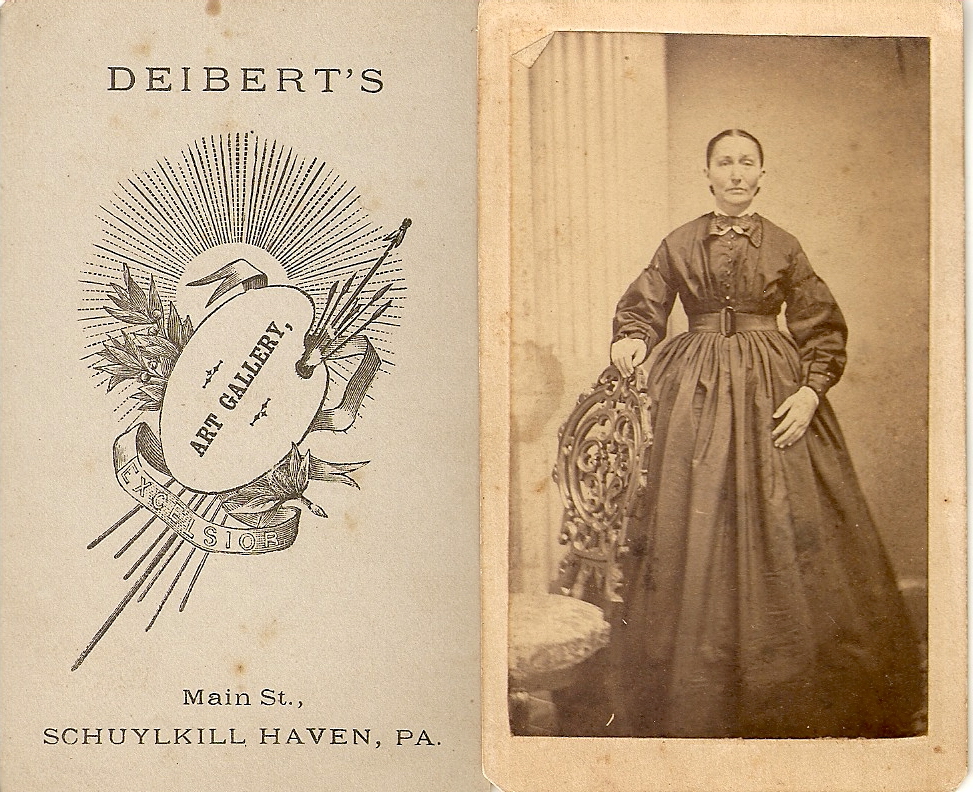
| Pottsville Republican of June 9, 1888 PHOTOGRAPH GALLERY RENOVATED The photograph gallery of Harry S. Deibert has been renovated and placed in order so as to compare with any in the county. All modern instruments and appliances are used so as to be at the front of his art. It is a picture of neatness being on the ground floor, with a large lawn in back of it which is arranged in a miniature park with trees, flowers, rustic benches and lattice work where he makes a specialty of taking groups and those who desire pictures of a romantic nature. The lightning flash photograph is a new addition whereby he can take pictures at night. A visit to his gallery is a study in this beautiful art. |
| Pottsville Republican of November 20, 1885 SCHUYLKILL HAVEN'S POPULAR HOTEL Two attempts have been made to sell the Washington Hall property here, but it has again been adjourned by the trustee for causes to the public unknown. Attorney Gerber represents the trustee and Attorney Weidman, the heirs of the estate of the late Philip Koons. The present landlord of the property is Colonel Charles D. Gold, who came to this place from Chestnut Hill in Philadelphia, and made this hotel what it now is, one of the best and most reliable hotel stands in this section of the state and whoever succeeds him will find a fine trade and with equal ability the same can be held. Colonel Gold leaves this place for Phoenixville in April next, where he has secured a permanent stand and judging from his success here, where he made a first class stand out of one that had been almost abandoned and gone to wreck. He will surely succeed anywhere. Our Phoenixville neighbors will find in Colonel Gold a good citizen, a man devoted to the cause of education and one who can give satisfaction to any reasonable sojourner, traveler or local customer. Schuylkill Haven will only feel their loss when he is once away. |
| Pottsville Republican of January 2, 1886 SALE OF WASHINGTON HALL The old and well known hotel, "The Washington Hall", at Schuylkill Haven, was put up for the fourth time at public sale this week and was finally struck off to Mr. Henry Zimmerman of that place, at the low figure of six thousand dollars. The property has been in the hands of the Koons family for more than twenty five years. It is the best located and most commodious hotel building in our neighboring borough and with proper repairs and a good landlord will do a large business. |
| Pottsville Republican of September 25, 1886 SCHUYLKILL HAVEN BANK On the subject of a new bank in that town, the Schuylkill Haven Enterprise of this morning says: the Enterprise has been persistent in its efforts to awaken an interest among our businessmen and citizens of the need and convenience of a bank located in our midst. The suggestions as to the wants of our town in this particular, were widely copied by exchanges and today we point with pride to the fact that a movement has been inaugurated towards the establishment of a banking institution. A preliminary meeting of the businessmen was held at the Washington Hotel, at which five of the Directors of the Bank of America, Philadelphia, were present. They were Louis E. Pfeifer, President, R. W. Cline, Cashier, J. B. Wiswell, C. L. Work and J. J. McFarlane, Directors. They fully explained the branch bank system which is made a special feature of this well managed and prosperous bank. Those present were favorably impressed and at once resolved themselves into a meeting, electing Dr. H. N. Coxe as Chairman and George F. Dengler as Secretary. It was then suggested that the chairman appoint a committee of nine, whose business shall consist of gathering subscriptions for stock, select a banking building and suggest the names of suitable officers for the branch bank. The following committee were announced: C. A. Meck, Chairman, Charles Wiltrout, F. J. Simon, William D. Kline, Robert Jones, George E Hoffman, H. Berger and Dr. D. Dechert. The next meeting is called for Tuesday, October 5th, when all persons interested in banking facilities in our town, whether it be that you desire stock or merely deposit accommodations, are asked to be present and hear more of the system of the proposed branch bank. |
| Pottsville Republican of October 16,1886 SCHUYLKILL HAVEN'S BANK The prospect for starting a bank at Schuylkill Haven has taken on quite a boom the past week. A meeting of the citizens was called for Tuesday evening last and a large number were present and ready for business. A committee consisting of Messrs. Charles A. Meck, Robert Jones, F. J. Simon and Charles Wiltrout was appointed to receive subscriptions for stock and to report Tuesday next at Metamora Hall at 8:00 p. m. when the foundation of the institution will be determined upon. |
| Pottsville Republican of December 9, 1889 A NEW DAILY PAPER The "Schuylkill Haven Gazette" makes the following announcement, "Commencing with Monday next we will begin the publication of an afternoon edition which will be circulated in Schuylkill Haven, Cressona, Orwigsburg and throughout the whole lower section of Schuylkill County. The increasing popularity of our town demands it and the accommodation of advertisers must be taken into consideration. The daily issue will be a five column folio and will contain a summary of all telegraphic matters, reported for this paper by the Associated Press and also all local events of interest. The management of the Gazette have made all necessary arrangements to give its readers a good spicy daily paper. |
| Pottsville Republican of March 7, 1895 BUSINESS REPORT Schuylkill Haven industries are well worthy a note. The shoe factory and knitting mills give employment to several hundred men, women and boys and all are extraordinarily prosperous. We have already referred to Berger, Brown and Company's shoe factory. Here women's misses and children's shoes are turned out in excellent style and pattern and in great quantities. There are five knitting mills. That of Harrison Berger and Son is located at the old flour mill on Dock Street. J. F. Bast's establishment in on Berne Street and starts up Monday and works until Saturday night without shutting down steam as they work two shifts. Daniel Sharadin's mill is near Columbia Street near Canal. J. F. Thompson and Company's works are on Margaretta Street and E. H. Baker is running a big plant on a small street off of Saint John Street. The latest acquisition is Keller Shoemaker and Company whose new mill just started up this week. It is located on Prospect Hill and is fitted up with all the latest machinery. All the factories make underwear and one makes fast black hose. The capacity of these five mills is nearly five thousand shirts a day. The shoe factory and the knitting mills use immense quantities of paper boxes and this gives prosperity to W. F. Doherty's big box factory. Yes, Schuylkill Haven is forging ahead and that too without much brass band business. |
| The Call of February 12, 1898 A PORTABLE WASHERY Hiester C. Boyer and John H. Phillips of Pottsville put men to work this week at the lower end of the town to reclaim coal washed into the Schuylkill River from the collieries situated along its tributaries. The scheme they are about to adopt is an original one. It is proposed to build a large scow upon which they will erect screens and shutes to separate the coal from the silt and the assort it into different sizes and then deposit it on the river's bank. The screens will be run by an engine propelled by steam supplied by a boiler, all of which will be erected upon the scow. A soon as the coal is removed from the river bed in the vicinity, the scow will be transported to a point farther south and operations will be again resumed and so on until the coal in the entire length of the river, a distance of one mile, is removed in this way. This firm has secured a lease for all the land owned along the river from the Graver Hotel to a point about one mile south. The culm is deposited from six to eight feet in the river bed and it is estimated that millions of tons of coal will be reclaimed by this method, every pound which will find ready sale to local consumers, which will bring handsome returns for the investment. This novel washery can be operated at little expense. |
| The Call of October 5, 1900 NEW WASHERY IN OPERATION - Improved Apparatus Now in Use to Abstract The new coal washery now in operation in the Schuylkill River at Quarlie Point, the foot of Canal Street, this place, is attracting large numbers of spectators daily. The apparatus was built and is owned by Mr. James Ammon, a retired coal merchant of Reading. Mr. Ammon's purpose is to abstract the coal from the dirt and culm now forming the bed of the river. The deposit of culm is from thee to six feet in depth and is known to contain a large percentage of the very best free burning coal. To accomplish this purpose, a scow fourteen by twenty five feet in size has been constructed and on this is placed the machinery, which consists of a powerful and latest improved suction pump, operated by an eighteen horsepower engine. A twenty four horsepower boiler furnishes the steam. Sieves and other necessary fixtures are also placed aboard the scow. A six inch hose attached to the pump extends down into the mass of water, dirt and culm and all substances less than six inches in size in close proximity to the opening are drawn up through the hose and deposited in a revolving screen or sieve, with meshes of four different sizes, which separates the buckwheat, pea, nut, and stove coal. From the screen the coal drops into bins below, from which it is removed by workmen and carried to the shore in boats specially built for that purpose. The water, sand and other fine dirt separated from the coal is caught up by a trough at a point under the screens and run off the rear of the scow into that part of the river already gone over by the hose. The scow, which is moved by means of ropes on shore, seesaws across the stream, making its own course and each time advancing about ten feet. It is Mr. Ammon's intention to traverse the river up to the Columbia Street covered bridge. The pump has a daily capacity of one thousand tons and it is expected that that amount of material handled will give a daily yield of about 125 tons of coal, nearly all of which he expects to ship to other points. He will do some retailing. The first trial of the apparatus was made on Wednesday morning and proved entirely successful. |
| The Call of October 19, 1900 THE SCOW SANK An unfortunate occurrence put a temporary halt to the operations of the new coal washery in the Schuylkill River at the foot of Canal Street, this place. Last Friday evening, shortly before the suspension of he day's work, the scow suddenly sank, but fortunately the water at that point was only about two feet deep and the valuable machinery aboard was not submerged. It was supposed that the scow had been built sufficiently large to carry the weight of the heavy machinery. Instead of floating, as had been supposed, the scow had been simply resting on the deposit of culm covering the bottom of the river. Large quantities of the culm surrounding the scow had been removed by the pump and the scow, losing its support, went down. Mr. Ammon, the proprietor, is having another scow constructed, twenty by thirty three feet in size, which is calculated large enough to sustain the enormous weight. The operations up to the time of the accident had been very successful. |
| The Call of February 13, 1903 CAFE KAUFMAN Douglas Kaufman has given Schuylkill Haven something for which there has been a crying need for several years - a first class restaurant, where meals can be obtained at all hours and where the finest beers, wines and liquors obtainable can be had. Café Kauffman opened on Saturday last and has been enjoying a trade that is very gratifying to its proprietor. The café is located in the Kaufman building on Main Street, between Saint John and Saint Peter Streets. The bar and lunch rooms are on the ground floor. They are painted and papered in green and white, while the handsome fixtures are of antique quartered oak floor and is fitted with a coal range and a gas range both of the latest and most approved patterns. On the second floor are two public dining rooms and a private dining room, all beautifully carpeted and handsomely furnished with pretty pictures on the walls and lace curtains on the windows. The café is lighted throughout by electric light. It contains every modern requisite for the comfort and speedy service of its guests. It is understood that the formal opening will take place on the seventeenth and that a chicken and waffle supper will be served. |

| The article at right denotes the opening of "Cafe Kaufman in Schuylkill Haven. The ad at left appeared on the front page of "The Call" regularly after the grand opening. |
| The Call of May 8, 1903 IT WAS A PUT UP JOB - The Street Fight Precipitated by a Gang of Toughs The unfortunate street fight on Main Street on Tuesday night of last week has been he subject of a thorough investigation upon the part of Douglass Kaufman, the proprietor of Kaufman's Café. Mr. Kaufman was holding his opening, and his restaurant was crowded with patrons, most of them personal friends, many of whom had come from a distance to aid in the making the affair a success. The Schuylkill Haven Drum Corps,engaged for the occasion, were playing in front of the café, when suddenly there was an attack upon the assembled crowd in the street, which was ended in a few moments by prompt and decisive action upon the part of those standing by. Mr. Kaufman was busy in his cellar getting out supplies and knew nothing of the disturbance until it was over and at no time was there any disturbance in the café. Mr. Kaufman is reliably informed that a crowd of young fellows came down from Pottsville with the avowed purpose of creating a row. They were not intoxicated but were bent upon mischief and kept up their tactics until the disturbance resulted. No one deplores the affair more than Mr. Kaufman, although he realizes he is not open to censure in the matter as it was something for which he is not responsible and could not control. Mr. Kaufman's sole idea in locating here has been to give this town the benefit of a restaurant that is first class in all of its appointments and where an appetizing meal may be had at any hour and he believes the community will support him in the maintaining of such a model establishment. |

| The Call of May 27, 1904 DRUG STORE CHANGES HANDS Wellington Hartman last week sold the Gem Pharmacy to G. I. Bensinger, who has been his clerk for a number of years. Mr. Bensinger graduated with honors from the Philadelphia College of Pharmacy in 1886 and has been practicing his profession ever since. He is one of the most popular young men in the town and his success is assured. Mr. Hartman has for some time been manufacturing specialties for the drug and liquor trades and has recently established a wholesale liquor house and he retires from the retail drug business in order to more fully devote his time to the manufacture and sale of his specialties, which have already won a statewide reputation and by merit alone are pushing their way into all the surrounding commonwealths. |
| The Call of September 11, 1914 WILL CELEBRATE ANNIVERSARY Tonight there will be celebrated an interesting event in the town's business section. It will be the tenth anniversary of one of our most enterprising young businessmen, namely,E. G. Underwood. Today it is just ten years since this businessman, as manager for the Doutrich and Company store, opened for business in Schuylkill Haven. In that time he has not only developed a most up to date gent's furnishing store but has set a standard for successful businessmen in our town. Ten years ago, this burg was, so far as its businessmen were concerned, at a standstill. Shortly after the arrival of Mr. Underwood in the town, his up to date business ideas and public spiritedness began to make itself felt in many directions. Other businessmen began to see their opportunities which they were leaving slip by for making this a livelier and busier town. They began to pursue different tactics and to the credit of this one man, it must be said the town took on a new life. In the ten years he has been in Schuylkill Haven he and his work has been an incentive for bigger and better things which have done much to advance the town. The steady and vigorous growth of the clothing store with which for two years he was connected as manager, and for six and one half years as a member of the firm Doutrich and Company, and for the last year and a half as proprietor, is due to the splendid service, sound business judgement and honest and straight forward business methods employed. This store, as it stands today in appearance and the ready response of the people, the large increase in volume of business, fully attest that Mr. Underwood has proven himself a most thorough and efficient businessman. A man capable of knowing just what the people need and should have and a man who has not hesitated in beginning at the very first stage, i. e. creating the desire to be clothed in stylish and well fitting and up to the minute clothes and then supplying the demand. The store has become the most popular among the men and boys of this town ans the surrounding community. Mr. Underwood came to Schuylkill Haven from Gettysburg where he was employed in the store of Weaver and Son. As manager for Doutrich and Company the store had a depth of seventy five feet. This later was increased by forty feet. After a few years the merchant tailoring feature was added to the line of gents clothing and furnishings. Later almost two complete floors were occupied instead of one. Only last year the store was further enlarged for the accommodation of a Ladies Department of coats, suits and furs. It is in celebration of the ten years Mr. Underwood has been in business in Schuylkill Haven that he has arranged for an anniversary. Mr. Underwood fully is cognizant of the fact that it is to the public to whom is due the greater portion of credit for his success, as it was by their patronage that the present business has prospered and grown to such an extent. In view of this fact he extends a cordial invitation to everyone to attend the anniversary ceremonies which will be held tonight, Friday, September 11. |

| At left is a bottle of "Old Virginia Bitters" supplied by Wellington Hartman of Schuylkill Haven. This rare bottle commands a premium price. At right is an ad from the Call newspaper for one of his concoctions. |

E. G. UNDERWOOD

The insatiable demand for houses and the prospects of Schuylkill Haven's prosperity for some time to come have created somewhat of a real estate boom and the new addition to the town opened by Messrs. Saul and Stanton appears to be the favored location. Within the past week three of the finest building sites have been sold and the purchasers expect to build in the spring. This is one of the most desirable locations in the town, being high and dry, with pure air and a splendid natural drainage and is within easy reach of the Pennsylvania Railroad and the trolley, while it is only a five minutes walk from the center of town. |
| Schuylkill Haven was considered a prosperous town in the county and area one hundred years ago and the real estate business flourished. The article at the left from the Call of November 3, 1905 made a regular appearance in the paper along with the plot plan at right as seen in the August 4, 1905 edition. The plot plan shows available lots on what is now Centre Avenue, Stanton Street and Pennsylvania Avenue. |
FINE BUILDING SITES
| Owning an automobile in 1912 was considered quite different then it is today. Below is an article listing all auto owners in Schuylkill Haven. This type of listing appeared at various times throughout the year. The Call of July 19, 1912 LIST OF LOCAL AUTO OWNERS The following is a list of automobile owners in Schuylkill Haven and the name of the car. There are forty nine automobiles, six of this number are trucks. Last year there were twenty eight machines in town or an increase in one year of twenty one machines. It is quite likely before the season is over this number will be increased to a still larger number as there are quite a few persons who expect to purchase a machine this year. The Ford and Cadillac machines seem to be the favorites with the local drivers, there being an equal number of each make in the town, eleven Cadillacs and eleven Fords. H. R. Heim Cutting Joseph Michel Cadillac Samuel Rowland Cadillac Frank Heim Inter-State Carl Bitzer Buick George H. Michel National O. O. Bast Ford Charles Michel Cadillac Howard Stager Maxwell George A. Berger Cadillac George Saul Cadillac W. Hartman Ford Jacob Reed Cadillac Mrs. Charles Sheaf Buick Dr. L. D. Heim Overland Charles Faust Cadillac D. D. Coldren Ford Dr. J. A. Lessig Ford Dr. A. H. Detweiler Ford F. B. Keller Inter-State John Ebling Ford Rev. E. H. Smoll Buick Edward Borda Maxwell T. J. Davis Ford Daniel Greenwald Ford Thomas Berger Cadillac John Berger Cadillac William Kramer Cadillac Blaine Sharadin Maxwell William Stitzer Ford Irwin Becker Ford Herbert Baker Buick William Killian Studebaker Daniel Kramer Rambler Frank Runkle Buick Saul and Zang Modern Truck George Long Buick Sam Sausser Rambler Walter Meck Everett W. H. Moyer Overland Harry Dohner Flanders John Dohner Ford Jacob Berger E. M. F. Mrs. D. Dechert Buick J. Harry Filbert Cadillac P. T. Hoy and Sons Chase Truck Michel Brothers 1 Mack truck, 2 Modern Trucks |
| The Call of August 6, 1920 TEARING DOWN ONE OF TOWN'S OLDEST FACTORY BUILDINGS During the week, the frame rear portion of the Hoffman Knitting Mill was being torn down by the contractor preparatory to the construction of a brick addition to this plant. The frame portion to be demolished is probably one of the town's oldest factory buildings, having been built and used by Francis Warner as a shoe factory. It has for years been used as a factory building, both as a shoe factory and underwear mill by different firms. The excavating adjoining the present Hoffman Mill continues, a sufficient depth not having been reached yet. On this site will be constructed a three story brick factory building. The present mill will have another brick story placed on it. When completed, the Hoffman Mill will be entirely of brick of a size 110 feet in depth and 50 feet frontage, three stories in height and a basement. For some time three buildings have been used by Mr. Hoffman for his knitting mill, namely the Margaretta Street mill, the mill across the street, formerly the candy factory and the building formerly occupied by A. H. Kline as a factory. It is proposed to have all the operations conducted in the new building when completed. |
| The Call of December 12, 1919 TOWN HAS LARGEST GARAGE IN COUNTY The automobile garage on West Main Street of Berger and son is about completed and ready for occupancy by ninety autos. This is the number of machines that can be accommodated in this building. Already some thirty machines have had reservations made for them by their owners. The garage as was stated in these columns some time ago is the largest one floor garage in Schuylkill County. It is 68 feet wide with a depth of 148 feet. The placing of iron girders made it possible to erect the building without the use of supports or posts at different parts of the floor. This affords an unobstructed floor space of unusual size and will greatly facilitate the handling of cars and make it possible for auto owners to take out and put back again their car with greater ease. The garage is fireproof in its entirety. In addition to the same being a garage, the owners will carry a complete line of auto tires and all kinds of accessories. A gasoline and air tank will also be installed. It is planned to have a formal opening of the garage in the very near future at which time a band is to be present to furnish music for those who may wish to dance. A demonstration will also be given of the Overland and Cole Eight autos which this firm is agent for. |
| The Call of March 5, 1920 TO HAVE COMPLETELY EQUIPPED MACHINE SHOP In addition to the George A. Berger and Son building on West Main Street being one of the roomiest garages in the county, it will also be a modern and first class equipped machine shop, where it will be possible to procure prompt auto repairs of the cost complicated nature and all kinds of general repairs. The motors, lathes and other machinery has arrived and will be set up the coming week. There will be several machinists employed. One of the machinists will begin work the coming week. He is George Blew, formerly foreman of the Serfas Motor Car Company of Pottsville. There are some sixty five automobiles stored in this garage at present. There remains but a small part of the floor space to be concreted. Work on this will begin the coming week. |
| The Call of July 16, 1920 GIRL CAME NEAR DROWNING Mildred, eldest daughter of Mr. and Mrs. Walter Meck, narrowly escaped drowning at Killian's on Wednesday evening. She with her brother Charles were enjoying themselves when suddenly she went under. Charles promptly called for help. There were no adult persons in the vicinity and Miss Mary Lessig, daughter of Dr. J. A. and Mrs. Lessig, who was nearby and had been enjoying the bathing came to the rescue. Nothing but a bubble on the water's surface could be seen. She dove at the point where the bubbles were noticed and struck the body. Upon coming to the surface she quickly made known her finding. By this time there was considerable commotion and excitement. Mr. Harry Sterner of Centre Avenue, who happened to be walking along the dam, as soon as he learned of the facts, threw off his hat and fully dressed dove in under and brought the girl to the surface. As soon as the air was reached the child sort of regained consciousness and with a little effort was soon out of danger although her face was very blue when rescued and it was feared her rescuer came too late. She was taken to the home of her parents on Saint Peter Street in an automobile and put to bed. Outside from suffering from shock she appears none the worse for her narrow escape from drowning. |
| The Call of September 16, 1927 NEW BUILDING ON OLD LANDMARK One of the oldest buildings in Schuylkill Haven is soon to be razed and on its site will be erected two pretty and very modern dwelling houses. The building that will be razed is the Voute-Filbert-Keller-Call Building. It is known by any one of these names by reason of it having at one time been owned by the first three and for twenty five or more years, and up until several years ago occupied by The Call. The building will be razed by Contractor Canfield. Work of demolition was begun in a small way this week. The steam shovel will be put on the job shortly and although strongly constructed and in the good old manner of building, it is expected it will be down in a very short time. With the building will also be removed a number of trees, one in particular, a horse chestnut tree, on the premises is over a hundred years of age. Messrs. F. B. Keller and H. E. Snayberger will have built upon the site a very modern double two and one half story dwelling house. It will be of the Foxcraft stone. This is the same stone as the Strunck Memorial Hall is built. The building will be several feet above the grade of the street and will face on Dock. At each side of the building will be a large porch, one to face on Main Street and the other toward Spring Garden. There will be one main entrance to the building which will be off of Dock Street. There will also be driveways. The style of architecture will be on the Colonial style. The contract for the construction of this building was recently let to Burton E. Cooper of Port Carbon. The architect is Harry Maurer of Reading. When the new building is completed it will be occupied by Mr. and Mrs. F. B. Keller and Mr. and Mrs. H. E. Snayberger. Its completion will probably mark the beginning of building alterations and operations on a large scale at the First National Bank of which Mr. Keller is president. The space used as living quarters now occupied by Mr. Keller in the bank building is to be used for the banking space and the new banking building is to be of the most modern in style and design. |

| This truck and two teams of horses were used by Joseph Killian who operated the ice business at Killian's Dam in the Willow Lake area of town. He also operated the swimming pool that was located there. |
| The Call of October 7, 1927 PUTTING IN SIDE TRACK TO WASHERY A side track or siding to the Manbeck Washery is being placed by the Reading Company. In order to provide the siding slag and cinder is being taken from the Rolling Mill property. This in turn will make this piece of land more necessary fill to the washery which is very near the end of Canal Street or Parkway, a fill of four feet consisting of desirable as building lots. The placing of the side track to the washery will make it possible to load the coal for shipment at the washery instead of trucking it to the coal chute near the Union Knitting Mill. It will in turn also eliminate the condition at this point sometime complained of by pedestrians, namely, that of the pavement over which the trucks passed of being covered with mud. |
| The Call of June 14, 1929 D. M. BITTLE'S MORGUE FINEST IN THIS LOCALITY The morgue and embalming parlors of Undertaker D. M. Bittle of Schuylkill Haven are without a doubt the most modern and up to date in this section of Pennsylvania. One usually thinks or possibly speaks of a morgue as a place only to be visited by the undertaker and the dead and the mention of the word results in chills creeping up and down one's back. However, modern methods used in caring for and preparing the dead for burial have relieved this phase of the work of its so called horrors. A visit to the morgue of Mr. Bittle can be made without the slightest fear of being unnerved. This because he has provided a large space for modern equipment and furnishings and everything possible is done in order that the lifeless body can be tenderly cared for in a most sanitary and clean manner. One finds the morgue is a large room resembling the operating room of a modern hospital. It is enameled in white, is well lighted and all the equipment is of white porcelain. One finds a large white porcelain operating table, white instrument cabinets, wash stands with hot and cold water available and shelves and closets wherein are arranged in an orderly way, carefully labeled bottles containing the necessary fluids for the work at hand. Adjoining the operating room, one finds the slumber room to which room the body is taken after being embalmed. It is placed on a day bed. There are chairs and a table in the room and it is to this room relatives of the deceased can come and silently commune with the spirit of their loved ones. Another room is fitted up as a display room and here are on display quite a number of caskets of different designs and types. Here also may be found samples of the garment or clothing obtainable for the dead. The selection of all the necessities for the burial may be chosen with ease under these conditions. The general public can feel that in the event of an accident, etc., which sometimes necessitates the removal of a body to the undertaking establishment before removal to the home, it is being cared for and prepared in a clean operating room and under the most desirable all around conditions. |


| These three ads below were featured in the Call during 1928 and 1929. |
| When First Lieutenant Joseph S. Kaufman was about to be discharged from the Army in 1919, he read an article stating milk should be sterilized via pasteurization for the safety of the consumer. After discussing this with his fellow Schuylkill Haven resident and Army buddy, Charles (Bags) Graeff, they decided to become partners in the milk pasteurization business. In 1920, Kaufman and Graeff started in a basement in a home on Naffin Avenue in Schuylkill Haven. Most dairy farmers in the area sold their raw milk to local residents and they tried talking Kaufman out of his new venture. They were unsuccessful and in 1921, Kaufman hired prolific Schuylkill Haven builder and entrepreneur Paul Naffin, to build a milk processing plant on Naffin Avenue. At the height of the business, an eight hundred quart pasteurization vat was filled three times a day, and four times the next, so that 2,800 quarts per day were delivered to local customers. The price of a quart at that time was ten cents. The raw milk was supplied to Kaufman by forty farmers throughout Schuylkill and Berks Counties. An early employee of the dairy was Paul Boger, who began there at the age of eleven. He would arise at three o'clock in the morning and work until school began. In 1928, he became a full time employee and remained at the dairy for twenty four years. At that time the milk from Berks County arrived by train and it was known the trainmen would get to the milk and skim the cream off the top of the forty quart containers. Kaufman bought out his partner in 1921 and operated the dairy with his father, Daniel. The process would begin at three o'clock in the morning. He and employee Chock Fey would deliver it to their customers. Bob Frey and Harry Kerschner were also long time deliverymen for the operation. When Kaufman's son Joseph got out of the service in 1946, he started to work at the dairy as a milk processor. Joe took a course at Penn State University and became a licensed milk tester, testing the butter fat content of the milk. Milk was delivered every day including Sundays. In 1947, Kaufman purchased a machine to homogenize milk which keeps the cream distributed throughout the container. Customers were given the choice between homogenized or nonhomogenized which was bottled in what was known in cream top bottles, which allowed the cream to collect at the top. Surplus milk was run through a separator machine, separating the cream from the milk. The cream was containerized and sold to Yuengling Dairy for ice cream and the remaining milk, skim milk due to the absence of cream, was drained into the creek behind the dairy. The creek would turn white with hundreds of gallons of the considered worthless skim milk running into it. Kaufman's Dairy was sold in 1951 to Hiram Fisher, who worked for Rothermel's Dairy. He in turn went out of business in 1959. The dairy was demolished in 1970, a home now occupying the lot. This article is composed of information by the dairy founder's son Joseph and grandson Joerd. The accompanying pictures were kindly provided by Joerd Kaufman. |


| KAUFMAN'S DAIRY |
| This July 1950 photo shows Harry Kerschner and Joe Kaufman in front of their delivery truck on Saint John Street on the northeast corner of the intersection of Union Street. Also pictured in the center is dairy founder, Joseph S. Kaufman and at right is an advertising fan featuring the dairy. |

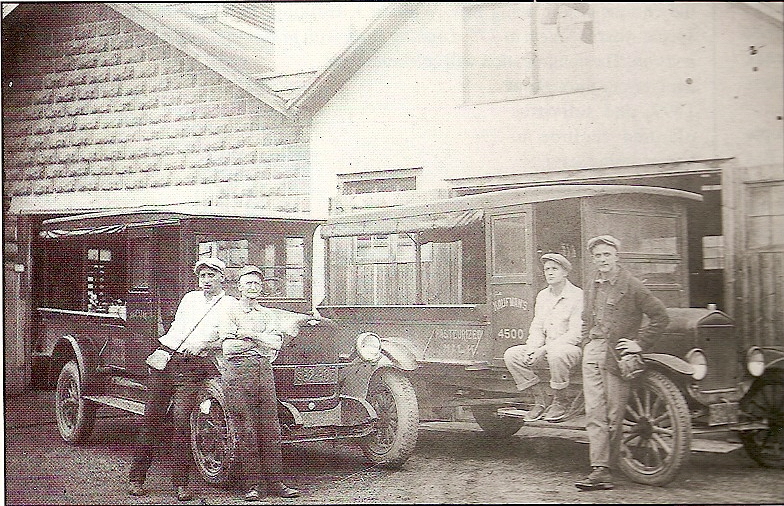
| This photo at left shows the Kaufman Dairy float being readied for a Schuylkill Haven Fourth of July parade. At right employees of the dairy from left to right: Chock Fey, Daniel K. Kaufman, Daniel K. Kaufman Jr. and owner Joseph S. Kaufman. |


| At left are two embossed Kaufman Dairy bottles. The next image shows two pyroglaze bottles with the old 227 phone number. Next are two highly collectible "baby face" bottles from the dairy. Note the bottles are of the cream top variety to separate the cream from the milk, in this case in the form of a baby's face. At far right are two more pyroglazed bottles. |

| WALKIN SHOE COMPANY |
| Located at the corner of Parkway and Columbia Streets, the Walkin Shoe Company was founded in 1887. It was organized in a 60' by 40' frame building along the banks of the old Schuylkill Canal. It began as Berger, Brown and the borough sold the old lock up and ground on which it stood and an addition was made. In August of 1909, it the latter two men left the business and H. E. Snayberger partnered with Mr. Keller. For many years the company specialized in children's corrective footwear and were sold nationwide. The 1968 anniversary booklet about the company stated that at the time 2000 pairs of shoes were made daily by a work force of 250 employees. The Walkin later succumbed to a changing economy and foreign imports. |

| Invoice from company from August 1909 when Gerber sold his interests in the business. |

| The Gerber Shoe factory in the original building. Note the old canal in front. |

| The Industrial review published in 1898 shows the pictures of the owners of the company that later became the Walkin Shoe Co. |
| P. T. HOY & SONS CO. GENERAL STORE |
| Many residents can recall the beautiful Victorian brick structure at the corner of East Main Street and St. John Street that housed the P. T. Hoy General Store. The business had it's origin during Civil War times located in Landingville. The original store was operated by the father in law of Pancoast Thomas (P. T.) Hoy, Lewis Main Street. In 1875, P. T. Hoy entered the business and assumed ownership. In 1894, he moved the business to a building at Main and St. John Streets expanding it to the well known three and a half story turreted structure that was a centerpiece of the business district. The store sold a wide variety of dry goods and groceries. This building became the largest completely electrically lit building in town between 1905 and 1910. Part of the original building on the site predated the Civil War. A portion of that retained in the basement evidence of old store fronts. This was a remnant of the era when the level of that intersection was a full story below present street level. Hoy, ever the entrepreneur, sought out special contracts. He supplied troops in Shenandoah during the 1902 coal strike and also obtained contracts to serve traveling circuses. Delivery teams delivered groceries to outlying areas and also purchased goods from farmers for resale. Hoy was one of the first commercial enterprises in the county to utilize motorized trucks, sometime around 1910. The business also offered gasoline for sale in the early days of automobiles. Hoy discontinued his delivery business during World War One, maintaining the fixed site operation only. It is said that P. T. Hoy was the first business in the area to offer Shredded Wheat and Quick Mother's Oats during the advent of those staples. It was reported that confectionery pioneer, Milton Hershey, was an occasional visitor of the Hoy business as he began operations. A Lionel train display filled the front windows of the Hoy store at Christmas time. According to my uncle and others, at times, the store cat also shared this space with fresh sausage and other goods. The store operated into the 1960's with Rudy Hoy as proprietor until his retirement. The grand structure was demolished around 1966 and is now the site of Brok-Sel Markets. P. T. Hoy was apparently a man who recognized the value of advertising. Many items bearing his store name still exist. Below you will find pictures of some of those surviving items. In addition, is a picture of two unique items. A flour sifter from the counter of the store bears the P. T. Hoy name but is hard to read especially in a photograph. The other item is a wooden washing machine from over one hundred years ago. |


| These three images depict P. T. Hoys beautiful edifice before it's demise. Upper left is from September 1959, in the center is from January 1963 and at right is April 1966. |

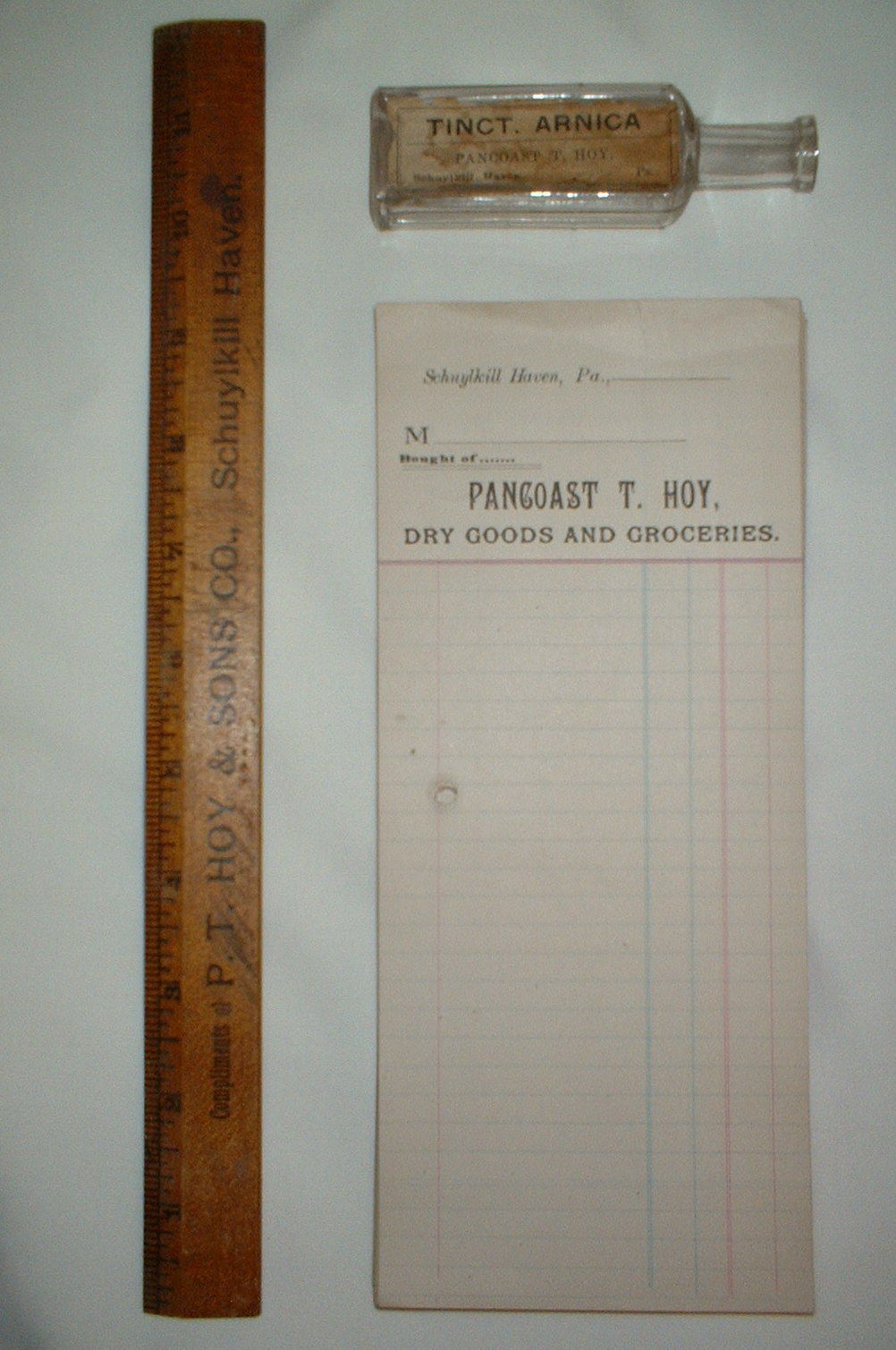


| Here are some items related to the P. T. Hoy General Store. Clockwise from upper left: coupon book and money saving punch card, Deer Note stationery designed for his store, ruler, medicine bottle and receipt pad. |


| At left is an old washing machine called "Hoy's Special" with a patent date of June 20, 1899. It was manufactured by the A. G. Christman Co. of Reading. At right is a flour sifter from the counter of the store. It is marked General Merchandise, Schuylkill Haven, PA. |


| On the left is Pancoast T. Hoy and on the right is his wife, Cora nee' Huntzinger |

| This picture is of the interior of the P. T. Hoy store in the Business Review of Schuylkill Haven in 1898. |


| The grave stones of P. T. Hoy on the left, his wife Cora on the right and their son Rudy, below, on the family plot in Union Cemetery. |
| MESSNER AND HESS |
| Anyone growing up in Schuylkill Haven in the 1950s through the 1970s would certainly remember the Messner and Hess five and ten cent store on Main Street. I spoke to the last owner of the establishment, Harry Naffin. He related the following information about the business. The original company was started by Clarence Messner and Daniel Hess, both hailing from Lancaster County. They had two other stores in Girardville and Minersville in addition to the store in Schuylkill Haven. The partnership became a sole proprietor when Messner bought out Hess's half but retained the original store name. Harry Naffin began his career with the business in 1939 when he was offered a job washing Messner's Packard while still a high school student. He worked part time at the store until graduating from Schuylkill Haven High School in 1940. Harry then accepted a full time position working sixty hours per week for a salary of thirteen dollars. He said he was the only graduate to obtain a job right from school that year. Harry worked at the Minersville store while his future wife, Kit managed the Schuylkill Haven store from 1942 until 1948. When Harry returned from his Army stint in 1948, he became manager of the Schuylkill Haven store. In 1969, Messner died and by 1970 Harry Naffin had purchased the business. He says that at most times they employed eight to nine girls to work on the floor. The store was always well stocked with goods including toys, trains, hardware, school supplies, sewing notions and candy. Entrance could be gained from Wilson Street which was noted as a "shortcut to Main Street". As I recall, when entering from the back door, train supplies and model kits were what one first encountered along with glassware and knick knacks. One would then go down a few steps to the main floor. Toys and games were in the two aisles to the left and hardware to the right. School supplies were located near the front of the store. At the Main Street entrance was a large candy counter where bulk candy could be purchased. Harry states that the cases were quite special and the company who made them used the display in Messner and Hess in their catalog. With the advent of large chain stores and malls, Naffin was forced to close the store after Easter in 1982. I had the privilege of occasionally visiting Harry at his home in Pine Grove where we enjoyed discussing the past of Schuylkill Haven. Harry has provided information used on this web site including pictures. Widowed after losing his wife Kit, Harry remained busy doing various woodwork projects including making beautifully fashioned wooden bowls. He passed away in 2009. |

| At left, Harry Naffin, owner of Messner and Hess on Main Street, peddles his wares at the first sidewalk sale in Schuylkill Haven in the early 1960s. In center is the store with the font windows decorated for Christmas and at right is the store between Cleland's furniture and Atkin's Five and Ten |


| The Call of November 18, 1910 To the P. T. Hoy and Sons Company belongs the honor of putting into service the first motor truck in Schuylkill Haven. The truck has a capacity of a ton and a half, is of twenty horsepower, air cooled gasoline three cylinder motor and was manufactured by the Chase Motor Truck Company of Syracuse New York. The car was purchased through the Commercial Motor Car Company of Pottsville, of which Thomas J. Charlton is the manager. Other merchants will doubtless install motor delivery wagons within the coming year. |
| The Call of July 15, 1910 P. T. Hoy and Sons Company last week put in operation at their big store a mammoth cash register that can do almost everything in the business line except talk and collect bad debts. The machine automatically registers the amount of every purchase no matter how small or large and it delivers a check with a memorandum of the transaction stamped thereon showing settlement, charge account, cash sale, etc. The entire day’s business, both cash and credit, together with amounts paid out goes through the machine and when the store closes in the evening a record sheet is taken from the machine showing every transaction and by which clerk or members of the firm the transaction was made. The cash register is one of the most useful and necessary adjuncts to the transaction of a modern retail business. |

| The photo at right is from the fifth annual banquet held on November 12, 1955, of the Schuylkill Haven / Cressona Barbers Association. From left the barbers are: Guy Lehman, Ernie Rizzuto, Homer Zimmerman, Monroe Miller, Dutch Coover, Merlin Fisher and John Cake |


| BUSINESS IMAGES OF SCHUYLKILL HAVEN FROM THE PAST |

| The Schuylkill Haven Paper Box Manufacturing Plant was located on Penn Street below Parkway. The building remains today, used by a door and window company. |
| The Union Knitting Mill was located on Williams Street below the railroad tracks. It was destroyed by fire a few years ago. |
| The Haven Casket Factory was and still is located on Liberty Street. The building looks very much the same today as it did when this was taken. |
| The Manbeck Ice Manufacturing Plant was located on Liberty Street. The building remains today, used as a storage building |


| At right is an unissued stock certificate for the business. |


| This image is from a pamphlet promoting Schuylkill Haven in the first half of the last century. It shows Meck Knitting Mill on West Main Street looking much the same today. |
| The Call of March 21, 1930 AUTO COMPANY PRESIDENT VISITS SCHUYLKILL HAVEN Earl Stoyer was host last week to the head of a prominent automobile concern in the person of Joseph Graham, president of the Graham-Paige Corporation, of Detroit, Michigan. Mr. Stoyer has won honor medals, service medals, and most anything he tried for, which was offered as an inducement by the corporation and though in competition with cities of great population, he has succeeded in winning the prize. Mr. Graham started out in a Graham sedan from his home in Detroit some time ago and since that time has covered ten thousand miles, first going to the Pacific Coast, thence south, primarily to visit Florida, and came north enroute to still further northern points, before returning to his home. Being a mechanical engineer of note, he was particularly interested in the machinery Mr. Stoyer has installed in his Schuylkill Haven works and highly complimented him on the same, likewise expressing gratification at the beautiful display parlors at Pottsville and Schuylkill Haven. He also complimented Mr. Stoyer on the extraordinary good looking condition of his used car department, saying he never saw a better prepared line of cars than those now on the big bargain list. They look like new cars and are fitted out splendidly. Mr. Graham was accompanied by Guy A. Willey of Philadelphia, the distributor for the Graham-Paige in this territory, and both were loud in their praise of the Stoyer establishments in this territory, and left feeling he can now understand how Mr. Stoyer manages to capture the prizes in a limited territory such as he is located in. It is service to the last degree. He was delighted with the conditions of business as he found it in our section of the country and as he traveled all over the country, knows what he is talking about. |
| The Call of July 25, 1930 CHAMBER OF COMMERCE LEASES BUILDING FOR TOWN'S NEW INDUSTRY Negotiations have now been completed whereby the Losch Automatic Heater Company of Schuylkill Haven will move into much larger quarters in Schuylkill Haven. This will enable this firm to manufacture and assemble on a larger scale their automatic furnace, which is conceded to have many superior features over other automatic furnaces. The company will shortly occupy the new factory building of Berger Brothers on Garfield Avenue. Some interior changes must be made in order to accommodate the new concern but they will be of such a nature that they can be made very quickly and Mr. Losch expects to have all machinery and equipment moved from his plant on Columbia Street and in operation in the new building by the latter part of next week. Some of the machinery was moved on Thursday and the men are now at work hanging the shafting, etc. Mr. Losch is very well pleased with the new quarters. As a result of larger quarters, Mr. Losch expects to be able to greatly increase his output and to meet the demand for the automatic furnaces which is growing heavier right along. All heating concerns and companies who have seen the plant in operation express the opinion that it is destined to meet with a ready sale on the market. The company had inducements to bring their plant to other towns, but Mr. Losch was loyal to his home town, Schuylkill Haven and made inquiry whether the Chamber of Commerce of Schuylkill Haven could not supply a larger building. Negotiations have been underway for the past several months by the Board of Directors of the Chamber of Commerce to obtain building sites for the erection of a building. In this the public would have been asked to cooperate. The demands for increased quarters became so heavy that increased facilities were necessary immediately. The Chamber of Commerce therefore leased the said Berger Brothers new factory building for a period of years with the privilege of purchase and from its funds obtained by membership dues, will provide this latest Schuylkill Haven industry with a building rent free. |
| The Call of August 29, 1930 HEAVY DEMAND FOR FURNACES OF LOSCH FIRM The Losch Automatic Furnace company of Schuylkill Haven is now in full operation in the new quarters in the Berger Brothers new mill building on Berger Street. The plant was moved into this new building several weeks ago. Some little time, of course, was required to get the machinery set up and things moving along smoothly on the increased scale. Fifteen men are now employed and on an average of three to four furnaces are being completed weekly. In order to take care of the orders on hand and the demand for the furnaces, a working force of at least fifty men would be required. Considerable space is required to assemble the furnaces. The second floor of this building is now being fitted up and will be made use of very shortly. An adjoining building can be readily adapted to the needs of the plant when this becomes necessary. The Losch Automatic Furnace is being made in five different sizes to accommodate different sizes of homes and buildings. Two of the largest size furnaces are being built at this time for the Nurse's Home at the Pottsville Hospital and one for the home of Clinton Confehr. Last week a large one was placed in the home of Mr. Couch, owner of the Troy Laundry at Pottsville. Representatives for the company were given notice three weeks ago to discontinue taking orders for the furnaces because of it being impossible to make them fast enough to supply the demand. Ordinarily one would think the proper procedure would be to immediately increase the working force. While men might be available for this purpose, the manufacture of the furnaces is of such a nature that it requires some time before a new employee can be made thoroughly acquainted with the procedure, the requirements and the assembling. |
| The Call of October 2, 1931 CANDY KITCHEN REMODELS - NEW SERVICE ADDED The opening of the newly equipped luncheon parlor of the Schuylkill Haven Candy Kitchen will be held on Saturday of this week. Workmen have been busy the past several weeks transforming the interior of this confectionery into a modern wonderland. An artistic open work archway of walnut and white glass composition, separates the store from the serving parlor. Beyond the archway, you will see a beautiful candy display case which backs up the entire aisle of booths. In all, there are twenty individual or private booths as follows: six double ones on both the east and west sides of the room which will accommodate four persons each and eight single booths to accommodate two persons each, in the center of the room. The booths are constructed of walnut and the table tops are of vitrolite. Beautifully designed panel mirrors grace booth has a unique hat and cloak rack. Bernheim and Sons Incorporated of Philadelphia installed the new fixtures. A new luncheonette service, in connection with the regular fountain service was opened on Wednesday and is in personal charge of Mrs. Joe Reber. The luncheon display of a large baked ham, salads, sandwiches, soup and pies is most inviting. Fried oysters will be served as an extra special on Saturday evening. A new Frigidaire cooler has been added for the convenience of the culinary department. Proprietor Parris Lazos is to be congratulated upon his new improvements. Eleven years ago he opened his first business establishment in Schuylkill Haven, in the The booths are constructed of walnut and the table tops are of vitrolite. Beautifully designed panel mirrors grace store room now occupied by the Sausser firm. His efforts have been successful. He now reciprocates by giving the public a metropolitan luncheonette and ice cream parlor at a considerable outlay of money. The adding of this each booth. The wall booths have individual side lights harmonizing with the modernistic ceiling lights. Each luncheonette service will fill a long felt need in Schuylkill Haven and is sure to be given the patronage of the community. |
| The Call of December 11, 1931 OPEN PAINT AND PAPER STORE Today, Friday and tomorrow, Saturday, will be the opening days for a new place of business in Schuylkill Haven. It is the Harry Feger Jr. Paint and Wallpaper Store. It is at 27 East Main Street in the Moser Building. By reason of the fact that folks nowadays are doing more of their own painting in and about the home and redressing and toning up furniture, doing their own paperhanging and decorating in their home, this character of store throughout the country has become very popular. Mr. Feger has had eighteen years of experience in decorating and painting homes and is therefore in a position to determine just what will appeal as well as what will be proper and desirable for the home. Accordingly, he has placed in stock an unusually large line of paints, varnishes and stains that can be purchased either in large or small can sizes. Wallpaper can also be chosen from samples and stock and obtained in any quantity. Mr. Feger Jr. will not accept any painting or paper hanging jobs, his desire being merely to supply the requisites for work of this character. In charge of this store will be a well known Schuylkill Haven resident, namely Clayton Bubeck. Mr. Bubeck has had many years of experience in painting and will therefore, be enabled to make helpful suggestions and to give advice on painting problems. Mr. Feger, who now resides in Port Carbon, expects to move his family to Schuylkill Haven in the near future. |
| The Call of December 25, 1931 NEW MILL TO BEGIN EARLY IN YEAR The Alberta Underwear Factory in Schuylkill Haven will begin operations between January 1st and January 15th of 1932. This will be a branch of the Miller Factory of Port Carbon. It was intended to begin operations in the Schuylkill Haven branch on Hess Street a month ago but delay in the arrival of machinery made this impossible. Mr. Harry Welker who will be the superintendent of the new mill, has been on the job for the past several weeks, directing the placing of the machinery and getting the plant ready for operation. Thus far between 125 and 150 persons have made application for employment. The applicants have not only been from Schuylkill Haven but from the district and towns for miles about Schuylkill Haven. Mr. Welker will require about twenty five employees when the mill is first put into operation and the number will be increased from time to time. |
| The Call of January 15, 1932 LOCAL MILL WORKING DAY AND NIGHT SHIFT Dame Fashion in milady's underthings is responsible at this time for at least one of the Schuylkill Haven underwear mills working to full capacity, on a full schedule of fifty four hours per week for the female employees and a full twenty four hour day shift for some of the male employees, from Sunday midnight to Saturday at midnight. Others of the Schuylkill haven underwear mills, it is likely, will also be kept quite busy for some time by reason of heavy demand for their product. All this is quite heartening and encouraging news for the year ahead and it is hoped indicates a return of the unusual era of prosperity and good business that had been enjoyed by all of Schuylkill Haven's industries. The one particular plant that has now in its employ every employee for which any possible space can be found in the plant is the Hoffman Knitting Mill, operated by Julius Kayser and Company. This company, with its main plant in Brooklyn, also owns and operates large mills in seven or eight other towns and cities, as well as operating a plant in Canada, one in Australia and one in Switzerland. The new garment which is meeting with such popular approval by the women folks is a two piece ladies shaped vest and tights and is called Kayserettes. It is manufactured by the local plant in cotton and also in pure silk. This plant has been rushed since October and orders are in hand sufficient to keep it steadily employed until April or May. One hundred and seventy five persons are given employment the full schedule of hours for the week. The knitting machines are operated continuously from Sunday at midnight until Saturday at midnight. An unusual feature in connection with applications received by H. A. Goas, Superintendent of the Schuylkill Haven plant, is that nine out of every ten are married women. It is understood several of the other Schuylkill Haven mills are about to begin work shortly on some new styles of underwear for women which it is hoped will meet with equal approval and provide heavy orders for full capacity plants for some time to come. |
| Below are a series of articles about business in Schuylkill Haven during the Great Depression. The details reveal the ingenuity, the drive and the struggles of the time. |


| At left are postcards Stoyer sent out in 1940 and 1941 advertising Oldsmobiles. At right, top, is a raffle ticket for the Grange Fair with a car from Stoyer's as the prize. Below that are advertising pieces from the dealership over the years. Clicking on image enhances detail. |

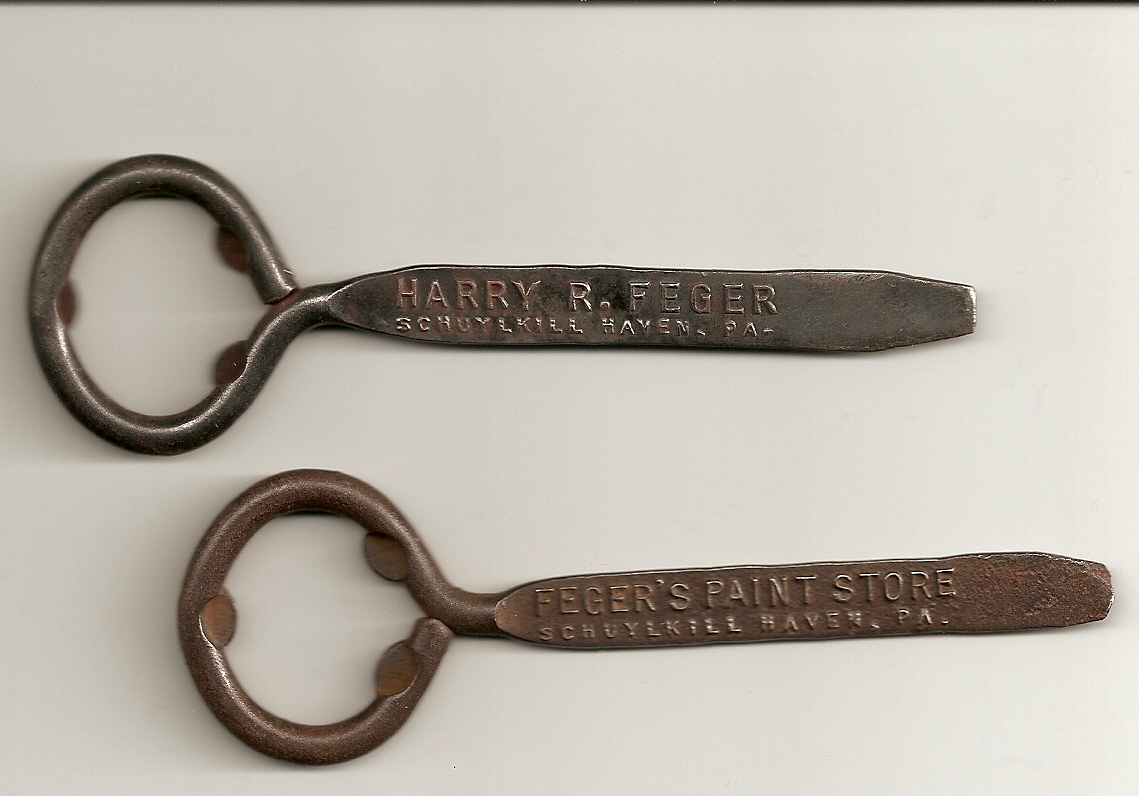
| Above is a fan given away by the Schuylkill Haven Candy Kitchen,and beloware can openers from Feger's Paint Store mentioned below. Clicking images enhances detail. |


| At one time banks issued their own currency. Here are two fine examples issued by the First National Bank of Schuylkill Haven. At left is a $10 note from 1902 and at right a $20 note from 1882. |
| The Call of March 21, 1930 PREPARING FOR "TALKIES" HERE Schuylkill Haven is soon to have talking motion pictures. They are to be of the very best type and character and will add greatly to this class of entertainment. During the week the Refowich Theatre has been closed for the purpose of making the installation of two new Simplex machines from the Radio Corporation of America, for producing Vitaphone and Photophone pictures. Messrs. Refowich are going to a heavy expense for the installation of this latest feature in motion pictures. Not alone are the machines expensive but in order to successfully operate, a number of expensive alterations have been made necessary in the theatre. In speaking with the men in charge of the placing of the new mechanism, it was learned that the Refowich Theatre is most ideally suited both in size and arrangement of stage and balcony and height of ceiling for excellent results from the talking pictures. It is expected that the best of results will be obtainable and that the general public will be most delightfully impressed with the entertainment which it will now be possible to offer at unusually low prices. It is expected that the installation will have been completed by the middle of next week in order to permit the holding of a grand reopening of the theatre by the latter part of next week. Due announcement of the reopening, together with the program, and details of the new sound producing mechanism will appear in next week's issue of The Call. |
| The Call of March 28, 1930 "TALKIES" TO MAKE DEBUT HERE SATURDAY Saturday, the Refowich Theatre, of Schuylkill Haven, will offer to the general public of Schuylkill Haven and surrounding towns, its first sound pictures or "talkies". The early part of the week, the installation of first class sound reproducing picture mechanism was completed and the necessary changes made in the projecting mechanism to enable the showing of the very best of pictures. The first test of the mechanism proved entirely satisfactory in every way and the management was indeed highly elated over the first showing and tests. It is felt that the general public too, will be at first surprised and then greatly pleased with the results that have been obtained in this theatre in the matter of sound production of movies with the synchronization of action with sound. At first there was some uncertainty as to whether it would be possible to procure first class results in the sound reproduction in all parts of the theatre. The mechanism installed is of such type that no trouble of any kind was experienced in this regard. With the placing of this sound producing mechanism, it will be possible for the Refowich Theatre to offer to its patrons the very highest class of talking pictures at prices considerably lower than what is charged elsewhere. |
| The Call of January 22, 1932 PRIZES AT SCHUMACHER STORE REOPENING Next Thursday evening the reopening of the H. Schumacher and Brother store on Columbia Street will take place. This reopening is being held because of the fact that so very many changes have been made at this place of business that it is only proper that special and official public consideration be given. Probably the most noteworthy change is that of a thirty foot addition which has been added to the store room, making the total floor space seventy by thirty feet. The entire interior has been done over in white enamel. Fixtures, counters, shelving, etc., are all white, thereby providing a most unusual, inviting and clean effect. The store on the outside is being given a repainting, green and white being the color combination. The large display windows have been somewhat enlarged and new ground ceiling glass provided. They now have a paneled background while heretofore they were open. New shelving, new counters and new equipment has been provided. The floor has been covered with a composition floor covering. A new heating plant has been installed. A large skylight will provide considerable natural light and twenty four white bowl electric fixtures will, at night, provide almost daylight illumination. One of the very important and attractive new features added to this store is a twelve foot two temperature electric refrigerator case of steel, porcelain and glass. In this case will be displayed meats, cheese, fruit, vegetables and more. There are two distinctive compartments in this particular case. One is styled the frosted meat side, where the temperature will always be maintained at 33 to 36 degrees. The temperature, however, in both compartments, can be changed at will or will automatically change to meet all climactic conditions. Both cases are of the display type with electric light illumination and the front being of four thicknesses of glass. The cases stand thirteen inches in height. They were made by the Fleetwood Corporation of Fleetwood. The electric refrigeration was installed by the Ryan Sales Company of Mahanoy City and was designed by Harold Leisawitz, refrigeration engineer, who, by the way, is a son of Levi Leisawitz, a former resident of Schuylkill Haven. The reopening of the store, next Thursday evening, will be marked with very special ceremonies. There will be a short street parade in the evening headed by the Legion Bugle Corps. There will be a hundred or more prizes. The list of prize winners will be announced in this publication next week so that it will not be necessary for one to remain in the store until the drawing takes place to be eligible for the door prize. Refreshments will be served and there will be many samples of different foodstuffs given away free. For entertainment there will be a vocal quartet present from York, who will broadcast from a regular broadcasting studio into amplifiers so that everyone may hear distinctly. Grocerymen from all parts of eastern Pennsylvania will be in attendance. |
| The Call of July 15, 1932 RABBIT BREEDING FOR MARKETING BEGUN IN SCHUYLKILL HAVEN A new and interesting business has come to Schuylkill Haven. It is that of breeding rabbits for marketing purposes. Mr. Edward Geary of Columbia Street has forty eight pens or hutches and twelve breeders, while Mr. William Nye of the same street has the same number of breeders. A visit to the rabbitry of William Nye of Columbia Street proves quite interesting and enjoyable. One can get a close up view as well as touch the very finest of rabbits and watch their antics without any discomfort whatsoever. The rabbitry is housed in a two story building, twelve by thirty feet. Mr. Nye has twelve breeders, two bucks and ten does. They are New Zealand whites, registered and pedigreed. The rabbits breed every three months and there are from eight to fourteen rabbits to a litter. It is always necessary to take a number from the litter as the mother can only give the proper attention to but six to eight. By removing several from the litter the development of the others is speeded up considerably. The purpose of breeding rabbits is to sell them. Mr. Nye will dispose of the young rabbits when they reach five pounds in weight, to the Blue Mountain rabbitry at Bethel. Here the rabbits are killed and dressed in a large packing department and shipped to either the Hotel Lincoln, reading or the Hamburg Sanitarium, Hamburg. This particular rabbitry is under contract to furnish between four and five thousand rabbits per week to these two concerns. One of the first questions that arises when it is announced this number of rabbits are killed each week is that of, "What is done with them?" They are eaten of course and in most cases too, eaten for chicken. This is explained in this way, white meat of chicken is preferred by most folks, especially for sandwiches and salads. There is only a small or limited amount of white meat on a chicken, but with a rabbit, all its flesh or meat is white, has a most savory taste and thus rabbits take the place of chickens. In the last several months or since Mr. Nye started this rabbitry, 102 rabbits were born in it. Of this number only 67 are being raised, the balance having been killed for the reason above stated. The rabbits now weigh in the neighborhood of four and one half pounds. They will not be shipped to market until they reach a weight of five pounds. For food, pellets of compressed and complete food is given. The pellets look like large sized pills which physicians frequently hand out to humans. They contain fourteen different ingredients. The particular rabbits used for breeding purposes are all year round eating rabbits and breed every three months. The breeders cost between thirty and fifty dollars. They are snow white. On the underside of the ears can be plainly seen the registration number stamped thereon. The rabbits are given quantities of food twice a day. The daylight hours are called the sleeping time for this particular rabbit, particularly so from ten in the morning until about six or seven in the evening. During the night however, the rabbits are very active, romping about and having a fine time in their respective pens or hutches. There are thirty six hutches in the rabbitry at present. Additional hutches are being added right along and Mr. Nye hopes to have at least one hundred and ten by the end of the year. The hutches are of good size. They need not be very high but are of good size in width and length. They are of the sanitary, self cleaning type. The floor of the hutch is hardware cloth or wire netting of special quality. Underneath this flooring is a sloped metal floor or pan, thereby making the hutch readily accessible for cleaning purposes. |
| The Call of May 5, 1933 CAPACITY OF ICE PLANT INCREASED Recently the Manbeck Ice Plant at Schuylkill Haven underwent improvements and installation of new equipment which has resulted in an additional daily capacity of ten tons of ice. The changes were made in the condensing system, the change being made from an atmospheric type condenser to a shell and tooth system. To the average reader this may mean nothing. An explanation, however, is to the effect that with the atmospheric type condensing system, same is operated by having water drop on the outside stands. With the new system, water is distributed through spirals in tubes in a boiler like compartment. This water drops through the inside of the tubes, giving about ninety percent efficiency on cooling ammonia gases. The roof of the ice plant was changed in pitch to enable the erection of a spray pond on top of the building for the purpose of precooling the water and enabling its being used over and over again. By the new system, pressure on the machines is reduced with the resultant power and water consumption and providing about ten tons additional refrigeration, because the ammonia is cooled to a lower temperature and this in turn means lowering the brine temperature more readily and easier thus providing for quicker freezing of the water in the ice cans. The new installation was completed at a cost of close to nine thousand dollars. In line with President Roosevelt's much heralded "New Deal" for the country, along various lines, the Manbeck Ice Company of Schuylkill Haven is cooperating in providing an entirely new deal in providing ice distribution service to consumers. At the present time, the company is erecting a large gas, oil and ice station on the southern end of the state highway in Hamburg. Twenty four hour ice service will be given. The station will be completely refrigerated with a temperature at all times of ten to twenty degrees above zero. It will have a capacity of one hundred three hundred pound blocks of ice. Cash and carry service in the way of ice will be possible from this station. In addition, ice service to residents of hamburg and vicinity will be provided by a local dealer. This particular station will be known as the Coolerator Service Station. In addition to the Hamburg Ice Station, Mr. Manbeck is also providing for similar cash and carry ice service stations at Strausstown, New Ringgold, Suedberg and at the Mirror Swimming Pool in Summit Station. These stations will all be provided with a large supply of ice from the local plant and customers can with little convenience, purchase any quantity of ice they desire or need at the time. It is something entirely new in ice service for this section of the state. |
| The Call of June 23, 1933 BUILDING HOME ON HIGHEST POINT IN SCHUYLKILL HAVEN Good progress is being made by Contractors Meck and Dewald in the building of the colonial house for Melvin Bamford on Fairmount, at a point, the highest in town. The building is under roof and the Bamfords expect to eat their Thanksgiving Day dinner in their new home. Of a colonial type, the home will have twelve rooms and four bathrooms. It is two and one half stories in height and has been designed by the firm of Muehlenberg, Yerkes and Muehlenberg of Reading. The general contractors are Meck and Dewald. The bricks used are of the Glen Gery kiln and of a three toned kind. The bricks have been laid in irregular rows, giving an unusual effect. The painting will be done by Leroy Edling, the electrical work by William Morris, and the plumbing and heating by Howard Fritz of Reading. A Losch automatic heating plant will be placed with a vapor heating system. A thousand gallon water tank has been placed in the ground near the home, thus assuring a good supply of water as well as a fresh and cool supply at all times. The home, as stated above, is being built on the very highest point in Schuylkill Haven. A splendid view of the surrounding territory is possible, including the very near and distant mountain scenery on all sides. The towns of Adamsdale, Cressona and Orwigsburg can also be seen from this point and the valleys to the southeast and southwest and the towering blue mountains in the distance provide a most gorgeous panoramic view. |
| The Call of July 7, 1933 HAS MODEL PASTEURIZING PLANT It is quite a treat as well as interesting to visit the dairy of Wilson Minnick on the Hill Farm which overlooks Schuylkill Haven. One finds it very clean and equipped with the very latest of milk pasteurizing equipment. First of all, Mr. Minnick has the only dairy in this locality owning cows and operating a pasteurizing plant. The stock consists of twenty three Jersey, Holstein and Guernsey cows. The amount of milk obtained daily is about 250 quarts. Automatic milking machines have been in use in this dairy for a number of years. The pasteurizing plant, installed in May, has a capacity of one hundred gallons of milk. After the milk is obtained, it is cooled by pouring it over a series of coils in which there is running water. The milk is then placed in the refrigerator overnight and in the morning the pasteurizing process begins by having the milk heated to 150 to 180 degrees. It is then cooled gradually, placed in bottles and ready for the consumers. Since the installation of the pasteurizing plant, the business or number of customers of the Hill Farm Dairy has considerably increased, indicating that the general public is beginning to realize the importance of using milk that carries a guarantee of being free of all impurities. |
| The Call of July 14, 1933 TOWN NOW HAS TWELVE BEER SALOONS Schuylkill Haven now has an even dozen licensed places where the legalized beer can be purchased. There are five more places licensed at this time in Schuylkill Haven than operated for the past several years and sold near beer. Three of them are termed beer gardens and two hotels or saloons. On the beer garden list we find the Menas Beer Garden on West Main Street, conducted in connection with a pool room, where James Mellon formerly operated a saloon and restaurant. Then there is the William Hyde Beer Garden at the corner of Dock and Broadway, formerly a grocery store operated by Mr. Hyde. And then we find another groceryman embarked in the beer business, namely John Freeman, who after selling sugar, soap, butter and a full line of groceries and operating a small sized department store for twenty six continuous years at the corner of Centre and Garfield Avenues, has had his place of business changed around and is now operating a beer garden. The two additional saloons over those in operation for the past several years are the Columbia House, now operated by W. G. Yost and the saloon on West Main Street, now operated by Robert Riffert. William Sharpe now and has been for some time operating the old Rudolph Saloon on West Main Street. Gabe Luongo is back on the job again on Saint John Street with beer and lunch. During the past week, the interior of this property has been changed considerably in order to comply with the space provisions required by law. Joe Matonis is continuing the operation of the Hotel Central on Main Street. Joe Dallago and Frank Yenosky are doing business at their same stands in the West Ward. Benjamin Luckenbill is operating in the same location on Dock Street as for the past several years while Francis Brinich is operating the saloon conducted by Earl Witman, now deceased. |
| The Call of August 11, 1933 MEN AT CASKET FACTORY WENT ON STRIKE THURSDAY Thursday morning, employees of the Schuylkill Haven Casket Factory went on strike and up until Friday morning at nine o'clock, had not returned to work and were uncertain as to the outcome of the situation. A representative of the men stated to The Call man that for a week or more the question of rate of wage per hour had been under discussion and in controversy. Men, individually and in small groups, discussed the matter with the superintendent, F. D. Starr. Thursday morning, all of the men went to the office and demanded a definite statement as to intentions. This being given and being contrary to the wishes of the men, the strike was called. A statement made by the representatives of the employees, was to the effect that while the casket factory had signed the NRA, and hours have been reduced from fifty to forty hours per week, as per the blanket code of the NRA, nevertheless the men were told they would be paid for forty hours at the same rate as on the fifty hour basis. This the men claim is entirely contrary to the agreement signed with the president. Mr. F. D. Starr, Superintendent of the Casket Factory, was requested to make a statement Thursday and again on Friday morning. "The men simply walked out on us. We do not have any statement to make. We did not throw anybody out of work." Mr. Starr further added the directors had not authorized him to make any statement. The casket factory, for some time, has been enjoying a healthy growth with orders being received from all sections. At the present time there are twenty nine persons employed at the factory, most of them skilled mechanics, eight on the machine floor, seven in the cabinet room, three in the paint shop, five in miscellaneous departments and six women on linings and trimmings. |
| The Call of January 2, 1892 STITZER'S NEW HOTEL AND CAFÉ One of the most attractive improvements of the past year in our neighboring borough of Schuylkill Haven was the erection by that old, tried, and well known constable and tax collector, William F. Stitzer, of a handsome three story hotel and restaurant on the main street opposite the Reading depot. From a couple of old time story and a half frame houses in this prominent locality, Mr. Stitzer has built up a double building which is imposing in exterior proportions and is fitted up within a style that denotes not only comfort but luxuriousness which strangers and hotel patrons delight to indulge in when from home. It is within these new home precincts that the captain today celebrated his fifty seventh birthday surrounded by an interesting family and his friends. A few weeks since he opened a temperance restaurant and hotel from which he had been dispensing the finest oysters we have met with this season, in every style and everything else in the eating line. The rooms in the new hostelry are large, airy, convenient and accessible by both elevators and stairs. Captain Stitzer has applied for a hotel license and as his new house is as the law requires and the owner so well known for his uprightness as a citizen and his official connection with the court and finances of the county for more then a quarter of a century there will be but little question as to its granting. The house is furnished throughout in the finest style, thoroughly heated and lighted by gas and electricity. In short it is one of the coziest hotels in this section of its kind. |


| The two ads below appeared in the 1895-1896 Boyd's Directory for Schuylkill County. |


| Below are some ads as they appeared in the Call newspaper in 1892 |
| The August 13, 1892 Call newspaper printed the following information on local dentists, Peter and Samuel Detweiler. The ad above is for their practice. |
He was born in Kutztown, Pa, July 23rd, 1833. He is the son of Charles and Catherine Detweiler, and spent his boyhood years in his native borough and attended the public schools of that town. At the age of fifteen he learned the carpenter's trade and followed it from the age of sixteen to twenty one. He thereafter established in this business in our town, locating here in October 1856. He has followed the same calling ever since, with but a year's interruption in 1873, when he preached the Gospel at Shamokin, having been previously ordained by the United Brethren Conference. He was twice married, the first time to Miss Rebecca Bowen, who at her death left him with a few children. His present wife and mother of his younger children was Miss Lucetta Horne. Dr. Detweiler has served for several terms in our Borough Council as well as in our School Board and has always favored progress. |
He is a son of Peter and Rebecca Detweiler and was born in our town on September 22nd, 1861. He was educated in our town schools, being one of the first class that graduated from our High School in 1879. Like his father, he learned the carpenter's trade and followed it for two years, working for Sterner and Brother. After a short absence from town he returned and at once began preparations for his present calling by studying at the Pennsylvania College of Dental Surgery at Philadelphia, from which he graduated in February 1885. He has ever since been associated with his father in the practice of a successful business. He was married on October 27th, 1887 to Miss Gussie Saylor of town and is the happy father of two children. |
| DR. PETER C. DETWEILER |
| SAMUEL B. DETWEILER D.D.S. |


| Below are examples of advertising pieces given by some of the merchants in the ads shown above. On the left is a china plate from I. B. Heim, in the center is a biking cap, ruler and pencil holder from Michel's and at right is a wooden hanger from Charles Keller. Clicking on the images will enhance the view of each item. |
| SCHUYLKILL HAVEN BUSINESSMEN IN 1894 |
| Various businessmen from Schuylkill Haven were featured in the July 7, 1894 issue of the "Journal of Commerce" published in Philadelphia. The individual narratives give insight into the businesses of the day. |
| J. F. Bast - Manufacturer of Knit Goods on Berne Street. The manufacture of knit goods is a most important industry here and one of the most extensive concerns is that of this gentleman, whose factory occupies a two story main building, thirty by forty feet in size, with a two story annex of the same dimensions, fitted up with modern facilities, including electric lights, steam power and a complete equipment of the latest improved knitting frames, etc. for successfully conducting the fine and medium grades of ladies and children's cotton, worsted and wool vests and undergarments. From fifty to sixty operatives are employed when running full force and the factory has a capacity for the production of 325 dozen finished garments per day. This important enterprise was native of Berks, but has been a resident of Schuylkill since he was eleven years of age. The steady demand for is products taxes his capacity to the utmost and he is now enlarging the plant and increasing his facilities. |
| Robert Sterner - Contractor and Builder, Union Square near Margaretta Street. Building interests here are most ably represented by this gentleman. The business was established 27 years ago by J. H. and R. Sterner, and the present proprietor assumed sole control a little over seven years since, having conducted the same with increasing success. The premises utilized comprise a two story shop, 24 by 24 feet in dimensions, equipped with all appliances and during the busy season, a number of assistants are employed. Mr. Sterner contracts for the erection of buildings and does job and repair carpenter work. This gentleman is straightforward and reliable in all his dealings, a native of Schuylkill County and has executed many important building contracts here and is well regarded generally. |
| George L. Burton - Dealer in Coal and Wood, Main Street and Philadelphia and Reading Railroad. This stand is popularly regarded as a leading depot for the supply of anthracite and bituminous coal, kindling wood and foundation stone, brick, sand, cement, etc. The business was established about four years ago and has attracted an influential patronage. The yard has a large storage capacity and every requisite including a siding from the Philadelphia and Reading Railroad is at hand. Mr. Burton makes a specialty of the Reading Company's hard and free burning white ash coal, and is prepared to fill orders promptly at rates uniformly low. All coal is carefully screened and free from dirt and slate, and prompt service and honest weight is guaranteed. Three wagons are kept in service and he also contracts for hauling of all kind at short notice in the most careful manner. Mr. Burton, who is a native of Schuylkill County, is a gentleman of enterprise and sound business principles, highly esteemed. |
| Pancoast T. Hoy - Dealer in General Merchandise, Main Street. This representative mercantile house was established by the present proprietor in 1884, and his honorable business methods and liberal policy have gained for him the substantial; patronage of an appreciative public. He occupies the first floor and basement, merchandise, including foreign and domestic dry goods, dress fabrics, trimmings, notions, ladies and gentle and fancy groceries, provisions and food products, china, crockery and glassware, tin, wood, and willow ware, lamps and lamp goods. Mr. Hoy, who is a native of Orwigsburg and has been for many years engaged in commercial pursuits, has recently purchased the store previously occupied by the late W. D. Kline on the corner of Main and Saint John Streets, which he will shortly proceed to remodel and improve, putting in a new brick front, thirty feet in width and making other important improvements. He will take possession of this property August 1, but will not occupy it for business purposes until April 1, 1895., when he will open with one of the largest and finest stocks in this section. Mr. Hoy commenced his commercial career in this building nineteen years ago as a clerk in the employ of his uncle, Mr. W. D. Kline. |
| H. Berger and Son - Manufacturers of Hosiery, Dock Street. This concern was established four years ago and in 1893 removed to its present quarters, where a well arranged two story structure, forty by sixty feet in dimensions, is utilized for manufacturing purposes. The works are thoroughly equipped and an average force of seventy operatives is employed in the manufacture of various products. The factory has a capacity for turning out 200 dozen hosiery and undergarments per day, the demand for which is steadily increasing. Mr. Berger is a native of Berks County, but has resided in Schuylkill Haven since childhood. His son and partner, John D. Berger, is a native and lifelong resident of this county and both members of the firm devote their attention to the general management of the business. |
| C. A. Meck - Lumber Dealer, Columbia Street below Schuylkill Canal. This gentleman entered upon his business career forty years ago. He was formerly engaged in mercantile pursuits, embarked in the lumber business twenty years ago, and almost thirteen years since, gave his entire attention to this line. He has two large sawmills in Schuylkill County, well equipped, propelled by steam, and turns out all kinds of lumber. He also has a large mill in Center County, which has twelve miles of railroad connecting it with the Pennsylvania Railroad, and two engines are used for hauling. At this mill he turns out wheelwright timber, telegraph poles, railroad ties, white pine, hemlock etc and in all employs a large force of men. His premises in Schuylkill Haven contain a large shed, where favorable terms. He is also prepared to contract for the erection of all kinds of buildings, drawing up plans and specifications for the same and furnishing estimates. Mr. Meck, a native of Schuylkill County is highly regarded. |
| D. A. Krammes - Meat Market, Main Street, below Saint John Street. The premises occupied by this house comprise a sales room of ample dimensions, equipped with all appliances, including a large refrigerator, holding a thousand pounds of ice. The stock embraces choice beef, veal, mutton, lamb and pork, a part of which is killed and dressed by the proprietor, salt, smoked and cured meats, sausage, bologna and scrapple manufactured in season and fresh butter and eggs. The stock is the best to be had and the prices are reasonable, while competent assistants are employed and a team kept for the collection of orders and the delivery of goods. This business was established by the present proprietor one year ago, but he has for the past four years followed this branch of trade. He is a native of Schuylkill County, well known as a reliable dealer. |
| Luke Fisher - Marble and Granite Works, Corner of Dock and Berger Streets. Established by the proprietor seven years ago, this enterprise has occupied the present site since the fall of '93. The premises are of ample dimensions and are well equipped, while attention is given to the manufacture of fine cemetery work in foreign and domestic marble and granite including monuments, columns, tablets and headstones. The capabilities of the proprietor in this line are clearly evidenced by the artistically designed and perfectly finished work shown in the numerous beautiful monuments to be seen in the various cemeteries in this vicinity, executed either by his own hand or under his closest personal supervision. He also executes all kinds of builders work and railings and work in this line. Mr. Fisher is a native of Schuylkill County and stands high in public confidence. |
| Star Knitting Mill - E. H. Baker, proprietor, Saint John Street. These mills were established two years ago by the present proprietor, who occupies for manufacturing purposes a two story building 32 by 42 feet in dimensions equipped with improved machinery, propelled by steam power, furnishing employment to from 15 to 25 operatives according to the exigencies of demand. A leading specialty is made of fine and medium grades of ladies knit underwear and the works have a capacity for turning out from 100 to 200 dozens per day according to the number of hands employed. The trademark of this mill is recognized in commercial circles as a guarantee of excellence and its products are distributed to all sections of the Union through Philadelphia and New York jobbers. Mr. Baker, who is practically conversant with the business, is a native of Berks County, but has been a resident of Schuylkill Haven for the past twenty years. |
| Z. T. Hendricks - Steam Heating and Machine Works, Main Street. This gentleman established here in 1870 and conducts the leading house in his line. He is prepared to execute steam and hot water heating for hotels, boilers and engines and handles pumps, wood and iron tanks, pulleys, belting, iron and brass goods, and in fact all fixtures for steam and water. Sanitary plumbing is also executed in all its branches. A prominent specialty of the house is all kinds of electrical work, such as wiring for lights, fans, call bells, burglar alarms, telephones, etc. and he is prepared to fill contracts with promptness. Estimates are furnished for all classes of work. The premises are equipped with every convenience and a force of skilled assistants employed. A native of Schuylkill County, this gentleman during his business career has won the esteem of trade circles through honorable methods. |
| David Commings - General Merchandise, Main and Dock Streets. The present proprietor succeeded to this business nineteen years ago. The premises utilized comprise a sales room, fifteen by fifty feet in dimensions, well fitted up and containing an admirably selected stock of dry goods, trimmings white goods, as well as teas, coffees, spices, sugars, table delicacies, canned and bottled goods,dried and evaporated fruits, culinary requisites and laundry supplies, butter, eggs, cheese, lard, smoked, dried and cured meats. His stock is first class in every respect and the prices low. Mr. Commings, who is a native of Schuylkill County, is thoroughly conversant with this business and highly esteemed by all. |
| T. D. Brownmiller - Marble and Granite Works, Corner of Dock Street and Broadway. No house in the Schuylkill Valley is better able to meet the demands of patrons in its line then this one, which was established eight years ago by the present proprietor. The premises are of ample dimensions and are well equipped. Both building and cemetery work are executed, but the specialty is in the latter branch, which includes monuments, columns, tablets, headstones, etc. and the artistic design and perfect finish of the work show that the gentleman is not excelled in the art of marble cutting and designing. He has devoted many years to the business and enjoys an enviable reputation, many of the finest monuments in the cemeteries of this section having come from his shop. All work receives prompt attention and estimates are furnished upon application, while the prices are low. The house is also prepared to offer inducements in the way of railings, enclosures and other cemetery supplies. Mr. Brownmiller is a native of Lebanon County, and since taking up his residence here has won the confidence of the community. |
| Sausser Brothers - Hardware, Stoves, Tinware, etc. Main Street. This firm established here six years ago and occupies a prominent position in this line of trade. The premises occupied comprise two floors and a basement of a building 25 by 100 feet in dimensions, containing a large stock shelf, builders and heavy hardware, stoves, heaters, ranges, oil and gasoline stoves, tin, enameled and sheet iron ware, and kitchen furnishing goods in variety. They are prepared to furnish estimates and contract for hot air heating, range setting, roofing, spouting and guttering, and sheet metal work of every description. William and Jacob Sausser, the personnel of the firm, are natives of Berks County, thoroughly identified with all that concerns the welfare of their adopted county and enjoy the esteem of the community. |
| Samuel H. Butz - Groceries and Provisions, Dock and Centre Streets. This store was established by the present proprietor a year and a half ago. The premises occupied comprise a sales room 16 by 24 feet in dimensions, conveniently arranged and the stock embraces teas, coffees, spices, canned and bottled goods, vegetables, fruits and green truck in season as well as a choice line of confectionery and notions, stationery, etc. guaranteed to be of superior quality and sold at low prices. Competent assistants are employed. The proprietor, who is a native of Lehigh County, is conversant with the trade and one of Schuylkill Haven's honorable business men. |
| Charles Keller - Merchant Clothier and Tailor, Main Street. This leading concern was established by the present proprietor fifteen years ago as a ready made clothing house, the merchant tailoring feature being added six years since. The premises occupied comprise a two story building, 18 by 34 feet in dimensions, used as a clothing stock embraces a fine line of suitings, of both European and domestic manufacture, of fashionable pattern and design. This gentleman's son, Robert M. Keller, is a practical tailor and expert cutter, a graduate of John J. Mitchell School of Cutting of New York City, and in this department six assistants are employed. The stock of ready made clothing comprises fashionable cuts in materials in dress and business suits, for men, youth and boys. Here is also a varied assortment of hats, caps and gentleman's furnishing goods, hosiery, underwear and gloves, trunks, valises and umbrellas. Mr. Keller is a native of Berks County, and his son of Schuylkill County and both are esteemed in the community. |
| J. H. Sterner - Contractor and Builder and Dealer in Lumber, Corner of Union and Saint Peter Streets. This gentleman embarked in business in 1868 as the head of the firm J. H. and R. Sterner, which partnership was dissolved seven years ago. His facilities are such that he can promptly execute the most extensive building contracts and a number of the finest residences and business blocks in Schuylkill Haven and neighboring places have been erected and remodeled by him. He also carries a large stock of rough and dressed lumber and mill work including siding, flooring, doors, sashes, blinds, shutters, mouldings, brackets and casings. The premises occupied comprise a lumber yard 56 by 110 feet in dimensions, fully provided with shedding for storage, and a two story carpentry shop, 18 by 36 feet in dimensions. He also carries in stock a large quantity of hemlock lumber which he stores at the railroad. A native of Schuylkill County, Mr. Sterner enjoys the highest esteem of the community. |
| H. S. Deibert - Photographer, Number 4, Main Street. A representative exponent of this important art in Schuylkill Haven is this gentleman, whose premises on the ground floor comprise a space 26 by 30 feet in dimensions, and equipped with improved accessories and all conveniences. He uses the instantaneous process and is prepared to execute every description of fine photographic portraiture, outdoor and interior work in the highest style of the art at popular prices. Orders are also received for crayon work, which is done by the best artists in that line. Mr. Deibert, who was born four miles from here, is thoroughly conversant with the business, having established here thirty four years ago. His grandparents were among the pioneer settlers of Schuylkill County, and his father before the advent of railroads hauled coal by the wagon load to Philadelphia. |
| Robert Jones - Groceries and Provisions, Dock Street near Coal Street. This house was founded by the present proprietor twenty four years ago. The premises occupied comprise a sales room of ample dimensions, well fitted up, and the stock embraces choice teas, coffees, spices, canned and bottled goods, sugar, syrups, butter, eggs, lard, cheeses, flour and feed, fruits and vegetables as well as salted and smoked meats, crockery and glassware, and a full line of dry goods and notions. The stock is of the best and sold at low prices: while competent assistants are employed and goods delivered free. Mr. Jones has for nearly all his life been identified with mercantile pursuits and is enabled to give his customers many advantages in goods and prices. He is a native of Schuylkill County, well regarded. |
| John D. Coldren - Jeweler, Main Street. This attractive establishment was founded in December last and has been accorded a large patronage. The premises occupied comprise a sales room, 18 by 26 feet in dimensions, attractively fitted up and containing a large stock of English, Swiss and American watches in gold and silver , plain and decorated casings, clocks, fine jewelry, silver plated tableware suitable for wedding presents or holiday gifts. Mr. Coldren is also a specialist in optics, testing the eyes free and fitting them with glasses, of which he carries a full assortment. Repairing of watches, clocks and jewelry is also executed. This gentleman is a native of Schuylkill County and has been prominently identified with the jewelry business for six years. |
| Mrs. George McWilliams - General Merchandise, corner of Dock Street and Broadway. This stand was founded by the husband of the present proprietor in 1872 and has since been under her control for the last seven years. The premises utilized comprise a store of two floors, each twenty by sixty feet in dimensions, attractively fitted up and containing a large stock of fashionable dress fabrics, white goods, notions, linings, trimmings, tapestry and ingrain carpets, oilcloths, window shades, crockery and glassware and lamps, all manner of groceries and mens, ladies and children's' footwear. The stock is first class and sold at reasonable prices, while several assistants are employed, and a team used for delivery purposes. Mrs. McWilliams, who is a native of Schuylkill County, is a reliable business woman, well regarded. |
| H. Berger - General Merchandise, Dock Street. This business was started by its present proprietor in 1870 and was previously conducted at Cressona. The premises occupied comprise a sales room, 22 by 58 feet in dimensions, gentleman's furnishing goods, and underwear, tinware, crockery and glassware as well as teas, coffees, sugar, spices, bread stuffs, canned and bottled goods, fruits and vegetables, butter, cheese eggs, lard, etc. Mr. Berger is also senior partner in the firm of H. Berger and Son Knitting Mill, and is a thoroughly reliable and progressive businessman. |
| Charles W. Sausser - Stoves and Tinware, Saint Peter Street. This gentleman is located two doors above the Schuylkill Hose House, where he occupies premises twenty by thirty feet in dimensions, containing all tools and appliances. All kinds of stoves and ranges including oil and gasoline stoves, tin enameled and sheet iron and hollow ware, and a general line of kitchen furnishing goods is in stock. Contracts are taken for hot air heating, range setting, roofing and spouting, painting and repairing of tin roofs, and a leading specialty is in the manufacture of galvanized gutters and conductors, and the repairing of all kinds of tinware, which is called for and delivered free, a team being kept in the business. Mr. Sausser is a native of Schuylkill Haven and a young man of enterprise and business ability. |
| George M. Ehly - Fine Bread and Cakes, Dock and Berger Streets. This well conducted bakery was established by the present proprietor a year ago. The premises occupied contain a well supplied sales room and there is baked fresh daily all kinds of wheat, rye, and graham bread, rolls, buns, biscuits, pretzels, plain and fancy cakes and pies, only the best flour and other ingredients entering into their composition. Ice cream of all pure fruit flavors is also manufactured and sold to customers during the summer months, while competent assistants are employed and a wagon kept busy serving a route throughout town and suburbs. Mr. Ehly personally attends to all details of the business. He is a native of Schuylkill County and is well known for his honorable dealing. |
| Charles Schumacher - Dealer in Groceries and Shoes, Columbia Street. This stand was established by the present proprietor a little over five years ago. The premises occupied which are fifteen by fifty feet in dimensions, are conveniently fitted up and stocked with a choice line of the best teas, coffees, sugars, spices, culinary and laundry supplies, pickles, bottled and canned goods, preserves, butter, eggs, lard, fruits and tobacco. About two months ago, a line of fashionable footwear for men , women and children was added. His stock is all noted for its purity and the prices are uniformly low. Competent assistance is employed and a team is kept for delivery. Mr. Schumacher is a native of Schuylkill County, and previously conducted a barber shop here for ten years. |
| D. A. Croll - Groceries and Provisions, 164 Dock Street. This leading house in its line was established two years ago by the present proprietor. The sales room occupied is 16 by 25 feet in dimensions, attractively fitted up and the stock embraces choice teas, coffees, spices, sugars, butter, eggs, lard, flour and feed, fruits and vegetables, salt, smoked and cured meats, confectionery, tobaccos, and all kinds of shelf and farmers hardware, as well as house furnishing goods of every description, everything guaranteed to be of superior quality and sold at low prices, while competent assistants are employed. Mr. Croll has long been identified with the grocery trade, is a native of Schuylkill Haven and one of its prominent businessmen. |
| Located in one of the most fertile parts of Schuylkill County, is Schuylkill Haven, a place of about 2,700 inhabitants. It is an active town, possessing modern improvements and advantageously situated for manufacturing enterprises of almost any kind. From the hill sections of the town a most beautiful view of the Schuylkill Valley is to be had and the environment is most healthful, while pure mountain air and water are consumption, as well as poultry and dairy products are produced in the surrounding country, while fish abound in the streams and game in the mountains. There is an excellent system of water works and a well equipped fire lighting. The streets are in good repair and the sidewalks well kept, and a number of pretty residences with pretty lawns, present a handsome appearance. The business concerns, the more important of which we mention, are well equipped and transact a large annual business. Located in the immediate proximity of the anthracite coal region, the generating of steam power can be done at a small cost and there is ample water power that might be utilized. Shipping facilities are afforded by the Philadelphia and Reading, Pennsylvania, and Pottsville Division of the Lehigh Valley railroads, thus giving all the advantages of competing rates. The principal manufacturing enterprises in operation here now, consist of a shoe factory and seven knitting mills, although every reasonable encouragement will be extended by the people to deserving concerns in other lines that desire to locate here. Pottsville, the county seat, is but six miles distant and taken altogether, this may be considered one of the best places of its class in the county. |
| Hotel Grand |
| Perhaps the best known hotel in Schuylkill Haven history was the Hotel Grand located at the corner of Main and Saint John Streets. Below is an article from the Pottsville Republican of February 26, 1898, noting the quality of the establishment. |
| WHAT A MODEL HOTEL IS Such as is the Grand Hotel at Schuylkill Haven COMFORT; CONVENIENCE! |
| A Luxurious Home for the Traveling Public- An Ornament to the Place and a Credit to the Owner - A Monument of Enterprise |
| Pottsville Republican of February 26, 1898 Staid old Schuylkill Haven, as many are accustomed to think and speak of her, is not making much boast or bluster, but is keeping pace with the growth and progress of her other sister towns. In fact she is setting the other boroughs, in this vicinity, an example by the establishment of her many industries, which include a diversity of manufactories, all of which are successful; giving profit to the owners and employment to the people of the town. The capitalists of Schuylkill Haven when they found by reason of the canal being abandoned that her residents would be compelled to look elsewhere for a means of support, set about to circumvent this and kept her people there by establishing factories by which now about a dozen or upwards give employment to hundreds of men, women and children. The church edifices and school buildings of that town are all models as are also many of her business places and residences. For her first class hotels, Schuylkill Haven is noted and consequently many of the commercial men and those who travel for pleasure seek that town and make one or the other of her public houses their temporary place of Its principal public house is the Hotel Grand, owned and run by the prince of landlords, Daniel D. Yoder. Ten years ago, Mr. Yoder occupied the old Washington Hotel and finally purchased the stand. After but a few years under his proprietorship, Mr. Yoder found the building too antiquated and too small to suit the tastes and capacity of his house, and he resolved to raze the front building to the ground and erect upon its site a modern, commodious hotel. The owner set about immediately to procure plans and after due care and deliberation, decided upon the plans and specifications, by Rudy and Richards, the Lebanon architects, and awarded the contract for its erection to Jere Sterner, the well known builder and contractor of Schuylkill Haven. The Grand Hotel stands forth as a monument to the enterprise and thrift of the owner and to the skill of the architects and builder. It is a model of hotels and is an ornament to the town. Built of Philadelphia pressed brick, it is a substantial as well as a magnificent building. Its windows are of the very finest French plate glass. Its exterior has been by no means been slighted nor was any minor detail overlooked and the Grand Hotel is truly a thing of beauty. But it is of the interior that this article will more fully speak of. For after all it is comfort and rest that the weary traveller seeks. This, the hospitable landlord, D. D. Yoder, knows and to this end did he plan and build and it may be said without contradiction that there is not anywhere a more cheerful and homelike hotel in this broad land with the many model hostelries. The two lower stories of the main building are furnished in oak and the two upper stories in cypress. The floors, excepting the large public parlor on the first floor, are of tile, and there are exactly 12,000 pieces of tile in the floor of the vestibule. The ceilings are high and of metal. The halls are wide and airy and all the rooms cheerfully lighted and well ventilated. Its fifty four bed chambers are furnished with the most modern and magnificent furniture and with cozy, comfortable beds. On each floor are water closets and bathrooms for the use of the guests. Both gas and electricity are supplied for lighting and in every room and in all the halls are erected radiators, and every room from basement to roof is comfortably heated by the steam plant of the hotel. The fourth story of the main building is occupied by Page Lodge Number 270, F. and A. M. as a lodge room. The basement will be devoted to billiard and pool rooms and to bath and sample rooms. The barroom and office furniture and fixtures are the handiwork of DeLong's factory at Topton. In this department that urbane and genial gentleman, J. T. Griffiths, presides as clerk. A warm handshake from Clerk Griffiths makes you feel at home at once. The same care and thoughtfulness wee exercised in the furnishing of the interior that were displayed upon the exterior of the building. The exterior views of landscape, to be seen from many portions of the building, are magnificent, and as one of the guests of the Grand recently said, "it is a scene to inspire the poetic muse". Not only were the comfort and health of the guests considered by landlord Yoder in the construction of this model public home, but likewise their safety in the erection of fire escapes of easy access should other means of egress be shut off. The building is also provided with Babcock Fire Extinguishers for prompt application should occasion require it. Landlord Yoder does not miss an opportunity to keep up the excellent standard of this grand hotel. His dining tables are always supplied with the very best the market affords which is prepared in the best style and manner of the cuisine art, and served neatly and carefully by the most obliging and considerate waitresses. Here too, Mr. Yoder may be found during meal hours studying even the whims and fancies of the most critical guest, so that nothing may be overlooked to disarm any such from an opportunity to become cynical. One of the most wonderful things in connection with all this luxury to be enjoyed at the Grand Hotel is the fact that the rates are no higher than the ordinary commonplace hotel. The traveling public, quick witted to know a good thing, therefore travel from afar and pass other towns that they may find food and shelter under Landlord Yoder's roof. |


| Above left is a letterhead from the 1890's from the Washington Hotel which was razed to make room for the new Hotel Grand. Above right is an envelope for mailing featuring advertising and a picture of the Hotel Grand from 1898. |
| In 1898, the Industrial Review of Schuylkill Haven had this to say about the Hotel Grand.... HOTEL GRAND - Daniel D. Yoder, Proprietor The cordial and cheery reception extended by Host Yoder, of the Hotel Grand, to all who favor him with a sojourn beneath his roof, is one of the charms which combine to render the house popular with wayfarers from all parts of the country. The Hotel Grand is without exception, the largest, most handsome and finest equipped building in Schuylkill Haven. It is a four story structure and basement built of Philadelphia pressed brick, the windows being of the very finest French plate while the architectural design is magnificent. The two lower stories of the building are finished in oak and the two upper stories in cypress. The floors excepting the large public parlor on the first floor are of tile, and there are exactly 12,000 pieces of tile in the floor of the vestibule. The ceilings are of metal. The hotel is conveniently located, comfortably arranged, elegantly furnished, warmed in cold weather with modern steam apparatus, lighted by both gas and electricity, provided with toilet and bath rooms, hot and cold water throughout and contains fifty four airy and cozy sleeping compartments. The table is first class, lavishly supplied with the best and choicest food obtainable, prepared by an experienced chef, and politely served by attentive and unobtrusive waitresses. In connection with the hotel, and by far the finest in the village, is the bar. The fittings throughout are of oak, polished to the highest degree. Behind the counter in its elegantly and artistically arranged framework, a large French plate mirror reflects the brilliancy of the glassware and lends a grand and imposing effect to the general surroundings, which are of the most costly and appropriate description. Here the choicest and rarest of wines and liquors of imported and domestic product are dispensed. Mr. Yoder handles the very best and purest brands of lager, ale and porter while his whiskies are well and favorably known to the trade for their superior and extraordinary quality. From the start of his present business, Mr. Yoder has succeeded in securing an enduring hold on public favor which has resulted in the development of a very large and influential trade, owing to the fact that only the best brands of wet goods are carried and the wisdom of this policy is evidenced by the very large business done. Mr. Yoder is too well and favorably known this throughout this entire section to need any special comment. He is a courteous and pleasant gentleman and one who thoroughly understands his business and by honesty, integrity and perseverance, has succeeded in placing himself among our representative business men. |
| The successful completion of the paving of Main Street in 1909 was cause for celebration as can be seen by this announcement below of a banquet at the Hotel Grand. At right is the article in the Pottsville Republican noting the event. |

| In 1910, the Municipal League held their banquet at the renowned Hotel Grand. At left is shown the front and rear covers of the program with the officers of the league noted on the back. At right is the inside of the program with the menu and agenda. Below that is the Pottsville Republican article noting the event. |


| Pottsville Republican of December 10, 1909 BANQUETTED HIS FRIENDS Contractor John A. Rauen, of Reading, who constructed Schuylkill Haven's street pavement, tendered a banquet to the members of town council and a few other friends at Hotel Grand on Thursday evening. Covers were laid for thirty and when Landlord Souder's efficient corps of waiters began to serve the following were around the board: President J. C. Lautenbacher, George A. Berger, Charles Bubeck, Robert Keller, Milton Meck, James Umbenhower, Lawrence McKeone, Dr. G. H. Moore of town council, Borough Solicitor J. A. Noecker, Borough Engineer George W. Butz, Supervisor Charles A. Becker, Clerk George E. Runkle, Water Supt W. H. Werner, William Courtney, Claude Bittle, Charles Keller, W. J. Saylor, Floyd Minnig, I. L. Lautenbacher, James Schucker, Charles Schucker, John Brown, William Brobst, Carl Bitzer,Frank Starr, Earl Witman and James A. Rauen and his wife and daughter. President Lautenbacher of town council acted as toastmaster. Mr. Rauen welcomed his guests in a neat little speech and after a few remarks by the toastmaster, brief speeches were made by Solicitor Noecker, Engineer Butz, Dr. Moore, Supt Werner and others |
| Pottsville Republican of April 9, 1910 SCHUYLKILL HAVEN MUNICIPAL LEAGUE BANQUETS The second annual banquet of the Municipal League of Schuylkill Haven was held at Hotel Grand in that town and was attended by about fifty of the members. The members met in the parlors of the hotel at 6:30 o'clock and marched in a body to the dining room. During the serving of the banquet and at intervals during the speech making, Bensinger's orchestra rendered several renditions. President of the League, acted as toastmaster. The following toasts were responded to: "Sanitation" by Frank Brown, "Schools" by Professor E. P. Heckert, principal of the Schuylkill Haven High School, and "Commission Government in Municipal Government" by J. A. Noecker. |
| The Call of August 25, 1916 PURE ICE BEING MADE HERE Schuylkill Haven’s infant industry, the ice plant, opened operations on Monday morning last, under the most auspicious circumstances and with the brightest prospects of being more than able to dispose of every pound of ice that is manufactured. When the pull was made on Monday morning, approximately forty five tons of pure sparkling ice was placed in the ice house adjoining the plant. It only remained here for a short time as it was readily disposed of. A car containing twenty three tons was loaded and shipped to Tower City while the remainder was purchased by residents living in close proximity and by ice men of the town. It is a fact that the majority of the local ice dealers supply is near exhausted. They are reaching toward the bottom of their ice houses and this ice is being supplied to the hotels and butchers, while the manufactured ice, clean and pure as human ingenuity can make it, is being delivered to the house wife and consumer of small quantities. The plant is being run under the name of the Baker Coal and Ice Company. On Wednesday afternoon a representative of the Call was given the privilege of inspecting the plant and incidentally learned a few points on making ice. Providing the time should come when Dame Fortune should smile upon him and he should desire to turn his attention from the field of journalism to that of ice making, The pointer given by the owner of the ice plant, Mr. Harry Baker, will serve him to excellent advantage. Of course there are a few twists and bends that must be eliminated before the plant is running in what is commonly known as “apple pie order.” This will be only a matter of a few weeks at the most and in the meantime will not materially interfere with the output of the plant. To use the expression of one of the employees, Mr. Stripe, who has been on the ground since the erection of the plant was started, “It is one of the most modern of its capacity in the state of Pennsylvania”. Its capacity is about twenty five tons. One of the most important factors in connection with the manufacturing of ice is the water supply. Adjoining the plant is a well more than two hundred feet in depth. A suction pump draws the water from this well and deposits it in a large covered wooden tank. From this tank it is distributed to the three hundred tanks. When frozen each of these tanks contains a cake of ice weighing more or less to 250 pounds. The water is first filtered before entering the tanks and as it comes from the well, registers fifty degrees. Should the well for any reason fail to furnish a sufficient supply of water, connection has been made with the borough water line. Following the placing of the water in the tanks or receptacles, a small quarter inch pipe is placed in the center of the tanks. Through this pipe air is pumped. This is known as agitating the water. This agitation continues until the water starts to freeze and has attained a thickness of two or three inches around all four sides of the tank. The agitation has a tendency to cause all impurities to rise to the top. The remaining unfrozen water is then taken out by means of a suction and other water forced in. It is this process that causes what appears as a column of frost in the center of the ice. Mr. Baker calculated that it required about forty hours to freeze a tank of water. These tanks are encased in a pit through which is driven a solution of ammonia and salt brine. It is this solution which causes the freezing. At no time does the water in the tanks come in either direct or indirect contact with the solution and hence the taste of the ammonia is eliminated. It is only in worn out plants where the taste of ammonia is noticed. After the ice is solidly frozen, the tank is lifted out and placed on an incline chute. Here warm water is run over the tank until the cake inside becomes loose and runs down the chute to the ice house, through a door that works mechanically and closes after each and every cake has passed. This ice house is kept at a freezing temperature by means of pipes through which runs the solution. Ice several inches thick was noticed on the outside of the pipes. At the present time there are two shifts of four men each employed. Mr. Baker states that after the plant is running smoothly, two men on a shift can handle the plant to perfection and without the least bit of difficulty. While The Call representative was at the plant, a car was placed on a siding to be loaded for the Merchants Ice Company of Reading. Mr. Baker expects to be able to supply not only the wants of Schuylkill Haven and the immediate towns, but to be able to ship the same to all sections of the state and outside if necessary. Mr. Baker is charging a small price per ton for the ice at his plant. He believes that the ice dealers can purchase the manufactured ice, haul it around the town and dispose of the same, making a neat profit, for less money then they can harvest it in the winter and keep it stored until the spring or summer months. He further believes that no resident should be compelled to pay forty or fifty cents a hundred for this summer necessity. Mr. Baker invites an inspection of the plant so far as cleanliness and sanitation is concerned. He is ready any hour of there day or night to supply ice in any quantity from a five cent piece to that of a wagon load. The town can well feel proud of its infant industry and should encourage the proprietor by demanding of their ice men, ice that is not exposed to the weather during freezing process, but ice that is pure and clean. Tuesday afternoon a cake of ice containing a cantaloupe and several peaches was placed on exhibition at the First National Bank. It drew large crowds and caused favorable comment and at places was clear enough to read a newspaper through it. |


| Here are two newspaper ads from The Call advertising the roller skating rink in Schuylkill Haven. It was located where Boyer's Market is today and was built and operated by renowned Schuylkill Haven builder, Paul Naffin. The ad on the left is from January 19, 1912 touting a race between skaters and bicyclists. The ad on the right from May 31, 1912 teases about a special attraction. |
| The Call of February 19, 1915 OPEN JEWELRY STORE HERE On or about April 1, Schuylkill Haven will have a real jewelry store. During the week arrangements were made by a practical and experienced jeweler to open a store in the town and in the course of several weeks the stock will commence to arrive here. The store will be opened and conducted by Mr. S. M. Rupley who at present conducts a large jewelry and optical store in Monaca Pennsylvania. The lower portion of the S. L. Pflueger store has been rented and will be occupied by Mr. Rupley. Mr. Rupley has had several years practical experience in the jewelry business and intends to give this town an up to date and first class store. He has already rented a house and will move his family and household goods here as soon as possible. While in town the past week, Mr. Rupley and his father S. G. Rupley, of Mercersburg, made many friends. They have been acquainted for years with several prominent families now residing in Schuylkill Haven. |

| The news article at left announces a new jewelry store in town. At right is a sign from that long gone business. |
| The Call of October 19, 1917 NEW HOSPITAL OPENED HERE A visit to the Dr. G. H. Moore Private Hospital on Main Street, which has recently been opened, will prove interesting and surprising indeed. The hospital located on the third floor of the Moore residence contains in all eleven rooms. All of them at this time have not been quite completely furnished as the mechanics still have some of their work to finish. Entrance is gained either through the doctor’s office entrance or around the side of the house and over the second story porch. By the use of the latter entrance, the Moore family need not be disturbed or interfered with. A sun parlor will be constructed on the second floor for the use of the patients later. On the third floor there is a cheerful comfortable and roomy living or reading room. Here also is a dumb waiter from the kitchen on the first floor. A large south side sun room permits a fine view of the rolling hills of Long Run Valley and the Schuylkill Mountain. Then there is an emergency room of good size and a chapel for the use of persons who wish to be alone for a period. On the walls are three beautiful pictures, “Returning from Jerusalem”, Suffer the Little Children”, and “The Last Supper”. Then comes a large sized bedroom with which to connect a signal system from all the other departments of the hospital. It contains a novel idea of a three in one built in chiffonier, wardrobe and dressing table. From this room is obtained a view of Main Street, the P and R railroad to the Mine Hill crossing, the mountains and the hills. Then comes a laboratory with equipment for examining blood, disease germs, etc, microscopes, electric sterilizers and numerous other appliances necessary for a hospital. A stationary hot and cold water stand is also found here together with wall closets for the storing of additional equipment, chemicals and appliances. The bathroom is next door containing the usual bathroom features with three large medicine chests. Here is also a large gas heating boiler to be used in summer time when there is no fire in the living quarters. The gas is lighted and in a short time hot water is furnished for the bathroom, the sterilizing room and the operating room. The eighth room is a bedroom containing two beds, where “The Call” man found two young patients asleep, who underwent operations for the removal of adenoids the day previous. The next room is another bedroom with two single beds, dresser, etc. This room faces on Main Street and plenty of light is obtainable. The room is large and finished in white with a special hardwood floor. It will be very pleasant. In the sterilizing room is found a large metal stand whereon is a sterilizing tank for dressings, a hot water tank, a cold water tank and an instrument sterilizer. Here also is a wash stand for the use of the surgeons or nurses in order that it will not be necessary to touch the usual spigots to turn on the water; the water pressure is operated by foot pedals at the floor. One presses one of the pedals and the water flows from the pipe. Communicating with the operating room is a large closet. The instruments and bandages, etc are placed in the closet from the sterilizing room. They can be procured from the other side of the closet in the operating room. The operating room is a large well lighted room facing on Main and High Streets. Here is the usual operating table, an operating chair for nose work. McKenzie light for special eye work, electric appliances for suction making tonsil operations almost bloodless, and various other operating room equipment. Most of the rooms are in white with sanitary mineral flooring. The operating room, sterilizing room and the bathroom are in white enamel. Direct and indirect lighting system is in use. The entire building will be heated with steam heat. As high as eight to ten patients can be accommodated at one and the same time. The institution will be known as the G. H. Moore Private Hospital and will be used exclusively for eye, ear, nose and throat work. |
| The Call of August 26, 1921 OPERA HOUSE TO OPEN SEPTEMBER 12 The remodeling and refurnishment of the Opera House on Saint Peter Street is being rushed with every bit of speed possible. It is planned to have the formal reopening of this theater either on September 10th or 12th. Motion pictures will be the program and a nightly schedule will be in order. Vaudeville performances will be given occasionally and the theater will be open for local theatricals and various events. Mr. White the owner promises to give the community high class pictures at a reasonable admission and to bring to town occasional high class vaudeville acts. The exterior walls of the theater have been stuccoed and the front wall and woodwork will be painted gray and trimmed in white. The walls and ceiling of the auditorium have been painted dark cream. The woodwork and trimmings have been painted brown and trimmed in dark cream. The walls are to be stenciled and further decorated. A new system of lighting and new electric fixtures are being installed by electrician William Morris. The floor beneath the balcony has been pitched toward the stage. A Wurlitzer electric organ with orchestral effects has been purchased. A new mirror screen will be put in position and all new stage properties and scenery will be procured. Tuesday Mr. White was in Philadelphia and placed an order for a new boiler for the heating plant. New apparatus and the system will be changed. The Schaffner-Maberry firm recently completed the plumbing conveniences. New seats have been ordered and if they do not arrive in time for the opening date the seats formerly in use will be placed. Judging from the present appearance of the auditorium, it when finished will be unusually pretty and comfortable. The ceilings and walls in the hallway have been repainted and the woodwork all revarnished. At this time Mr. White has not decided what use he will make of the third and first floors. He is considering alterations to the third floor so that it could be used for Lodge rooms or as apartments. The first floor will be arranged for living quarters. |
| The Call of February 19, 1926 TOWN UNDERWEAR MILL GOES OUT OF BUSINESS One of the first of Schuylkill Haven’s industries is to be discontinued. In fact operations have been recently discontinued and some of the machinery already has been disposed of. The plant to be discontinued is that of the Spring Garden Knitting Mills, operated by Berger Brothers. The bleachery, a very large unit of this plant, will however be continued as heretofore. The other large brick buildings will be used for storage purposes. The reason given for the retirement of this well known firm from the cotton underwear manufacturing business is that the market for this class of goods is heavily overloaded and that the demand for this product grows less every season. The firm is one of the oldest of the local industrial concerns. It was established on March 4, 1889 in a small frame building on the site now occupied by the Harry Butz and Mrs. Sallie Butz properties on Dock Street. The building had first been used as a warehouse. The manufacture of hosiery was first begun. It was operated by Mr. Harrison Berger, father of the present owners of the plant, Daniel Berger and Elwin Deibert. A year later Daniel Berger sold his interest to his nephew, John D. Berger, the present senior member of the firm of Berger Brothers. The elder Berger a year later purchased the interest of Elwin Deibert and the firm name was changed to H. Berger and Son and the name of the mill, Spring Garden Knitting Mill, retained. In 1893, the Seifert Grist Mill on Dock Street was purchased from Mrs. George McWilliams and converted into a mill and the manufacture of ladies cotton underwear was begun. In the year 1902, a large additional building was erected which housed the machinery for the bleachery. In 1905 another new two story brick building was built and the mill proper transferred to it. In 1907, Harrison Berger sold his interest in the firm to his two sons, Harry and Thomas, and the firm name was changed to Berger Brothers. The Berger firm up until recently employed during the busy season as high as one hundred persons. When hosiery was the product of the mill as high as 144 persons were employed. Many of the employees of this industry have already procured employment in other local industries. Miss Ella Kipp, of Cressona, holds the distinction of being in the employ of the Berger firm for the greatest period of time, namely thirty seven years. Miss Lizzie Shadel has been employed for a period of thirty one years. The Berger firm from the date of beginning the manufacture of underwear continued this line, always manufacturing ladies cotton underwear. Goods were shipped to all parts of the United States, England and Australia. |
| The Call of August 5, 1927 TO OPEN NEW BATHING POOL For some months operations have been underway a short distance above the Columbia Heights Lake, formerly Bittle's Pond, under the direction of Dr. G. H. Moore. They have now so far progressed that there has been evolved a concrete swimming pool of no mean size which is to be thrown open to the public shortly. It is 125 feet by 140 feet. In depth it will be from one to nine feet. It will be within ready and easy access from Columbia Street and promises to become one of the most popular outdoor swimming pools in this section. One of the special features of this pool will be that it will contain filtered chlorinated water. For this purpose a large filtering tank has been completed and will be filled with eight different sizes of stone pebbles and sand. The pool will be drained daily and for this purpose a five and one half horsepower electric motor was installed this week in a pump house near the pool by electrician Dewey Graeff. A system of pipes has been placed which will make it possible to drain the pool in a short time. Around the pool is being built a six foot rustic boardwalk upon concrete supports. A large slide is to be built at a later date. There has been erected a large bath house at the west end of the pool with separate compartments for men and women and each provided with lockers and will be provided with showers. As a means of safety a steel rope will be placed about the pool at its deepest point. The water which will be used in the pool will be that of several good sized fresh springs that are in the vicinity. This water will also be filtered and chlorinated. Dr. Moore intends to provide every convenience to bathers and to offer to the general public this healthful recreation under every first class and clean condition. Operations will also be continued tending the development of the vicinity of the pool into an inviting park. There will be a caretaker in charge of the pool at all times and also an instructor in swimming will be present. The pool will be thrown open to the general public shortly. |
| The Call of September 1, 1933 GUS MENAS CLOSES PLACE OF BUSINESS During the week, the pool room and cigar store of Gus Menas was discontinued by the former owner. The license to operate a saloon in connection with this place of business had been held by Sonny McCord. Mr. McCord will continue to operate as a saloon. The closing of the business of Menas was the result of a series of happenings that followed rapidly upon one another, beginning last week. It appears a Mrs. Grace Jacobs was taken ill in the Menas place last Thursday evening. She was given a room upstairs for the night and in the morning could not be awakened. Mrs. Jacobs was a waitress at The Maples, opposite the Half Way House on the Orwigsburg Pike. Instructions were received from The Maples at 1:30 Friday afternoon, that a doctor should be called to administer to her. Dr. Mengel was called at 4:30 that afternoon and ordered her immediate removal to the hospital. She was taken to the hospital and dies at 4:30 Saturday afternoon. Monday morning a government official arrived in town and questioned Menas regarding his citizenship in the United States. It was learned he had only taken out first papers. In the meantime, some of the equipment in the Menas place of business was removed by the owners. Menas had been mixed up with the local authorities on thirteen different charges since 1926, three of which have been maintenance of gambling devices. |
| The Call of November 10, 1933 NEW BASKETBALL HERE Added interest on the part of the general public has been aroused in the construction of a gas filling station and garage by Elmer Ketner on Columbia Street by reason of the fact that the building will contain a hall suitable for basketball purposes, for dances and private or public similar events. The hall referred to will be on the second floor of the building and will be sixty by sixty feet. This will provide ample space for the basketball cage and considerable space on both sides for bleacher seats. It is figured that seats to accommodate from seven to eight hundred persons will be possible. The entire space will be free of upright steel girders, thus making possible a hall ideally suited for many purposes. The building will be a two story structure. There will be a showroom on the Columbia Street side, about thirty five by sixty feet. The service station space will be about sixty feet square. On the second floor front will be a seven room apartment as well as the large hall above referred to. The building will be of brick and tile. The brick will be of Clearfield manufacture and of a golden buff. The architecture is not to be elaborate but of a most neat and very attractive design. Mr. Ketner will continue to operate the service station at the present location just across the street from the new plant. In the new service station and garage he will be associated with his cousin, John D. Ketner. The Chrysler agency will be retained by Mr. Ketner. Fourteen men are being given employment at this time at the building operations now underway. The contractor is Mr. George Moyer. |
| The Call of January 26, 1934 BASKETBALL HALL SOON READY Schuylkill Haven's honest to goodness basketball hall will be ready for occupancy in the next four to six weeks, depending to a great extent upon weather conditions. This will be welcome news to basketball fans. It had been hoped to have the hall ready for the beginning of the second half period of the South Anthracite League schedule. This however, will be impossible. With the opening of the basketball hall, the first in Schuylkill Haven since the Naffin Skating Rink had been used for this purpose, additional teams are already being formed in town. Other social events planned for the next several months are being arranged with the new hall in mind. The hall itself will be most properly and modernly appointed and finished in attractive form. There will be two dressing rooms with showers, two toilets and the floor will be of concrete with marble chip finish. Seats will be of the removable kind with the seating capacity for basketball events up to at least eight hundred. The roof on the building was completed by contractor George Moyer last week and the interior work for the entire building is now going forward very rapidly. This building was started on November 2nd and on the average, Mr. Ketner has employed about twenty five men. The building is of neat design. It is two stories of brick, tile, concrete and steel construction. Its size is sixty two by one hundred feet, the first figure being the Columbia Street dimension. The new building has improved appearances in that particular section of the town one hundred percent. On the Columbia Street side, Mr. Ketner will have an auto showroom. On the Saint Charles Street side there will be a service station and storage room. The building on all sides and on both floors is well lighted, there being extra large sections of windows, each section having fifteen panes. The building is to be heated with a Losch Automatic Furnace. The Unit heating and ventilating system is to be used. A. R. Saylor is the contractor for the heating. Harold Ney will be the contractor for the electrical work. Sam Bernard has the contract for the plumbing. |
| The Call of February 9, 1934 NEW HALL FOR BASKETBALL READY FOR SATURDAY EVENING'S GAME This week, men have been working day and night on order to have Schuylkill Haven's basketball hall and cage in readiness for the opening game this Saturday evening. The new hall is located at the corner of Columbia and Saint Charles Streets and is part of a three story brick and steel building, constructed by Elmer and John Ketner for the housing of an automobile display room, apartments and filling station. The hall is located on the second floor of the building and the entrance to the basketball hall is on Columbia street. One finds here a four foot wide stairway of terraza composition upon a steel frame. On entering the hall proper one is impressed with the large amount of natural light. This is obtained with the eight sections of windows, four being on the east side of the building or on Charles Street and four on the west side of the building. In each one of the sections there are forty five window glasses, for a total of 180 panes on each side. The roof is of the monitor type construction, being twenty feet high in the center and above the playing floor and the space from the floor to the roof above the bleacher seats being twelve feet. The floor, not only for basketball, will be found to be a splendid one and to meet every requirement. Its construction is that of a four inch foundation upon which have been built three inch sleepers and on top of this is a yellow pine sub base with a topping of hardwood maple. The baskets will be on the north and south end of the hall with nine rows of seats on the east and west sides of the space, with a capacity of about eight hundred. Heat is furnished by a Losch Automatic furnace through a combined heating and ventilation system. With this system there are no radiators but warm air is blown into the building from several different ventilating machines located at different parts of the hall and close to the ceiling. They are operated with electric motors with the cold air being drawn in from the rear. The lighting system will be of the very best. Above the bleachers will be located ten one hundred watt globes and above the playing floor will be located three three hundred watt globes and four two hundred watt globes enclosed in steel reflectors. The shower rooms and rest rooms will be located on the north end of the building. This portion of the hall will hardly be completed by Saturday evening but will not interfere with the playing of the opening game as bathroom facilities for the players will be provided nearby. |
| The Call of April 27, 1934 H. SCHUMACHER AND BROTHER OPEN NEW FOOD STORE Last evening hundreds and hundreds of persons visited the new store of Harry Schumacher and Brother in the Moser Building on Main Street. It was the formal opening of the store and was observed in as auspicious and pleasing a manner as could possibly be arranged for. Everybody was afforded an excellent opportunity to examine this new store, its equipment and stock. Everybody was made to feel at home and everybody was given a souvenir and prizes of a worthwhile and useful character were given to a hundred or more persons. The new store, painted white on the exterior, is the second one to be operated by Mr. Schumacher in Schuylkill Haven. He will continue to operate his first store on Columbia Street as heretofore. This particular Columbia Street store is one of the largest most inviting and finest equipped stores in Schuylkill haven. His new store, just opened last evening on Main Street, is also equipped in an up to date method in that customers have a full view of the foodstuffs on the shelves on both sides of the storeroom. In the center front of the store is a large steel display case. It is a Dayton Mystic Sprayer, a case three feet in height with numerous compartments for vegetables and green truck. Through an ingenious arrangement, a light spray of water will constantly fall on the merchandise, thus keeping it crisp, fresh and sanitary at all times. While the case occupies a comparatively small amount of floor space, it is so constructed that an unusually large amount of merchandise can be displayed. It is the first case of its kind to be installed in any store in the county. |
| The Call of May 18, 1934 E. S. KETNER AND COMPANY HAVE HANDSOME LARGE NEW GARAGE One of the finest and most modern auto display rooms and most completely equipped service departments in this locality is that of E. S. Ketner and Company on Columbia Street in Schuylkill Haven. Today, Friday and tomorrow, Saturday, the public is invited to attend the grand opening. That all attending will be more than surprised an elated goes without saying. Located on the ground floor of the large fireproof two story building, the main entrance to the display room is on Columbia Street. The display room has a thirteen foot ceiling and one is at once impressed with the entire front, with the exception of a few feet, is entirely in glass. On Columbia Street there are two nineteen foot display windows in three sections with the glass set in narrow steel frames. On the Saint Charles Street side, there is one nineteen foot section and one ten foot section. The windows are eight feet high and above all of them is additional window lighting by means of three foot English obscure glass. Illumination at night is provided by six suspended electroliers of a neat design. The gas pumps, outside the building, are close to the building line with a sloped curb which permits the driving of an auto onto the ten foot wide pavement with ease. Shrubbery will be planted along a space provided close to the building line and add to the effectiveness of the Gothic design of architecture of the building. On entering one is also impressed with the floor, it being of terraza composition or seventy eight percent marble. The square large sized slabs of gray and dark maroon are laid in a herring bone pattern with brass dividers between. It required more than a month to put this floor down. It surely is a beauty. The walls and ceiling are of California stucco finish in buff. The woodwork is finished in walnut and the counters and desk match. Girders in the ceiling are of grained walnut. An inside telephone system is part of the office equipment and will permit additional service to customers. Two neon signs on the display windows seem to be of just the proper size and add to the brilliance and attractiveness to the scene at night. From the display room, one enters the service department in the rear. This is quite large and the floor is concrete. The sides are of pearl gray for more than one half the height and ivory for the other portion. The ceiling is also finished in ivory. The steel work and window frames are finished in aluminum. This department like the display room is unusually well lighted with large windows on three sides. Over one hundred lights light the area. There are only two upright girders in the service department, the second floor or basketball hall being supported by means of a special system of girder construction. This then gives an unusual amount of floor space free of upright supports. The service department will be equipped with all the latest kind of equipment for repair and servicing of cars. Already there has been installed an air and hydraulic lift, latest greasing outfit and motor tuneup apparatus. Another feature in servicing equipment is the individual work benches. One might term these work benches on the order of small wagons containing several shelves with all tools and equipment. Instead of wasting much time going to the usual stationary work bench and tool kit and returning to the car, the work bench is wheeled to the machine to be repaired and with the work bench containing tools and equipment, repairs can be made in less time. An air vent system provides heat and ventilation and this system is controlled by thermostats. The heating apparatus is a Losch coal furnace of the largest size made by Mr. Losch. Coal is hoisted by means of a conveyor to the coal bin on the second floor and falls into the top of the furnace as needed. An emergency automatic lighting system provides thirty six different lights for the stairway and hall on the second floor. The Ketner firm can certainly feel mighty proud of its new home, and the public, too, will be quick to appraise the same as most inviting and modern in every way. The Ketner Building, it must surely be said, by reason of its having been built on the site of two small frame dwellings which for years had not been kept in any too good repair, has enhanced Columbia Street and this particular section of the South Ward one hundred percent. |
| The Call of July 13, 1934 UNVEIL TRADEMARK STONE OF NEW COLDREN $100,000 MILL Sharply at ten o'clock Thursday morning, the gong in the Coldren Knitting Mill sounded and the employees gathered to walk in a procession over to the new mill building to participate in the unveiling ceremonies. The Bressler Band started the program with some well rendered selections after which Mayor Scott took over the task of Master of Ceremonies. The Chief Burgess announced the singing of America by those assembled with the result that the voices of the nearly one thousand people present was inspiring. The Chief Burgess called upon the Reverend Mr. Jeffery, pastor of the First M. E. Church to lead in prayer. The prayer was followed by the address by the Chief Burgess, in which he, among other things, expressed the community's pride in the new $100,000 mill being erected, just what its progressive leadership meant to the town in its payrolls, the large group of citizens effected thereby. He also referred to that large unseen nationwide Coldren organization and who enjoy a part in the monthly payroll of very nearly $300,000. A very fitting and touching tribute was paid to Mr. D. D. Coldren, the owner, who founded the industry many, many years ago and who is enjoying the rather unique distinction of, during his lifetime, building a mill which will long stand as an example of the most efficient and modern mill probably in the entire state of Pennsylvania, if not in the entire East. Few men, Mr. Scott said, enjoy the pleasure of founding an enterprise and then, after many years of operation, erecting a new building such as that in construction. Mr. Scott voiced his personal appreciation in being given the task to preside at the unveiling service and complimented the employees upon the fine new building they soon would labor in, a building in which no less than $10,000 will have been spent in comforts, rest rooms and other conveniences for employees alone. Mr. Scott then introduced Miss Lizzie Werner, the oldest employee in actual time of service, who pulled the cord that unveiled the stone which is a replica of Czar, the Russian wolfhound that has become the Coldren trademark. An interesting feature of the ceremony was the presence of the living dog, Czar, who in life paid a tribute to the carver of the stone, Mr. Wert. The likeness was so realistic that an audible murmur of surprised enjoyment was decidedly evident. Mr. Scott then called upon Mr. Jensen who for the employees, voiced appreciation to Mr. Coldren for the fine and thoughtful planning and construction of the new mill. He pledged that as in the past, so in the future there would be the same degree of loyalty and satisfaction which has resulted in such pleasant and happy relationships between employer and employee. He thanked Mr. Coldren for the many fine things that indicated his generous consideration of the comfort of every employee in the installation of so much that only could be justified because of the pride and pleasure a real employer takes in the happiness and working conditions of his employees. Mr. Jensen closed his remarks with a solemn pledge that the employees pray that there might be evidenced one fault only with this new magnificent building to wit: that business might so grow that in a few years an addition would be necessary. With the playing of the national anthem, the services were brought to a close. It was the largest gathering of its kind ever spontaneously assembled in the town of Schuylkill Haven. |
| The Call of August 14, 1934 BRICK PLANT STARTED HERE IN 1906 TO BE SOLD One of Schuylkill Haven's industries, which for a number of years was a scene of great activity and employed a large number of men, is now on the market for sale, either in part or parcel. It is that of the Schuylkill Pressed Brick Company. The plant has not been in operation since March 17, 1932 but only on Thursday of last week did the board of directors definitely determine to offer the plant for sale. From this Schuylkill Haven industry came the brick for the erection of many homes and buildings in Schuylkill Haven. Buildings in nearby towns are also constructed of the Schuylkill Haven brick. At one and the same time, the local plant was busy making the brick for the Capitol Theatre building, Necho Allen Hotel, Lefkowitz building, the Doutrich and Company building and the Troy Laundry of Pottsville. The Schuylkill Haven High School and the Borough Electric Light Plant are built of this brick. All of the school houses in Pottsville are built of this brick, including the recently constructed and beautiful high school building in Pottsville. The product of the plant was sent to many towns and cities in Pennsylvania, New York and New Jersey. The plant was the only one in the state still making dry pressed brick. The plant was put in operation in 1906. It occupies a plot of one hundred acres along the Schuylkill Haven - Orwigsburg Pike, a short distance outside of Schuylkill Haven. Included in this one hundred acre tract is at least ninety acres of what is termed the finest of shale for the manufacture of brick. The plant originally had several kilns but now there are only five. They are of the down draft beehive type. When the plant was in full operation, fifty two men were given employment and the payroll of this company amounted to thousands of dollars each and every month. Most of the men employed at the plant were from Schuylkill Haven and nearby surrounding localities. From twenty eight to thirty four thousand bricks per day were baked during the plant's busiest season. While the plant has not been operated since March of 1932, the machinery and all equipment has been kept intact and given careful attention and therefore is in good condition. For the past two years a heavy stock of brick has been used to fill orders that have been constantly coming into the plant. A stock of at least 60,000 brick is still available. For the past eleven years, the plant has been under the superintendency of Mr. Warren Brown of Schuylkill Haven, who has been with the company for fifteen years. The largest order of brick which the local plant furnished was the two million order for the construction of the P. P. and L. plant at Pine Grove. The second largest order, something over a million, was for the Pottsville High School building. Officers and directors for the Pressed Brick Company are: President G. G. Reichley of Saint Clair; Secretary S. H. Daddow of Saint Clair; Treasurer G. H. Michel of Schuylkill Haven and directors F. B. Keller of Schuylkill Haven, W. J. Evans of Saint Clair, Howard Glick of Frackville and J. P. Ryon of Pottsville. |
| The Call of September 14, 1934 MACHINERY BEING PLACED IN NEW COLDREN MILL Wednesday of this week the removal of machinery from the present plant of D. D. Coldren to the large and handsome recently completed factory building on Columbia Street, was begun. This work will require some time. It is planned to have the mill in operation in the new quarters within the next week or two. The new factory has a frontage of sixty feet on Columbia Street and on Railroad Street has a depth of 258 feet. It occupies the site of the former Becker Planing Mill and its completed cost will be in the neighborhood of $155,000. The basement will be equipped as a modern cafeteria for the employees. A suite of twelve offices on the ground floor will surround a handsome showroom, forty by sixty feet, where the numerous models produced by the Coldren Mill will be exhibited. The offices and showroom will have a fine rubber tile flooring. Fine tiled restrooms with lavatories for the men and women employees are featured in the building which embodies the most modern features in factory construction. Tiled baths will also be provided for the workers. The building will be heated, air conditioned and cooled. The heating system is operated with a Coxe traveling automatic grate. The boilers will be 125 horsepower. A Frigidaire cooling system will furnish iced drinking water at all times. The steel construction of the building has been protected throughout by aluminum paint. An interesting feature of the building's exterior is a life sized reproduction in stone of Mr. Coldren's pet dog, Czar, a beautiful Russian wolfhound, which has been placed in the center of the building over the entrance. A huge truckload of choice shrubbery has been planted around the new building. Fifteen thousand invitations for the opening will be sent out to representatives of the Coldren organization and the numerous personal friends and business associates of the family. It is expected that five thousand representatives of the Coldren Mill will attend and elaborate plans are under way to make the affair one of the largest and finest things of its kind ever seen in Schuylkill County. |
| The Call of January 25, 1935 OLD LANDMARK ON MAIN STREET TO COME DOWN Within the course of the next several weeks, the appearance to the Main Street and central business section of Schuylkill Haven will undergo a considerable number of changes. Not only will the front of the Bittle and Confehr building be changed but directly across the street, Joseph Matonis, proprietor of Hotel Central, will make very marked changes to the property adjoining the hotel building. On the site of the two small buildings, now occupied by E. A. Schaeffer as a shoe repair shop and A. J. Moore as a fruit store, will be erected a brick structure which when completed, will be occupied by the American Stores Company, which store now occupies the property of Parris Lazos. Work on the razing of the buildings was in part begun during the week by the contractor, Harry Becker. A week's notice has been given to the tenants. Mr. Moore will move his fruit store into the Burket property, on the corner of Main and Haven Streets and will be open for business in the new location on Wednesday of next week. Mr. Schaeffer, when interviewed, Wednesday, had not as yet determined where he could open the shoe repairing shop. He had several places in mind but had not determined on any one in particular. The building occupied by the Moore Fruit Store is perhaps one of the oldest buildings on the Main Street and with the exception of some paint and some minor changes made from time to time, and the removal of the wooden awning, is today in almost the identical size and form as when built many years ago. For more than a half century, fifty four years to be exact, this building was occupied by a hardware store. It was first rented from Mrs. Bryant by J. F. Thompson, who embarked in the hardware business. In a few years time it was purchased by Mr. Thompson and when he retired from business, was purchased by Sausser Brothers, who conducted a hardware store in it for many years. |
| The Call of February 1, 1935 135 YEAR OLD BUILDING TORN DOWN During the week the two small one story frame buildings adjoining Hotel Central were razed. On their site will be built a modern brick structure that will be occupied by the American Stores. The razing of one of the two buildings, that occupied by Moore Grocery, for a number of years, and in the earlier days by Sausser Hardware Store, also the Thompson Hardware Store, eliminates from the building line of the business section, perhaps one of the oldest and only remaining small buildings of the town's business of many years ago. On the side of the building after some of the boards had been removed, could be seen evidences of the fact that the building had been used to display large advertising posters. One or two theatrical attractions and advertisements of national products could be deciphered. Some very old account books were also brought to light. Many names of former residents, who long ago have passed on, were found to have been patrons of the store. One item listed the sale of a range for forty dollars. There are various conflicting reports as to the age of the building but without doubt, it is conceded to have been one of the oldest of its type in Schuylkill Haven. There is one report of a local man's father who came to Schuylkill Haven in 1850, remarking that the building had evidently been standing fifty years before he came to Schuylkill Haven. This would make the building 135 years old. It was heavily constructed of timbers that were mitered together with wooden pegs rather than spikes or nails. Age, however, had greatly reduced its strength and many of the timbers had rotted completely where they had been joined together. The strength of the building had been very materially reduced and that it did not tumble down in parts before being razed was mere good fortune. It was long a fire trap. Old timers report the building being occupied in days gone by, at one time, by a flour mill conducted by Benjamin Ketner and later by Schuylkill Haven's first casket factory, Emanuel Pflueger and William Achenbach, skilled cabinet makers, putting together caskets on special order. Later the building was occupied by a Mr. Thompson as a hardware store and after him by the Sausser Brothers hardware store for many years. On the site of this building, the contractor Harry Becker, will build a one story thirty by eighty foot brick veneer building. Thursday the steam shovel of Harry F. Loy was on the job, excavating for the foundation work. |
| The Call of June 21, 1935 BUILT 108 HOUSES HERE IN TWENTY ONE YEARS We believe there are few building contractors in small towns who have equalled or can come anywhere near the record of Contractor Paul R. Naffin, for the number of homes built within a specified period. The Schuylkill Haven general public well knows that this one individual in the past number of years has been responsible for the erection of an unusually large number of homes in the town. Hardly anyone, except Mr. Naffin himself, had any idea of the actual number he constructed. It can be said for this contractor, that most all of the homes he built were of and along modern lines and types. He has been responsible for the development of at least a half dozen different sections of the town, having first purchased the ground, graded streets, put down curbs and pavements, and then built houses thereon, either on contract or for himself and later disposed of them when completed. Mr. Naffin, in addition to the building of homes, has done considerable construction work on other buildings such as stores, garages and public buildings but confining his work to the actual building of homes, we find the total number since 1914, or twenty one years ago, has been 108. Of this number, twenty three houses were built on contract or to specifications determined by the owner before hand. Here is a list of streets and number of homes built on each by Mr. Naffin: West Main Street - 17, Saint Charles Street - 5, Hoover Street - 10, Penn Street - 8, Schumacher Avenue - 8, Willow Lake - 1, Stanton Street - 10, Hess Street - 29, Margaretta Street - 4, Naffin Avenue - 7, and one each on Wilson Street, Saint Peter Street, Union Street, Avenue C, East Main Street, Garfield Avenue, Centre Avenue, Haven Street and Columbia Heights. |
| The Call of November 1, 1935 COAL STOKER BEING MADE IN SCHUYLKILL HAVEN Among the variety of products being manufactured in Schuylkill Haven, such as underwear, burial caskets, and shoes, has been added an item equally as useful and important, namely, an automatic furnace stoker. It is called the Air-O-Matic Rice Coal Stoker and is manufactured by the Valentine Machine Works of Liberty Street in Schuylkill Haven. The Air-O-Matic stoker is not a new product entirely, for Mr. Valentine has been manufacturing these stokers for the past three years and already has a large number of them in use and service and what is more, they are proving quite satisfactory. The price for the stoker installed is one of the lowest on the market today. It has a minimum number of working parts, can be and is made to fit any size of boiler. It is very quiet in operation and entirely dust proof. In this stoker, Mr. Valentine has eliminated the usual worm gears that cause endless trouble in a number of similar devices. The Air-O-Matic is an ingenious device which provides for the feeding of the coal to the fire by air feeders. The stoker requires but an eighth horsepower motor to operate, therefore this cost of operation is cut to the very minimum. In addition to the manufacture of the stoker, an automatic clock is provided which automatically regulates the stoker, and the burning flame, and therefore cuts down the cost to at least one third of the cost of a continuously running stoker, by means of both coal and electricity being saved. The manufacture right in Schuylkill Haven of a coal stoker, the device which has proved its worth many times over, provides for the people of this section an unusual opportunity of procuring, in a direct manner, from the manufacturer, these stokers and in doing so, effecting a saving of the agent's or middleman's commission or profit. Mr. Valentine has in operation a number of his stokers in Schuylkill Haven and adjoining towns and is placing additional stokers right along. Owners of these stokers are enthused over the results and willingly permit inspection of the same by interested persons in their homes. At the plant of Mr. Valentine on Liberty Street can also be seen one of these stokers in operation. |
| The Call of January 24, 1936 FELIX DEPARTMENT STORE TO DISCONTINUE BUSINESS One of the oldest retail business firms in Schuylkill Haven will, in a short time, close its doors. It will be the Felix Department Store on Saint John Street. A mammoth liquidating sale is now in progress. On March 1st, Mr. H. D. Felix will begin the duties of Executive Vice President and Trust Officer of the First National Bank and Trust Company of Schuylkill Haven. He has been a director of this banking institution for the past ten years and for the past three years has devoted part time each day to the duties of Vice President. Last week he was made Trust Officer of the institution. The Felix Department Store in its sixty years in Schuylkill Haven established for itself an enviable reputation throughout the county for honest and square dealing and merchandise of a quality always better than could be found in most stores. At this date, nothing definite could be stated as to whether the store room will be occupied and for what purpose. Sixty years ago, or back in 1876, Mr. Albert W. Felix moved from Minersville, where he had conducted a grocery business for ten years. He opened his store in Schuylkill Haven in the Eli Mengle property, now the Bolton store, on Parkway. He sold groceries and oilcloth. Next he moved into the William Huntzinger property next door to the Edwin Becker property on West Main Street. From that location, as the business increased and more space was require, he moved into the storeroom at the corner of saint John and Union Streets. Later he moved back into the Huntzinger property for a short time and then moved into the heart of the business section, the Moser property on East Main Street. The day after excavations had been started for the building of a storeroom on Saint John Street, operations on the Schuylkill Canal ceased. His friends and fellow businessmen foresaw for him failure and urged that he discontinue the building of a new store. Undaunted, he continued and when the building was completed, moved into it. Mr. A. W. Felix passed away in 1910 but the business was continued by his wife until her death in 1923, when it was continued to the present time by the son, H. D. Felix and his two sisters, Misses Mattie and Sue Felix. Twenty four years ago the line of groceries and carpets was discontinued and in their place was added ready to wear merchandise. For a great many years, the store has been known as the Felix Department Store and has enjoyed a very generous share of the patronage of this community and surrounding districts. |
| The Call of May 1, 1936 MANY INDUSTRIES LOST TO SCHUYLKILL HAVEN IN THE LAST 25 YEARS The news of the intention of the Kayser Knitting Mill of Schuylkill Haven to move to Allentown within the next several weeks, arouses interest as to just how many industries have been lost to Schuylkill Haven in the past twenty five years. In the list herewith given is included industries that have moved elsewhere or have discontinued business. S. Thomas Knitting Mills Nipple and Nut Works Daniel Sharadin Knitting Mills Berger Brothers Knitting Mills Reidlers Knitting Mill Russel Reider and Brother J. E. Stanton Knitting Mill A. H. Kline Knitting Mill J. C. Lautenbacher Knitting Mill Schwenk and Company Knitting Mill Davis and Lawrence Paper Box Factory W. F. Doherty Paper Box Factory Baker Brothers Knitting Mill Philadelphia and Reading Car Shops Schuylkill Haven Rolling Mill Stocking Factory on Leonard Street Losch Automatic Furnace Company Fox and Brown Shirt Factory Schuylkill Haven Brick Plant Guarantee Laundry Company Becker Planing Mill Turner Concrete Block Company Huling Burial Casket Company |
| The Call of May 1, 1936 SCHUYLKILL HAVEN TO LOSE VALUABLE INDUSTRY Very unpleasant news for the people of Schuylkill Haven is announced by the Call this week. It is that of the Kayser Knitting Mill transferring its Schuylkill Haven unit to Allentown. Under present plans and arrangements, the local unit will be operated in Allentown by July 1st. Most of the orders and work now on hand at the Schuylkill Haven plant will be completed before closing down. About one hundred and sixty employees will be effected by the moving of the Kayser plant. All but about ten to twelve of these employees are women. The greater majority of the employees are Schuylkill Haven residents. There are a number of Cressona and Auburn persons included in the list of employees, as well as several from rural sections. The present average payroll of these employees is about $2300. This amount was considerably higher until several months ago, when in February the knitting department of the local mill was transferred to the large plant of the Kayser Company in Allentown. This change affected fourteen persons, all men, five of whom are now employed in Allentown. For the last twenty two years, or since 1914, this mill was operated continuously on a fifty two week basis. Two weeks each year were taken off for inventory and during this time period, the employees were expected to take their vacation and be ready to give continuous employment during the balance of the year. It was one of the most steadily operated plants in this section. Efforts are to be made by the Chamber of Commerce to induce the Kayser Company to change their plans and continue operations in Schuylkill Haven. Just what success will mark their efforts remains to be seen but from the fact that the high officials of the Kayser Company are enroute to Europe and will not return for several weeks, it is uncertain as to what success may be expected by a conference, which has been arranged with junior executives. While it is not believed the firm can operate the Schuylkill Haven unit in Allentown as cheaply as it does in Schuylkill Haven, nevertheless, it is understood the primary idea of the firm is to have the manufacture of their products concentrated. This can be readily done in the Allentown plant for the addition recently built to it is a little bit more than twice the size of the Schuylkill Haven building. The original Allentown plant is almost as large as the Schuylkill Haven plant. In the Schuylkill Haven plant, cotton and silk underwear and sleeping garments for ladies, also ladies' cotton sportswear, were manufactured. The Kayser Company operates three plants in Pennsylvania, namely in Allentown, Bangor and Schuylkill Haven. They have several plants in New York City and one each in Canada and Australia. This company has been operating the local plant on a one hundred percent ownership basis since 1921. For four years before that date, they operated on part ownership with the R. J. Hoffman Estate. From the year 1912, the firm took the entire production of the R. J. Hoffman Mill. Mr. Hoffman began operations at the present location in 1909 and in 1920 began the building of a large addition. This addition was occupied in February of 1921. The present superintendent of the Schuylkill Haven plant, Mr. H. A. Goas has served in this capacity since 1913. It is understood he will have a similar position at the Allentown plant. His daughter Miss Margaret, who has served as forelady of the Schuylkill Haven mill for a number of years, may also accept a similar position in Allentown. This means, of course, that the family will move to Allentown. Whether or not opportunity will be given of the employees of the Schuylkill Haven mill to accept employment at Allentown is not known. The three story brick building on Margaretta Street, owned and occupied by the Kayser Company in Schuylkill Haven, has been advertised for sale for the past month or more. It might be interesting to note that it was through the foresight and interest of the employees of this industry that the Community Christmas Tree feature was instituted in Schuylkill haven. From prize money won by the employees in several parades, was contributed the fund to purchase the first Community Christmas tree and to provide for the Christmas Tree service. This was back seventeen years ago. The employees of this industry, too, have always been loyal in every way to the community, contributing most liberally whenever any special drive or campaign for funds was under way and also being the first to participate in community events of any kind. |
| The Call of February 5, 1937 BARBER SHOP AT NEW LOCATION Beginning Friday morning of last week, the Merlin Fisher Barber Shop, formerly located on West Main Street, was opened for business on the Parkway. Mr. Fisher purchased the Bolton property and gave it a complete rebuilding and refinishing. A large plate glass window in the front of the shop provides an unusually fine amount of illumination. The interior of the shop is finished in white. Three large mirrors have been used to good effect. A fine pattern of inlaid linoleum of the shades of terra cotta, dark grey and mahogany, add to the appearance of the shop. While the new quarters are not quite as long as the former shop, it is somewhat wider and the floor space is therefore about the same as the former location where Mr. Fisher did business at the West Main Street address for a little more than twenty one years, having opened in October of 1915. Thus far all of his customers have not been inconvenienced in any way and have easily found the new address. The entire property has undergone considerable changes, Mr. Fisher having had almost every type of work done or has it underway, including replastering, painting, new floors, new woodwork, rewiring, new plumbing, new heating plant. The family is now domiciled at the new address. |
| The Call of February 26, 1937 FEGER PAINT STORE BEING IMPROVED Workmen are now engaged in enhancing and considerably changing the appearance of the Harry Feger Paint and Wallpaper Store on West Main Street. When completed, the result will be most inviting and very pretty. Nothing like it will be provided in any store in the state. The entire interior is being changed. A pottery shelf will first greet the customer. There will be two wallpaper display racks, each with twenty patterns of paper. There will be three attractive paint shelves on the opposite side of the store room. Above all, the shelving along the two sides will be a cornish with flood lights shedding light upon the store. In the rear of the store room will be a replica of a portion of a colonial house with the ten inch weatherboards with two colonial windows and the French doorway. There will be flower boxes in the windows and the effect promises to be very pretty. The walls of the store room will be finished in the new shade of blue with hand painted flowers in grey and rose. The fixtures will be in grey as will be the cornish. Blue and rose stripes will add effect to the cornish. The floor will be finished in grey. All of the fixtures in the store will be brand new. It is expected the same will be ready by March 5th and 6th when the general public will be invited to inspect the same and note the very, very inviting and comfy appearance, provided by the more modern trend in interior store room decorations. |
| The Call of October 15, 1937 NEW MOTOR COMPANY FOR SCHUYLKILL HAVEN Schuylkill Haven is to have a new motor company, garage and filling station. It is to be located on the site of an old stand, namely, the corner of Columbia and Saint Charles Street. The new firm will be known as Haven Motors Incorporated. The formal opening of both the garage, auto display room and filling station will be Monday of the coming week. To this end, the property, leased from the owners by John Ketner, Kenneth Santee and Joseph Zimmerman, is undergoing marked changes. The garage itself, on its interior, has been repainted and equipped with new mechanical devices of various kinds to facilitate servicing and repairing of automobiles. The shop manager will be John Ketner, a capable auto mechanic. The display room, fronting on Columbia Street, is being given a brightening. This showroom of unusually large size is concede to be one of the finest in the county. The autos which this firm will handle are the Plymouth and Desoto and 1938 models of both cars will be on display Monday. Kenneth Santee, for the past three and a half years manager of the J. M. Gipe Schuylkill Haven Garage will be the sales manager. Included in the new equipment which will be placed in the servicing department, will be new motor and electrical analyzing systems. Joseph Zimmerman, one of the members of the firm, has been employed in the lubricating department of the R. R. Sterner Garage at Pottsville. Two kinds of gasoline will be sold with the pumps being in service over an eighteen hour period. Charles Delbert has been engaged as clerk for the new firm. The Haven Motors will also operate the Hall on the second floor. Some changes will be made to the same and it will be available for renting for dances, festivals, parties and all social events. |
| The Call of September 16, 1938 NEW MILL NOW IN OPERATION HERE Schuylkill Haven's newest industry got underway on Monday of this week. It is the Alpha Knitting Mills, brought to Schuylkill Haven from Pottsville through efforts of the Schuylkill Haven Chamber of Commerce. It is located in the Hoffman Knitting Mill property, which property was purchased by this company from the Julius Kayser Company of New York City. The number of persons now being given employment in this new industry is seventy. The departments being operated are the knitting, cutting and part of the sewing department. The knitting department is being operated night and day at present. Additional machinery is being set up daily and as the new machines are placed, operators are started on the same day the end of this week or the early part of next week, it is anticipated at least one hundred persons will be employed. The product manufactured is women's winter underwear. The trade name is "Snuggies". The superintendent in charge of local operations is Cornelius Wasatonic. The Alpha Mills have orders to keep them running at top speed and full schedule for months in advance. The product is shipped direct to retail stores in all parts of the United States. |
| The Call of December 23, 1938 A & P OPENED SELF SERVICE STORE HERE TODAY The first self service A & P store in Schuylkill County opened at 133 West Main Street in Schuylkill Haven this morning at 9:00 under the management of Nelson Faust of Columbia Street in Schuylkill Haven, former manager of the grocery department of the North Centre Street A & P in Pottsville. A feature of this store is the provision that has been made for automobile parking. More than one hundred cars can be parked on the plot of ground adjoining the east side of the building. The parking is free to customers. The store is located five hundred yards below the railroad and only a few doors below the Parkway. The store personnel will include twenty full time employees and twenty part time employees, assuring customers of speedy and efficient service. Manager Faust has been associated with the A & P Company for the last ten years. He has been a resident of Schuylkill Haven for a number of years. Francis Lesher, also of Schuylkill Haven, will be manager of the meat department. He has been an employee of the company for more than five years. For the convenience of customers and to speed up the number of persons waited upon, many gliders, of the basket type will be available for use. Customers can use the gliders in traveling through the store to make their selections. There will be four checkers at the front door to assist buyers. The arrangement of the interior of the building is similar to that of other markets operated by the company. |
| The Call of February 17, 1939 SCHUYLKILL HAVEN TO HAVE A NEW FIVE AND TEN CENT STORE Schuylkill Haven is soon to have a new five and dime department store. It will be located on East Main Street, in the building recently vacated by the Atlantic and Pacific Company. Renovating and rebuilding operations will be started at once. A new and ultra modern front is to be placed in the building. The ceiling is to be renewed and many interior changes made to the storeroom. The new store will be operated and owned by the firm of Messner and Hess, which firm operates a similar store in Minersville. The deal for the lease for this storeroom was consummated through Realtor Gordon Reed during the week. It might be interesting to know that not ten minutes after the deal had been consummated, a firm operating a large number of large grocery stores, made tempting offers for the lease of the building. The following day another food store concern also made inquiries concerning the rental for the purpose of opening a large produce store. |
| The Call of March 10, 1939 NEW DEPARTMENT STORE BEING RUSHED A corps of mechanics are at work changing the interior of the building on East Main Street, formerly occupied by the A & P store, and which will, within the next several weeks, be occupied by Messner and Hess as a five and dime department store. The general remodeling is being done by Contractor Paul Naffin. The electrical work will be done by Bair and Shuey. The plumbing and heating changes are being made by Floyd Mattern. The floor will be covered with linoleum purchased from Robert Yoder. The store front will be placed by Hen Johnson. A new ceiling of masonite in panels will be placed. The wooden store fixtures, consisting of many counters and wall shelves are being put together and erected. The stands are of the fabricated type and were sent here in that condition for erection by local carpenters. The most marked change in the building will be the store front. This will be of the latest type. It will be of porcelain slabs placed upon fabricated steel. The sides of the store front and around the display windows will be in black with a yellow edging, fusing into the black. Across the top of the front will be a strip of yellow inlaid with chromium insets. The name or letters will be of red porcelain field with gold leaf background. The doors will be painted aluminum and finished with silver paint. The date of the opening has not been announced as of yet. |
| The Call of March 24, 1939 DEATH CALLS PIONEER MERCHANT Sixty years of continuous retail merchandising in Schuylkill Haven was brought to a close Friday morning, shortly after five o'clock, when death claimed P. T. Hoy. Mr. Hoy had been confined to bed but for ten days. He had, however, been in ill health for the past two and one half years and during that time had not been active in the duties and work connected with the store that bore his and the names of his sons. Mr. Hoy was one of Schuylkill Haven's oldest residents and one of the oldest active merchants in town. His funeral will take place Tuesday afternoon at two o'clock from the D. M. Bittle Funeral Home with interment in the Union Cemetery. The deceased was eighty three years of age last July 27th. He was born in South Manheim Township, and was the son of Thomas and Sara (Faust) Hoy. His boyhood days were spent in and near to Orwigsburg and then when he was twenty years of age, he came to Schuylkill Haven and obtained employment as clerk in the general store of William C. Kline on the corner of Main and Saint John Streets. Within a few years, he decided to embark in business in his own name and purchased the Huntzinger store on West Main Street. In the year 1895, he built the property at the corner of Main and Saint John Streets, and opened one of the largest general stores in this section. He continued active in the operation of the business until his sons were taken into the partnership, when he relinquished some of his activities but continued to maintain more than interest in the business. It was not until his health failed completely that he did not spend the greater part of the day in the store, greeting friends in his usual pleasant and affable manner. Mr. Hoy always took great interest in his community and the welfare of its people. He headed many civic progress improvements and, if not at their head, always was a staunch supporter of them. He served for a number of years as a member of the Board of Health. He was instrumental in numerous matters that made for the improvement of the town and was always considered the most zealous and energetic, as well as one of the most prominent businessmen in this entire section. Mr. Hoy was a member of the Saint Matthew's Lutheran Church. For many years he was the secretary of the Sunday School. He continued his attendance at the church services until the failure of his health. His wife preceded him in death in September of 1925 and in February of 1926, a daughter, Helen, passed away. He is survived by two sons and one daughter: Lewis H. and Rudy F Hoy, of Schuylkill Haven and S. Christine, wife of Thomas C. Cockill of Chester. These grandchildren also survive: C. Harriet Hoy, Lewis L. Hoy, of Schuylkill Haven and Thomas Cockill Jr. of Chester. The deceased was one of the oldest members of the local lodge of Odd Fellows, having been connected with the order since 1882. |
| The Call of April 7, 1939 NEW FIVE AND TEN CENT STORE WILL OPEN SOON Contrary to reports circulated, the new five and dime store of Messner and Hess on East Main Street in Schuylkill Haven will not be opened on Saturday. The date of the opening has not been definitely decided. It may be the end of next week and perhaps later. There is such a tremendous stock of such a large number of items to be placed at the most strategic points in the store, that the time required is considerable. The store equipment is all completed and work was started this week in unpacking and putting out merchandise. There will be many surprises in store for everyone when this store opens to the public. Due announcement will be made of the opening days. |
| The Call of April 14, 1939 NEW DEPARTMENT STORE TO OPEN NEXT WEEK Next Saturday, Schuylkill Haven's latest department store will open for business. This will be the second new store to open for business in Schuylkill Haven within two weeks. This is exclusive of the American Store, which had long been in Schuylkill Haven but which last week opened in quarters more than twice as large as formerly. It is also exclusive of the Feger Paint and Wallpaper Store which last week had its formal opening in larger quarters at the same address. The new store of Messner and Hess is of unusually large size. It has a width of thirty five feet and a depth of one hundred and twenty five feet. It will be filled with a choice stock of quality merchandise of a great variety. There will be at least twenty thousand different color and size articles. This stock will be arranged and displayed on seven different box counters of four sections each; also on counters and shelving along the full length of the store room on both sides. There will be many different departments. Those of special large size will be the Candy Department, toilet Article Department, Departments for Notions Hardware and Paint, Tinware and Aluminum and the Hosiery Department. Other large sized departments will be Stationery, Woodware, Toys, Ribbon, Lace, Art Goods, Jewelry, Glassware and Crockery, Handkerchiefs, Towels, Electric Supplies, Kitchen Utensils, Garden Tools and Seed Department. The firm of Messner and Hess conduct similar large stores in Minersville and Girardville. The storeroom has been beautifully done over. The ceiling is of masonite. There are thirty seven ceiling electric bowl lights. The counters and shelving are finished in cherry with black base. Mirrors and palms atop the wall shelving lend an attractive tone to the storeroom. An unusual feature is the floor being covered with a heavy linoleum of a design that matches well with the other color scheme of the store. The store front is attractive in yellow and black porcelain inlaid with chromium. The windows are of a most modern type, one being on each side of the center entrance. |
| The Call of April 21, 1939 MANY PERSONS VISIT NEW STORE ON INSPECTION DAY Thursday was a big day for the Schuylkill Haven public. This because it was the day for inspection of the new Messner and Hess Department Store on East Main Street. From noon until late in the evening, people just simply crowded the new store. They were stock and equipment. It was noticed that so many people were more than showing a passing interest. Careful examination of many lines of goods was made. It would be hard to say just which department attracted the most attention and notice from the visitors. Roses as souvenirs were given from six in the evening. The high school band entertained with concert music in front of the store for a long period. The storeroom was glorified with gorgeous spring and hot house flowers presented by firms and individuals as a means of congratulating the firm on the opening of this new store. The presentations were in the form of massive baskets. The manager of the Schuylkill Haven store will be Mr. Harvey, who hails from Bloomsburg. He will make his residence in Schuylkill Haven as soon as he can find an unoccupied apartment or house. All of the girl clerks to be employed will be from Schuylkill Haven. The official opening of the store took place this morning at nine o'clock. There were additional presentations of congratulatory baskets of flowers. |

| The Call of October 6, 1939 BUECHLEY FIRM ERECTING LARGE WAREHOUSE AND OFFICE Building operations are well underway near the cutoff on Broadway, Schuylkill Haven, by the Buechley firm. By the first of the year, it is expected the two story warehouse and office now being erected on this site will be ready for occupancy. The concrete foundation walls are about completed. The building is being erected on the west side of what formerly was the cutoff for the Schuylkill Canal. The new building will be forty by eighty feet and will be of frame construction. The front part will be occupied as an office and display room. The appointments throughout will be of the very finest and most up to date where will be displayed all the newest and proven accessories for builders and contractors. The local plant of the local firm occupies four and one half acres. Over a million feet of lumber of various kinds are on hand at all times. In addition to this, there is an enormous quantity of builders hardware, building accessories and building material. The Schuylkill Haven manager is Mr. Oscar Hill, better known as "Mox" Hill. The Buechley firm has been located in Schuylkill Haven for thirty one years. Mr. Hill has been the local manager for a full thirty year period. |
| The Call of December 1, 1939 NEW INDUSTRY EMPLOYS THIRTY MEN Schuylkill Haven recently acquired an industry without solicitation or effort, that already is giving employment to at least thirty men. The prospects are that fifty men will be given employment when the industry is operated at full capacity. The new plant is a coal breaker. It is located near the old canal locks at the south end of the Parkway. It occupies almost the same site as did a breaker and washery of Charles Manbeck some years ago. The industry is operated by the Pine Ridge Mining Company, which company operates and owns several similar breakers at other points in the district. Coal is brought to the breaker in trucks and taken by truck up a runway to a hopper twenty feet high. It is dumped into the same and drops into a breaker or series of cogs and screens underneath. From this point it is screened and the large sizes of coal taken on an endless conveyor to the breaker building nearby. The breaker building is sixty feet in height, seventy seven feet in length and thirty six feet wide. The coal taken into the breaker building is carried on the conveyor through a series of screens and drops into the proper sized pocket. After being sized, it is ready for the market. Shipping will be done by truck and by rail. A spur track of the Reading Company is now being completed into the plant. Operations were begun during last week. The breaker has a capacity of five hundred tons of coal per day. Schuylkill Haven, as a site for this industry, was chosen because of its close proximity to several points in the county, from whence the coal to be broken and sized is received by truck. Building operations are not yet completed and indications point to additional buildings and an office building, being constructed in the near future. Electrical power for the operation of the industry is obtained from the Schuylkill Haven Electric Light Department, the amount of motors in use being one hundred and twenty horsepower. This is the first coal breaker of large size to be located in or near Schuylkill Haven. |
| The Call of November 15, 1940 LEWIS MOVES TO NEW STORE Frank S. Lewis, local newsdealer, on Friday moved his storeroom to the Gipe building recently purchased and remodeled, on the opposite side of Main Street. The storeroom which was vacant when Mr. Lewis made the purchase, was formerly occupied by the J. M. Gipe five and ten cent store. The entire three floors were renovated, with apartments being made on the second and third floor. Mr. and Mrs. Lewis will occupy the second floor. The storeroom, twenty by fifty five feet, has been modernized and equipped with attractive shelving tables, card racks and stands. A long room has been constructed with wall tables on the side for newsboys and an office in the rear. Large display windows with good lighting add to the attractiveness of the new place of business. Mr. Lewis has increased the amount of stock carried and will add a number of new lines in addition to his regular newspaper, magazine, stationery and greeting card business. The change in location to a larger storeroom was necessitated by the steadily increasing amount of business done by Mr. Lewis since coming to Schuylkill Haven fourteen years ago. Mrs. William Calsam of Margaretta Street, expects to open a hat store in the building formerly occupied by the newsstand. |
| The Call of March 25, 1893 THE STRIKE - Lasters Make Trouble in a Shoe Factory The firm of Berger, Brown and Company, shoe manufacturers, have had experience with their five lasters during the past two weeks which resulted in their going on strike. About two weeks since the employees in the lasting department came to the manager of the factory, Frank Brown and demanded a raise in their wages. He agreed to give them the raise provided that they would sign a contract that for any inferior work that would be discovered after going through a partial process of manufacture would be allowed to be finished and charged to the party or employee at whose hands the work was done at wholesale prices. The object of this was not to take advantage of the employees but was to be an incentive to good workmanship and faithful service by him and as a protection to the firm. They all agreed to and signed the contract. Matters moved on without much friction until last Saturday when the hands received their pay. One of the lasters had charged against him four pairs of shoes and another had one pair. They were supposed to take the shoes and the price of them was to be deducted from their regular wages. On Monday morning one of the lasters quit his job. The others called at the office of the manager at eight o'clock and presented a shoe which had been given and charged to one of their members and claimed that it was not inferior work. Mr. Brown claimed that he was the man that passed judgement in the matter and did so, pointing out the defects. Then they upheld that he was infringing on the rights of them as employees by charging a certain one of their number with shoes that were of inferior workmanship. Not having received the satisfaction they expected, they returned to their department and held a consultation. The manager approached them and asked them what they expected to do in regard to the matter. Shortly after, they left the factory unceremoniously and thus forfeited their positions. This caused a stagnation in the business for a few days but the places have been filled by competent hands and everything is moving along as heretofore. |
| The Call of August 26, 1899 ROLLING MILL CHANGES HANDS Will Resume Operations in the Course of a Week or so. We are Also to Have a Nut and Bolt Works. The Schuylkill Haven Iron Works were on Monday sold to Colonel Thomas H. Rickert of Pottsville, representing a syndicate, for $21,000. The syndicate is composed of Dr. Filbert and a number of other wealthy Philadelphians, with Colonel Rickert, ex-Senator Charles F. King and some other monied Pottsvillians, whose names are withheld. Colonel Rickert and Walter F. Rahn, the latter the secretary and treasurer of the Schuylkill Haven Works, went to Philadelphia on Tuesday, where the deed was transferred to the syndicate and Mr. Rahn was paid the purchase money. The rolling mill of the Schuylkill Haven Iron Company was erected in 1870 by the Direct Iron Company to change ore into iron, but two years later was changed to a rolling mill proper. The product of this plant was merchant iron bar, truck bolts, railroad and horseshoe bars. Two trains of rollers for turning out merchant iron and two heating furnaces which have been used for a number of years are still intact and they will be put into shape immediately. The mills had a capacity of about fifty tons a month but in the course of the next few months this will be doubled. The plant was purchased and incorporated in 1881 by William Weissinger, George R. Kaercher and Frank R. Rahn and worked continuously until May of 1898 when work was suspended owing to the dullness of the trade. It is the purpose of the syndicate to place the mill in operation at the earliest possible moment, within a week or ten days, using the present machinery. The building will in the meantime be enlarged to twice its present size and the output doubled. Two large puddling furnaces and a blast furnace will be put in and several other improvements will be made. About forty hands will be given employment in the beginning. A large plot of ground adjacent to the works, and which was part of the property, was purchased by Walter R. Rahn. It is learned that the gentleman will shortly erect a large plant for the manufacture of nuts and bolts. Plans are already being arranged for the building. |
| The Call of September 2, 1899 ORGANIZING THE ROLLING MILL A meeting of the stockholders of the Schuylkill Haven Iron Works was held on Tuesday at Philadelphia for the purpose of organization and also to discuss plans for the operation of the works. The election of officers resulted as follows: President, Colonel T. H. Rickert of Pottsville; Vice President, Kennedy Crossan of Philadelphia; Treasurer, Honorable C. F. King of Pottsville; Secretary, Clarence Crossan of Philadelphia. The directors are T. H. Rickert, W. C. Martin of Philadelphia, C. F. King, Kennedy Crossan and C. C. Kauffman of Columbia. It is expected that the works will be in condition to begin operations on Monday or Tuesday of next week giving employment to about thirty hands. In a week or so this number will be increased to forty or forty five. There may be a delay in starting if the supplies do not arrive promptly. It is the intention of the new owners to improve the mill by adding modern machinery and enlarging it as soon as possible. |
| Miners Journal of June 6, 1868 NEW IRON FURNACE All the preliminary arrangements having been made, and the company having been organized, work has been commenced in Schuylkill Haven on the buildings required for the Griffith Direct Iron Producing Furnace. The site selected by the company is one of the most eligible for a work of this kind in the county, bounded on the east as it is by the Philadelphia and Reading Railroad and on the west by the Schuylkill Canal. The necessary excavations for the foundations for the buildings are being made and the stone masons are cutting and preparing stone. The castings are all made, the lumber ordered and the work on the machinery is being pushed forward as rapidly as possible. We understand that this company starts out under very auspicious circumstances. Twenty five percent of the capital subscribed has been paid in, and under the management of its able and energetic President T. C. Zulick, esquire, there is every prospect of the early and satisfactory completion of the furnace. This project promises to result differently from the contemplated steel works at the same point a year since. It will probably be of the interest of the reader to state that by the new and simple process, the invention of Mr. Griffith, which will be used at this furnace, rolled iron of any kind, rails, rods, bars and sheets are produced from the ore with only one heating. The apparatus consists essentially of a series of vertical retorts with movable bottoms communicating with a puddling chamber. The retorts are charged with the broken ore and charcoal, and the molten iron, after reduction, is drawn off into a puddling chamber where the surplus carbon is burned out and the metal is piled into balls for the rollers. The fuel used in the operation is anthracite coal, through which a blast of steam is driven; the vapor of water is decomposed by the heat, the hydrogen, released, gives out an intense heat and the liberated oxygen powerfully supports the combustion. The works at Schuylkill Haven, we learn, will be in operation within two months and will under the superintendence of Mr. Griffith, the patentee of the direction process. The Board of Management consists of T. C. Zulick, Joseph Patterson, Thomas Wren, Charles Wiltrout and Charles Meck. |
| A button hook from P. T. Hoy's store. |
| At right is Hoffman Knitting Mill, located on Margaretta Street, today the home of Alpha Mills. |
| The Call of November 28, 1913 TO EMPLOY FIVE HUNDRED MEN In the very near future five hundred men can find employment in Schuylkill Haven. This will be caused by the changes, improvements and extensions that will be made to the plant of the Schuylkill Haven Iron and Steel Company. A number of changes and improvements are now under way, about fifty men being employed on the new work. In the course of several weeks an additional mill will be erected together with a number of smaller buildings. Within the past week a large piece of ground was purchased by Mr. H. H. Light, owner of the Iron and Steel Company, from Messrs. Phillips and Michel. It is the plot of ground adjoining the present site of the mill. At first it was proposed to extend the mill buildings toward William Street but it was later found advisable to extend them toward Canal Street and this piece of ground was accordingly purchased. The present land holdings now include the plot occupied by the present mill and the ground bounded by William and Canal Streets. A new nine and twelve inch finishing mill will shortly be erected on the newly acquired property. It will be necessary to raze the Straub house which now occupies a corner of the site. The new mill will be 200 feet by at least 400 feet in size and will be constructed of corrugated iron. The old or original puddle furnace will be dismantled and an eighteen inch mill fitted up in its place. This with the present ten inch mill will make four separate mills, namely, a 9, 10, 12 inch finishing mill and an 18 inch muck mill. Seven additional puddling furnaces will be placed. This number in addition to the present furnaces in use will make a total of ten. A large heating furnace will also be added to the ten inch mill. A large warehouse, 100 by 150 feet, new machine shop, new office building and a number of smaller buildings will also be erected very shortly. A large new shears capable of cutting a six inch square piece of iron is now being placed. Work in the ten inch mill will be resuming Monday and a day and night shift will be put on immediately. About two hundred men will be employed. It is expected the new mill will be completed and will be in operation by February 1st when an additional three hundred men will be required. When all improvements and additions are completed, the Schuylkill Haven Iron and Steel Company plant will be the most complete and up to date of any of its kind in the state. The only condition which is effecting and handicapping this company in its work is the scarcity of houses in Schuylkill Haven. Sufficient mechanical and experienced iron workers can be secured to operate the plant but it is impossible to secure homes or boarding places for these men and they refuse to come to Schuylkill Haven. A number of employees unable to secure quarters here have rented a two story house on the mill property, fitted it up and are "batching" it. There are fifteen in this party, all the owner, Mr. H. H. Light, praises. In an interview with The Call man, the owner, Mr. H. H. Light, he deeply deplored the scarcity of houses in this town, stating that the men he would like to employ and secure, the large majority being experienced men, hesitate coming on from the fact that they desire to bring their families here and permanently locate. |
| The Call of January 23, 1914 A PLEA FOR PATRONAGE It is quite surprising and at the same time regrettable fact that the Schuylkill Haven public is so extremely hesitant upon tendering its support to the local theatre, the Losch Opera House. In view of the fact that many persons have time and time again, for a period of years, deplored the fact that the town was without a suitable place where several hours could be spent in enjoying a theatrical entertainment, the slim patronage of the local theatre seems somewhat strange. Just why Schuylkill Haven people insist on patronizing out of town theatricals when the same class of entertainments are given right in the town is beyond understanding, nevertheless it has always been thus. Local enterprises are always sacrificed for those out of town yet the out of town enterprises in no way benefit this town. The owners of the Losch Opera House have spared no expense in fitting up a cozy theatre here. The theatrical offerings on a par and above those of the surrounding towns are given, yet the response from the town folk is far from being what it should be. Everything possible has been done to awaken enthusiasm and increase patronage but without any great success. It would be no surprise if the management of the Losch Opera House became thoroughly disgusted with the manner in which the public is showing its appreciation of the efforts made to give first class entertainment and discontinue the weekly attractions. While the stage does not find favor among a great many of the townsfolk, still there are sufficient number of theatre going folks here to make it possible to support a local theatre and as a local enterprise there is no reason why it should not have the patronage of the townsfolk. |
| The Call of April 3, 1914 LOCAL FIRM CHANGES HANDS Tuesday evening of this week negotiations were concluded whereby Messrs. Oscar and David Bittle became the owners of the furniture store and undertaking establishment of D. M. Wagner of town. The new firm will be known as Bittle Brothers. A cordial welcome to the family of the town's business houses and businessmen is extended to the members of the new firm. In purchasing and acquiring the ownership of the furniture store of D. M. Wagner, one of the oldest and best established business houses in Schuylkill Haven changed hands. This store was established over fifty years ago by Eli Ziegenfus, deceased. In 1902 the business was purchased and continued by D. M. Wagner up to the present date. The new firm, Bittle Brothers, are both well known and esteemed young men. The senior partner, Oscar Bittle, has been with D. M. Wagner for the past two years. Prior to coming to Schuylkill Haven he was employed by the Webber Brothers furniture dealers and undertakers of Pottsville for seven years. For ten years prior to his employment by Webber Brothers he was in the employ of several of the county's largest furniture stores. He is a practical businessman thoroughly acquainted with the furniture business. As an undertaker and embalmer his skill is unrivaled. His quiet and gentlemanly manner of conducting funerals has won for him an enviable reputation in this particular business. The junior member of the firm, Mr. David Bittle of Cressona, we hardly think needs an introduction to the great number of our readers. His presence in our town for the past seven years as a clerk at the clothing store of Doutrich and Company and with E. G. Underwood, has made for him a wide circle of friends and acquaintances. Prior to his being employed in this town, he conducted a green grocery business in Cressona for several years. His pleasant disposition and courteous manner in serving hundreds and hundreds of customers has won for him the best regard of persons in this town and the surrounding towns and will be a great asset to the new firm of which he is a part. Mr. Bittle has also had considerable experience in undertaking and embalming. |
| Miners Journal of February 8, 1845 BANK AT SCHUYLKILL HAVEN Our friends at Schuylkill Haven appear to be in earnest about applying for a bank at that place and we see no good reason why they should not have one. It is notorious that our region is deficient in the amount of banking capital required by the present large and increasing business and we have always entertained the opinion that a well regulated banking system, particularly in new and improving sections of the country like ours, tends greatly to develop its resources and advance the best interest of the community. But on the other hand, if they should become mere speculative machines, used only to promote private interests, they generally prove to be a great curse. |
| Miners Journal of February 8, 1845 BANK MEETING At an adjourned bank meeting, held February 1, 1845, at the public house of Frederick Haas in the Borough of Schuylkill Haven, the following proceedings were had. On motion, Charles Huntzinger, Esquire, was called to the chair and Dr. J. G. Koehler, Mark Mellon and John Marlin, Esquire, were appointed secretaries. The meting was then addressed by A. W. Leyburn, Robert Bass, Esquire and Colonel Edward Huntzinger. The committee appointed at the previous meeting reported a petition for signatures to be presented to the present legislature, which was adopted by the meeting. On motion, Colonel E. Huntzinger and Mark Mellon, Esquire, were appointed a committee to select different persons in different townships of the county to procure signatures to said petition and make report of their progress on Saturday evening, February 8, at seven o'clock at the public house of Frederick Haas, to which time and place this meeting stands adjourned. On motion it was resolved: That the proceedings of this meeting be signed by the officers thereof and published in all the papers of Schuylkill County, favorable to the cause. |
| Miners Journal of February 22, 1845 ADJOURNED BANK MEETING Agreeably to public notice a large and respectable meeting of the citizens of Schuylkill Haven and adjoining neighborhood was held at the public house of Frederick Haas in the Borough of Schuylkill Haven, on Saturday, the 8th of February at seven o'clock in the evening. The following proceedings were had: On motion, Philip Boyer, esquire, was called to the chair and George Kauffman and William Sterner were appointed secretaries. The committee appointed to procure signatures to the petitions to be presented to the present legislature to incorporate a bank to be called the Farmers Bank of Schuylkill County, to be located in the Borough of Schuylkill Haven, made returns of their petitions numerously signed, after which the following committee: Colonel Edward Huntzinger, S. H. Shannon, William Kramer, A. W. Leyburn and George Kauffman, Esquires, was appointed by the committee to take charge of said petitions and proceed to Harrisburg to have them presented and do all in their power to procure an act of corporation for said bank. The meting then passed the following resolution: Resolved that the proceedings of this meeting be signed by the officers and published in all papers of Schuylkill haven, friendly to the cause. The meeting then on motion, adjourned. |
| Miners Journal of August 30, 1845 BANK MEETING An adjourned meeting of the following named commissioners: Colonel Edward Huntzinger, A. W. Leyburn, George Kauffman, James B. Levan, R. Bass, John D. Deibert, Dennis Dougherty, William Kramer, Mark Mellon and John W. Shoemaker, convened at the public house pf Samuel Beard in the borough of Schuylkill Haven on Saturday evening, the 23rd at half past seven o'clock p. m., when on motion it was resolved that R. Bass preside as president of the meeting and James B. Levan and Mark Mellon act as secretaries thereof. Then on motion, it was: Resolved that the book to receive subscription to the stock of the Farmers Bank of Schuylkill County be opened at the public house of Samuel Beard in the borough of Schuylkill Haven on Saturday, the sixth day of September next, at 10:00 a. m. and remain open until 3:00 p. m. of said day, and if the balance of the stock of said bank, remaining unsold, be not disposed of on that day, that the said book will be opened for the purpose aforesaid on Monday, the eighth day of September next at the public house of Colonel C. M. Straub in the borough of Minersville at 10:00 a. m. and be kept open until 3:00 p. m. of said day and that James B. Levan, Edward Huntzinger and Dennis Dougherty are appointed to open said book at Schuylkill Haven at the time and for the purpose aforesaid and that R. Bass, Mark Mellon and John D. Deibert are appointed to open the books at Minersville at the time and for the purpose aforesaid. On the motion, it was then: Resolved, that the commissioners now absent, appointed by the Act of Assembly, to incorporate the bank aforesaid, are hereby respectfully invited to attend at all or either of the places above mentioned, to assist at the time and for the purpose aforesaid. Resolved that the proceedings of this meeting, be signed by the officers thereof and published in the Miners Journal and Pottsville Emporium and that this meeting stands adjourned to meet again, at the same place on Monday evening, the eighth day of September at 7:30 o'clock p. m. |
| The Call of April 14, 1900 GREETING (The Call Changes Hands) With this issue, the ownership and management of The Call passes into new hands. Limited space prevents us from outlining at length the various changes and improvements contemplated and already being inaugurated not only in the tone and makeup of The Call but in the entire printing and publishing business connected therewith. Suffice it to say that the business, so well established by our predecessor, will be given new life under its new management and that nothing will be left undone to make The Call one of the leading newspapers in Schuylkill County and a factor of great importance in the further development of the borough of Schuylkill Haven. The first issue of the paper under its new management is by no means even a fair sample of what it is proposed to make it in the near future, owing principally to the time and labor expended during the present week in installing a large additional printing equipment, including a complete outfit of new machinery, type, etc., of the latest design. With lifelong experience in the newspaper publishing and job printing business and a thoruogh knowledge of the requirements of a successful journal, the new management hopes for and respectfully solicits the patronage of the public. THE CALL PUBLISHING COMPANY H. J. VON NIEDA, EDITOR J. W. VON NIEDA, MANAGER In severing my connection with The Call office, I do so with regret. My long connection with it and many business relations with the citizens of this community have fastened ties of friendship and respect. For the liberal patronage I feel very thankful and as my successors are practical printers and social businessmen, I confidently bespeak for them the kind treatment and patronage due publishers of a town paper, which will be shortly rejuvenated and made a valuable medium for advertisers and prospectus of the progress of our commercial and borough interests. Give them your undivided support with your job printing and advertising and you will be doing a progressive citizen's privilege and help to further the interests of the community. By the terms of the transfer, all advertising and job printing bills due to April 7th are to be paid to the retiring owner and all subscriptions unpaid to said date are to be collected by the new firm. MOST RESPECTFULLY, GEORGE F. DENGLER RETIRING PUBLISHER |
| The Call of November 2, 1900 A GROWING NEW INDUSTRY Schuylkill Haven boasts of another new industry that bids fair to become an important adjunct to the borough's numerous enterprises. About a year ago, Mr. Wellington Hartman, proprietor of the Gem Pharmacy, commenced the manufacture of three specialties in his line - Wild Cherry Phosphate, Peptonized Lemon Juice and Old Virginia Bitters. These preparations, manufactured and sold on a small scale at first, have steadily become so popular that they are now in constant demand by dealers and the public in many sections of the state, having been successfully introduced in Berks, Dauphin, Lebanon, Lehigh, Northamptoin, Monroe, Northumberland, Mifflin, Snyder, Schuylkill and other counties. The goods are all prepared at Mr. Hartman's Main Street drug store. The Peptonized Lemon Juice is for all purposes for which lemons are used. The Wild Cherry Phosphate is a tonic for kidney and stomach troubles and the Old Virginia Bitters is claimed to be the greatest tonic, appetizer and man restorer on earth. The constantly increasing demand for these popular preparations will compel Mr. Hartman to greatly increase his manufacturing facilities in the near future. |
| The Call of June 14, 1901 BUSY BUILDING GASOLINE ENGINES There is a growing demand for the Losch gasoline engine, of which Mr. J. S. Losch of this place, is the patentee and maker. Orders are standing for a number of these engines and they are being completed as fast as possible. These include a variety of sizes and all thus far in use give the best satisfaction. Several weeks ago Mr. Losch delivered a specially constructed ten horse power engine on a truck to the firm of Freeman and Patchet at Moyer's Station. The engine was guaranteed to make a run of ten hours with ten gallons of gasoline, which is a better guarantee than gasoline engine builders usually offer, but the few weeks' trial of the engine developed the fact that although it was run from six o'clock in the morning until 7:30 at night, the consumption of gasoline was only five gallons. Mr. Losch, and the owners as well, are highly pleased with this performance. The modern, expensive machinery received some time ago by Mr. Losch has been put in position in his plant, which is now a finely and thoroughly equipped workshop. |
| The Call of September 13, 1901 ANOTHER NEW INDUSTRY FOR SCHUYLKILL HAVEN Another new industry, a paper box factory, will soon be in operation in this place. The industry will be located in the two story, fifty by fifty foot building owned by Dr. P. C. Detweiler, adjoining the knitting mill of Schumacher, Keller and Company on West Columbia Street. The projectors or owners of the factory are G. P. W. Saul and W. F. Zang ,of Harrisburg, both men of many years experience in the manufacture of all kinds of paper boxes, those for shoes and underwear being a specialty. The factory is being equipped with the latest improved machinery, some of which has only appeared on the market during the past year. A twelve horsepower boiler and eight horsepower engine have already been placed in position to furnish the power. Both floors of the building will be occupied. On the first floor, the cutting will be done, while on the second floor, the pasting and finishing will be executed. When in full running order, the new industry will give employment to at least 30 or 35 hands. Operations at the new factory, the firm expects, will be started on Monday with twelve or fifteen hands. Both members of the firm have families and will reside here. Mr. Zang moved his family and household effects to a dwelling on Fairview Street on Wednesday, while Mr. Saul expects his family here on Monday, intending to move on upper Main Street. |
| The Call of November 29, 1901 LANDLORD YODER'S NEW HALL Landlord Yoder, of the Hotel Grand, has just completed his fine new Keystone Hall building on Saint John Street, to the rear of the hotel, and the building is now open to the inspection of the public. The spacious basement of the building will be used as a carriage and wagon storage room in connection with Mr. Yoder's steadily increasing livery business. The main floor is divided into two fine store rooms, each 18 by 60 feet in size, with a specially constructed floor of rift flooring. The hall will be rented for balls, afternoon and evening this winter. The building is lighted throughout by electricity and a huge furnace will be installed in the cellar which will heat the entire building. The hall is a handsome addition to our town and is a monument to Mr. Yoder's energy and enterprise. |
| The Call of September 4, 1903 BUSINESS CHANGES Elwood T. Eiler, who for years has been the town's leading barber, on Wednesday sold his shop, good will and fixtures to John L. Boussum. Mr. Eiler will shortly open a first class music store and will carry an up to date stock of pianos, organs and other musical instruments, Edison phonographs and Victor Talking machines and records, sheet music and musician's supplies. Mr. Eiler says he can beat city prices on exactly the same goods. Some time next week, Mr. Boussum will remove the barber shop from Mr. Eiler's old stand to the H. I. Moser storeroom opposite the post office where he will be pleased to attend to the wants of all of Mr. Eiler's old customers and trusts to be favored with the patronage of a host of new ones. Mr. Boussum worked for seven years under Mr. Eiler and was well liked by the latter's patrons. He has recently been employed in one of the very best shops in Reading. He announces that the shop will be run in the most approved uptodate style, a clean towel for every customer and the best of everything in the way of Bay Rum, colognes, etc. Harry Eiler, who was his brother's assistant, has purchased the McCaffrey barber shop on Dock Street in Spring Garden and on Monday took full charge of the establishment. Harry is a good barber, attends strictly to business and his many friends will wish him a full measure of success. |
| The Call of July 15, 1904 SQUIRE GOAS IMPROVEMENTS Squire C. H. Goas, our efficient Justice of the Peace, real estate agent and harness maker has recently been enlarging his establishment on Saint John Street to give more room for the rapid increase in all branches of his business. While there is so little criminal court business in this town that a justice is hardly needed, the Squire does a goodly share of all the other business that requires the attention of a justice and his real estate business is making considerable inroads on his time. In the harness business, the Squire is compelled by the demands made upon him to carry a large and varied stock and his goods are of such excellent quality and prices are so reasonable that it is small wonder that his trade is large. The squire excels in repair work and always has his hands full. |
| The Call of July 29, 1904 MCWILLIAMS BROTHERS MILL The McWilliams brothers expect to start their new underwear mill within two weeks, the orders already on hand being sufficient to keep them running until Christmas, and the prospects being that the entire output for the mill for the year will be sold within the next month. The McWilliams mill is located on Haven Street, is 36 by 60 feet in dimensions and two stories high, with a large engine and boiler house annex. The mill is equipped with a fifty horsepower and a forty horsepower engine, is heated by steam and lighted by electricity. At present there are six knitting machines and two sleevers, together with a half dozen finishing machines. The firm several months ago turned out a line of samples, the excellence of which has already secured for them a nice lot of orders. The mill is what is known as a light weight mill, in as much as only light or summer weight goods will be made. The size of the mill and the capacity of the engine and boiler is such that the present capacity of the mill can be quadrupled. |
| The Call of September 2, 1904 THE NEW STORE The new clothing and gents furnishings store will open in the Yoder Building on Saturday of next week with a full line of everything in the way of mens' wear except shoes. Everything else that man wears will be found in this uptodate establishment and our people who have been accustomed to go to Pottsville or Reading for this class of goods are invited to inspect the new store's stock. A carload of furniture has arrived for the equipment of the establishment and early in the week the stock, embracing all the latest styles and novelties, all brand new and fresh from the manufacturers will arrive and will be placed on the counters ready for the opening. Messrs. I H. Doutrich of Orwigsburg and F. B. Keller of town are the proprietors of the new establishment and will conduct the business under the name of Doutrich and Company. Both are gentlemen of sterling integrity and their names are a guarantee of their goods. |
| The Call of September 9, 1904 OPENING TOMORROW - Doutrich and Company's New Store is Ready for the Public's Inspection The handsome new clothing and gents furnishings store of Doutrich and Company in the new Yoder Building will be thrown open for the public's inspection tomorrow. The store is equipped with the very latest showcases, hat cases, shelving, counters and tables of golden oak and contains a wealth of goods the like of which has never been before seen in this town. The store room is brand new, roomy and has plenty of light and the stock is just fresh from the manufacturers. In the clothing line are shown the very latest and correct fall and winter styles in a variety of fabrics that can not fail to please both the taste and the purse of the purchaser. Hats and caps are shown in the latest styles and the display of gents furnishings is uptodate in every particular. It will be the aim of Doutrich and Company to give Schuylkill Haven a regular big city store and as the firm is successfully operating three other stores and is therefore a large buyer this can and will be done and our shoppers will benefit thereby. Doutrich and Company extends a most cordial invitation to all to visit their store tomorrow. In honor of the opening, Eiler's Orchestra has been engaged to give a concert from 7:00 until 9:30 o'clock Saturday evening. |
| The Call of October 28, 1904 YODER BUILDING OPENING D. D. Yoder has issued invitations for a public inspection of the handsome new store and office building which bears his name, and which has just been completed. The formal opening of the building will take place tomorrow evening and the public is invited to inspect the structure between the hours of 7:00 and 9:00 in the evening. At 8:00 o'clock an address will be delivered in the main lodge room by George W. Gise, Esquire. The ladies are especially invited to inspect Schuylkill Haven's first modern office building. The building is three stories in height with a front of iron and buff mottled brick. Two fine store rooms occupy the first floor, there are six handsome offices on the second floor and on the third floor is a fine lodge room with six ante rooms, so that six different lodges can be accommodated. Modern toilet rooms and lavatories are conveniently located and the building is heated throughout by steam and lighted by electricity. The building is one that a much larger town other than Schuylkill Haven might well be proud of and it reflects much credit upon Mr. Yoder's enterprise. |
| The Call of September 8, 1905 A FINE NEW FACTORY Davis and Lawrence, the paper box manufacturers, are now at home in their new factory on Haven Street and are filling orders from their numerous customers with their usual promptness and dispatch. Their new factory is forty by eighty feet in size and is a model of convenience. All of the machinery is operated from one line shaft and a short countershaft and a fine ten horsepower engine and a twenty horsepower boiler furnish the power. The mill is heated by steam and lighted by electricity. A fine large stable with box stalls, ample space for the big delivery wagon and the heavy wagon and large hay mow furnish splendid accommodations for the firm's team. Messrs. Davis and Lawrence have made many friends during their three years business career here and are to be congratulated upon their success. |
| The Call of January 16, 1925 TELEPHONE COMPANY TO MOVE INTO NEW QUARTERS Within the next several weeks or months the Bell Telephone Exchange located on Saint Peter Street will be moved into the Schuylkill Haven Trust Company building. The entire front part of the second floor of this building will be used. This portion of the building was until recently occupied by the United Telephone Company as an exchange and the Manufacturer's Association as an office and meeting room. The exchange of the United Telephone Comp-any has been moved to the rear of the building into the room vacated some time ago by the Prudential Insurance Company. The Manufacturer's Association moved their furniture into the room occupied by the Schuylkill Building and Loan Association. With the Bell telephone Company moving into new and considerably larger than at present, it is understood a new and much larger switchboard and other equipment necessary to the successful operation of an exchange will be installed. |
| The Call of July 13, 1906 THE BRICK WORKS A deed for the Imboden property near Schuylkill Haven to the Schuylkill Pressed Brick Company was placed on record Monday. The company has had tests made as to the quantity of material on its property and finds it practically inexhaustible. The quality is said by experts to be superior to any material for high grade bricks to be found in the east. Situated as it is, with a good market for wagon delivery at Schuylkill Haven and Orwigsburg, right at the gateway of the anthracite coal region, on a direct line to the Lehigh Valley region and to New York, with good freight facilities in every direction, and with cheap fuel, there is every reason to prophesy a very profitable business for the company. The company's intention is to make high grade pressed bricks of a red and mottled shades and has promises of large markets, not only locally, but in the large cities of Boston, New York, Brooklyn, Newark, Philadelphia, Baltimore, Washington and many other localities. The material on the company's property is practically inexhaustible and the industry, which will be located near Schuylkill Haven, will be a desirable addition to the many and varied industries of this thriving town. In addition to making high grade pressed bricks, this material will also make the best of vitrified street paving bricks, terra cotta sewer pipe, hollow, fire proof building material, conduits for wires, roofing tile, etc., so that the company owns a first class asset to start with. Unlike most other manufacturing concerns, the company will own its free raw material, which is not subject to fluctuations in price, but is a constant quantity, always to be depended upon. Some of the best people in the county are interested in this new company and it gives every promise of being a high class operation. |
| The Call of April 27, 1906 BUILDING SITES What is destined to become one of the handsomest sections of Schuylkill Haven and one of the most desirous residence places in town is the Stanton and Saul Trust in the North Ward lying between the Pennsylvania Railroad and Centre Turnpike. A reference to the advertisement in another column will show the plan of the tract and the sizes of the lots. The tract is all high ground with splendid natural drainage and the price of lots is so low that they are bound to be snapped up in a hurry by persons seeking home sites. Messrs. Stanton and Saul this week started work on the grading of the streets, the laying of four inch water mains and the placing of three fire plugs. So large a water main will insure an ample volume of water in case of fire while at all times there will be water in plenty and to spare for household purposes. Quite a number of fine lots have been sold but there are yet some choice locations and the early purchaser will get the pick of these. Building operations have begun on the tract this spring by A. F. Alspach who is putting up a nice home and by owners of the plot who are erecting a double block of houses which will contain all the modern conveniences, hot and cold water, range, bath, water closet, furnaces in cellars and electric light. It is more than likely the other lot buyers will build before the close of the year. |
| The Call of December 2, 1904 BANK'S NEW BUILDING - Business Now Being Transacted In The Handsome New Structure The First National Bank on Thursday opened for business in its handsome new building at the corner of Saint John and Main Streets. Wednesday the public was invited to inspect the banking room and the greater part of the population availed themselves of the privilege. The structure is of the Colonial style of architecture, two stories in height built of buff brick and buff terra cotta trimmings to match. It is a banking house and residence combined, the banking room opening onto Main Street and the residence fronting on Saint John Street. The banking room has a high vaulted ceiling, is lighted by large windows and is finished in quartered golden oak, the counters and desks being of that material with polished brass gratings and beveled French plate glass panels. The depositors' desks of which there are three are of French plate glass. The banking room is tiled with marble and wainscoated with the finest quality marble. A room is provided for ladies who have business with the bank and a closed telephone booth is of easy access to the bank officials and the public. Just to the rear of the banking room is the private office of the cashier and back of that is the directors' room, both handsomely furnished in keeping with the banking room. The most important part of the bank's equipment is the fine large fire and burglar proof vault. The vault stands on solid masonry, has walls of masonry three feet thick and is lined throughout with a triple lining of drill proof steel. The massive door is fitted with an automatic locking device controlled by a triple time lock. The mechanism of the lock being set in motion and the door closed, the bolts are automatically thrown and the vault is locked and the door can only be opened when the time lock automatically throws the bolts. The entire locking mechanism being on the inside of the door there is no possible way for a burglar to effect an entrance. To make assurance doubly sure the interior of the vault is supplied with a burglar proof money chest locked by a time lock. A feature of the big vault is a compartment devoted to safe deposit boxes which the bank will rent out to patrons at a nominal cost. The residence section of the building comprises a reception hall with open stairway lighted by a skylight; a handsome dining room with built in buffet, a large pantry and a kitchen on the first floor. In the basement are laundry and storage rooms and a coal cellar. The upper floor contains a fine parlor, sitting room, library, three bedrooms, bathroom and a servants room with ample closets. The residence is finished throughout in chestnut. The building is heated throughout by steam, both the direct and indirect systems being used and is lighted by both gas and electricity. The property cost close to $25,000. William McAuley of Philadelphia was the architect and I. H. Becker of town was the general contractor. W. J. Saylor Jr. did the plumbing and he and Mark Campbell of Orwigsburg put in the steam heating apparatus. Israel Kline did the painting, Barr Brothers the plastering and Luke Fisher the paving. The big vault was furnished by the York Safe and Lock Company. The officers of the bank are C. C. Leader of Shamokin, president; S. E. Mengle of Schuylkill Haven, vice president; F. B. Keller of Schuylkill Haven, cashier; J. A. Noecker of Schuylkill Haven, solicitor. The directors are I. B. Heim, Simon E. Mengel, Frank Brown, J. F. Bast, A. H. Kline of Schuylkill Haven; J. S. Brown of Friedensburg; D. D. Yoder of Reading; J. A. Sprenger of Cressona and C. C. Leader of Shamokin. The bank was organized in 1899. It has capital of $50,000 and a surplus of more than $25,000. It has paid dividends the past three years. |
| The Call of February 17, 1911 TRUST COMPANY BUILDING COMPLETED - New Building to be Open For Business Thursday February 23rd A Handsome Piece of Architecture and a Credit to the Town, Public Inspection day February 22nd With the formal opening for the transaction of business Thursday, February 23rd, of the Schuylkill Haven Trust Company, in their handsome new three story building on Main Street, the fact marks the successful completion of one of the most remarkable and stupendous undertakings that has been attempted by citizens of this town for many years, that is, the organization of a second banking institution for the town, and the erection and completion of its own home, one of the most handsome banking structures in this section of the state, all within a period of a few years. Although a description of the exterior and interior of this massive structure can be given, a careful personal inspection must be made to fully appreciate the many excellent qualities and features of the building and for this purpose, the directors of the bank have set apart Washington's Birthday as a day of public inspection. The Trust Company building is 32 by 57 feet, three stories high. The front is of Pennsylvania white marble, built in effective style. The cost of the building as it stands was $26,000. The original cost of the property and lot was $10,000 while the remodeling and the erection of the present structure cost an additional $16,000. The work of reconstruction was begun April 13th and completed February 8th, 1911. The first floor is divided into a banking room, treasurer's room, vestibule, ladies' room, directors' room, cloak room, toilet, three booths and a public space. The floor of the public space, vestibule and booths is covered with mosaic tiling. The entire first floor is of fireproof material and of hard wood maple, filled and shellacked. The ceiling and walls are of hard white finish. Scroll work on the ceiling gives a pleasing and pretty effect. The fixtures are of quartered oak, as are the doors and windows. The fixtures surrounding the banking room are of quartered oak, the wickets are supplied with solid bronzed grills, the deal plates are of a greenish flat marble, the woodwork is of quartered oak, while the glass is etched and blown. The base of the counter work and around the three sides of the vault is of green Easton marble. The second floor is divided into six good sized rooms which will be used as office rooms and a toilet room in the rear. Three of these rooms have already been rented to be used as offices, and options have been placed on two other rooms. The walls and ceilings are papered with paper of a pretty design. The woodwork and fixtures are grained. The third floor is divided into one large room, suitable for a lodge room, and three small rooms, suitable for ante rooms. The walls and ceilings are of hard white finish, the woodwork is finished in natural color. The basement or cellar is cemented and contains a storage vault and the steam plant. The building is lighted with electricity and gas and heated with steam. A heavy and very substantial fire escape leading from the third floor to the ground is attached at the rear of the building. The steel lined, burglar and fire proof vault or safe is an admirable feature of the interior of the building. It is 11 by 19 feet, extending from first floor to basement. It is divided into two compartments, one compartment for the money chests and lockers for the use of the Trust Company and the other side is fitted with 76 safe deposit boxes, 21/2 by 5 inches and 30 inches deep, and 24 larger boxes which will be rented to customers. Each safe deposit box is locked with a special key. Customers at any time during banking hours can have access to their safety deposit boxes, but only after the large compartment has been unlocked by the Trust Company cashier or officer. The vault in the basement will be used to store the company's books and papers. The vault has a vestibule entrance, outer doors of ten inch metal, hung on crone hinge and with pressure system locking bolts and two 72 hour triple movement and combination locks. Its construction makes it proof against the elements and man. The walls are constructed of 13 inch specially mixed concrete, in which are embedded sixty pound railroad rails and a lattice work of heavy steel. The exterior is covered with one and a half inches of solid metal in three layers alternating as follows: half inch heath steel, half inch Brooklyn chrome steel and half inch open hearth steel. The safe cost $6,000 which is in addition to the cost of the building itself given above. Irvin Becker, of town, was the general contractor, and the completed building stands as a high compliment to his ability as a successful contractor. Subcontractors were as follows: marble and stone, George L. Schreader of Pottsville; concrete, John Hill of town; electric fixtures, Thomas Meck of town; plumbing and gas, William J. Saylor; plasterers, Barr Brothers of town and B. I. O'Neil of Allentown; tiling, Willard Scheyer Company of Montgomery County; vault, Mossler safe Company of New York City, banking room fixtures, Hummel and Son of Baltimore; painting, W. L. Kline of town; steam heating plant, Mark Campbell of Orwigsburg and slag roofing, Fred Hoeffel of Pottsville. The officers and directors of the Trust Company, and to whom must be given the praise for the handsome building which now enhances the appearance of our Main Street, with its pure white marble front, and which will ever stand as a monument to their aggressiveness are: President John D. Berger; Vice President Dr. Daniel Dechert; Second Vice President Rowland; Secretary H. C. Wilson; Solicitor J. L. Stauffer; Directors George W. Saul, Walter Meck, W. J. Saylor, H. V. Keever, Reubens Peale, Evan L. Thomas, J. D. Reed, H. J. Dohner, Harry A. Reber, W. H. Luckenbill, D. M. Wagner, Wellington Hartman, George A. Berger, Joseph O'Donnell, P. W. Fegley, George Weissinger, F. S. Snayberger and William H. Wagner. |
| The Call of June 10, 1910 TRUST COMPANY BANK OPEN The Schuylkill Haven Trust Company opened for business on Monday in the store room of Hotel Grand, which has been turned into a very nice banking room. There is ample accommodation for everyone desiring to transact business with the institution and a big fire and burglar proof safe guarantees the safety of all valuables deposited therein and a watchman on duty from the time the bank closes at night until it opens in the morning is an assurance that the safe will not be tampered with. The opening days deposits reached the gratifying figure of $66,312 and the amount of deposits and the number of depositors shows steady increase as the Trust Company nears the close of its first week in business. The company pays interest of three percent on savings accounts. It loans money on judgements and mortgages and is empowered to act as executor, trustee or guardian. The Trust Company's new building is well underway and the contractor expects to hand it over to the company by the first of September. It will be three stories in height with an imposing marble front and will contain an immense fire and burglar proof vault of the most approved design fitted with safe deposit boxes for rental to the company's patrons. The company's officers are all Schuylkill Haven men and its directors and stockholders are all from this town or its surroundings and it starts out with every prospect of success. At Monday night's meeting of directors, Captain Charles Brown of town was elected watchman and immediately went on duty. |
| The Call of April 29, 1910 A HANDSOME STORE Notwithstanding the inclement weather last week one of the most successful events in the history of the town was the opening of the handsomely rebuilt and enlarged Felix's Bee Hive on Saint John Street on Wednesday, Thursday, Friday and Saturday and the throng of buyers that crowded the store on these days is evidence that the people of Schuylkill Haven will patronize their home merchants if the merchants will take the trouble to get what the people want and then advertise so that the people may know the articles they desire are to be had right here at home. The Felixes long ago recognized these two requisites to successful business and as a result of their foresight the enlargement and improvement to their store was made necessary by the steadily increasing throng of regular patrons. The entire old front of the store has been replaced by one that is thoroughly modern in every particular. The show windows have been enlarged so that large displays can be given in them, in fact it takes nowadays almost as great a quantity of goods to fill a pair of modern show windows as formerly sufficed to stock a store. To the store room has been built an addition about forty feet in length, giving a depth of 100 feet to the entire store. In the ceiling of this addition is a huge skylight that gives the most perfect illumination of the interior. The entire grocery department together with the carpet, oil cloth and window shade department has been moved into this section of the store and the private office is also located there. The entire front end of the store is now given up to dry goods, notions, fancy goods, lace curtains, portieres and the thousand and one articles of ladies wear. The enlargement of the store has made possible the increasing of the stock so that it is now double its former size. At night the store and the big windows are brilliantly illuminated by electric light, the tungsten lamp being used and there being a large number of individual lights placed at advantageous points instead of the old style way of placing the lamps in clusters or using arc lights. Last Wednesday, the opening day, every visitor to the store, whether a customer or sightseer, was presented with an American Beauty rose as a souvenir. |
| The Call of June 20, 1913 W. J. DOWNS TO LEAVE OUR TOWN W. J. Downs, the popular Main Street druggist, Wednesday of this week disposed of his drug store and stock to W. Earl Stine of Williamsport. Mr. Stine took charge Thursday morning. Mr. Downs will remain at the store for the balance of the week or until Mr. Stine has become acquainted. Mr. Stine, as stated above, hails from that live and hustling city, Williamsport. For the past fourteen years he was a clerk in Blackburn's Drug Store, the largest in that city. Mr. Stine has a thorough knowledge of drugs and his years of experience makes him thoroughly capable of catering to the public. Mr. Stine will keep the best, purest and freshest drugs and a complete stock of the numerous side lines which are carried in all first class drug stores. Mr. Stine will retain in his employ the smiling and accommodating clerk, Mr. Horace Feger. Mr. Stine will take up his residence with his family in the home now occupied by Mr. Downs and family and which will be vacated shortly. The above business change was a complete surprise to the many friends and acquaintances of Mr. Downs, who for the best part of the last nine years was located in our midst. In this time his pleasant disposition and kind manner made and retained the friendship of every resident in this and the surrounding towns. Mr. Downs was also one of this town's real, live and progressive businessmen. He was ever ready to further any movement which made for the benefit of this burg or its people, and the enviable position he occupied in this respect, thus made vacant, will be difficult to fill. His work will be sorely missed not only by his fellow businessmen and close associates but the public in general. Mr. Downs with his family will move to Philadelphia where he no doubt will locate. While the public is loathe to bid adieu to both Mr. Downs and Mrs. Downs, The Call wishes, in behalf of the town, to extend a most hearty welcome to Mr. and Mrs. Stine and hopes they may find Schuylkill Haven a pleasant and desirable place of residence. |
| The Call of October 2, 1908 SHOE FACTORY TO EXPAND The G. H. Gerber Shoe Company is making preparations to enlarge their factory to a large extent in the near future. With the addition of a line of childrens' misses and women's welt shoes to their product, their business has increased to such an extent that the factory must be positively enlarged. New machines will then installed and the output per day be increased to 2200 pairs per day. To their nine representatives covering almost every portion of the country, another has been added several days ago and in all probability the force will be increased in the near future. This increase and improvement was made possible only by the securing of the plot of ground adjoining the present building, otherwise, they would have been handicapped for space to erect an addition and the output could not have been increased. |
| The Call of December 17, 1909 BOWLING ALLEY TO OPEN The Becker and Schumacher bowling alley on South Main Street opened to the public on Saturday evening and Chief Burgess Hartman rolled the first ball. There was a large crowd present all evening. With the bowling alley, a big skating rink and two moving picture theatres, there is no dearth of entertainment in this burg. The Main Street of Schuylkill Haven since being paved presents such a delightful scene that every loyal citizen takes a pride in pointing to it as a much up to date improvement. So satisfactory is the work and appearance that the citizens of saint John Street have the signatures of the required number of property owners desiring and petitioning the borough council to pave that street from Main to Union Street just as soon as the weather permits in the spring. This petition will be presented at next meeting of council and it is hoped the good work of progress may go on. |
| The Call of October 11, 1911 A THEATRE TO BE BUILT HERE - D. M. WAGNER TO TURN HIS BUILDING INTO PLAYHOUSE Schuylkill Haven theatre going folks will in the near future have a theatre of their own. One which will vie very favorably with those in cities many times the size of this town. The announcement is hailed with delight by the residents of the town in general as it will fill a long desired want. The theatre will be one in which the largest and best of performances can be given and also be fitted so it can be used for a moving picture theatre when not occupied by theatrical troupes. First class vaudeville, best of one night stand companies and moving picture shows will soon be given to the local public at a Schuylkill Haven theatre. D. M. Wagner, the local furniture dealer, who for the past year or more has been in the process of disposing of his stock and turning the building into a theatre under consideration. He has about decided on this procedure and a mammoth sale will be held in the near future and as soon as the stock is disposed of, work will at once be commenced on turning the present building into a theatre. The building will first be extended in length an additional hundred feet to the alley. This alley will provide excellent access to the rear of the theatre for transfer of baggage and theatrical properties. Many interior changes will be made and it is impossible at this time to enumerate all of them. The floors in the building will all be changed and the partitions will all be torn out. A large balcony will be built in and everything fitted so as to accommodate the largest of shows and audiences. The stage will be an exceptionally large one, fitted with the latest devices for handling scenery and so built to accommodate shows carrying large companies and spectacular effects. The third floor of the building will probably be remodeled so as to be suited for lodge meeting purposes. Several of the lodges have already made inquiry to rent this room. |
| The Call of March 31, 1911 SOIL PIPE MILL FOUNDATIONS BEING BUILT - WORK WELL UNDERWAY Building to be One Story Brick 80 x 160 And Will be Ready For Machinery Within Five Weeks Work on the construction and erection of the Schuylkill Haven Foundry Company building, situated along the P & R Railroad, a short distance south of town, on a tract formerly known as the Baker farm, is being pushed very rapidly. Contractor Conneen of Philadelphia has a large force of men at work digging the foundations. The large timbers for the frame work are expected most any day. Large quantities of brick and stone are on the ground. The railroad siding from the Baker siding to the Foundry Company plant is expected to be finished this week, the railroad company now having men at work on the same. The contractor who will dig the artesian well, at this writing has not arrived, but is expected this week. Some of the heavy machinery for this purpose is already on the ground. The building will be a one story brick building, dimensions 80 by 160 feet and will be completed and ready for the installation of the heavy machinery within five weeks from the present date. The foundry will be equipped with special machinery for the manufacture of the soil pipe, a complete machine shop with drills, presses and several traveling cranes, a large oven for the smelting of pig iron, a fifty horsepower engine and an eighty horsepower boiler. Immediately upon the completion of the building the machinery will be placed. When completed Mr. Heming will assume the managership and will begin the making of patterns for the manufacture of the soil pipe and other job work that has already been secured. From fifteen to twenty men will be engaged at the outstart, of this number several experienced and practical men have already been engaged. At the end of the first year there will be employed at this foundry between 75 and 100 men. All of the stock of the company has been disposed of with the exception of a few shares, for which there are a number of prospective buyers. |
| The Call of May 12, 1911 THEATRE ALMOST COMPLETED The moving picture theatre of Perry and Bowen on Main Street, below the P & R Railroad, is being rapidly pushed to completion and from the present indications, will be open to the public by Decoration Day. The theatre is 100 feet in length by about thirty in width. It is of frame construction with an elevated floor. The entrance from the street brings one into the front of the theatre and the further to the rear he goes the higher the elevation of the floor and more desirable the seats. The seats have been ordered and are expected to arrive most any day. The seating capacity will be over three hundred. The moving picture booth, wherein the machine is kept, will be of fireproof construction. Several exits from the sides of the theatre will enable the management to empty the house quickly. All the latest and best subjects in the moving picture work are shown and patrons of this house are always assured a pleasant evening's entertainment. |
| The Call of March 17, 1911 NO FREE SHAVES - Monthly Shaving Contracts Abolished The monthly contracts for shaving with the local barbers are now a thing of the past and there will be no more free shaves or an extra haircut as heretofore on the contract plan. This was decided by the local barbers who at a recent meeting decided to abolish the contract work and charge straight prices to all. The price of hair cutting has also been increased, that is, cutting hair of children will not be done for less money than that of an adult. For the trim of the hair the same price will be charged as for a complete haircut. The prices decided upon are as follows: shave, ten cents; shampoo, fifteen cents; tonic, ten and fifteen cents; honing, twenty five cents; hair cutting, fifteen cents, children included. They also decided to close shop at 12:00 noon every Thursday and have a half holiday. The schedule of prices given above will be strictly followed and any of the barbers violating the same will be fined for each and every offense. The barbers included are John Hess, Fred Mengle, Adam G. Barr, H. D. Roeder, J. J. Deibert and Harry Eiler. |
| The Call of September 12, 1902 THE PAPER BOX BUSINESS - Saul and Zang Put in New Machinery Almost Doubling Their Plant's Capacity One of the most prosperous of the town's industries is the manufacture of paper boxes and this branch of trade appears to be steadily growing, the manufacturers finding no lack of orders either at home or abroad. The firm of Saul and Zang, which established in town in the paper box manufacturing business not quite a year ago, has been compelled from time to time to enlarge their plant and during the past few weeks has installed seven new machines, almost doubling the capacity of their large plant. Saul and Zang occupy a factory building fifty by fifty feet in size and two stories in height, located on Penn Street near Market. A six horsepower steam engine supplies the power to run the machinery of the factory and a sixteen horsepower boiler supplies steam for the engine and heating purposes. On the lower floor of the factory the stock which is to be made up into boxes is stored. Here are located the engine and boiler, the big lever cutter which cuts a hundred big sheets of strawboard with the ease that the grocer slices off a pound of cheese; the slitter which cuts up sheets of cardboard that are too large for the cutter; the scoring machine that marks out the shape of the boxes; the corner cutter that cuts out the pieces that permit the folding of the boxes into shapes and the bending machine which bends the pasted edges of the boxes into shape, doing the work of four hands and doing it better. On the second floor, the finishing of the boxes is done. There are two big ending machines which put the ends on the boxes under a pressure of a ton to the square foot; two corner staying machines, which put on the heavy paper and canvas stays the make of the box lids retain their shape; six covering machines that put on the pretty colored and gilt paper that ornaments the sides of the boxes and lids and two topping machines that put the paper on the tops of the lids. Then too there is an unique little machine that prints labels on the lids and the ends of the boxes. The capacity of Messrs. Saul and Zang's plant is now 10,000 shoe boxes per day or 5,000 knit goods boxes in the same period. In one day's work more than a ton of cardboard is turned into boxes and about 250 pounds of glazed colored paper is used to cover the boxes. The firm therefore finds it to advantage to purchase cardboard by the carload lot and paper by the ton. To enable the firm to work this big factory to its fullest capacity, thirty five hands are employed and the monthly distribution of wages places quite a snug sum of money in circulation. Just at the present time the firm is cramped for floor space, the finished boxes occupying considerable room and expect to soon have an addition put to the factory building. At the present time one team, with an immense wagon especially built for the purpose, is kept busy hauling the product of the factory to the firm's many customers and another team will soon be put on the road. The firm is composed of Messrs. George P. W. Saul and William F. Zang, who established their factory here the latter part of last year and at once took up their residence in our town, having become two of our most substantial citizens. Messrs. Saul and Zang deserve the success they are meeting with and The Call but voices the sentiment of the community when it wishes them a continuance of it. |
| The Call of March 22, 1912 A NEW THEATRE IS ASSURED - D. M. Wagner is Having the Specifications Drawn Now - Will Run Vaudeville and Movies Some time ago there appeared in these columns an article in reference to the opening of a moving picture theatre and vaudeville house by D. M. Wagner, at present engaged in the furniture business. Many people thought it was a "pipe" on our part. We are not in the habit of running "pipes" or putting our dreams into print. It was a true statement and further proof of it is given below. This week, Muhlenberg Brothers of Reading, architects of note, went over the entire building now occupied by D. M. Wagner, got Mr. Wagner's ideas of what he wanted, offered suggestions, took measurements, etc., and left to prepare the general plans and specifications for one of the swellest moving picture theatres and vaudeville houses in this section. The plans will be finished within ten days and as soon as they are received and accepted bids for the immediate smaller buildings now erected on the rear of the main building. The width will be the full width of the present building, 32 feet. The first door will be lowered and pitched toward the alley in the rear, thereby making the entrance to the stage sufficiently low enough to allow the handling of baggage and stage properties to and from the dray teams with ease. Many alterations to the present building will be necessary and as they have not all been decided upon by the owner, we cannot give them. In order to embark in the show business, Mr. Wagner will positively dispose of his extensive stock of furniture, carpets, etc., at a mammoth sale which he will conduct beginning April 1. |
| The Call of June 18, 1915 TRUST COMPANY TO FURNISH TOWN CORRECT TIME - Large Chime Clock Placed on Main Street Building This Week With the placing of the large clock on the building of the Schuylkill Haven Trust Company a great convenience has been given to the public and the appearance of our Main Street considerably enhanced. This is in line with the policy of this institution on giving to the public the very best and latest service possible. The Trust Company is to be congratulated on giving to the Schuylkill Haven public something which it has long been desirous of having. Since its being placed on the building persons from all parts of town have been drawn to Main Street to view it and listen to the beautiful tones of its chimes. The clock is a McClintock-Loomis chime clock. The diameter of the face of the clock is three feet. The case is eight and one half feet high and four and one half feet wide and is placed on the front of the building in such a manner that the same can be seen for several squares in either direction and the hour of the day or night easily ascertained. It is constructed of brass and steel and bronzed in a dark green shade. The clock is operated by a Seth Thomas regulator or wall clock in the interior of the building. This in turn is operated by a system of fifty two dry cell batteries. The exterior clock is illuminated by electric power from the local plant. No one will have any excuse for having any time but the correct time as the new clock will be set to standard time secured from Washington. The new clock is fitted with a set of beautiful chimes, which at the quarter, half and three quarter and on the hour, ring out in various musical combinations. On the quarter hour the chimes are sounded four times, on the half hour eight times, on the three quarter hour twelve times and on the hour sixteen times after which the hour of the day is struck. |
| The Call of November 12, 1915 TO OPEN PHOTO GALLERY After being closed for some time and the people of this town and section expressing their hope and desire that someone would open a photograph gallery here, the old Wood's Gallery on Saint John Street has been opened for business. J. W. Easterline has taken advantage of the opportunity in this town and has embarked in the business. Mr. Easterline is not new in the business or a man who is liable to "fly by night." He is a resident of Reading. For thirty years he was in the photograph business in Scranton. For the past few years however he has not followed up his vocation. Thursday the gallery, after being thoroughly cleaned and renovated, was opened for business. Mr. Easterline invites the public to visit his gallery and learn what can be done by an experienced photographer. |
| The Call of December 15, 1916 MAY HAVE COAL MANUFACTURING PLANT HERE A firm for the utilizing of all the finer grades of coal, especially the grades that are taken from the river, is about to be organized in Schuylkill Haven. Wednesday afternoon, W. F. Oswald, a former resident of Schuylkill haven, visited The Call office and explained the process. It is the intention of the new firm to take the finer grades of coal, crush them to a powder and then press them into what will be known as briquets. These briquets will be coated with a non water absorbing composition of 100 percent carbon. The process for the manufacture of the briquets is a secret that will be known only by the members of the firm. Mr. Oswald stated that the briquets can be manufactured and sold for less cost than freshly mined anthracite coal. The results are guaranteed to surpass that of coal. At present the briquets are being manufactured in the city of Harrisburg, where the supply in the city alone is far from being equal to the demand. Mr. Oswald stated that it is his intention to organize the firm in this section and to have the same composed of Hamburg, Schuylkill Haven and Pottsville capitalists. All four available sites have been located within easy range of two railroads. When the plant is completed, a double shift of five men will be put to work and the plant will have a capacity of nearly 50 tons per day. |
| The Call of July 14, 1916 WILL INCREASE CAPACITY OF ROLLING MILL Work was started this week on what will eventually end in the erection of a large addition to the Schuylkill Haven Rolling Mill. This information was obtained by The Call when it was observed that several teams were at work leveling the ground on the south side of the mill. From the information obtained, it is the intention of the management to construct at least ten new furnaces and to erect new rollers in order that iron and steel can be turned out, suitable for the manufacturing of railroad bolts and spikes. It is more than likely that these bolts and spikes will be manufactured right at the mill and shipped from here. This will mean considerable for the town of Schuylkill Haven. From the same source it was ascertained that every effort will be put forth to double the capacity of the Schuylkill Haven Rolling Mill. This information was obtained on Tuesday last and it was stated that Mr. Light had gone to Virginia to secure the necessary help and to bring it back with him. Inquiry was made in the plant Wednesday and the information received was to the effect that Mr. Light was out of town and not likely to return until Thursday night or Friday. This would seem to substantiate the report given to The Call representative. Fifty additional men will be given employment and if conditions warrant the same, both day and night shifts will be put to work. Part of the lot adjoining the mill has been procured for the erection of the new furnaces and addition. At present a force of men are extending the railroad track or siding toward William Street, that cars loaded with dirt can be run there and unloaded, thus bringing the foundation on a level with the present building. |
| The Call of September 22, 1916 MAY IMPORT COLORED HELP The question of female help in the underwear mills and hosiery plants of Schuylkill Haven and in fact the entire state was discussed at length by the members of the Pennsylvania Underwear Manufacturers at their regular meeting held at the Blue Mountain Game and Fish Association. With a sense of seriousness, the matter of importing colored female help from the south was discussed. For sometime past the mills have been handicapped for female help. Several of the members voiced the opinion that the colored help is willing to learn. Should they be imported, special quarters would have to be provided for them and this several members thought would be an easy matter. Those who attended from Schuylkill Haven were: Messrs. Henry Berger, Harry Berger, Harry Reber and Walter Meck. |
| The Call of September 5, 1919 LOCAL INDUSTRY CHANGED HANDS This week a deal was completed whereby the paper box factories of Saul and Zang, located at Schuylkill Haven and Hazleton, were taken over by the Lebanon Paper Box Company of Lebanon. The transaction was consummated Wednesday and the new firm took charge on Thursday morning of both plants. The local plant is the largest of the two and will be in charge of Mr. Roy Batz of Lebanon. The former superintendent of this plant, Mr. Thomas Wagner, will continue in this capacity under the new ownership. The Lebanon Paper Box Company has a plant at Lebanon with a capacity of 150,000 paper boxes per day. The Schuylkill Haven plant has a capacity of 50,000 per day. It is the intention of the new firm to greatly increase the output of both the Schuylkill Haven and Hazleton factories. In order to accomplish this, additional machinery will be installed here shortly and this increased production will of course only be possible by the employment of additional employees. The Hazleton plant will remain in charge of Mr. Alex Saul. The Saul and Zang factory here has been in operation for about 18 years. About four persons were first employed. This plant under the supervision and control of Mr. George Saul has grown to such proportions that now 120 persons are employed and the plant, a two story brick building, has 40,000 square feet of floor space. The plant throughout is equipped with the most modern paper box making machinery. Mr. George Saul made no definite announcement of his plans for the future. |
| The Call of April 19, 1918 WILL OPEN UP TO DATE SHOE STORE Another business place will soon be added to this town's number. It will be a shoe store and it will be conducted by Mr. James Mellon. This week carpenters began making changes at the present property of Mr. Mellon on Main Street for the necessary alterations for the shoe store. It is proposed to use the space now occupied by the hallway leading to the ladies' dining room, the ladies' dining room and the Mellon private sitting room for the shoe store. This will give a store room size of about twenty by forty. Mr. Mellon intends to conduct a thoroughly up to date shoe store and for this purpose will handle ladies', men's misses and children's shoes. The store will be opened for business just as soon as the necessary fixtures arrive and are placed. This will quite likely be within the course of a week. Later on Mr. Mellon intends adding a shoe repairing department to the store. Goodyear shoe repairing apparatus of several different kinds will be placed so that shoes can be repaired while customers wait on them. |
| The Call of August 6, 1915 TEARING DOWN ONE OF TOWN'S OLDEST FACTORY BUILDINGS During the week the rear frame portion of the Hoffman Knitting Mill was being torn down by the contractor preparatory to the construction of a brick addition to this plant. The frame portion to be demolished is probably one of the town's oldest factory buildings, having been built and used by Francis Warner as a shoe factory. It has for years been used as a factory building, both as a shoe factory and underwear mill by different firms. The excavating adjoining the present Hoffman Mill, continues, a sufficient depth not having been reached yet. On this site will be constructed a three story brick factory building. The present mill will have another brick story placed on it. When completed the Hoffman mill will be entirely of brick of a size 110 feet in depth and 50 feet frontage, three stories in height and a basement. For some time three buildings have been used by Mr. Hoffman for his knitting mill, namely the Margaretta Street mill, the mill across the street, formerly the candy factory and the building formerly occupied by A. H. Kline as a factory. It is proposed to have all the operations conducted in the new building when completed. |
| The Call of August 15, 1919 MICHEL STORE TO OPEN SEPTEMBER 1-15TH The new ice cream parlor and confectionery store of Charles Michel will be open for business the forepart of the coming month. The exact date for the opening has not been beautiful one in appearance. The parlor and confectionery store will be 22 feet in width and 86 feet in depth. A space 22 by 48 feet will be for the ice cream parlor. A metal ceiling, finished in gold and white with mirrored sides in the ice cream parlor, and with mahogany finished furniture and marble top tables will make a pretty appearance. The indirect electric lighting system will be used. The floor of the entire space will be tiled. All new candy display and wall cases will be placed. A handsome and large Italian marble soda fountain will add to the appearance of the store. Palms and potted plants will lend a pleasing effect to the ice cream parlor. |
| The Call of November 14, 1919 ENLARGING THE BUTCHER SHOP William Ball the Main Street butcher this week had I. H. Becker and his corps of carpenters enlarging his butcher shop and making other improvements that when completed will result in his having a very pleasing and large market. The space formerly occupied as an office and sitting room has been thrown into the shop proper. A new floor will be placed in that portion of the store. The present refrigerator will be given several coats of white enamel as will also the entire interior. Additional appliances, also a white enameled refrigerator/display counter will be installed. When all is completed the shop will be very inviting, sanitary and commodious. |
| The Call of August 29, 1919 TO HAVE ANOTHER UNDERWEAR FACTORY HERE To the already eleven underwear mills in this town will be added another very shortly making the total number an even number. The firm that will make the latest addition to our manufacturers is the firm of Daniel Sharadin and Brother, being composed of Daniel Sharadin and Blaine Sharadin, sons of the late Daniel Sharadin, one of the pioneer underwear manufacturers of the town. The mill is to be of brick construction, two stories in height and of 36 by 50 feet in dimensions. Paul Naffin, local contractor, has the contract and intends to begin excavating immediately following Labor Day. The new mill will give employment to another thirty five to fifty employees. The new mill will be located to the rear of West Main Street on the plot known and used as a tennis court for some time. |
| The Call of October 10, 1919 MICHEL OPENING SATURDAY EVENING The new Michel ice cream parlor and confectionery store will be opened to the public on the coming Saturday evening. Thursday and Friday the clerks were busy moving the stock into the new store room and arranging it on the display cases. The new store certainly presents a handsome appearance. The wood work is finished in mahogany with a metal ceiling, walls of very light tan, the indirect electric lighting system and with tiled floor, large candy cases and counters, not to mention a handsome soda fountain with a twenty foot marble bar at which eleven persons can be accommodated, the room certainly looks inviting. Then too there is a handsome large wall display case which contains the packaged goods. The ice cream parlor is 25 by 35 feet in size. In it will be placed about two dozen tables so that a very large number of persons can be accommodated at one time. A raised platform at the rear of the store will be equipped with an office. Mirrors around the sides of the ice cream parlor space add a pleasing effect. Mr. Michel plans on making the opening an auspicious one. The general public is invited to come and pay a visit on Saturday. In the evening the formal opening will take place. Bensinger's orchestra with Mr. Lutz as the singer has been engaged to entertain. Souvenirs will be given. |
| The Call of September 12, 1919 GARAGE TO BE FINISHED IN TWO MONTHS Building operations at the George Berger garage on West Main Street are being rushed with every possible bit of speed. It is expected the bricklayers will complete their work this week. This garage when completed will be one of the largest, most convenient and best lighted in this section. It will have an interior measurement of 138 by 65 feet or a total space of 8970 square feet. It will contain an unusually large number of windows, namely twenty eight twin windows and three large double windows, one of which will be used to display autos and the others for the display of auto accessories. In this building will be used the largest steel trusses or girders used in any Schuylkill Haven building up to this time. They will be 67 feet in length and weigh approximately two tons each. There will be eleven of them used and by their use all posts and supports will be eliminated. The garage, it is expected, will be ready for occupancy within two months' time. Paul Naffin is the contractor on the job. |
| The Call of April 23, 1920 WILL DISCONTINUE MILK ROUTE One of the oldest and best known milk routes in Schuylkill Haven will be discontinued this week, namely the Bowen Dairy. For thirty two years this business has been conducted in the Bowen name. Mr. John Bowen originally purchased the route and good will of J. F. Bast, deceased, who conducted it for about twelve years, prior to his embarking in the manufacturing business. Mr. John Bowen conducted it for nine years and then sold it to his brother Morris Bowen, who conducted it for fifteen years. It was then handed over to Lester Bowen, son of Morris Bowen, who has conducted it for eight years. On account of the scarcity of farm help and the high wages demanded, also the unusually high cost of feed, Mr. Lester Bowen finds it would be better to discontinue the business. He has already disposed of some of his cattle. He will devote all his time and attention to general farming. |
| The Call of May 30, 1919 WILL ERECT TWENTY NEW HOUSES For some time the scarcity of houses in Schuylkill Haven has seriously interfered not only with its growth but with commercial and industrial activities as well. This hindrance in a measure is soon to be removed as at least one person in the town has enough nerve to enter into the proposition of erecting building homes on a large scale that will rent at a nominal sum and which will relieve the situation somewhat. During the week negotiations were completed by Paul Naffin, contractor and owner of the Roller Rink, whereby he acquired twenty building lots in Edgewood, the vacant building site along the P & R Railroad below William Street. Mr. Naffin will erect on these lots twenty houses, most of them to be of the bungalow and cottage style. They will be double and single homes. Some will be of the stucco and shingle construction and the others, the majority, of the concrete brick construction. Mr. Naffin recently purchased a concrete brick making machine which will turn out bricks in sufficient quantity in a short time for the building of these homes. The houses will be erected on the left hand side of Schumacher Avenue. Building operations will commence in two weeks. |
| The Call of May 2, 1919 READING MAN TO MAKE HOMEMADE CANDY HERE Thursday afternoon Paris Lazos of Reading, who it is understood owns and operates confectionery and ice cream parlors at Shenandoah, Shamokin and Ashland, leased the vacant store room and upper floors of the Keller property on Main Street, formerly occupied by J. M. Gipe. The period of the lease is for three years. Mr. Lazos will open a confectionery store, ice cream and soda parlor. He will manufacture his own candy and ice cream. In other words the principal line will be homemade candies and ice cream. The new owner will make, it is understood, some very extensive improvements to the store room. It will be repapered and painted, Mirrors will be placed on both sides of the room, an elaborate soda fountain is to be placed. The fore part of the room is to be occupied by a candy store and the rear as the ice cream parlor. The exterior of the building is also to be changed. Mr. Lazos will move his family here and occupy the second and third floors of the building. He expects to open the new store about July 1st. |
| The Call of January 24, 1919 RUMORED CHANGES IN OUR BUSINESS CENTER There are prospects of there being some very material changes in the business center of Schuylkill Haven within the next several months. Beginning at the corner of Main and Saint John Street, it is rumored that the Saylor property will shortly be disposed of and the purchaser open a green grocery. Then too, there are rumors of the purchase of the Coxe property and improvements made in it but no change in the store room which will be contained as a drug store. Then up the street at the Jacob Sausser and Sons store, big interior and exterior changes and improvements are expected here in order that this firm will be enabled to add new lines of goods and to carry a large stock of their regular hardware goods. Then too, an increase in the store room of Harry Cooper of Main Street, by the building of an addition to the first floor thereby largely increasing the floor space, is very likely. At the Euclid Theatre building marked changes are anticipated very shortly. It is understood the first floor of this building which has been used as a theatre will be so changed that it can be used as a store room and it is intimated that the firm of Bittle Brothers will occupy this floor, in addition to the present second and third floors that they now occupy. Rumors have also been rife that the present vacant store room of Charles Keller on Main Street will be occupied by a laundry. Another Main Street property it is understood will be turned into a doctor's office. Just how many of the rumors as above enumerated will materialize remains to be seen. |
| The Call of June 6, 1919 WILL HAVE LARGE ICE CREAM PARLOR This week the first timbers for the Michel Building were laid on the recently completed concrete foundation at the rear of the store room now occupied by W. E. Stine. This work will be rushed and it is expected will be completed in record time. As soon as the front of the store room is vacated it will undergo considerable improvements. The store room will be the full width, 22 feet, and extend in depth 95 feet. Of this 95 feet about ten will be used for the wholesale department. The balance of the room, 84 by 22 feet, will be for the confectionery store, soda fountain and ice cream parlor. An order has been placed for a beautiful and large soda fountain and it is proposed to devote a very extensive space to the ice cream parlor proper. A part of the store room floor will be tiled. The bake house will be built on the rear of the store room and will be two stories high. W. A. Bashore and Sons are the contractors on the job. |
| The Call of July 19, 1918 MAY HAVE ICE CREAM FACTORY HERE SOON It is altogether likely that Schuylkill Haven will be able to number among here industries an ice cream factory. This will be possible if the negotiations that have been under consideration by Harry Baker for some time with the manufacturers of the machinery for manufacturing ice cream are consummated. Mr. Baker proposes installing an ice cream mixer at his ice plant that will have a capacity of four hundred gallons. An order for this mixer has actually been placed and the only drawback to the ordering of the other necessary machinery is account on the restrictions issued in the use of sugar, etc. Mr. Baker states, however, that the ice cream plant will be a reality and an actuality for this town shortly. |
| The Call of September 13, 1918 MAY DISPOSE OF CIGAR FACTORY AND STORE It is possible that in the near future one of the town's oldest business establishments will discontinue business. It is the Palsgrove factory and cigar store. The owners are at present considering an offer made them recently by an out of town party by which the building would be used for a restaurant and quick lunch room. Several other persons are also desirous of obtaining this store room as it is ideal for a number of purposes and it is probable that Messrs. Palsgrove will dispose of their stock and retire from business. |
| The Reading Times of November 12, 1873 ROLLING MILL BEGINS OPERATIONS The Schuylkill haven Rolling Mill and Spike Factory, which has just been completed, went into operation on Monday. For the present, the mill will make only spikes and merchant bar iron. It starts today with about seventy tons of orders in advance, and the proprietors look for an immediate receipt of large orders, it being the expectation to run the mill at the capacity of about fifty tons per week, giving employment at once to sixteen men and twenty boys. |
| The Call of January 16, 1920 MAIN STREET BUSINESS CHANGES As per the announcement per these columns a month ago, one of the saloons of this place is now being equipped for a grocery, coffee and tea store. It is the saloon conducted for twelve years by Samuel Buehler. Removal of bar and bar fixtures was begun Tuesday of this week. The entire interior will be renovated. A modern front with two large display windows will be built. The store is to be occupied and ready for business on February 1st by the Great Atlantic and Pacific Tea Company. This firm conducts a chain of stores throughout the county. The Schuylkill Haven store will be one of five hundred new stores to be opened by this firm. Nearby stores of this syndicate are located in Pottsville, Minersville, Orwigsburg, Saint Clair and Tamaqua. With the retirement of Mr. Buehler from the saloon business passes a proprietor who has always had the reputation of conducting one of the most orderly and "cleanest" saloons in town. For nine years he conducted a saloon in Spring Garden and for the last twelve years to the present location on Main Street. |
| The Call of January 30, 1920 ONE SALOON TO DISCONTINUE Inquiry from the proprietors direct of the nine saloons in Schuylkill Haven by The Call representative on Thursday elicits the information that all but one will continue their places of business. Licenses for the sale of the near beer dope now offered have in most instances already been lifted. Those who have not lifted the same reported expecting to do so either today or Saturday. Saturday will be the last day for the old licenses. In each case new licenses have been issued on the monthly basis only, that is, a renewal being required each month. The only saloon keeper who will not lift his application is Frank Stripe of the Spring Garden Hotel. Mr. Stripe will, however, continue to conduct the hotel, furnishing board and lodging to all who may desire the same. The purpose of the local saloon men in taking out new licenses, as stated by them, is simply to give the matter a trial. If they cannot make any profit on the sale of the present beverages permitted, all have unhesitatingly declared they will refuse to renew the monthly license. |
| The Call of July 16, 1920 NEW BOARDING HOUSE TO BE OPENED SOON The new boarding house for Schuylkill Haven, namely the Columbia House, formerly the Krammes Hotel, will have an official and formal opening on Wednesday, July 21st. At this time, the new proprietor, Mr. Ralph E. Bast, a well known young man of town and an ex serviceman, will greet his friends. The building has undergone some changes and is being equipped from top floor to first floor to accommodate boarders either for the day or week or month. Good old fashioned country meals will be served and it is planned to make things as convenient and comfortable as possible for the patrons. In addition to this building being used as a boarding house, the room formerly occupied as a bar room will be used as a confectionery and candy store. Refreshments such as sandwiches, coffee and the like will be served. The first floor room formerly used as a parlor will be converted into an ice cream parlor. Mr. Bast will handle the Yuengling ice cream. It is understood one of the local bands will be engaged to give a concert on the opening night and the public is invited to attend. |
| The Call of November 12, 1920 EXPECT TO BE IN NEW STORE BY DECEMBER 1 It is the expectation of Bittle Brothers to be located in their new store room on the first floor instead of the second floor of their building on Main Street by December 1st. To this end every effort is directed. Contractor Becker is rushing the work with all speed possible. Already the alterations are well advanced. By the end of the week the inclined floor will have been replaced with a level one. The first floor front will then be torn out. The steel beams will be placed next week if they are on hand by that time. Two large display windows will grace the front of the building. The entrance to the store will be between the two windows. The scenery that was in the Euclid Theatre has been purchased by Reverend D. S. Conahan for use by the Saint Ambrose Dramatic Society. |
| The Call of December 10, 1920 BANK TO INSTALL BURGLAR ALARM SYSTEM In line with its efforts to provide the best service and protection to its depositors and patrons, the First National Bank of Schuylkill Haven, is about to complete negotiations for the installation of an electric burglar alarm system. The system is of the latest and most perfect and effective. It will provide for the electrification of the large steel vault in the banking room and by this means any attempt to tamper with the locks on the vault, to burn or melt any portion of the vault or to cut any wires on the outside, will immediately set off a large electric gong. The system is so sensitive that the mere touch of the vault by a pin will set the electric gong ringing. The First National will be the first institution in this part of Schuylkill County to install this system of burglar protection. |
| The Call of October 7, 1921 BIG OPENING OF COOPER STORE The reconstructed Cooper Clothing Store will be formally thrown open to public inspection this evening, Friday. Everyone is invited to attend the opening festivities. There will be entertainment for everyone and opportunity given to inspect the storeroom which is probably the largest or next to the largest storeroom in the town. Its dimensions are 30 feet in width and 120 feet in depth. This large storeroom was obtained by the building of a 90 foot brick addition in the rear. The ceiling and walls are finished in white enamel. The store fixtures are of ivory and gold and the electric fixtures are of the daylight system. Three large skylights provide an unusual amount of light in the room and in the center. On one side of the store will be found the stock of ladies' apparel and on the opposite side men's apparel. New plate glass display cases, new counters and garment cases have been placed along the two sides of the room and in the center. There are two entrances to the store, one for the ladies and one for the gents. Both are off of the entranceway which is 16 feet in depth and covered with tiling of a dark red hue. There are three large display windows 16 feet in depth and one side case. The entire building has been painted and a new concrete pavement put down in front of the store. Persons who have visited this store now that all building operations have been completed, are surprised at the immensity and the excellent arrangements of all the appointments. |
| The Call of September 2, 1921 OPERA HOUSE TO OPEN SEPTEMBER 12 The remodeling and refurnishing of the opera house on Saint Peter Street is being rushed with every bit of speed possible. It is planned to have the formal reopening of this theatre either on Saturday or Monday, September 10th or 12th. Motion pictures will be the program and a nightly schedule will be in order. Vaudeville performances will be given occasionally and the theatre will be open for local theatricals and various events. Mr. White, the owner, promises to give the community high class pictures at a reasonable admission and to bring to town occasional high class vaudeville acts. The exterior walls of the theatre have been stuccoed and the front wall and wood work will be painted gray and trimmed in white. The walls and ceiling of the auditorium have been painted dark cream. The wood work and trimmings have been painted brown and trimmed in dark cream. The walls are to be stenciled and further decorated. A new system of lighting and new electric fixtures are being installed by electrician William Morris. The floor beneath the balcony has been pitched toward the stage. A Wurlitzer electric organ with orchestral effects has been purchased. A new mirror screen will be put in position and all new stage properties and scenery will be procured. Tuesday, Mr. White was in Philadelphia and placed an order for a new boiler for the heating plant. New apparatus and the system will be changed. The Schaffner-Maberry firm recently completed the plumbing conveniences. New seats have been ordered and if they do not arrive in time for the opening date, the seats formerly in use will be placed. Judging from the present appearance of the auditorium, it, when finished, will be unusually pretty and comfortable. The ceilings and walls of the hallways have been repainted and the woodwork all revarnished. At this time Mr. White has not decided what use he will make of the third and first floors. He is considering alterations to the third floor so that it could be used for lodge rooms or as apartments. The first floor will be arranged for living quarters. |
| The Call of September 23, 1921 TO FORM HOUSEBUILDING CORPORATION At last another effort is to be made to supply one of the great needs for the town, namely houses. It has been more than two years since this matter was discussed among the citizens in general or an effort made to take up house building on a large scale. One of our prominent citizens, quite recently on his own initiative began to stir up sentiment on the house building question with the result that he has interested several other persons. It is now desired to interest more persons, as many as possible, in the organization of a House-Building Corporation, or a Building Company or any title it may seem fit to give it. The object is to build houses in this town. The aim for the building of one hundred houses has been set. It is said that fully twice this number could be disposed of as people from other towns would be glad to move into Schuylkill Haven as they can procure labor here. All persons who think Schuylkill Haven ought to have more houses and all persons who have any suggestions to make as to how it is possible to procure the same, are asked to attend a meeting in the Manufacturers' Room on this coming Monday evening at eight o'clock. This meeting is not one fostered by local individual manufacturers or the Manufacturers' Association. Individual persons have interested themselves and wish to have it known that the meeting by reason of its being of a public nature is open to all persons. The idea is to form some sort of a plan whereby the house shortage can be relieved. |
| The Call of December 22, 1922 MOVING INTO NEW FACTORY ADDITION Recently the fitting room of the W. Y. Miller shoe factory on Liberty Street was moved into the new addition of the building. The coming week it is expected to be able to complete the moving of the machinery in the making room or second floor into the new addition, also the stock room may be occupied. The new addition is 40 by 120 feet, three floors and built of brick and concrete. The new addition with the other large part of the mill gives a total of about 25,000 square feet of floor space. The building was to have been entirely completed by August 15th but the contractor's delays on various items made this impossible and there are still several appointments to be completed. The new addition to this factory was made necessary by reason of the departments being cramped for space. This addition will also make it possible to considerably increase the output of this industry. This will be accomplished by early spring. The Miller shoe factory is owned and operated by three brothers, W. Y., Preston and Herman Miller, all well known local men and well experienced in the shoe business. They began the shoe manufacturing business in 1905 in a small shop at the rear of their father's home on Liberty Street. "Soft Soles" or shoes for babies were manufactured at that time. Continued increase of business made an increased factory necessary and on several previous occasions the factory has been enlarged. |
| The Call of August 10, 1923 WANT LOCAL CANDY MAKER'S RECIPE IN AUSTRALIA Dilman C. Gilham, proprietor of the local Fairmount Apiaries, and manufacturer of several kinds of honey confectionery, recently received an interesting letter from a bee keeper in Maryborough, Queensland, Australia. Request is made for Mr. Gilham's recipe for his Hon-E-Nut Candy and Hon-E-Nut Butter. The letter states the writer noticed an article in the American Bee Journal for January concerning Mr. Gilham's product. He states he would like very much to have the recipes and adds that there would be no danger of competition against him as far as that side of the world is concerned. A postal money order for six shillings, which would be about $1.30 in American money, is enclosed with the letter. The envelope in which the letter was mailed is quite interesting. It is about the regulation size 6 3/4 envelope, white in appearance and printed all over the face, with the exception of a space for the address, with the advertisement of the sender who is in the bee business, namely the Simpson Apiaries. The type is of American make and is of English text. The postage stamp used on it is of four pence value. Mr. Gilham states he will be glad to comply with this request and has already mailed complete information about his confectionery products. |
| The Call of April 20, 1923 TO ENLARGE CASKET FACTORY The Schuylkill Haven Casket Company plant is to be considerably enlarged by the building of a 50 by 150 foot fire proof three story addition. Plans and specifications are now being prepared. The addition to this section will increase the present capacity of the plant from twenty caskets per day to fifty caskets. At present forty men are employed. When the addition is completed fully one hundred men will be given employment. Recently five dry kilns with a capacity of 50,000 square feet of lumber were completed. As it required eight days for the lumber to be properly seasoned for the building of caskets, these kilns considerably increased the capacity of the plant but not sufficient to take care of the heavy volume of business this firm enjoys. Caskets are shipped to all parts of the United States by the local industry. The present size of the plant is 80 by 160 feet. The superintendent of the plant is Mr. George W. Saul and it has been through his careful management that this industry has been developed. The directors of the company are Messrs. Saul,, George Michel, George Berger, Joseph Michel, George Paxson, John Ebling, Samuel Strause, O. A. Bittle. |
| Philadelphia Times of October 3, 1899 COAL OPERATORS SUED - Property Owners In Schuylkill County Object To Culm In The River An equity suit was begun in court today for seventy five different residents and property owners living at Schuylkill Haven, Landingville, North Manheim Township and Auburn against sixteen coal operators who conduct washeries along streams which empty into the Schuylkill River. The properties of the plaintiffs all border on the Schuylkill River and they claim they have suffered damages by reason of culm and coal dirt being washed upon their lands, the refuse coming from the washeries of the defendants. The plaintiffs pray the court to restrain the defendants from further depositing culm in the streams and also pray the court to ascertain the damages each has sustained and to assess the amount against each of the defendants in proportion to his or its contribution to the injury sustained. A preliminary injunction was granted. |
| Lebanon Daily News of June 23, 1913 FURNACES TO RESUME AT SCHUYLKILL HAVEN The furnaces at the Schuylkill Haven rolling mills were scheduled to be started today. A number of skilled hands from Lebanon and some of the former workmen from town were on hand at that time. A large force of men were at work for the past week getting the plant ready. Another mill will be constructed and a nut and bolt works added. It is expected that the plant will be run full handed. H. H. Light, of Lebanon, the new owner will personally operate the plant and a rapid growth is expected. From two hundred to three hundred men will be employed. The reopening means a new era of prosperity for Schuylkill Haven. |
| The Reading Times of July 14, 1913 READING LOSES SHOE FACTORY Schuylkill Haven is to have a new shoe factory in the very near future. The plant is at present located in Reading and is greatly handicapped on account of lack of floor space. Local capital has been invested in the firm and the entire stock and machinery will be removed to Schuylkill Haven. The plant will employ forty hands at first and will be enlarged as the business warrants. The Scharadin building on Main Street, formerly a furniture and undertaking establishment has been purchased for the shoe factory. The work of dismantling the plant now in Reading and of preparing the large building here will be started at once. |
| The Call of January 12, 1923 1,000 TON ADDITION TO ICE PLANT The new purchasers of the local ice plant, Messrs. Charles and Thomas Manbeck, a week ago took the ownership of this industry and the coal washeries formerly owned and operated by Harry Baker. It is their intention to add an addition to the ice plant early in spring to enable them to store at least an additional one thousand tons of ice. The aim of the Manbecks is to manufacture Clear Ice and for this purpose additional equipment and machinery, all ready ordered, will be installed. The retail ice business in Schuylkill haven during the year will be conducted by Messrs. Jake and Conrad Ney, who have already purchased an auto truck and three teams. In Cressona the retail ice business will be handled by Frank Schaeffer. The coal washery is being rebuilt and repaired and new machinery of the latest coal washery type will be placed. The firm name of the new concern will be Manbeck Brothers Coal and Ice Company. They will wholesale and retail both coal and ice. |
| The Call of January 26, 1923 WILL OCCUPY NEW FACTORY This week the planned move of the machinery of the Reider Shoe factory from its present location on West Main Street to the recently completed three story brick, steel and concrete building on the same street a short distance from the old factory. The new building is of the latest improved factory design so that an unusual amount of light is obtainable in all parts of the building. It is 124 feet by 40 feet and therefore gives floor space to the amount of 14,000 square feet. In addition to many large windows, the interior is finished in white and gray enamel thus adding to the light rays in the building. The machinery units have in some cases been doubled and in others tripled and the output will be increased from a capacity of 400 pairs per day to 2,000 pairs per day. The force of employees will be increased from 55 to 200 as soon as the additional help can be procured. The new building is a model in convenience and modern features. It was begun in April of 1922. I. H. Becker was the general contractor. Ray Saylor installed the plumbing conveniences and Thomas Meck the electrical fixtures. All machinery will be operated by electricity, the motors being installed on the group system. |
| The Call of November 28, 1924 "THE CALL" NOW IN NEW HOME This is the first article written in the new Call office and building on Saint John Street. Even the typewriter itself seems to be stiff and unruly from not being used for several days and to the shakeup incident due to the moving. Our fingers too are pretty stiff and might sore and the wrong keys seem to have a perfect delight in getting into the spelling of the words. Nevertheless we must go on. The Call is now located in a recently completed building at numbers 12 and 14 Saint John Street. This new building permits us greater freedom and space in printing and publishing and we hope to be all the better able to serve our subscribers and the general public, our patrons for the past fourteen years. It was just fourteen years ago on December 1, 1910 that The Call was issued under new ownership. This issue then is sort of an anniversary issue although no effort has been made to put out an issue commensurate with the special event. A new building to house The Call has not come about through an unusual accumulation of profits from the printing and publishing business. New quarters were a necessity, not only because of our being cramped for space in the old location but because our former quarters had been disposed of by the owner and this owner will in the near future, we understand raze the entire structure. On its site may, we hope, arise a commodious, modern and beautiful hotel which will be a credit and fill a great need for the community. Almost every dollar put into the construction of The Call building had to be borrowed. We mention this particular and personal fact to dissuade the minds of the general public of the opinion that enormous profits are ours from this particular line of business; also to correct the impression that prices will be advanced to cover the expense thus incurred. Moving day or days for a print shop, whether large or small is not accomplished as readily as moving of household goods. Our presses linotype had to be torn down and rebuilt. For this purpose an expert linotype machinist from New York City, Mr. Condon by name and Mr. Mitchel Jepson from Philadelphia, an expert on printing presses had to be secured. We began moving some of the paper stock and odds and ends into the building last Friday and Saturday. Thursday evening Ed Shollenberger with his crew of movers transported the office equipment. By Friday noon the office was in readiness to do business and the first business we did was to pay out money for several bills of freight and express. The linotype machine was the first machine in the new quarters. It had been torn down to its very foundation, nevertheless by Saturday afternoon, Mr. Condon, with the assistance of our linotype operator, had the several hundred parts all assembled and shortly after two o'clock power was turned into it. Monday morning it was in operation on regular copy for The Call. The cylinder press gave us the greatest amount of concern and caused the greatest amount of back strain for the eleven men on the job. However, by Monday afternoon, after working Friday, Saturday, Saturday evening Sunday and Sunday evening too, it was ready for power. Tuesday, adjustments were made and the ponderous machine was then ready for the forms of this issue. The small jobbers were set up and given power Tuesday. The type, type stands and the other equipment was placed in the meantime and by Tuesday evening we all heaved a sigh of relief for the completion of a rather monstrous undertaking. The Call will occupy the entire first floor and portion of the basement of the new building. The second and third floors are being fitted out for apartments which we hope will be ready shortly. Not until they are entirely completed will it be possible to make any definite arrangements for tenants. |
| The Reider Shoe Factory on West Main Street completed in 1923 is now an apartment building. |
| The Reading Times of July 31, 1915 CLOCK FACTORY MAY LOCATE IN SCHUYLKILL HAVEN - Boston Firm Considering Plot If a satisfactory deal can be made with some of the land companies in Schuylkill Haven this place will be the site of a large branch clock factory. J. M. Watkins of Boston Massachusetts, who is a controlling partner in one of the big clock factories in Connecticut, was in town a few days ago surveying conditions and he also looked over the situation at Mahanoy City and Ashland but says that he prefers Schuylkill Haven, owing to the superior train service this place has over the both towns north of the mountain. He looked over several plots of ground here, Fairmount, an open plot in the northern part of the town, and the site of the old Dunlap factory, which burned down a few weeks ago. The latter is well adapted to this sort of work, as the shipping department could be easily fitted up on that site and railroad facilities would be good on that plot. |
| The Call of December 2, 1921 BOROUGH IS NOW MAKING GAS As per previous announcement made in these columns the machinery at the gas plant in the West Ward was tested and put in operation the forepart of the week. Tuesday the manufacture of gas was begun and the borough of Schuylkill haven entered another industrial field, the manufacture of gas. It is now one of the only towns, regardless of size, in the entire state of Pennsylvania that owns, controls and operates its own gas, water and electric plants. The gas plant has undergone many changes and improvements, all of which were necessary to manufacture gas with any degree of success or in an efficient manner. Some few additional changes may be necessary and different mechanical parts, etc., before the plant is in the first class operation the superintendent desires it to be. Between twelve and fourteen thousand cubic feet of gas are consumed daily in Schuylkill Haven and to supply this demand gas must be made every other day almost as the gas holder or retaining tank holds but 20,000 cubic feet. Everybody in the town knows the borough has its own electric light plant, knows where it's located, but not all know how electricity is generated. The manufacture of gas is not of common knowledge. A visit to the electric light plant will be enlightening as the generation of the current can be seen. This enlightenment is not possible in the manufacture of gas as it is all done inside of large tubes, boilers, etc. The formula or procedure necessary to be followed does therefore prove interesting. |
| The Call of October 5, 1923 MAY BUILD TEN STORY HOTEL IN THIS TOWN A ten story hotel for Schuylkill Haven. My, wouldn't that be fine. It is not impossible nor is it improbable. It is learned from good authority that the erection of a large most modern and a fireproof building of this character is being considered and has been under consideration for the past two months. A building of this size and character would go a great way toward booming the town and supplying a long felt want. In speaking with the persons interested it is learned that an ideal location for a structure of this kind would be the corner of Main and Dock Streets, formerly the Filbert property. Embryo plans would provide the most modern and up to date hotel, with bath and every convenience in all rooms, a large dining hall, probably a roof garden and all appointments with which the hotel of more recent construction are provided. Upon the ground floor would be large and spacious rooms fronting on both Main and Dock Streets. This could be used as store rooms and there is every likelihood they could be readily leased. Everyone who has heard of the idea or plan heartily endorses it and have given the promoters every assurance that it would be a splendid and successful venture. More definite information may be available later. |
PLENTY OF ICE NEXT SUMMER Manbeck Brothers will be in position to furnish an elegant sufficiency of ice to this community and the entire section by the summer of 1924. This by reason of the fact that the present 25 ton capacity plant will be increased to a 75 ton capacity plant. Contracts for installation on ponderous machinery were signed the forepart of the week. Two electric driven compressors of 15 and 35 ton capacity respectively will be installed and are to be driven by a 50 hp and 100 hp electric motor. A new feature of the plant will be a three can ice puller to be operated by an electric crane and automatic dump and filler. Six hundred additional filling cans will be placed. Into these cans is placed water and by being placed in an ammonia solution cause the water to be frozen into large cakes of ice. In order to take care of the additional machinery, a new 25 by 55 foot brick addition to the plant will be built. Work on the construction of this addition was begun Wednesday. The increased capacity ice plant is in line with the promises made by this firm to their customers during the summer that they would be in position to supply all and of the best ice desired by the summer of 1924. |
| The Call of December 14, 1923 NEW BANK TO OPEN SATURDAY The State Bank of Schuylkill Haven will be formally opened Saturday with ceremonies fitting the occasion. The public is cordially invited to visit the institution in the building at the corner of Main and Saint John Streets, inspect it and get acquainted. This will be the third banking institution for this town. It is capitalized at $50,000 with a surplus of $25,000. The officers and directors are as follows: President J. M. Gipe; First Vice President George A. Berger; Second Vice President A. M. High; Secretary Howard Stager; Cashier Walter A. Jones; Solicitor George M. Paxson; Directors: George Wolfe of Pottsville, Joe Roeder of Summit Station, John Ebling, G. H. Moore, John Reichert, G. M. Paxson, Howard Stager, A. M. High and George A. Berger. The institution will open with very bright prospects and begin business in a banking room equipped in all its appointments in a most modern, inviting and pleasing way. The contractor, I. H. Becker, with the subcontractors, have transformed the former Hotel Grand lobby and grill into a roomy and delightful banking room. The ceiling has been finished in white enamel, the walls will be a buff shade. The floor will be covered with cork linoleum. There will be two entrances to the institution, one on Main Street and one on Saint John Street. Pretty lighting fixtures of the indirect lighting type have been placed. The banking fixtures and the banking furniture are of quartered oak. The vault is a large one of concrete reinforced with 100 pound steel rails. It is fire, water and burglar proof. The five ton eight inch steel door was placed by the York Safe and Lock Company. Special attention has been given in the construction and arrangement of every detail in connection with the bank. Cashier elect Jones, who was assistant cashier at the Lansford bank and cashier of the Liberty Bank at Girardville, will be assisted by the directors in welcoming the public. Other bankers employed include: Mr. Alexander, William Feich, Mr. Michel and C. M. Stickler. Souvenirs in the form of carnations to the ladies and cigars to the men folks will be given Saturday. The general contractor was I. H. Becker, the painter was I. W. Emerich, the electrician E. Lester Beck and the plumber Ray Saylor. |
| The Call of December 21, 1923 OVER $40,000 DEPOSITED FIRST DAY The third bank for Schuylkill Haven, the State Bank, opened auspiciously Saturday. Many people visited the institution and were shown about and made acquainted with the directors. The deposits for the first day overran the $40,000 mark. The President of the institution, J. M. Gipe, was the first depositor. Charles Snyder was the first to open a Christmas savings Account. As an evidence of the number of persons who visited the institution during the day and in the evening, we may say that over a thousand carnations were given to the ladies and eight hundred cigars to the men folks. The school kiddies were given several hundred school companions. Misses Paxson and Kline welcomed the ladies and presented the carnations and Directors Reichert and Berger received the gentlemen and handed out the cigars. The institution was open until ten o'clock Saturday evening. Elmer Moyer, son of William F. Moyer of Schuylkill haven, was chosen as a clerk and assumed his duties Monday morning. Saturday the banking officials of other institutions as listed in these columns last week were present and assisted in greeting the public. |
| The Call of August 19, 1907 BOUGHT HOTEL AT SCHUYLKILL HAVEN The Eagle Hotel on Main Street, which was run by George Paule until his recent death, was sold by the executors of the estate at public sale Saturday afternoon. Mr. Lynch of Forestville, Pennsylvania, purchased it for $14,325. Mr. Lynch has a saloon at Forestville and is doing a good business there but he desired to locate in a larger town and this being an extremely good opening, he of course took advantage of it. Mr. Lynch has a number of warm friends here and will shortly move his family and effects to town and take charge of his newly acquired property in the course of a few weeks. Sherman Reed, the well known auctioneer, had the sale in charge. The Eagle Hotel is and always was a good stand and it is more than likely that it will continue to be such under Mr. Lynch's care. |
| Lebanon Evening Report of June 14, 1913 BUYS OUT IRON PLANT AT SCHUYLKILL HAVEN - Harry Light To Put Mills In Operation There H. H. Light, of Lebanon, one of the leading iron manufacturers of this locality, has purchased the big iron plant of the Schuylkill Haven Iron and Steel Company at Schuylkill Haven and will put it into operation in a few weeks, as soon as preliminary work to be done at the plant, which has been idle for some time, has been completed. The plant was owned by a Philadelphia concern, capitalized at $100,000. The company failed and the plant has been idle for about fifteen months. There are two mills turning out bar iron and the capacity of the plant will be doubled by the erection of two or more mills. When the improvements are completed and all the mills are running, the plant will employ 350 men. This deal is a big thing for Schuylkill Haven, the plant having been the town's principal industry. It will give employment to a number of people who have always earned large wages. Mr. Light will personally operate the plant and a rapid growth is predicted for the plant, no man in this section having a larger acquaintance and more experience in the rolling mill field than he has had. His plants here have always been operated full handed and have always had plenty of business. |
| Harrisburg Daily Independent of April 3, 1916 FORGOTTEN DYES A BONANZA A boy in Schuylkill Haven has stumbled on forgotten colors that are now a treasure because of the war. Melvin Bamford, a Schuylkill Haven boy, yesterday accidentally discovered a large quantity of German dyes in a warehouse owned by his uncle, Samuel Rowland, on Haven Street. The warehouse was once used as a bleach and dye plant and the dyes were placed there fifteen years ago, when they were cheap, and forgotten. Now they are worth 1000 percent more than when they were bought. |
| Reading Times of February 7, 1918 STORE CHANGE Mr. Gipe will move his present variety store from the present location to the new quarters as soon as extensive changes are made to the newly acquired property. The change of location will also mean a change in the line of business for Mr. Gipe He will continue the .05, .10 and .25 cent business but only as an especial line of business, the main store will be house furnishing goods. The store will be conducted on the scale of a large department store. The new store room will be 84 feet in depth, 24 feet in width at the front and 28 feet in width at the rear. |
| Reading Times of March 19, 1918 DAUBERT HEADS COMPANY TO DREDGE RIVER FOR COAL Jacob Daubert, of the Brooklyn baseball team, whose home is in this county, has become the head of a company which will dredge the Schuylkill River near Schuylkill Haven for the coal which has been washed down from the mines for more than half a century. Hundreds of thousands of tons of coal already have been recovered in this manner but much still remains to be taken out. Associated with Daubert will be John Boyer, of Schuylkill Haven, and John Auchenbach of Pottsville. The coal recovered from the river makes an excellent fuel for steam purposes and is in big demand all over the country. |
| Mount Carmel Item of October 30, 1925 WASHERIES REAP HARVEST Schuylkill Haven coal washeries are reaping a harvest from the coal suspension. The Aulenbach washeries are shipping eight cars daily, the Manbeck Brothers are shipping an average of four cars and the other smaller washeries are shipping a corresponding amount of river coal. A large number of men are employed and work is being rushed so that the owners may get full advantage of this unusual demand for their coal. |
| Miners Journal of April 30, 1908 FAIRMOUNT ADDITION HAS BOOKLETS The owners of Fairmount, the new addition in Schuylkill Haven, have had printed a large quantity of small booklets, which contains a very interesting historical sketch and industrial notes of town. Also, photos of various industries, residences, fire companies and views of the town. A thorough idea of the town and the building lots which have been laid out at Fairmount, which number is six hundred, can be gained by an examination of the booklet. Quite a large number of building sites have already been sold and each day the number increases. This section of the town in a few years will be the most desirable one. Schuylkill Haven will certainly be well advertised throughout the land by the medium of this little booklet, |
| Miners Journal of June 16, 1908 LAUTENBACHER CANDY FACTORY The J. C. Lautenbacher candy factory is already employing twenty hands, which in itself is a cause of rejoicing during the present somewhat stagnation of all kinds of trade. The plant consists of four distinct buildings and is equipped to turn out two thousand pounds of the finest grade chocolate creams, bon bons, etc., daily. The fifth building is to be added shortly. The best argument for the success of this new plant is the fact that Mr. Lautenbacher is the pioneer of the underwear trade in this county, having established the first mill in 1886 and today his plant ranks first in the manufacturing of this class of goods. The demand for the product of the candy factory is already greater than its production which means a still increase and greater employment of hands. |
| Miners Journal of June 17, 1908 TELEPHONE SUBSCRIBERS BEING ADDED The businessmen and prominent citizens of town are in high spirits over the fact that they will soon be connected with the outer world by the telephone company for the past several weeks has had its representatives here canvassing for subscribers and up to the present time they have secured fifty eight. The company has three offers of rooms for rental to be used as an exchange and it is probable that the storeroom on Main Street, formerly occupied by A. R. Saylor will be chosen. Citizens of this place who have occasion to telephone frequently have gotten tired of being continually put off by the song "the line is busy," and further unsatisfactory service and are determined not to be fooled with any longer. The work of the new telephone company by putting in the phones, fitting up the exchange, etc., will be rushed with all possible haste. |
| The Call of April 18, 1924 INCREASING BLEACHERY CAPACITY The capacity of the Bast bleachery is being considerably increased by the installation of a large dye and tint vat of two thousand pound daily capacity. The end of the bleachery has been torn out to accommodate the new vat. This will be used for dyeing and tinting the goods. Heretofore it was only possible to bleach the goods entering into the manufacture of underwear. The Rowland bleachery recently had a dye and tint vat of one thousand pound daily capacity installed and another vat of two thousand pounds daily capacity is now being placed. Both are for the same purpose as that of the Bast dye and tint vats. It is understood that a considerable less quantity of water will be used by these two bleacheries by reason of the fact that the demand has greatly increased for dyeing and tinting material for the manufacture of underwear instead of the bleached goods and this process does not require as much water. |
| The Call of June 6, 1924 MAMMOTH ICE PLANT NOW IN SERVICE One of the biggest ice manufacturing plants in eastern Pennsylvania is now in operation in Schuylkill Haven. It is the Manbeck Brothers plant. The recent additions to the plant have increased its capacity to such an extent that it has obtained the particular honor of being the largest. The new electric unit to the former steam unit was put in operation on Memorial day. This unit consists of mammoth electric machinery in the form of electric driven ice compressors. One is a thirty five ton capacity and the other a fifteen ton capacity. These compressors are driven by electric motors of the largest in the town, namely a 100 hp motor and a 60 hp motor. The daily capacity of these two electric units will provide a full fifty tons of ice daily. This quantity added to the twenty five ton capacity of the steam unit previously in operation gives the Manbeck plant a daily capacity of seventy five tons of ice per day. In order to provide for the new machinery and the large freezing tank containing 300 cans, it was necessary to build quite a large brick addition to the plant. Two freezing tanks are used with a capacity of 600 cans. A new deep water well was also sunk and this well provides a stream of 140 gallons of water per minute. The storage capacity of the plant is over 600 tons. The plant is being operated day and night and almost the entire daily output of the plant has already been contracted for by individual consumers in Schuylkill Haven, Auburn, Cressona, Orwigsburg, Pine Grove and Pottsville. Many persons often express the desire that they might just see how ice is made. We venture the statement that there is not much to see and furthermore, it would require almost a full twenty four hours to see the complete making of a cake of artificial ice. Then too, many folks have an idea that artificial ice contains ammonia. This is incorrect. Around the freezing tanks, each containing three hundred cans, is a network of inch and a half pipe in coils very close to one another. Salt water covers this network of pipe coils and surrounds the ice cans. Into the ice cans is placed natural pure water. The large steam and electric compressors above referred to are used to pump ammonia through the network of coils making the salt water and maintaining it at a temperature of ten degrees above zero. The natural water then freezes in the large cans but it requires a full twenty four hours to completely freeze a cake of ice in each can. The large cakes are then removed from the large cans by playing boiling hot water on the outside of them. The Manbeck plant is operated to its full capacity both day and night, and in addition to being the largest plant, it is said to be the most modern and well equipped. |
| The Call of July 25, 1924 REFOWICH THEATRE TO BE VERY PRETTY A few moments visit to the Refowicz theatre this week proved the assertion made some time ago that this playhouse when completed will be one of the prettiest in this section. Thousands and thousands of dollars have already been spent in beautifying the interior of the building and another considerable outlay will be used in its completion. Some idea of the extensive improvements can be made from the statement that the auditorium has undergone a complete remodeling. The iron posts which supported the balcony have been removed. This was possible by placing heavy steel girders from the side walls. The floor has been pitched. The walls have been finished in a pale pink. The ceiling has been finished in very light pink with panels of very light tan. French doors have been placed at the entrance to the auditorium and at the entrance to the balcony. The front of the balcony has been finished in stucco style. The arch of the stage has been finished in cream. New seats will be placed. The electricians and steam fitters are now engaged in putting the lighting and heating facilities in place. The hallways have been increased in size by a change in the stairways. The space offstage will be considerably greater than heretofore as it is planned to have dressing rooms underneath the stage rather than off at the side. A complete set of scenery, drops, main curtain and an asbestos curtain will be placed. It surely can be said that persons who visited this theatre heretofore will hardly believe their own eyes when once opportunity is given to visit it after it is thrown open to the public. |
| The Call of September 7, 1923 NEW BANK BOTTOM OF GRAND HOTEL Schuylkill Haven's third bank, to be called the State Bank of Schuylkill Haven, is expected to open its doors to the public on or about November 1st. It will be located at the corner of Main and Saint John Streets, the Hotel grand property having been purchased of Mr. Clayton Bubeck, the latter part of last week. The consideration is said to have been $55,000. Improvements and the remodeling of this building will be begun on Monday, September 10th, and the work will be rushed with all speed possible in order to have the banking room completed by the desired opening day of November 1st. The barroom and lobby on the first floor will be converted into a banking room. The balance of the hotel property will remain at present and will be conducted as a hotel but without a barroom. This will make some changes necessary on the Saint John Street side of the building. The stock for this new banking institution is being sold quite rapidly. There has been an unexpected demand for stock from outside sources but the directors are not anxious to dispose of it desiring to retain it for persons in Schuylkill Haven and this vicinity who might wish to purchase. The charter for the institution was granted several weeks ago. The officers selected and the Board of Directors are as follows: President J. M. Gipe; First Vice President G. A. Berger; Second Vice President A. M. High; Secretary H. W. Stager; Counselor G. M. Paxson; Directors G. H. Moore, John Reichert, John Ebling Samuel Bast, H. W. Stager, A. M. High, G. A. Berger, J. M. Gipe of Schuylkill Haven, H. W. Wolfe of Pottsville and William Rohrer of Orwigsburg. The bank will be capitalized at $50,000. The surplus is to be $25,000. |
| The Call of February 1, 1924 BITTLE DAM TO GIVE WAY FOR BUILDING SITES Schuylkill Haven will be the beauty spot of the county. For years and years the growth of Schuylkill Haven has been seriously handcuffed for two well known reasons. The scarcity of water has given to our town an undesirable reputation far and wide. Then too desirable building sites have for years been very hard to find. The Call is pleased, however, to announce to the people of our borough that one obstacle has been removed and from this time forth we can fling out the word on the highways, " Dwell Here and Prosper." A deal of vast magnitude was consummated on Wednesday evening which will add more for Schuylkill Haven's future growth than anything that has happened within a generation. In this transaction the farm of the late Marcus Bittle was conveyed by Rosa Bittle and her children to the Schuylkill Haven Realty Company. The farm comprises 43 acres, all of which is to be cut up into building lots. The plans of the company are to offer large building lots to prospective home builders at a reasonable price, also to make Columbia Heights a little city of comfort and pleasure and the beauty spot of Schuylkill County. That section of Schuylkill Haven which in the future will be known as "Columbia Heights" has always had an abundance of water. In addition the residents of this section will enjoy all other conveniences such as electric light, gas and sewage. Cesspools will be unnecessary. The state highway will be built through the little city this summer. A five minute walk will bring the residents to the train, trolley or the very heart of the town. The scenery in that section is so well grown and favorably too, that it needs no description. As to the development of the plot the company has the following in mind. The dam is to be drained and the small dam will be arched making the entry to the tract perfectly dry. Wide streets will be opened and shade trees planted. The thicker part of the woods, to the south, will be cleaned out and turned into a park. All pavements will be of cement with curbs and gutters. All lots will be large dimensions so as to afford ample room for gardens and lawns, flower beds and shrubbery. Simply stated, Columbia Heights will be the residential section of Schuylkill Haven. The aim of the company is to encourage and assist all home builders with the erecting of houses and bungalows in strict harmony with the beauty of the surroundings and yet within reach of the ordinary wage earner. The Call rejoices in this great and worthy undertaking and we confidently predict that a great building boom is on the way for our little city. |
| The Call of August 22, 1924 SURVEY OF INDUSTRIAL CONDITIONS From an interview with local industrial captains, and a careful survey of the situation, there is every reason to believe that there will be work aplenty for everyone who wishes it very soon. Probably the best explanation of the cause for idleness among the underwear mills was explained by one manufacturer to The Call representative in but one word - "overproduction." It was stated prior to the World War the mills were enabled to supply the demand. During the war the demand for knit goods became greater. New industries throughout the country were built and a majority of plants in operation before the war increased their production by the building of additions. Now that the war is over demand is about the same as prior to it. The production however is far greater and as a result some mills must be closed down until a more equitable plane between demand and production can be reached. Just when this condition will be obtained is uncertain. However we find the following: The S. Thomas Knitting Mill is at present on a five day a week schedule on the manufacture of heavy weight cotton garments. Sufficient orders are in hand to keep the plant working for some time and the demand for the goods of this concern is expected to become quite heavy. The Crown Hosiery Mill was working full handed until about a week ago. It is now closed down. Orders are being received and operations will be begun shortly. The Coldren Knitting Mill is working full handed. The product of this concern is cotton underwear and ladies' sport cotton and silk fabric dresses. This mill designed and has patented a cotton and silk dress which is being sold direct to the wearer by agents in every state in the union. A splendid business has been built upon this article and the prospects are that it will continue to grow as the article named increases in popularity. This mill expects to eliminate the manufacture of the cotton underwear entirely in a short time. All sizes of dresses for women of the above fabric, in many different shades are made at this mill. The capacity is to be increased to 5,000 dresses per week. Both the ice plant and the brick plant are working to full capacity night and day. The demand for the product of the first named is so great not only in this section but in other towns that the entire capacity of the plant, which it will be remembered but was recently increased is required for every day consumption. The brick plant is supplying contractors and builders throughout this entire section with brick and while not so large a quantity is being shipped in cars by freight, auto trucks can be noticed daily on the state highways near and far to this town conveying brick for building operations in this section and in faraway towns. The Hoffman Knitting Mill will resume operations full handed on Tuesday, September 2nd after a month's idleness, not due to a lack of orders but for the annual vacation given the employees. Orders are on hand to keep the mill in operation full handed, 130 employees, for the entire season. This plant manufactures ladies' lightweight cotton vests and union suits. The Dewald Knitting Mill on Centre Avenue has been kept busy up until several weeks ago. They are now operating on a short schedule but expectations are that operation will be resumed in the very near future which will require the services of a large number of employees every day of the week. All the local shoe factories as well as the Lebanon Paper Box factory are working on a schedule, which while not up to full capacity, is such that the employees have little to complain about. With the resumption of industries throughout the country, the business of the box plant will be greatly increased and this firm will be able to employ almost all the persons who apply for work. As to the shoe factories, a heavier anticipated demand fop their product will send them all back to their machines with a full schedule for capacity production. The Bashore and Bernd Underwear Mill on Haven Street is working full handed and to capacity at this time. Orders are on hand to keep the plant at full operation. This firm recently purchased a plot of ground from John Batz located to the rear of his property on Dock Street. Here will be put in operation their factory which will provide more than double the floor space and therefore enable a much larger production. The Reider Brothers Factory, one of the latest additions to our industrial world, began the manufacture of shoes the latter part of last week in their plant on Haven Street. Samples are now being made up and when completed orders will be solicited from the trade. Stitch down misses' and boys' shoes will be manufactured. The capacity of this plant will be 500 pairs a day which will require fifty or more employees. The casket factory is working full handed and already find that their huge addition completed some months ago is getting somewhat too small to handle the demand for their product. Salesmen covering a wide area are sending in heavy orders and tghe daily shipment of caskets from the local plant and of "dry goods" for use in caskets and for the dead from their branch plant, The Philadelphia Funeral Supply House, is very heavy and is every day growing heavier. Prospects for continued operation, full handed and with overtime, are very bright and another addition to the plant in the near future is now being considered by the stockholders. Berger Brothers will shortly close down their plant temporarily. This mill has been operating right along, although not exactly full handed. Orders however are being received and in a very short time it is expected capacity operation will be resumed. The Bast Knitting Mill is again working full handed on heavy cotton goods as well as silk goods. A temporary layoff may be granted the employees to attend the fair. Orders are on hand to keep going until next summer. This plant recently began the manufacture of silk goods in addition to the cotton goods and find a ready market for their new product. The Union Knitting Mills during the summer has been operating on a half capacity schedule. The mill will be closed down Monday, August 25th for a two week vacation. Prospects are that with the resumption on September 8th will mean capacity production for some time. This firm is now manufacturing artificial silk in addition to its line of light cotton underwear. The Daniel Scharadin and Brother Knitting Mill which has been working full handed all summer expect to close down for a week's vacation. Upon resumption steady work for some time is assured the employees. The Meck and Company underwear mill closed for several months is expected to resume operations full handed very shortly. The Edward Scharadin Knitting Mill which has not been ion operation since May will be operated again in the very near future. |
| The Call of August 22, 1924 NEW THEATRE TO OPEN NEXT WEEK Thursday, August 28th has been set for the opening for the Refowich Theatre in Schuylkill Haven. Since the last theatrical season, the Opera House on Saint Peter Street was purchased by the Refowich Brothers of Pottsville and converted into one of the most modern and pretty theatres in this section. Pictures will be shown for a time and if the demand warrants it vaudeville and first class one night shows will be put on. The Refowich firm promises the people of Schuylkill Haven, Cressona, Orwigsburg and the entire lower section of Schuylkill County a program of high class entertainment and of merit for the winter season. G. L.. Figard, who has a wide experience in theatrical business, has been engaged as the manager of the theatre. In an inspection of the new theatre we find many changes have been made. By placing the dressing rooms underneath the stage there is provided off stage room great as that of any theatre in this section. New drops, new border lights and new foot lights have been placed. A gold fiber 12 x 16 foot picture screen has been purchased and mounted upon a movable frame. This for the purpose of removing it when the stage is to be used for purposes other than pictures. About the screen will be built up a platform and the whole draped with 390 yards of old rose imported sateen. This will make a very pretty stage setting for the pictures. A new floor has been placed on part of the stage. New supports have been put in under the stage so that acts of all kind can be put on without the fear of the stage floor breaking down. Three new sets of scenery complete with drops, borders, etc., have been ordered. The steam heating apparatus in the cellar has been given thorough overhauling and the entire system changed. An extra or additional thousand feet of radiation has been added to the building. The orchestra pit has been changed somewhat and a new piano placed therein. The floor of the auditorium has been inclined. New individual hard wood theatre seats which will be found to be unusually comfortable because of a back higher than the usual theatre seat and armrests longer than the usual type theatre chair. The seating capacity of the auditorium will be 458 and of the balcony 200. There are three aisles in the auditorium and these will be covered with carpets. Cork mats, rubber mats and cocoa mats will be placed in different parts of the building. The balcony seating arrangement has been changed very considerably making possible a better view of the stage. The iron posts underneath the balcony have all been removed. This was possible by the placing of large iron girders. The weight of the balcony is supported by heavy steel beams that extend to the basement where they rest upon concrete piers. This also strengthens the walls of the building. The auditorium is finished in old rose with the base of the side walls in imitation Tennessee marble. The ceiling is done in cream with gold and old rose trimming. The front of the balcony has been finished in stucco with glass pebbles as a covering. French doors have been placed at the auditorium entrance and at the theatre entrance. There are six exits leading to fire escapes in addition to the main entrance and stage exit. A large electric chandelier is hung from the center of the ceiling. The side walls have the candlestick electric lighting system and will look very pretty with their varied colored shades. Indirect lighting features the portion of the auditorium underneath the balcony. A new Powers projection machine with Mazda lamps has been placed. The use of the Mazda lamps will eliminate the unsteady flickering noticeable as the result of lighting with carbon lights. A noticeable improvement is at the entrance to the auditorium. The landing of the hallway having been raised permits entrance to the auditorium on a level while heretofore two steps were necessary. The stairways have been increased in width, the hallways repainted and the entrance made snappy looking by a snow white office placed in the center. Plans of the Refowich firm call for putting the third floor of the building in condition for dances. An orchestra stage has already been placed. Another fore escape will be added for the third floor. Drinking fountains will be placed on the third floor. A ladies' rest room has been placed on the first floor for the accommodation of the theatre patrons. Rest rooms will be placed on the third floor. The first floor or basement will be remodeled so that it will be in shape for use for festivals, banquets, suppers, etc. |
| Miners Journal of December 5, 1900 KAUFMAN RESTAURANT IN SCHUYLKILL HAVEN Schuylkill Haven can now boast of having one of the most handsome and up to date restaurants in this section. Both in service, appearance and convenience, it compares favorably with the large first class restaurants of the cities. Douglas Kaufman has spared neither time, labor nor expense to obtain the above results at his Main Street restaurant, and a visit to the place will confirm the statement most emphatically. The dining parlors on the second floor have been remodeled and improved. Panel work in dark green covers one half the height of the walls, while the other half is covered with a rich red paper. The ceiling is covered with a pretty white paper with a neat design of red flowers in the center. The wood work of both rooms and hallways is finished in a dark green shade. Handsome Brussels carpet covers the floor and steps in the hallway. The color scheme of green and red is carried out grandly in all the furnishings. A handsome sideboard and beautifully carved dresser are conveniently located. The tables have been painted green and the chairs red. Expensive lace curtains drape the windows. The electrician has placed the electric bulbs in the most effective positions. The dumb waiter service and communication with the kitchen and bar is considerably improved by the installation of an electric bell connection. It is unnecessary to dwell on the kitchen service, which with Mrs. Kaufman and an efficient corps of cooks, has always been most satisfactory in every item. Add to the above the congenial and accommodating waiters and Café Kaufman is worthy the patronage of our public. |
| Miners Journal of August 22, 1910 INSTALLING SPRINKLER SYSTEM - The Walkin Shoe Factory To Be Equipped With Fire Extinguisher The Walkin Shoe Company of Schuylkill Haven are having an automatic fire extinguisher or sprinkler system installed in their large mill. A large force of men of the Sprinkler Company of America are now working upon the installation if the same. It will require about thirty days work before it is completed. The system consists of a large tank being erected upon the roof of the building which will have a capacity of many thousand gallons of water. With this tank are connected pipes which reach to every nook and corner of the entire building. At frequent intervals along the pipes spray valves are placed, each one sealed with a compound that will melt at a certain degree of heat , and in case of fire, the heat melting one or more of these valves will liberate the water, which will extinguish the fire, an automatic fire alarm system is also arranged, so that when one or more of the valves are opened, the alarm is given. The system is the first of its kind to be installed in this town. |
| Miners Journal of June 21, 1913 WILL BUILD FACTORY Ground is being broken for the erection of a large two story shoe factory which will be erected on Liberty Street, opposite the Kantner Hotel, by the Miller Brothers, manufacturers of shoes, of Schuylkill Haven. The building will be eighty by forty feet will be two stories in height with a basement. The building will be built of concrete and brick construction, fireproof, modern in outline and construction. Several years ago the Miller Brothers, well known young men of town, embarked in the shoe manufacturing business on Liberty Street. Their business has so increased that the present quarters seriously handicap them in getting out their product. At present they have in their employ twenty five persons. When the factory is completed their output will be more than doubled and the number of employees will be between eighty and one hundred. |
| Pottsville Journal of January 26, 1915 PLANS COMPLETED FOR DR. BINKLEY'S HOSPITAL Plans have been completed for the Dr. G. K. Binkley Memorial Hospital at Schuylkill Haven. The plans were drawn by J. Ross Hecker of Tamaqua. The hospital will be somewhat unique in form. It will be of the bungalow type. The plans have been drawn for one bungalow but the other four buildings will be an exact duplicate. They will be built of brick and will be located at a distance of fifty feet apart. They will be absolutely fireproof and strictly sanitary. In the basement will be the laboratory, laundry and a large store room. A large operating room will be located in the rear, on the second floor and the doctor's quarters will be on the same floor. Four large wards will be located on the third floor and the fourth will be the home of the nurses. As soon as the weather permits ground will be broken for the erection of the first bungalow. It will be located on a five acre plot on the road leading from Schuylkill Haven to Orwigsburg. It is the aim of Dr. Binkley to move from Orwigsburg to the new hospital upon its completion. He will make his home there and upon his death the building will become the property of the Southern Schuylkill County Medical Society. They will erect the balance of the buildings not erected by the doctor at the time of his death. One building will cost about $25,000. A characteristic of the building is that there will not be a corner in any of the rooms and there will be no right angle where the floor and side meet. The corners will be rounded off and so will the walls. The walls will be gradually rounded off for a distance of four feet. |
| The Call of May 14, 1937 FIRST ALL CONCRETE HOUSE IN TOWN The R. C. Gehrig Jr. house is the first all concrete home ever to be built in Schuylkill Haven. It has its advantages in addition to every convenience, in the fact that it cannot burn, as concrete, cannot burn, rot or rust. It is termite proof as well as damp proof. The reasonable first cost is matched by practically no future repair bills. It is absolutely fire safe. The house is finished in Rockband cement stucco and is white and with the roof covered with black composition. It is modernistic in design. It is built up on a terraced elevation and sets back from the curb twenty five feet. Shrubbery enhances the white of the home and the black effect of the roof. A solid concrete unroofed porch is built to one side of the front. Black steel window frames add to the color effect. It has a living room, two bedrooms, bath, combined dining room kitchen, all on the one floor. The second floor is a large room, styled a recreation room. There is a large basement in which is a solid concrete coal bin, hot water heating plant, and large space to be used as a garage. A bucket a day heat plant in the cellar provides for heating of water. The only wood work in the basement are the garage doors. The joists and beams in the entire house are made of precast concrete and made by the builder, Robert C. Gehrig. On top of the steel rods used for the floor sub base was poured a four inch solid concrete floor. Steps to the basement are of solid concrete. The home stands upon a lot 33 by 100 feet. The living room has a floor of block oak with natural finish, put down on aluminum strips upon a solid concrete base. The wood blocks are of various shades and with beautiful graining. The walls are of concrete blocks, plastered, and covered with attractive wall paper. Woodwork is ivory. The electric fixtures throughout the house are very pretty in design and are chromium. The two bedrooms have oak flooring. One of these rooms is finished with blue wallpaper and a cream colored ceiling, while the other is finished in light yellow with cream ceiling. Woodwork is ivory. The bathroom has a built in tub, a one piece toilet and cabinet wash stand all of white porcelain. Walltex covers the walls, the design or pattern followed being twelve inch strips of solid black alternating with twelve inch strips of white figured pattern. The strips are running across the walls. The floor of the kitchen is of Rockbond flooring with a solid dark blue center with black border. There is a full length sink, electric range, ironer, etc. The wall cabinets are in white with the base cabinets in green. A built in breakfast nook takes the place of dining room chairs. A concrete porch is at the rear of the house. |
| The Call of May 21, 1937 MANY PERSONS INSPECT TOWN'S TWO NEWEST HOMES The public inspection of Schuylkill Haven's two most modern and pretty houses on Fairmount Addition to Schuylkill Haven, have thus far proven, without any doubt, to be the most successful events of this nature held in the county for many years. The two homes that have had public inspection by more than 2,500 persons from all parts of the county since last Saturday, are the all concrete home of R. C. Gehrig and the air conditioned colonial home of F. C. Phillips, adjoining each other on Avenue D, Fairmount. Last Sunday there was an unusually large number of persons on hand to visit the homes. Cars were parked on all streets in vicinity of the homes and gave one an idea there was a picnic or special outdoor athletic event in progress. Quite a number of persons came from points outside the county. The inspection given the homes was thorough in every way. Guides who assisted the visitors answered all questions and furnished complete information. Every detail of construction and equipping of both these homes, that are offered for sale by real estate dealer Gordon D. Reed, was placed only after safety permanency and comfort details were considered. As a result, the housewife will find either one of these two homes has every possible convenience and provides every possible comfort. Mr. Reed, who has been in charge of providing for a public inspection of these two homes, has expressed keen satisfaction at the manner in which the public has accepted the invitation to inspect them. It has proven that the average family is always interested in providing themselves with every comfort and convenience in the home. The response, too, has indicated that the general public is more interested in homebuilding than for some years. This, it is expected, will make the year 1937 a year of more homebuilding than for some time. In Schuylkill Haven, this is especially true, and, judging from the number of building lots that have been sold on Fairmount within the past several weeks, the development of this plot is about to make a very marked step forward. |

| Pottsville Journal of June 7, 1919 WILLOW LAKE TO BE OPENED SUNDAY Joseph Killian's new summer resort, "Willow Lake" on Garfield Avenue in Schuylkill Haven will be formally opened for the season next Sunday afternoon at two o'clock. There will be a concert given by the Citizen's Band and other interesting features will be introduced to make this occasion enjoyable. This resort is an exemplification on the plans started at that point last year. Primarily, it is a bathing and swimming dam. Last summer on occasion, there were several hundred people enjoying the aquatic sports. Pottsville people spent a great deal of time that the place afforded. A number of times last year it was crowded and more will join with the people in the vicinity of Schuylkill Haven this year. This year the dam has been lengthened. A plank walk has been constructed about the breast and diving boards have been placed at advantageous points. A boat house has been erected and there are four boats on the water, one of them being power driven. Willow trees have been planted all about the dam and seats and benches placed near them. It is estimated that the dam and the park cover a space of almost an acre. There are lockers and every advantage offered to swimmers and bathers. The Schuylkill haven people have taken an enthusiastic interest in the place and the new park is destined to jump into speedy popularity. |
| Pottsville Journal of September 29, 1919 DISALLOWED COMPENSATION Referee Thomas C. Seidell of the Workmen's Compensation Bureau awarded a decision in the case of Isaac T. Seibert of Schuylkill Haven. He was disallowed compensation against the Walkin Shoe Company, of the same place, for disability alleged to be the result =of coming in contact with a small electric bulb. However, it was found that his condition is due to an affliction of chronic Bright's disease and that he did not sustain an accidental injury in the course of his employment, and consequently is not compensable. |
| Pottsville Journal of October 5, 1926 SCHUYLKILL HAVEN HAS NEW INDUSTRY - Screen Factory Will Be Moved There As Soon As Its Business Will Permit - Shirt Factory Starting The Schuylkill Haven Chamber of Commerce is starting to do some work for the town. It was announced some time ago that a fly screen manufacturer was going to locate here. An agreement was entered into for the purchase of the building east of Haven Street, formerly occupied by the Davis box factory. The factory had such a heavy rush of orders that it delayed the plant locating in Schuylkill Haven. The factory is now located at Weatherly, Pennsylvania and will be moved to Schuylkill Haven as soon as the building can be prepared for the machinery, etc. Between forty and fifty persons will be employed in the new industry. The new shirt factory or the Haven Manufacturing Company will be working in a short time. A large amount of machinery has been placed. Forty employees will start the operation and afterwards sixty persons will be employed. They will manufacture men's top shirts. |
| Pottsville Journal of February 8, 1927 WORKINGMEN'S STORE A new store called a workingmen's store was opened by Abe Gabralovich in the Fisher building on Main Street. The new carries a complete line of novelties, sporting goods and other articles for a working man. Mr. Russell Werner of Reading opened a green grocery store in the Heim building on Saint John Street. |
| Pottsville Journal of April 28, 1927 BUYS NEWS ROUTE Frank S. Lewis, of Shenandoah, has bought the combined news routes of the Pfluegers and Kaufmans and will come here to take charge at once. Mr. Lewis comes with a splendid reputation and recommendations and he will no doubt be successful, particularly as he has been able to consolidate both the Pflueger route, which for nearly fifty years has been conducted by the Pfluegers and the Kaufman route which has been held here for thirty years. Almost fifty years ago the late Squire M. F. Pflueger took over the authorized route then held by a Mr. Bast. He served Schuylkill Haven and Cressona for many years until Mr. Hagner purchased the Cressona rights and at the time of Mr. Pflueger's death Burt Kaufman entered the business here. The Pflueger agency sold approximately 1500 dailies and 1000 Sundays, the Kaufman agency had about 750 dailies and 500 Sundays. The united business considering the field will become one of the most desirable newspaper agencies in this section. Mrs. S. L. Pflueger will continue in her stationery store and will handle a full line of magazines as heretofore. Her son, E. Bright Pflueger, who has been associated with her in business will give his entire time to his insurance, real estate, and notary public business. Mr. Kaufman will retain his novelty store and magazine business. The new agency will occupy the office room in the Pflueger building. |
| Pottsville Journal of July 25, 1928 SERVICE EVERY HOUR IS STARTED BY BANK - Schuylkill Haven Trust Company Shows Itself Abreast Of The Times The Schuylkill Haven Trust Company has inaugurated a twenty four hour banking service. Depositors can deposit at this institution any time within the twenty four hours of each day or on Sunday. The bank building itself will not be open for business for this continuous service. Other means have been provided which will make this possible. A new receiving vault has been placed in the front of the building and into this vault from a special cylindrical opening or receiving cylinder at the front window at the east end of the building, depositors may place their deposits. Depositors wishing to make use of it can procure from the bank special deposit bags or sacks and special keys. The depositors then place the money that he or she desires to deposit in the canvas sack. The sack is secured at the top with a padlock fastened through heavy metal eyelets. Each sack is numbered for identification. At the bank building then the receiving cylinder of the night depository is unlocked by the depositor with a special Yale key which is furnished for this purpose. The sack is placed in the opening. The cylinder is then revolves until it automatically locks. As the cylinder locks the deposit sack goes down a deep heavily constructed steel chute built into the masonry walls of the bank and enters a specially designed burglar proof receiving vault. When the bank opens for business two tellers remove the deposit sacks from the vault and keep them until the depositor appears to unlock the bags and make the deposit in the usual way. No one can actually touch the contents of the sack until the depositor unlocks it. The receiving vault is burglar proof as is also the steel chute and access to it from the outside is impossible. Merchants and business houses are pleased with this new service as monies taken in on Saturday night could not be deposited until Monday. |
| Pottsville Journal of July 6, 1929 SCHUYLKILL HAVEN GETS LAUNDRY SERVICE FIRM Employing from between twelve and twenty persons at the start, Schuylkill Haven's newest laundry, the Guarantee Laundry Service Incorporated, began operations this week serving families of Schuylkill Haven and vicinity with laundered products of every description. It is hoped with an expected stimulus of business to increase the workers to thirty or forty persons. The concern will specialize in damp wash, rough, dry and semi-finished. The new company is composed of four men of business and commercial experience, James F. Loux, Cleveland, president and sales department manager; George J. Schott, Pottsville, vice president and service manager; Guy G. Ebert, Allentown, treasurer and property custodian and V. H. Von Steuben. Allentown, secretary, business and advertising manager. Machinery to the amount of $35,000 has been purchased for the laundry which will be of the most modern type and equipped with the finest of washing and drying apparatus. |
| Pottsville Journal of October 5, 1929 SCHUYLKILL HAVEN BANK OPENS OCTOBER 12 - New Building Will Have Formal Opening Next Saturday; Kiddies To See Movies - Remarkable Growth The officers and directors of the First National Bank of Schuylkill Haven have issued handsome engraved invitations to the formal opening of the new bank building which will take place on Saturday, October 12, from 1:00 until 9:00 p. m. On the preceding day, Friday, October 11, the school children have been invited to visit the building from two o'clock until 4:30 p. m. The youngsters will be given tickets to a movie show as souvenirs. Duplicate numbers have been stamped on some of the tickets and any two children who compare numbers and find they have the same will receive a $2.50 gold piece by presenting the tickets at the bank. The First National Bank has had a most successful career. Opening thirty years ago, capitalized at $50,000 it has not only outgrown the old building but has more than doubled its capitalization which has been increased to $125,000. The new building is very handsome, constructed of beautiful Indiana limestone. The flooring, wainscoting and desks are of Tennessee marble and the walls finished to resemble Spanish leather in soft tones of brown. The huge safe, weighing more than 30,000 pounds, has two inch doors, is burglar proof and fire proof, and is equipped with all of the newest safety devices. The estimated price of construction for the fine new building was $80,000. The officers of the bank are F. B. Keller, president; S. E. Mengle, vice president; R. E. Williams, cashier. In addition to the officers the following members compose the board of directors: G. M. Michel, David D. Yoder, Frank Brown, I. B. Heim, James C. Gray, John O. Lessig, F. A. Brown and Heber D. Felix. |
| Pottsville Journal of October 12, 1929 NEW BANK OPENED TO PUBLIC FOR INSPECTION The new home of the First National Bank and Trust Company of Schuylkill Haven, was opened for public inspection today and hundreds of persons visited the handsome structure within a few hours. The cost of the building and equipment totals about $180,000. It is the third home of the bank and is located on Saint John Street square. On October 1, the bank's capital was $125,000; surplus $325,000; undivided profits $67,674; deposits $2,595,302; assets $3,224,846. The new bank building is modern throughout, of Indiana limestone, and equipped with all the facilities of a modern financial institution. The bank staff is composed of the following: F. B. Keller, president; S. E. Mengle, vice president; I. E. Williams, cashier; board of directors: G. M. Michel, David D. Yoder, Frank Brown, I. B. Heim, James C. Gray, John O. Lessig, F. A. Brown and Heber D. Felix; solicitor G. E. Gangloff; trust officer H. R. Heim; Marion I. Lenker and Earl J. Sherer, tellers and Russell L. Brown, Annie F. Stanton and E. L. Moyer, clerks. The bank was chartered June 23, 1899 and opened for business on Tuesday, September 5, 1899 in the H. Saylor property on Main Street. Monday, September 4, the doors of the institution were thrown open for the inspection of the public. Business was conducted and rapidly grew in this building and on Thursday, December 1, 1904, the bank opened for business in a handsome new buff brick building on the northwest corner of Main and Saint John Streets. In July of 1928, the Board of Directors decided to proceed with construction of a new banking building and approved plans and the specifications that had been presented. Interior alterations of the building on Saint John Street, owned by J. M. Gipe, were begun in order to equip it as temporary headquarters for the bank. On Saturday evening, October 6, 1928, the equipment of the bank together with its banking furnishings, were moved into the temporary quarters and all was in readiness to begin business in the temporary quarters on Monday morning, October 8, 1928. The work of razing the banking building at the corner of Saint John and Main Streets was immediately begun and proceeded without delay of any kind throughout the winter months, regardless of weather conditions. On July 1, 1902, less than two years after opening the First National Bank, a dividend was declared. The dividend record of this institution remains unbroken to date. The dividend rate was increased from time to time until 1924 the rate was twelve percent. This rate of twelve percent annually has continued until the present date. The building extends north on Saint John Street for a distance of 142 feet and by reason of their grade of the street, the handsome Carolina base increases in height from fifteen inches on Main Street to five feet, ten inches at the rear. Upon entering the lobby one is at once impressed with its size and its stately beauty. The walls are stippled in three tints of brown, marked in four large gold edged or bordered panels. These four panels are directly opposite and the exact size of four of the large windows on the Saint John Street side of the building. The ceiling is stippled in rose and cream with three large octagon shaped ventilating screens, beautifully done in green, blue, terra cotta and gold. From each of these three ventilating screens are suspended the handsome bronze lanterns. These lanterns are more than six feet in size, octagon in shape and in three sections. They are of solid bronze, finished in pewter and gold and of maize colored art glass. Each lantern contains electric lights in each of its three parts, twelve in all. Among the efficient staff of employees of the First National, an outstanding figure is that of its present cashier, Mr. R. E. Williams. This person, born and raised in Schuylkill Haven, came to the institution in 1903 as a teller. In a short time he was made Assistant Cashier. This position he held until the election of the then Cashier, F. B. Keller, as its president. He was then unanimously chosen the Cashier of the institution by the Board of Directors. |
| Pottsville Journal of April 4, 1930 MANBECK PURCHASES CONNOR BALL PARK - Schuylkill Haven Promoter Has Acquired The Huff-Nagle Site - To Enter Local League Charles Manbeck, of Schuylkill haven, announced this morning, he has purchased Connor Park from Sam Huff and the estate of Gordon Nagle. Mr. Manbeck was desirous of placing a Schuylkill Haven team in the South Anthracite Baseball League, and the only thing that held him back was uncertainty regarding gaining complete control of the park. Announcement regarding the park means Schuylkill Haven is sure to have a team but Mr. Manbeck hasn't decided which faction of the local league he intends to adhere to. He expects to be present at the Chamber of Commerce meeting tonight. |
| The Call of February 16, 1917 MILLION DOLLAR PICTURE TO BE SHOWN HERE Thomas Ince's Million Dollar spectacular motion picture, "Civilization," will be shown in the Euclid Theatre next week. This truly is the most stupendous and most wonderful motion picture that was ever brought to Schuylkill Haven. A most reasonable admission will be charged, namely 25 and 50 cents. "Civilization" is the same picture that last week crowded the American Theatre at Pottsville at nine performances, the last three days of the week, at admission fees of 25 cents for the gallery and 50 cents to one dollar for first floor seats. Mr. Wagner has procured this wonderful picture only after agreeing to pay an exorbitant figure and even with the theatre crowded at every performance the expense of the same will just about be met. "Civilization" is a gigantic masterpiece that is written with the invisible ink of women's tears. Women's heartaches puncture it and the immortal tragedy of motherhood is threaded through the maze of horror, human anguish, devastation, love, hatred and ultimate good, which forms the background. War in its most tragic soul wracking hideous, cruel aspects, from the wreck of a single house to the near destruction of an entire kingdom and the menace of a nation's annihilation, is detailed upon the screen. Battles, land and naval, marvelously realistic, all of them; air raids, destroying towns and scattering desolation broadcast. Finally through the tender influence of a woman, and the God head transmitted to a soldier by the Christ, as shown in some wonderful, imaginative, spiritual scenes, peace brings happiness once more to suffering humanity and the lesson is learned. |
| The Call of November 23, 1928 CANAL LOCK UNCOVERED IN BUILDING THE NEW BANK First a surprise and now a considerable, additional and difficult work is being experienced by the contracting firm erecting the First National Bank at Schuylkill Haven. This because of the fact that the large and heavy stone walls, bed and gates of the abandoned Schuylkill Canal were discovered in the back yard of the plot of ground upon which the bank building will be built. Excavation for the walls disclosed first unusual heavy and large sized stones and further investigation revealed the situation. During the week, there was in plain view the old heavy timbered lock gates, the planked floor of the lock itself as well as the heavy stone walls of the lock. As the news of the discovery went about town, many people have been gathering at the site. The older people of the town recall the scene of many years gone by when the house of the lock tender stood upon the walls of the lock now being uncovered. They can describe in detail conditions of former years and many recall the boating scenes and the part they played in an industry gone from the community forever. The south wall of the lock has been exposed and also the heavy upper gates, standing in the closed position in which they have been since the last boat passed through, forty years ago. The upper part of the gates was chopped away many years ago but the lower part is still intact and the heavy oak timbers seem as string and solid as ever. The north wall of the new building will stand inside the lock itself, the northeast corner coming right to the point where the two closed sections of the lock gates meet. This lock lies underneath the lots at the rear of the properties running on Main Street between Saint John Street and the railroad. After the abandonment of the canal in 1888 and the tearing out of the dam in 1895, the lock was gradually covered with dirt and refuse from time to time, to such an extent that the wall and gate now uncovered lie from six to nine feet lower than the present elevation of Saint John Street at that point. As a result of the contracting firm finding itself building in the lock of a canal, a considerable extra amount of work will be necessary and the completion of the bank building itself will thus be delayed several months. |
| The Call of January 2, 1929 RINGING SYSTEM INSTALLED The Audible Telephone Ringing System was established in Schuylkill Haven on Saturday, December 22nd by the Bell Telephone Company. Audible ringing makes it possible for the Schuylkill Haven subscriber to determine as quickly as the operator who connects his call that the number he has asked for is being rung. A low purring sound is heard each time the operator rings the telephone that is being called, the sound continues until the called telephone is answered or the operator advises, "they do not answer." Just as a person standing at the front door of a residence can hear the bell ring within, when the push button beside the door is pressed, so the telephone user in Schuylkill Haven will be able to hear the bell being rung at the telephone he is calling. |
| Pottsville Journal of July 1, 1930 NEW GOLF COURSE AT SCHUYLKILL HAVEN Schuylkill haven has a new amusement to offer, a miniature golf course for obstacle golf, which has proved so popular all over the country especially for players who are trying to improve their putting. The new course has water hazards, sand traps and all kinds of obstacles which all golfers know and are anxious to learn how to overcome. The course which has eighteen holes is located on West Main Street, and although in operation for only a week, is being well patronized. Paul Naffin and Fred Minnig are the proprietors of the course. |
| Pottsville Journal of July 30, 1930 CHAMBER OF COMMERCE LEASES BUILDING TO LOSCH After due consideration the Chamber of Commerce of Schuylkill Haven has leased the Berger Building on Dock Street in the interest in the organizing of the new firm of the Losch Automatic Heater Company. This firm is the result of the invention of a new automatic heater by Mr. Serena Losch, a town resident. Mr. Losch has been working on his new product for the last year and had equipped a plant on Columbia Street for the manufacture of the heater. With the last few months it was found that the plant was not large enough for the increased output and the Chamber of Commerce offered support to Mr. Losch. The automatic heater proves remarkable in several different ways. It has the heating power to heat a large building with a fire box size of only twelve inches square. Another feature of the heater is the traveling grate which continually feeds the coal after the supply has been thoroughly burned. The heater consumes only a small amount of coal and furnishes heat for the largest of buildings. With the founding of this new industry, Schuylkill Haven has prospects of a new source for employment as the output gradually increases. Mr. Losch is to be congratulated on his splendid invention and for the general interest he has manifested in his home town in bringing the new industry to his own town. |
| The Call of June 22, 1917 EMPLOYMENT FOR 400 HERE, BUT.... If Schuylkill Haven people would have been able to raise from $180,000 to $200,000 the town would have stood a most excellent chance of securing an industry which at the outstart would have employed about four hundred men. For the past several weeks the directors of the Schuylkill Haven Industrial Association have been in close touch with the Rush Motor Truck Company of Philadelphia, in an effort to induce that company to erect one of its large plants in Schuylkill Haven. This company manufactures a half ton truck which it is understood is one of the best on the market. The company on account of an unusual increase in business gained from the success of its motor trucks, is desirous, in fact is compelled, to seek other quarters in order to erect a plant of sufficient size to take care of its business. The local directors learned of the matter and got into communications with this company. The company was impressed with the railroad facilities afforded by this town and on several occasions had its representatives and officers visit the town and inspect the several available building sites and go over other matters required for the operation of the plant. Plans and specifications of the building as prepared by the Rush Motor Car Company were submitted to the local Industrial Association. The building would have to be 100 feet by 600 feet of one story construction. That the concern would have been an excellent one to have in our midst was proven to the satisfaction of the directors but the company required that the town furnish a plot of ground and a building. This is where the hitch or drawback came in. Careful and considerate estimates on the amount of money required for this purpose produced a total of from $180,000 to $200,000. When the amount which this town would have had to raise became known the directors did not immediately drop the proposition but for three weeks endeavored to devise some method or means whereby this amount could be raised by public subscription. The amount of money required was too great and the Association came to the conclusion that Schuylkill Haven could not meet the requirements of this company in this respect. The Rush Motor Truck Company, it is understood, uses one of the Lautenbacher and Geary patented accessories on its trucks. |
| The Call of June 29, 1917 INSTALLED NEW SHOE MACHINERY Within the past several weeks, almost one dozen new and improved shoe making machines were installed in the W. Y. Miller Shoe Company on Liberty Street. Last week a tacking machine and a wire machine were placed. One more machine is to be placed and then all the machinery in the basement floor will have been replaced with brand new machines of the most up to date United Shoe Machinery Company type. The business of this firm is increasing very materially each year and the recent changes were made necessary on account of the increase in the demand for the product of the firm. Over four hundred pairs of turn shoes are made per day at this plant. |
| The Call of July 27, 1917 NEW FIRM TAKES OVER CLOTHING STORE Tuesday of this past week, Berger and Company purchased the entire store of E. G. Underwood who sells mens' clothing and furnishings and on Wednesday morning began business under the new firm name. The local business world will welcome the new firm and extend to them best wishes for all kinds of success in the venture. The members of the firm are well known Schuylkill Haven and Cressona residents but it is not desired that the personnel of the firm be made public at this time. The firm has selected one of its members, Mr. George A. Berger, to manage the store. Mr. Berger will shortly dispose of his Dock Street grocery store which he has conducted for a number of years and will devote his time entirely to the management of the clothing store. The new firm invites the public to become customers and at the same time asks its indulgence for a short time until the store can be restocked with an attractive and interesting line of mens' and boys' clothing and furnishings. It is the intention of Berger and Company to dispose of the greater portion of the present stock and in order to do so a Mid-Summer sale will be conducted, the first sale day being Saturday, July 28th. |
| Pottsville Journal of March 3, 1928 SCHUYLKILL HAVEN INDUSTRY SETTING ENVIABLE RECORDS Coldren Knitting Mills Reflect Business Romance of Man and His Two daughters; Business Jumps From $150,000 Annually to Anticipated $3,000,000 in 1928 Boom Helps Entire Community; Banks Indicate Prosperity An increase from an annual business of $150,000 to one which is expected to run to $3,000,000 by the end of 1928, is business history which D. D. Coldren and his two daughters, Miss Helen K. Coldren and Miss Mary R. Coldren, have written in the financial annals of Schuylkill Haven, with only a few years for the writing. Four years ago, Mr. Coldren was manufacturing men's union suits, after a pattern which he designed and patented. Following a long decline, the underwear business reached its lowest ebb at about this time and the manufacturer decided to convert his factory. With the aid of his two daughters, Mr. Coldren, who in his early life was a tailor, designed a knitted dress for women, began the manufacture of it, added new models and today the Tennis-Golf Knit Togs, made by the Coldren Knitting Mills of Schuylkill Haven, are worn by women in every state in the union and in every position in life, from the highest to the humblest. SUCCESS DUE TO TWO FACTORS Mr. Coldren attributes his phenomenal success to two factors, that the Coldren garments were the first reasonably priced dresses of their kind to be put on the market in the United Sates and to the fact that when the dresses were first offered for sale by his agents, Mr. Coldren figured, not on how small a commission he could pay his agents but how large a one he could pay and still make a reasonable profit. Whatever the reason, the Coldren dresses have appealed to American women and the Coldren Knitting Mills maintain offices in every state and in every large city in the United States. This success despite the fact that the ready to wear business is one of the most hazardous of modern industries with an overwhelming percentage of failure. With two mills, a maximum of 180 employees including thirty cutters, the Coldren Mills are turning out now, in the dull season, thousands of garments each week. FEBRUARY PRODUCTION IN CREASES February production showed a large increase over that of January of this year and Mr. Coldren expects that the increase by the end of 1928 will be three hundred percent greater than the present output. The Coldren Mills knit their own fabric, cut each garment to individual measure, and incidentally all this cutting is done by hand, finish the garments and mail them directly to the customers. Eighteen different models, all of them smart and stylish, a wide variety of colors, a money back guarantee that the customer will be satisfied as to fit, wearing qualities, styles, etc., have made the selection easy and established confidence. The Coldren Mills sell directly to their customers through agents. Seventy five district managers, many sub managers and nearly 5,000 agents are employed to handle the output. One hundred thousand yards of knitted fabric is kept constantly on hand. All of Schuylkill Haven has profited by the prosperity of the Coldren Knitting Mills. The Schuylkill Haven Bleach and Dye Works do all of the bleaching and dying of the knitted fabric. The Schuylkill Haven Post Office has jumped to one of the largest second class post offices in Pennsylvania, keeping two men constantly employed to handle the Coldren business, one of them being engaged exclusively in taking care of the money orders. Postmaster C. A. Graeff was compelled to rent a vacant store front at Christmas time to care for the orders that were shipped out. MAY USE AIRPLANES In fact the output of the Coldren Mills has grown to such proportions that Mr. Coldren is now negotiating with the government for two airplanes for service between Schuylkill Haven and the Pacific coast. Bank deposits, always a sound indication of a community's prosperity, have increased in Schuylkill Haven. The First National Bank deposits increased from $2,239,816 in 1926 to $2,531,513 in 1927 and the surplus in the same period increased from $250,000 to $300,000. The Schuylkill Haven Trust Company's deposits on June 6, 1927 were $1,789,483. Six months later they were $1,901,562. The surplus in the same period increased $25,000. Inevitably the merchants have profited. The Coldren Knitting Mills reflect the personality of the management, Mr. Coldren and his daughters. It would be hard to find a happier group of workers. They are nearly all women and girls and both Mr. Coldren and his daughters now every worker by name and take a personal interest in every employee. The mills have a friendly atmosphere and a fine spirit of cordial cooperation exists. If a woman is ill, she is taken to the Coldren home, just across the yard from the mill and is cared for with the same care and comfort that the Coldren family enjoys. Every employee takes a personal pride in its success and with this spirit prevailing from the president of the company to the errand boys, and extending to the thousands of agents, it is small wonder that the Coldren Knitting Mills have enjoyed an almost miraculous growth. |
| The Call of March 30, 1917 HOTEL TO CHANGE HANDS The modern and well known Spring Garden Hotel, successfully conducted for the past several years by Clayton Bubeck, is about to change hands. The new proprietor is Frank Stripe. Just as soon as the licenses can be transferred. Mr. Stripe will assume the management. He enters upon his duties with best wishes of a host of friends for a decided successful business career. Mr. Bubeck has not decided what he will do. |
| The Call of October 19, 1917 GROCER DISPOSES OF STORE TO A GROCER This week, O. O. Bast, the Columbia Street grocer, disposed of his grocery store to his nearby competitor in the grocery business, H. Schumacher and Brother. The Schumacher firm will occupy the storeroom occupied by O. O. Bast. They will move into the new quarters in several week's time and discontinue their other store at its present location. Mr. Bast is having a number of changes made to the store room and the new tenant will also make a number of interior changes so that when it is completed the firm of H. Schumacher and Brother will have a much larger and more pleasant store than heretofore. The Bast family will shortly take up their residence on Saint John Street. |
| The Call of October 19, 1917 JAKE DAUBERT TO CONDUCT EUCLID THEATRE Schuylkill Haven is again to have two motion picture theatres. The Euclid Theatre, which for the past several weeks has been closed, will open again and motion pictures will be shown. The well known Jake Daubert, who has made his residence here, recently leased the theatre from the owner. He will have associated with him in the business Jacob Rettinger. These two men are to make every effort possible and to leave no stone unturned to give the public an excellent and enjoyable line of motion pictures. Pictures will be procured from the Masterpiece Film Attraction Company and will be of a high order. During the week painters have brightened the exterior of the theatre. Interior improvements and renovations are to be made later. One of the two picture machines will also be replaced with a new one. A new mirror screen may also be added in the near future. The admission will be ten cents for all attractions. Children will be admitted for a nickel. The formal opening under the managership of Daubert and Rettinger will take place tonight, Friday. The picture will be a ten reeler with Nat Goodwin in that strong play, "The Marriage Bond." Saturday evening a stellar attraction will be offered in Annetta Kellerman in "Neptune's Daughter." The theatre will be open every evening and there are to be no special feature nights. Every night the very best kind of a program is to be presented. |
| The Call of October 26, 1917 LOCAL INDUSTRY NEEDS SIXTY GIRLS The Call takes pleasure this week in announcing that, after an idleness of several years, this town's oldest and first underwear manufacturing plant is again to resume operations. It is the J. C. Lautenbacher Mill. This mill was first started by the present owner and operator, J. C. Lautenbacher in 1884. Stockings were first made. Later the mill machinery was changed and underwear was manufactured. From the date of its first production, until several years ago, with the exception of a period of time devoted to rebuilding after a serious conflagration, the Lautenbacher mills enjoyed the enviable reputation of operating twelve months in every year from year to year. Several years ago Mr. Lautenbacher's health failed and he discontinued the manufacturing business. With the improvement of his health the pioneer manufacturer has again decided to take up his favorite business, and operations are to be resumed either by November 1st or 5th. Cutting will be commenced this week. Childrens', boys' and misses' union suits will be manufactured. During this week men were busy preparing to resume operations. When the mill was closed down the machines were all greased and covered and are now in first class condition and will be ready to operate as soon as the grease and oil used to prevent their rusting has been removed. The entire output for more than a full and complete year has already been contracted for. The mill will employ seventy some persons and fifty female operators can now procure employment and are guaranteed steady work. The male employees required have already been secured and a few of the female employees but about sixty additional girls can secure work at this mill. |
| The Call of November 2, 1917 CHANGES AT LIGHT PLANT Sunday was a busy day at the light plant when the steam feeders and feed lines were changed. The main line steam feed pipe was removed and a new twelve inch line placed. All new feed connections to each of the three engines were also put up. Valves were placed on the lines so that in case of a breakdown with an engine it will not be necessary to shut down the entire plant, the steam to any one engine can be shut off. This was impossible heretofore. In compliance with the new Pennsylvania laws, automatic and stop valves were placed on the boilers. Heretofore there was but one valve. The new size steam feeders when they have been coated will furnish a considerable larger amount of steam for the engines then the old ones of a less size. Already quite a difference is noticed in the working and running of the engines. The new boiler is about completed. The workmen expect to finish this week and it will then be ready for use but cannot be used until it is built in or rather built over. A new section or boiler house must be built around and about it and as bids have as yet not been invited for the new boiler house, it may be some time before this new boiler will be put in operation. It is supposed to furnish as much steam as the other three boilers combined. With the yearly additions and improvements to this plant the borough has accumulated a valuable plant. It is valuable and expensive to have but the borough receives nothing but the best service from the plant. Once considered a white elephant or a yoke in the town has come to be the most important and valuable asset, considering that the very life and activity of the place depends upon the current furnished by this plant for power and lighting purposes. |
| GULDIN'S DAIRY Located at Long Run Road, offers the people of this section milk and cream from a clean and sanitary plant and delivers to all the surrounding territory. During the last decade, the importance of the milk supply and its source and purity have received much attention and in this section of the state, Guldin's dairy of Schuylkill Haven has made a study of the subject. They have a modern plant where the latest equipment has been installed for the proper handling of milk and cream. The sanitary plant places the bottles in a condition of absolute purity. They are all sealed before being sent to the trade and this assures the public of dairy products of the highest purity. They offer a modern, scientifically equipped service that is the last word of science in the keeping of dairy products in the very best of conditions. All precautions are taken from the milking of the cows to the sanitary methods of delivery. They handle quality milk produced for those who want the best that can be had. It is produced from only carefully selected herds of cows under constant inspection and supervision. The farms from which they derive their supply are known for having some of the finest bred cattle of which they can boast. They are given the best attention, fed nourishing food, and every art of modern science has been brought into use for their well being. The milk and cream is kept in the best of condition at all times. The delivery trucks are especially designed and fitted for the transportation of all dairy products, which not only allows the dairy to offer superior products but also superior service, which is courteous and satisfactory. A phone call to Schuylkill Haven 106M will start their service. |
| BITTLE & CONFEHR Excellently located on Main Street, features the work of the masters in furniture craftsmanship and carry everything for the home, including furniture, rugs and specialties. They have aided in the building of happy homes in Schuylkill Haven and surrounding territory. A store that offers the finest furniture. Phone 217 Pay a visit to Bittle and Confehr and look over their remarkable furniture offerings at their February sale. Bittle and Confehr conduct one of the most modern furniture stores in this section of the state. They specialize in complete home furnishings and handle the products of leading manufacturers. They are prepared to furnish your home completely and the stock includes the moderate or the more expensive designs in furniture craftsmanship. If you are contemplating the furnishing of a room completely or if it is only one or two pieces that you want, you will be able to find the right thing here. A line of excellent rugs is carried. They are artistic and the colorings and effects charm and delight the eye. The people in charge of this department are familiar with the business and can tell you exactly what you need to match up with your surroundings and to make your home livable and attractive. At this store can be seen the work of masters in furniture designing, craftsmanship and construction. The management of this store and all attendants are thoroughly familiar with the stock, always courteous and anxious to be of assistance to the patrons. They have a large clientele from surrounding territory due to the quick deliveries and efficient service. In making this business review we are glad to recommend Bittle and Confehr as one of the best places top buy quality furniture and their advertisement is their many satisfied customers. |
| WEIDNER AUTO BODY & FENDER WORKS A very prominent concern, located at Centre Avenue, features auto painting, fender and body work. All work guaranteed and estimates cheerfully given. Phone 199J The Weidner Auto Body and Fender Works is headquarters for autoists and garagemen for many miles around. They offer a very complete service in body and fender repairing, auto top repairing, auto painting and auto repairing and have equipped their establishment with the latest of equipment for the complete repair of bodies and fenders. No matter what kind of a smashup you might have been in, you will find they will be able to take the car or truck and put it in such condition that you would never know it had been in a collision. This institution has kept many a truck and auto on the road that might have found its way to the graveyard much sooner of it had not been for their comprehensive and rapid service. If ion motoring along the highways you have been bumped by the road hog or a mad driver, and the body of the car is dented or the fenders bent, lamps are crushed, etc., just drive around here and they will fix you up so that all will look like new. We desire to refer this establishment to all people of this section and ask them to call for specifications and estimates on contemplated work. You will find them courteous and accommodating and highly efficient. |
| SHADEL'S FILLING STATION Visited by many motorists over this section of the state is this well conducted filling station. Here is operated an excellent filling station where the very latest of equipment has been installed for the expeditious handling of the trade. No matter which way you may be traveling, you can drive in here and get good service. The manager specializes in high grade oils and greases and is an excellent authority on what kind of oil should be used in every car and truck. Someone is always on the job and no matter what you want, there is no delay at this place. They will fill your tank with gas in a minute and fill your radiator with water, look after the oil and keep you running smoothly. Service is the watchword of this station, coupled with the fact that they only distribute high grade oils and greases, which has won for them a large patronage. |
| E. R. GREENAWALD Located at 29 West Main Street is one of the most representative coal dealers in this section. For quality and prompt service, phone 96R. E. R. Greenawald truly meets an emergency in supplying the most necessary article in life, coal. It is safe to say that this far seeing dealer has more than once met an emergency by supplying coal to the needy when other sources were unable to meet the demand. Supplying coal to a community such as ours is a task of no little consequence. This business requires a knowledge of the coal market, of coal prices and market fluctuations that only experience and a wide knowledge of business can give. It is also important in knowing when, how and from whom to buy coal, so as to be assured of good quality coal at consistent prices. Mr. Greenawald has built his business to its present size only because of his sincere desire to give his patrons a most reasonable price. |
| EHLY'S BAKERY With large and modern plant on Dock Street, is a leading baking concern, featuring homemade bread, Phone 178 The fine products of Ehly's Bakery are used extensively throughout this section. They are taking the place of home made bread and cakes in many homes. This bakery, long in business in Schuylkill Haven, knows how to make these products and they put on the market only the best. That explains their exceptional success. No concern is better or more favorably known throughout Schuylkill Haven and vicinity than this bakery and the products are widely used. The Ehly Bakery has established itself on a solid foundation and has put out products of such excellence that they have come to be considered household necessities in hundreds of homes. The majority of housewives these days do not bake their own bread because of the excellency of the product they can buy on the market and it costs them but little more than would the ingredients for the homemade products. Ehly's bread is preferred by many to the home baked product. In addition to the line of bread and rolls, the firm markets large and small cakes of many kinds. If you are not already acquainted with the bread, cakes and other products of the Ehly Bakery line, it will pay you to give them a trial. |
| SCHUYLKILL HAVEN PAPER BOX COMPANY With model plant located at Market Street, are manufacturers of high grade paper boxes that are of such uniform quality in the production that the find a large and ready sale. For the best in paper boxes - Phone 1. In a review of the business, professional and industrial interest of the community there is no concern more worthy of mention than this one. Here the public has at its disposal the service of men who possess the know how and who obtained their manufacturing and business education in the school of practical experience. From the inception of the enterprise, quality has been the aim and this standard has been maintained from the beginning. The establishment has been equipped with the latest scientific machinery for the production of high grade paper boxes. The name stands for reliability, quality and progress in this industry and as the advances of the times have worked improvements in the trade, they have kept thoroughly abreast of the times. It is a local concern under competent direction of men interested in local development and its substantial and well merited progress is a matter of actual fact well known to the public. The boxes manufactured by this concern are recognized by the trade as made of the best materials the market affords. In making this review of the onward progress of the community, we are glad to call the attention of the public to the advantages accruing to the public by the location of this industry here, and also the high quality of the paper boxes. We particularly call to our readers' attention that this is your own local concern and merits your undivided support. |
| WERNER'S GROCERY One of the community's leading grocery stores located at 43 Saint John Street, carries a wide diversity of food supplies for the housewife. Every Wednesday morning between 8:30 and 9:00 o'clock, this grocery broadcasts from the Reading station WEEU. Keep down the high cost of living by trading at Werner's. Phone 100. Werner's Store has one of the finest lines of staple and fancy groceries to be found in this section of the state. They bend every effort to satisfy their customers needs. They have the store very well arranged for the rapid handling of goods, thus assuring you of prompt service and their customers always find their food in first class condition. It is the principle of their business policy to do more for their customers than simply sell them groceries and their patrons appreciate this almost as much as they do the high quality goods. They are always first with fresh fruits and vegetables when in season, and country produce. Their stocks of canned goods are of the best brands and always kept fresh. Being extensive dealers they purchase the stock in such large quantities that they are able to undersell many similar concerns, and the customers reap the benefit of their increased buying power. The management has won the admiration and friendship of the entire community and in this review we feel justified to say that this is one of the most progressive concerns of its kind in this territory. We are not alone in this assertion, for their many customers who have patronized them have nothing but compliments and praise for them. |
| A. R. MABERRY A long established plumbing concern located at 407 Dock Street. Phone 310R. This concern has had a wide experience in all kinds of plumbing and heating. They and their establishment have greatly aided in the upbuilding of this part of the state. They have made a study of modern plumbing and heating contracting and install all work according to the most modern methods. They built their business upon quality and say, The Best is the Cheapest. Customers are always satisfied with their work and the business has grown from year to year. The scope of their work includes heating and plumbing in all the various phases and thus is very comprehensive. They will aid in the making of your plans and complete the work so everything will be satisfactory. They are always glad to give estimates and will go to any place and look over the heating problems in question and give a complete estimate on the work completed. They are in a position to offer the best of service in installation and all people employed by them are careful and artistic in all work. They do not disfigure property in placing heating systems in old buildings but will manage the work so everything will look fine when finished. In the employ of this cmpany are expert men who thoroughly understand the details of the work of the best advantage. The service is rapid and satisfactory, the work careful and tasteful. These craftsmen will go on your job and will astonish you at the results that can be produced. They are complete rural enh=gineers and are able to makake any country place just like a city home in the matter of modern systems. If you want modernize your place, just stop in and see them. They will aid you in your plans. We advise all our readers that when they want any of this class of work properly executed they will do well by going to this plumbing company. |
| The Call of February 5, 1932 offered these articles on nine businesses in Schuylkill Haven, featuring the advantages of doing business with them. |
| The Call of September 28, 1928 86 TONS OF CONCRETE IN BANK'S NEW VAULT Work on preparing the J. M. Gipe building on Saint John Street for temporary occupancy by the First National Bank of Schuylkill Haven is being rushed with all speed possible. Thursday the large vault door weighing twelve tons was unloaded and placed in the building. It will be hung on the vault at once. It is being installed by the Diebold Safe Company. The vault which is eleven foot by thirteen and ten foot six inches was completed last week. It is of concrete. Eighty six tons of concrete were required to construct the same. Plumbing fixtures in this building are being placed by C. S. Detweiler, while Billy Morris is taking care of the electrical installation. The painting is being done by J. M. Bubeck while J. D. Luckenbill is busy completing the gold leaf signs on the windows. The Burgear Duplex electric sound wave system has been placed in the vault and is so sensitive that the least little annoyance will set the burglar alarm system in operation. The building will be in readiness within a week or two. |
| The Call of November 1, 1929 OLD VAULT IS BLOWN TO PIECES The specially constructed vault of the First National Bank and Trust Company of Schuylkill Haven at their temporary headquarters on Saint John Street, used until recently, was blown up during the past ten days by the Tilghman Moyer Construction Company. The detonations were not as loud or as severe as had been expected but were quite numerous and covered a period of several days. One hundred and twenty holes were drilled into the large mass of concrete at different points. All of these were filled with dynamite and exploded. The first several blasts were the heaviest as three holes were blown at one time. They were at the rear end of the vault. After an opening had been made the subsequent shots were not as heavy and not so loud. In most instances only two holes were used. The entire mass of concrete and steel bars was completely crumbled and removal of the mass was underway for the past several days. The vault contained between seven and eight tons of and the walls were from twelve to fifteen inches in thickness. The destruction of the vault was under the direction of P. J. Brauch, an experienced man in this line of work and in the employment of Tilghman Moyer Company. He was assisted by Superintendent Brigham. |
| The Call of February 28, 1930 RIGHT TO SWIM IN WILLOW LAKE BEING CONTESTED Whether or not James Mellon, owner of Willow Lake, has the right to restrain persons residing at Willow Lake from swimming or boating on the said lake was being contested in the courts this week. The hearing is being held before Judge Houck. On a bill of equity brought by George W. Wolfe, who sold building lots to individual persons and who later were denied boating and swimming privileges by Mr. Mellon. During the course of the hearing an agreement was produced by Wolfe, drawn between Joseph Killian and wife, the former owners, and himself, to show that the boating and swimming privileges in the lake were transferred to him after they had been inadvertently omitted from the deed. Wolfe is represented by Attorney H. O. Bechtel, R. M. Bashore and D. V. Bechtel and Mellon by C. E. Berger. The outcome of this controversy will be awaited with interest. |
| The Call of June 27, 1930 TO OPEN NEW ADDITION TO SODA GARDEN A beautiful and inviting addition to the drug store of W. E. Stine is being finished, the first floor of which will be used as a soda garden. The new addition is twenty eight by seven feet, two stories and built of tapestry brick to match the balance of the building. It has been built on the Saint John Street side of the building. The entrance to it, however, will be from the drug store proper. Three large sized triple windows of crinkled two tone glass provide an easy amber light on the interior, while from the exterior a green appearance is given. Rough plastic walls, finished in a blending of green, rose and buff, add just the right tone in appearance. The woodwork of birch is finished in walnut. An inlaid linoleum of ancient stone design lends a touch of the old fashioned garden or historic castle hall floor. Five walnut twin booths will be placed. The ceiling lights of cadmium plate are of the cast metal ladcolite type. Neat wall lights will also enhance the garden. Mr. Stine expects to have the new addition ready for occupancy by Saturday of this week. |
| The Call of August 8, 1930 MICHELS HAVE ELECTRIC SIGN Saturday evening the large electric sign overhanging the pavement at Michel's store was illuminated. It attracted considerable attention and received favorable comment from all sides. The sign in itself is of a neat design and the letters on it in red and blue make it very attractive. This particular advertising sign is readable during the day as well as in the evening. It is of the neon electric type and is the first of its kind to be put into service in Schuylkill Haven. These signs are very costly and are of the very latest in advertising signs. The Michel firm is being complimented on having taken the initiative in investing a considerable sum of money in an electric sign, not alone for advertising its product, but for also very much pepping up and enhancing the appearance of the Main Street illumination. It is hoped that other business institutions and merchants will, in the very near future, follow the example of the Michel firm. |
| The Call of February 6, 1931 SCHUYLKILL HAVEN MERCHANTS TO HAVE BIG SALE NEXT WEEK Next week will be held in Schuylkill Haven, one of the biggest and greatest merchandising events that ever took place in the history of the town. Forty or more merchants, with all lines of businesses included, will offer to the buying public regular, first class and high quality goods at special prices. There will be reductions from ten to fifty percent on most every article of goods in every merchant's store. The greatest of all merchandising sales is being conducted in the form of a cooperative sale, which will last for three days only, namely Thursday, Friday and Saturday, February 12th, 13th and 14th. Every merchant cooperating will have his store windows specially dressed for the event and the store marked by a large yellow arrow so that the public can tell whether or not the store is offering the special reduced prices for the particular three days. The event is being sponsored by the Merchants Association of the town and is not for the purpose of reducing stocks of the stores but rather it is hoped to in this way prove that the stores of Schuylkill Haven are the equal of others in other localities both in merchandise quality, in merchandise assortment and in sales service as well as courtesy. This three day cooperative sales event is being participated in with enthusiasm on the part of every merchant. In addition to offering goods at unusually attractive prices, the purchaser of every dollar's worth of goods will be given free a ticket entitling the holder to free admittance to the Refowich Theatre on Thursday or Friday, February 19th and 20th. In addition, the stub of each ticket will entitle the holder to a chance on winning one of twenty or more prizes, valued at $75, which will be drawn Friday evening, February 20th from the theatre stage. |
| The Call of February 27, 1931 EMBARKED IN ELECTRIC AND BATTERY SERVICE Clarence Eckroth and Willard Shoener, two young men of Schuylkill Haven, this week purchased and took charge of the battery service station at the corner of railroad and Union Streets, operated by Mr. Wenrich. Young Eckroth has had considerable experience in the electrical and battery services, having been employed by the Pottsville Storage Battery Company and by H. A. Reber of Pottsville. Willard Shoener is a mechanic of considerable ability and experience on automobiles. He was employed at the H. A. Reber and at the Stoyer garages. The new firm in addition to taking care of all kinds of electrical work in autos, will be in position to repair from electric plants and give complete automobile service. |
| The Call of April 24, 1931 LOCAL FIRM OBSERVING 18TH ANNIVERSARY This week the Cooper Store of Schuylkill Haven is celebrating its eighteenth anniversary, for it was eighteen years ago that Mr. Cooper embarked in business in his own interest in Schuylkill Haven. He opened a gents' clothing and furnishings store in the same building which he now occupies and owns. About six years after he had his first customer, he considerably enlarged the store and added ladies' wear and a year or two thereafter, he purchased the building, practically rebuilt the entire front of it, and added a large addition in the rear. The firm selected an unusually clever architect, who planned and built for Mr. and Mrs. Cooper a storeroom both attractive and roomy. From the very first year of business in Schuylkill Haven, the Cooper Store has each year increased its number of customers and volume of business. It is known throughout the entire section and draws trade from an extensive area. The anniversary event, naturally, is being observed in a special manner, ladies', gents and childrens' wearing apparel and furnishings of the highest quality being offered at specially attractive prices. |
| Due to web page limits, all BUSINESSES stories from 1950 forward are now on another page accessible through the link here or at the bottom of the page. |
| USE THE LINK AT RIGHT TO SEE ALL BUSINESSES ARTICLES THAT TOOK PLACE AFTER 1940 |
| The Call of April 24, 1931 MAIN STREET BUSINESS CHANGES This week finds three changes in the Main Street business section of Schuylkill Haven. First, the Enterprise Furniture Store, which occupied the Graver building, has vacated after doing business here for a number of years. This property will shortly be occupied by another furniture store. The new store will have its opening on Saturday and will be operated by Elwood Moyer, the well known undertaker and formerly the manager of the Enterprise Furniture Store, and Essenial Moyer, teller at the First National Bank, who will be associated in this business. The latter, however, will retain his position at the bank. The new firm will be known as Moyer and Moyer. During the week a force of men have been busily engaged in uncrating and unpacking a big stock of furniture and all will be in readiness for the formal opening this Saturday. The Roxy Shoe Store, occupying the Lazos building, is having its closing out sale. At this writing, Mr. Lazos has not leased the storeroom, but it is understood, has a number of firms interested in taking out a lease for it. The Plaza Restaurant, in the P. T. Hoy property is no more. The proprietor, John Catranis and family, vacated the premises early on Monday morning. Their destination or new residence has not been stated. Furniture and equipment was loaded upon a large furniture van. The departure was a surprise to the owners of the building as well as to other local persons. |
| The Call of July 17, 1931 LOCAL FIRM CHANGES NAME The name of one of Schuylkill Haven's best known and largest industries was recently changed from that of R. J. Hoffman Incorporated, to the Sterling Silk Glove Company of Schuylkill Haven. The plant originally started in a small way in a small building, by one of the town's most esteemed young men, the late Robert Hoffman, grew in size until shortly before Mr. Hoffman's death, the plant was housed in the fine three story brick structure on Margaretta Street. At his death, the plant was taken over and operated by the Julius Kayser and Company, a New York corporation. This same concern owns and operates plants at Allentown, Bangor and Portland. With these plants being located in the state of Pennsylvania and the ownership being in New York, some interstate legal inconveniences were always present. To avoid these difficulties the names of the industries were changed to the same name as that carried by the Bangor and Portland concerns, namely the Sterling Silk Glove Company. The name "Glove Company" was retrained because the company originally manufactured gloves. The product of the four plants is ladies' cotton, rayon and pure silk underwear and full fashioned stockings. Almost 1530 persons are employed at the four plants. The Schuylkill Haven plant began operations on Monday of this week after a two week shut down to provide a vacation for employees and to take stock account and make plant repairs. By the end of the week the plant will be working full with orders on hand to keep all steadily employed for some time. |
| The Call of July 24, 1931 NEW ADDITION TO LOCAL MILL A good sized two story addition to the Bashore Knitting Mill was completed last week and occupied this week. Its size was 28 by 28 feet. The addition will be used as a cutting department on the second floor and on the first floor as a packing and pressing department. New pressing machinery has been placed and additional machinery is now in transit. This firm employs fifty five persons and is kept busy right along.. The product manufactured is ladies' cotton suits, union suits, bloomers and vests. Shipments are made to all parts of the country, the jobbing and retail trade being catered to. The plant is an unusually large one, additions having been added from time to time. The entire building is unusually well lighted by many windows. One portion is of brick construction and the other portion of frame, all covered with asbestos shingles. The firm recently changed its name to Bashore Knitting Mills. |
| The Call of September 18, 1931 NEW SHOE STORE ON COLUMBIA STREET C. L. Geary and Son opened their new shoe store on West Columbia Street this week. The new building which has been erected to take care of the increasing business, adjoins the Geary residence on the rear. It is twelve feet in width and thirty six feet in length and connects with the former store and workshop. The walls and ceiling are of celotex construction. The building includes a large basement which will house the rubber stock of the company. Mr. Geary and son will continue to handle the Lion Brand, Trade Builder and Musebeck double arch support shoes for men, the Natural Bridge and Arch-O-Thenic shoes for women and a complete line of children's footwear. |
| The Call of July 19, 1935 ANOTHER MERCHANT FOR SCHUYLKILL HAVEN To the list of merchants of Schuylkill Haven was added, the latter part of last week, another. Just what particular business he will engage in has not yet been definitely determined. Ten chances to one, however, it will be the same line as that of his father who conducts a grocery and b=green grocery store at the corner of Union Street and Parkway. Father has been rather busy this week, making the new merchant acquainted with some of his own friends, some in Schuylkill haven, and in Orwigsburg, where he resides. Some objection was at first raised to this by the mother but she was later convinced no harm could be done, at least not at this particular age or stage. The new merchant is the second child in the family circle. The mother, who has many friends in Schuylkill haven, is gaining in strength very nicely, and the father, who is none other than Mr. Elmer Steinbrunn, has chewed up four times his usual number of packs of tobacco for a normal week, thus far. |
| The Call of October 25, 1935 STATE LIQUOR STORE HERE NEXT WEEK It is expected that some time during the coming week, the State Liquor Control Board will have located one of its liquor stores in Schuylkill Haven. The store room of Gabul Luongo, corner of Wilson and Saint John Streets, where the liquor store will be located, has undergone considerable interior changes in preparation for and in compliance with the instructions of the Control Board. This is in order to fully meet the requirements of the state for a liquor store. The interior has been repainted, new electrical wiring and new electric fixtures have been placed. The display windows will be covered with heavy mesh screens or wires shortly. It is understood a fairly good sized stock of liquors will be carried at the Schuylkill Haven store. |
| The Call of November 8, 1935 LIQUOR STORE TO OPEN FRIDAY The state liquor store, corner of Wilson and Saint John Streets, will open for business today, Friday, November 8th. It is the first time in a number of years that Schuylkill Haven possessed its own liquor store where liquor could be purchased in wholesale quantity. For many years, W. Hartman conducted a liquor store on West Main Street in the store room now occupied by Harry Feger Jr. The state liquor store will be in charge of Waltman Hart, formerly of Shenandoah and for some time, manager of the Orwigsburg store. The store room in the Luongo building, formerly occupied by the Haven Music House, has been very considerably improved. The walls and wood work have been finished in buff and olive green. A great number of steel bins and shelving have been placed and steel counters have also been set up. It is understood the Schuylkill Haven liquor store has the latest and most up to date equipment of any liquor store in the state. Approximately four hundred different items can be carried in stock in the Schuylkill Haven store. There are no iron bars or a steel cage separating the public space from the store room. One may do business without feeling that you are either yourself n a cage or doing business with someone who, if it were not for the steel caging, might jump out and bite you. The schedule of hours the store will be open is: 1:00 to 5:00 p. m. and 5:30 to 8:00 Saturdays and days before holidays, the hours will be 11:30 to 4:40 and 5:30 until 9:00. The store can well be picked out by reason of the outside appearance, the store room having the standard colors adopted by the state for all its liquor stores, namely, blue and gold. Mr. Hart, the manager, is known to a number of local people. He is a Legionnaire and hails from Shenandoah. He enlisted at the outbreak of the war and served 28 months in the 4th Army Corps, having been bayonet instructor and trench tactician. He made four trips across the ocean during the period of the war. For the time being, the Schuylkill Haven store will be known as a one man store and as business warrants, an additional employee or two may be taken on. |
| The Call of April 2, 1920 NEW PARK OPENING ON MAY 30 From present indications, everything points to, the opening of Willow Lake above Garfield Avenue, taking place on or about May 30th. As this date falls on a Sunday, it is likely the opening will either be on the day previous, Saturday, or the following day. This week it was proposed to drain both dams, clean them out thoroughly and place the sand and gravel in them in order to make a fine bottom for the bathers. The large carousel building at Tumbling Run is being removed to Willow Lake. It will require about four more days to dismantle the building and its erection at Willow Lake will then be commenced. As soon as the weather permits work on preparing for the summer opening will be pushed with as much speed as possible. |
| The Call of January 20, 1928 BLEACHERY ALMOST FINISHED The new or almost entirely renovated bleach and dyeing department of the J. F. Bast Knitting Mills is almost completed. The building itself, a three story brick and steel structure of a size 80 by 40 feet replaces the former wooden structure of a considerably less size. Into the new building has been placed an almost complete new unit of dyeing and bleaching machinery. Except for one or two pieces of machinery, the location of the machines has also been changed. This has been necessary because of the complete renovation. This, therefore, has necessitated change in the plumbing, heating and electrical systems, as well as new units if each. During the week this particular building was a veritable hive of workmen. It is expected the plant will be entirely completed within a month or five weeks. New oxidizing machines, new wrenches, new sauering machines, new chemical units, etc., have already been placed. The capacity of the plant has been increased to 40,000 pounds of goods every six hours. This increased capacity was made necessary because of the heavy demands that have been made on it. On the second floor of the new building will be placed a new addition to the silk finishing department of the silk goods department. This will result in a much needed and desired increase in the capacity of this department. The Bast firm is manufacturing both silk and cotton underwear and have reserve orders on hand to require capacity production for the next several months. |
| The Call of April 19, 1929 GIPE GARAGE UNDERGOING CHANGES The J. M. Gipe garage on West Main Street is now in the hands of contractor Paul Naffin and is undergoing marked changes and will be enlarged. Twenty six feet on the front of the garage has been put away. This has been done in order to permit a driveway across the entire front of the building. Six gas pumps will be moved from the curb line and placed in the center of this twenty six foot driveway. This will permit a large number of cars being served at one time. The front of the reconstructed building will be of glass and stucco. There will be seven large sized plate glass windows. In the front of the building there will be a large size stock room. The balance of the width space of the present building will be used for display room purposes. An addition of 33 by 35 feet is being built on the east side of the building. This portion will be occupied as a showroom and the rear portion of it as an office. There will be no partitions between these various departments, the space being entirely open. To set off the front of the building, a five foot overhanging cornice is being built. Along the top of the building will be an illuminated advertising sign. Seven large arc lights in the front of the building will provide illumination sufficient at night for the driveway and the gas pumps. The work is being rushed so as to be completed early in the summer months. |
| The Call of May 3, 1929 SCHUYLKILL HAVEN TO HAVE NEW INDUSTRY Schuylkill Haven is shortly to have a new industry which at the outstart will employ from twelve to twenty persons. As the business warrants, the employment number may be increased to thirty or forty. The new industry will be that of a laundry, complete in more detail than the usual laundry. It will be located in the A. J. Brown building on Centre Avenue. The lease for the occupancy of this building was executed the latter part of last week. The machinery for the new plant has been ordered and will be in transit by May 15th. The company hopes to be in operation by June 1. The laundry will be of the most modern type and will be complete in such detail as to provide more than the usual wash tub laundry service. Machinery of the very latest type will be installed so that the most complete laundry service will be made possible for not only Schuylkill Haven but the entire surrounding territory. Machinery to the amount of $35,000 has been ordered. The new industry comes to Schuylkill Haven through the efforts of the Chamber of Commerce of Schuylkill Haven. This organization through its president, H. D. Felix, was alone responsible for Schuylkill Haven being chosen as the most favorable town from among twenty or more location that had been carefully scrutinized and investigated. The new industry comes to Schuylkill Haven without asking any financial assistance, grants or favors of any kind. Members of the firm who addressed the Chamber of Commerce of Schuylkill haven on Monday evening stated all that the Guaranteed Service Laundry would ask would be the confidence, cooperation and respect of the community. They feel confident of being enabled to prove within a comparatively short period of time after beginning to operate, the feasibility and desirability of being given the opportunity to serve the community with complete laundry service. The new company is composed of four men of no little commercial and business with credit agencies. The four men are: James Loux of Cleveland, George Shott of Pottsville, Guy Ebert of Allentown and V. H. Von Steuben of Allentown. During the week several truckloads of machinery for the new industry arrived in Schuylkill Haven. Men to assist in the unloading of the ponderous machinery were procured through the Chamber of Commerce as the representatives of the new firm were not in town at the time the machinery arrived. The work of placing it and getting it into operation will be started next week. |
| The Call of September 15, 1939 NEW SUPER FILLING STATION ON PARKWAY A new super filling station will shortly be erected at the corner of Parkway and West Main Street by a well known gas company. Notices were issued by the Reading Company last week to all tenants on the property of the company on West Main Street, from the old theatre building to Meck's Mill. It will mean the razing of the Unique Theatre building, for many years unoccupied as a theatre. The razing of the building occupied by James Fritz, also the razing of the one story building occupied by Charles I. Loy's barber shop. The Real Estate Department of the Reading Company assured the Call man that the placing of the gas station on the proposed site, on West Main Street at the north end of Parkway, will greatly add to the appearance and beauty of that particular spot as the station to be erected will be of large size, very modern and of attractive design. |
| The Call of June 16, 1939 TAXI SERVICE CHANGES HANDS Monday of this week, the C. and A. Taxi service of Schuylkill Haven changed hands and is now operated by John Harner. The permit from the Public Utilities Commission was received on Saturday but business was not assumed by Harner until Monday. He will continue to operate two cars and be at the beck and call of the public from this entire district for a full twenty four hour period a day. One of the cars will be at the Reading station. A private telephone will be available at the station platform for calling the taxi when it is not on hand. The other taxi will be at the office of Mr. Harner at the corner of Green and Wilson Streets. A filling station and servicing plant at the same address will be operated by Mr. Harner. The owner needs little introduction to motorists because for the past fifteen years, he has been employed in the servicing and assembling department at the Earl Stoyer garage. |
| The Call of February 2, 1940 WERNER'S STORE AT NEW LOCATION Opening Thursday morning for the day's business, Russell Werner greeted customers at a new location, 112 Saint John Street. The property which he now occupies is owned by Mrs. Maud Boltz and is located next to the Saylor Plumbing Shop. Mr. Werner has so arranged his stock that most of it can be self serviced by customers if they choose to do so. New lines of goods have been added and the new store presents an attractive appearance, alterations to the property having been completed just a day before the store was occupied. Mr. Werner has been in business in Schuylkill Haven for thirteen years. The 15th of February would have been the anniversary date; during which period of time he occupied the storeroom in the Heim property. |
| The Call of February 2, 1940 BUECHLEY FIRM TO ADD HARDWARE TO LOCAL STOCK Within a week or ten days, Buechley's will be in a position to offer one of the largest stocks of merchandise for builders in this section of the state. In addition to the present large and varied stock of paints, varnishes, lumber, mill work, etc., they constantly carry at their plant on Broadway, they expect to add an exceptionally large stock of Builder's Hardware. This stock will be complete in every way. In addition of this line of goods will mark the opening of the new addition to the group of Buechley buildings. The new building will be ready for occupancy within a week or ten days. This particular date will also mark the thirty first anniversary of the location of the Buechley plant in Schuylkill Haven. From a small, open lumber storage yard, the Buechley plant in Schuylkill Haven has grown to several acres occupied by buildings and sheds housing all kinds of builder's materials. The addition of the two story frame 20 by 80 foot building, with a 20 by 20 wing, will make possible the addition of the complete line of builders hardware. The Buechley firm offers a complete stock of merchandise, consisting of lumber, mill work, paint, varnish, wall boards, insulating materials, shingles, roofings, glass and now builders' hardware. To the local manager, Oscar Hill, is given credit for the constant increase in business and service of the Buechley firm. Mr. Hill was the first local manager and has therefore a thirty one year record. However, he was employed by the Buechley firm prior to his having assumed the local managership. |
| The Call of March 15, 1940 NEW PHOTO SERVICE FOR SCHUYLKILL HAVEN Charles Anspach of Schuylkill Haven announces he has opened a photo service at his home at 21 E. Liberty Street in Schuylkill Haven. Mr. Anspach has taken a complete course of instruction in modern photography and is completely equipped to furnish first quality portraits in various sizes, mounted, in a wide choice of attractive easels and folders at reasonable prices. All processing he will do in a modern darkroom, equipped with the most modern apparatus, using only the purest chemicals and highest quality materials. Mr. Anspach has done professional retouching for six portrait studios for over a year and is qualified to turn out first quality studio work. The service, which he is offering the general public, will also include the making of reprints and enlargements from amateur film snapshots, also making personal photographic birthday and holiday greeting cards. |
| The Call of April 19, 1940 NEW RESTAURANT FOR SCHUYLKILL HAVEN Schuylkill Haven is to have a new restaurant. It will be known as the H & S Restaurant and will be located in the basement of the Hotel Central on Main Street. This large space has undergone very many changes. New floors have been put in and the walls and ceiling finished in ivory and green. A large soda fountain with many fountain stools has been placed. Booths of the Old English design will be put in position today and it is expected that the restaurant will be ready for business by the end of the week. In addition to the regular soda fountain service, a complete restaurant with Dutch cooking will be provided for a full twenty four hours. The operators of the restaurant will be Leslie Hoffman of Reading and Paul Sullivan of Philadelphia. |
| The Call of April 26, 1940 NEW GAS SERVICE STATION FOR SCHUYLKILL HAVEN A new gas filling and service station for Schuylkill Haven will be built within the next several months. It will be operated by the Gulf Refining Company, which company has purchased the Edward Weiser 40 by 90 foot lot and dwelling at the corner of Dock Street and Center Avenue. It is understood the Weiser property will be razed shortly and the work rapidly pushed forward. The property to be razed has been owned by Edward Weiser for the last twenty five years and was acquired by him upon the death of his parents, Mr. and Mrs. Alexander Weiser, who originally obtained the property from one Solomon Long. Mr. Weiser is rapidly disposing of many of his shrubs, perennials and early spring flowering bulbs in his garden, which have always been greatly admired and which occupy the site to be used for the service station. |
| The Call of June 7, 1940 NEW GROCERY STORE FOR SCHUYLKILL HAVEN Schuylkill Haven will soon have a new grocery and meat store. It will be located on Dock Street near Coal Street and will be operated by Mickey Ambrosi of Pottsville, who also conducts a market on West Norwegian Street in Pottsville. Mr. Ambrosi, in Schuylkill Haven, will be located in the store room of Nick LaScala, who operated a confectionery store and ice cream parlor. The store room is now being repainted and refinished. Mr. Ambrosi, in addition to groceries and meats, will continue to operate the ice cream parlor and soda fountain. Mr. LaScala, for some time has been employed as agent for the Watkins Company, distributors of confectionery. |
| The Call of November 29, 1940 NEW LADIES' SHOP SOON TO OPEN A new ladies' shop will be added to the business section of Schuylkill Haven on or about December 6 when Mrs. W. J. (Bonnie Jean) Calsam will open a women's store at 19 East Main Street, the location formerly occupied by the F. S. Lewis newsstand. The new store will feature Gage hats and Van Raalte lingerie, two style leaders in their respective fields. A complete line of gloves and hats will also be carried, all being selected to meet the exacting requirements of American women as to quality, style and price. Mrs. Calsam has been a resident of Schuylkill Haven since 1935, living at 200 Margaretta Street. She is a native of Seattle, Washington. |
| The Call of June 1, 1928 NOW HAS COMPLETE SANITARY BARBER SHOP Spring Garden is the first section of the town to have a completely equipped all sanitary barber shop. Today, Friday, Homer Zimmerman reopened his tonsorial shop after having completely and entirely remodeled and equipped it. It will be the first complete sanitary barber shop in Schuylkill Haven. After having had the porch awning removed from in front of the building, large display windows were extended. The floor was covered on tile, the walls finished in light blue and the woodwork in mahogany. An entire new equipment has been placed, consisting of large, white, glass mirror case, white china lavatories, new white porcelain enameled barber chairs of an improved type. Sterilizing equipment has been placed and the day for the community shaving brush, comb and brush is gone. In its place comes individual shaving brushes with sterilized shaving cream and individual combs and brushes. The shaving brush is used but once and then removed from the holder and sterilized for twenty four hours. A new brush is used for every customer. The same applies to the hair brush and comb. They come in sets and are used but once and placed in the sterilizer for twenty four hours. Each customer will have a new brush and comb. All towels will be sterilized. The innovation and new features of this shop will surely be appreciated by the patrons. |
| The Call of June 22, 1928 COLDREN KNITTING MILL BUILDS SECOND MILL In order to take care of the continued and the increasing demand of the product of the Coldren Knitting Mills, ladies' outerwear garments, it has been found necessary to greatly increases the production. This cannot be done in the present large three story building on Union Street as all of the available ground is occupied. Mr. Coldren has therefore found it imperative that another building be constructed. Workmen already have the framework of a large sized two story factory building well underway on his property at the corner of Tennis Avenue and Union Street. The work is being rushed with all speed possible so that the building can be completed. It is understood all the knitting will be done in this new building. |
| The Call of August 17, 1928 TO BUILD LARGE GARAGE AND WAREHOUSE Harry F. Loy is having the bank near the electric light plant removed preparatory to beginning the building of a forty by sixty foot garage on this site. The second story of the garage will be used as a large warehouse and by reason of its close proximity to the Pennsylvania Railroad siding, will permit the unloading of building material and building products direct from the car to the warehouse. In the removal of the bank, the earth was found to be mostly of a shale formation and numerous soft sulphur diamonds were found by the youngsters. A vein of bone coal was also discovered. This is said to be the strata which is usually fond above a good vein of coal. Whether or not coal will later be found at this point is uncertain. |
| The Call of February 4, 1927 MERCHANTS TO FORM AN ASSOCIATION The Board of Directors of the Schuylkill Haven Chamber of Commerce held a lengthy session at the home of President Felix on Monday evening. Quite a number of important matters were discussed and acted upon. One of the very important matters at this time was the action to form an auxiliary organization within the Chamber of Commerce to be known as a Merchants Association. It is to include all the merchants now members of the Chamber and all who become members of the Chamber. The objects of the formation of such an organization are to handle only such matters as are of interest to the welfare of the merchants of Schuylkill Haven. Their work will be upon a broad scope and be under the head of a special committee appointed for this purpose. A meeting will be called shortly of all the merchants now members of the parent organization and matters with the businessmen will be taken up. The committee appointed by President Felix will be composed of J. Arthur Aulenbach, J. M. Gipe, A. R. Maberry, harry Cooper and H. E. Oswald. |
| The Call of February 11, 1927 WILL EMBARK IN GARAGE BUSINESS A new garage will shortly be in operation in Schuylkill Haven to take care of the needs of the constantly increasing number of local automobilists. It will be owned and operated by Mr. Harry Nunemacher who has leased the Naffin garage on Saint Charles Street. The same is undergoing a number of changes such as the installation of steel girders, concreting of the floors, and the placing of large display windows. The new garage will be ready for business very soon. Mr. Nunemacher is an expert auto mechanic having been employed for five years with H. A. Berger and for the last two years with Roy Hawkins. |
| The Call of February 11, 1927 RADIO STORE CHANGES LOCATIONS The radio store on Main Street known as the Radio Shop with Mr. Donald Eiler as manager, has moved into the store room in the Graver building, one door above its former location. The firm and the name has been changed. It will now be known as the Stephens Radio Laboratories and is composed of Donald Eiler, Clay Riegel and Ralph Stephens. The change in the store rooms has been made in order to provide a greater amount of floor space. The radios that the new firm will sell are the Golden Leutz, Ozarka and the Erla. They will also carry a full line of batteries and radio supplies and equipment. |
| The Call of February 25, 1927 BAST MILL PLACES ADDITIONAL MACHINERY Additional machinery for the making of silk underwear, costing between $5,000 and $6,000 was received by the J. F. Bast Sons Company this week and is being set up. This new machinery will considerably increase the output of this plant which is necessary by reason of the demand for their product. This knitting mill has had a knitting force on duty day and night since October of 1926. The knitting machines run continuously from Monday morning at 6:30 until Saturday noon, excepting during the noon day lunch hour. The Bast plant is the only mill in town spinning its own silk, dyeing finishing and knitting the silk garments. Other mills manufacture silk garments but have some of the operations completed in other mills. |
| The Call of May 27, 1927 NEW INDUSTRY SOON TO BEGIN OPERATIONS The H. and H. Nut and Bolt Company, the latest industry for Schuylkill Haven, will begin operations in about two weeks. A visit to the plant this week found a corps of workmen busy installing the ponderous and heavy machinery that will be used in the manufacture of the firm's product. Additional machines are now in transit and several are being finished by the Valentine Machine Shop which plant has been kept busy with a day and night force for the past three or four months turning out machinery. The new plant at the outstart will manufacture pipe nipples and later will turn out bolts, nuts, rivets, spikes, etc. The plant will be operated by electric power, quite a number of electric motors being required for the purpose. The plant is of frame construction. One portion is 55 by 68 feet while another portion is 20 by 70 feet. Messrs. Holstein and Hay are enthusiastic over the outlook for a market for their product as it will be possible to turn out the goods with added features not otherwise or heretofore produced. The local plant will be the only one of its kind to be completely fitted with a particular kind of automatic machine. At least eight or ten men will be given employment when the plant is put into operation. This number will be increased from time to time and in a short while anywhere from twenty to fifty may be employed. |
| The Call of November 23, 1928 BOX FACTORY TO REDUCE FORCE The news of the cut in the number of employees of the Lebanon Paper Box Plant of Schuylkill Haven is received with regret. This because of the fact that only thirty to thirty five persons will be retained to operate the local plant, the output of which will be confined strictly to boxes for the underwear and shoe factories in Schuylkill Haven and immediate vicinity. The firm by reason of centralizing the manufacture of confectionery boxes at its large plant in Lebanon will discontinue the manufacture of this class of boxes at the Schuylkill haven plant and will also discontinue use of that portion of the local plant that has been used for that purpose. Schuylkill Haven people will also learn with regret that Mr. Roy Batz, who has been a resident of Schuylkill Haven for the past nine years, will shortly move to Lebanon, where he will accept a similar position as superintendent in the Lebanon plant. Burgess Roy Scott will be the superintendent in charge of the local plant. The local plant supplies all of the Schuylkill Haven industries with paper boxes with the exception of four. |
| The Call of December 21, 1928 BURGESS SCOTT TO EMBARK IN BUSINESS With the first of the year, one of the industrial plants in Schuylkill Haven will change ownership. It is that of the Lebanon Paper Box Company, which has been purchased by Chief Burgess Roy Scott. Mr. Scott has leased a large part of the building occupied by the Lebanon Paper Box Company and will continue the manufacture of paper boxes. He will have in his employ between fifteen and twenty persons at the outstart. All of the machinery and equipment which the Lebanon Paper Box Company had intended in using in the manufacture of boxes at this place, following the transfer of a portion of the business to the plant in Lebanon, Mr. Scott has purchased. New machines and other equipment will be added to the plant very shortly. Mr. Scott is not a novice in the paper box manufacturing business. He has had fourteen or more years experience. For the past several years he has been the foreman of the local plant and recently has been made the assistant superintendent under Superintendent Roy Batz. During the week the surplus stock and machines not required in the particular line of manufacturing Mr. Scott will do, were shipped to Lebanon. |
| The Call of April 28, 1933 NEW RESTAURANT ON MAIN STREET Schuylkill Haven is to have a new restaurant about May 15th. It will be known as the Coffee Shop and will be operated by John F. Reed. It will be located in the Hoy Building adjacent to the Trust Company Building. The building is being repainted and being repaired and renovated to a considerable extent on th interior and the exterior. Mr. Reed will bring his family to Schuylkill Haven and will occupy the second floor of the building. The new restaurant proprietor has had considerable training and experience in the operation of restaurants and coffee shops and for the past several years has been located in Williamstown. |
| The Call of May 26, 1933 LOCAL FIRM OBSERVING 20TH ANNIVERSARY beginning with the coming Saturday, Cooper's Department Store will observe its twentieth anniversary with a giant and spectacular sale of seasonal wearing apparel for every member of the family at the most unusual and astounding prices. This firm, beginning in a small way in Schuylkill Haven, has grown to be one of the outstanding and prominent business firms in Schuylkill Haven. With a well established business principle of giving honest value for every dollar, this firm has established an enviable reputation, not only in this town but this entire section. It has enjoyed the confidence of the public and a generous share of its patronage. And it is in appreciation of this patronage that this store, on its twentieth anniversary, is offering additional values in all lines of goods at a special anniversary sale. |
| The Call of July 28, 1933 SHOE REPAIRER SCHAEFFER NOW BACK IN TOWN Elmer Schaeffer is back in Schuylkill Haven with his shoe repair shop. The latter part of last week he opened up on East Main Street. Full equipment was installed and this week he has been kept quite busy. Mr. Schaeffer needs no introduction to the Schuylkill Haven public. For eleven years he operated a shoe repairing shop just one door above the present location in the Central Hotel building. Then he left for Hamburg where he operated for three years. Prior to his going into business for himself, he was employed by one of the local shoe factories. Therefore, he has a world of experience in shoe making and shoe repairing and can be expected to fill every need or want in this direction. Mr. Schaeffer is introducing a new method of shoe repair in connection with the other usual methods. It is that of sole or heeling without stitches or without nails. It's a new process whereby the new sole or heel is pressed on and held in place by a paste or glue that sticks everlastingly. Mr. Schaeffer repairs shoes the same day they are brought into him. |
| The Call of July 28, 1933 KAYSER PLANT HERE ON FORTY HOURS The Schuylkill Haven plant of Julius Kayser, known as the Sterling Silk Glove Company on Margaretta Street, this week adopted the forty hour per week working schedule basis of operation on the plan of eight hours per day with a full Saturday holiday. This schedule effects not only the Schuylkill Haven plant where 150 persons are employed but the plants in Allentown and Bangor also. The adoption of this schedule is in compliance with the wishes of President Roosevelt and in line with the National Industrial Recovery Act. The plan is a temporary expedient until the code of the Underwear Institute is approved at a later date. It means, however, that no one under the age of 16 will be employed in these plants. This policy will be strictly adhered to. Salaries and work rate have also been adjusted with a minimum of $13 per week and higher wages have been increased proportionately. In many instances the $13 per week minimum does not mean a total increase in the sum of money but it does mean a considerable increase for each and every employee in the sum of money paid per hour or for the week, when it is considered the weekly hour schedule has been cut from an average of 54 to 40. The local plant manufactures ladies' underwear made of cotton, also ladies' pure silk underwear and ladies' rayon underwear. Ladies and children's sleeping garments are also manufactured as well as ladies cotton and wool underwear. A new combination of rabbit wool, silk and rayon, all woven into the garment in one thread is also manufactured at the local plant, whose directing head is none other than Mr. Hal Goas. |
| The Call of October 13, 1933 IMPROVEMENTS AT HOTEL Improvements for the past several months have been underway at the Columbia House on West Columbia Street. This perhaps is one of the oldest hotels in Schuylkill Haven today, its history dating back far beyond the boating days. For the past several months, improvement and alterations have been underway. The property had not been occupied for several years until recently. The present tenant is Walter G. Yost, brother to Harry Yost if Schuylkill Haven. Mr. Yost for twenty five or more years conducted a restaurant in the central part of Philadelphia. Recently work was started on the installation of a vapor heating plant. Thirty five radiators will be required to properly heat the building. Other parts of the building have been repainted, repapered or put in inviting condition. The band hall, or the third floor, is being converted into a dance hall and will be ready for use within a few days time. |
| The Call of October 13, 1933 KETNER TO BUILD NEW AUTO SALESROOM This week, work of demolition of a property at the southwest corner of Columbia and Saint Charles Streets, was started. The smaller of the two buildings or home has been razed. The other one will be razed as soon as the occupants move out. The property was purchased by Elmer Ketner from the Cressona Building and Savings Association. Mr. Ketner plans to erect on this site a large service station, garage and show or salesroom. The building may be two stories with apartments on the second floor. The plans are not quite complete but work is to be rushed so that he may be able to occupy the same as soon as possible. Mr. Ketner is the representative for the Chrysler and Plymouth cars and during the past several months has sold quite a number of them. |
| The Call of October 20, 1933 NEW INDUSTRY FORMED HERE Within the past week, a new industry was formed in Schuylkill Haven, and is already in operation and goods of a considerable amount have been shipped. It is called Triple Action Embalming Fluid Company. The product manufactured is embalming fluid. The plant is located at 25 East Main Street. The company is composed of Walter S. Greenawald, Orwigsburg, President; D. M. Bittle, Schuylkill Haven, Vice President and Clinton Confehr, Schuylkill Haven, Secretary and Treasurer. Mr. Greenawald has been manufacturing an embalming fluid for the past seven years. The same has now been considerably improved and the firm expects to find a ready sale for it. The fluid is of a superior quality, is a clear and beautiful red in color and makes a better looking corpse. That is, it will make possible a n more natural and life like body after its use. |
| The Call of February 8, 1918 HAD TO SHOVEL THEMSELVES OUT It was a jolly party of sleighers, representing the Manufacturers Association of Schuylkill Haven, that left here on Monday afternoon about four o'clock to enjoy a chicken and waffle supper at the Riland Farm in Panther Valley. The trip was not without its trials and tribulations. Extremely cold weather was encountered before the party, occupying two sleighs, finally left the Manufacturers' room at the Trust Company building. The trip to Friedensburg was uneventful but a short distance above that town is where the trouble started. The country roads in the surrounding area were badly drifted. A council of war was held and the occupants of one sleigh decided to go on while the others decided to return to Friedensburg. One of the occupants of the first sleigh stated, "We were game and after chicken we went." When near Riland's it was necessary to unhitch the horses, shovel the sleigh out of the drifts while the lady occupants mounted snow drifts ten feet high and walked the remainder of the distance. The horses and sleigh never reached Riland's. A special supper was prepared for the Friedensburg party. |
| The Call of February 15, 1918 2000 TELEPHONE CALLS IN A DAY That the local exchange of the Bell Telephone Company is some busy place of business and that subscribers or users of telephones should give the matter a moment of thought before talking to the operator in a minor key when an immediate "number please" is not given, is evidenced by the number of telephone calls handled per day. On the average there are one thousand calls through and over the local switchboard per day. This number is oft times increased to over fifteen hundred per day. The highest record in years however, for the local exchange was reached Tuesday of last week when two thousand calls were handled between the hours of 7:00 a. m. and midnight. The increased number for the one day is believed to be on account of the suspension of business on the Heatless Monday. Tuesday of this week the number dropped to one thousand. It is surprising the number of long distance calls that are made each and every day. Reading, Philadelphia, Norristown, New York City, Allentown, Wilkes Barre and Pittsburgh are included in the list. New York City, however, holds the record for the number of extra long distance calls made by local businessmen. The number of Bell Telephone subscribers in Schuylkill Haven is constantly increasing and within the past two weeks four additional subscribers have been connected. There are two hundred and twenty three Bell subscribers in Schuylkill Haven. There are five local operators employed at the local exchange, namely: Miss Ruth Fullerton, chief operator; Miss Cleary and Miss Kantner, day operators; Miss Effie Fisher, relief operator and Miss Mary Caffrey, night operator. |
| The Call of June 14, 1918 COAL LOADED BY ELECTRICITY John Sirrocco, proprietor of the washery at the Schuylkill River bridge recently put into operation at his plant, a scraper line by the operation of which the coal is loaded into wagons. This does away with the tiresome and lengthy loading by shovel. Two tons can now be loaded in less than three minutes. A similar scraper line has been installed at the Philadelphia and Reading freight yards where the coal is loaded into coal cars. All that is necessary is for someone to push the coal from the wagon into the scraper line pockets and it is conveyed and dumped into the car. |
| The Call of June 21, 1918 $100,000 GOVERNMENT ORDER The Bast underwear mills were notified this week that the government has placed an order with them amounting to over $100,000. Mr. Samuel bast confirmed the report that the order had been placed. He stated that he will now be compelled to place several additional machines, several of which have already arrived and that it wold be necessary to place both a night and day force of knitters immediately at work. By working night and day, the mill will be capable of taking care of both the government and civilian trade. The mill will also be assured of all the yarn necessary in the executing of these orders. The Bast Mill is probably the first in Schuylkill County to receive a government order and will mean steady work for all the employees for at least another year and a half. |
| The Call of July 26, 1918 LOW WATER HANDICAPS WASHERIES Low water is handicapping the operators of coal washeries in this locality. The coal washery being operated at the Columbia Street bridge can only run one boat at a time. It was found necessary to dig a trench and run the overflow from the Bittle Dam into the washery. The water company officials advise everyone to save all water possible as the water in the reservoir is low. Farmers all through this section state that a two or three day rain would be welcomed and would do more good than can be estimated in dollars and cents. |
| The Call of August 16, 1918 MAY PROVIDE ANOTHER SWIMMING POOL Another swimming pool may be provided for the residents of town and that with all conveniences. The place decided upon is the Bittle Dam, located in the South Ward. It is first intended to draw the dam off, cleanse the same and the construct a concrete wall around the three sides of the dam. Bath houses for both men and women will be provided. Residents of Berne Street have volunteered to help with the work gratis. William Spotts, the well known railroader, is at the head of the movement and actual work may be started any day. The dam is fed with numerous springs, thus making it one of the finest places in this section. It would also provide sufficient room for boating. |
| The Call of November 22, 1918 HARDWARE STORE CHANGES PERSONNEL The personnel of the hardware firm of Sausser Brothers, this week underwent a change when one of the members, William Sausser, withdrew from the same. He will be succeeded by Mr. Herbert Sausser, who with his father, Jacob Sausser, will continue the business. The new firm will be known as J. M. Sausser and Son. The firm of Sausser Brothers is one of the oldest in town, Messrs. William and Jacob Sausser having embarked in the tinsmith and hardware business thirty years ago. The store was first opened in the building and store room now the property of E. T. Eiler. It was later moved to the present location which stand has been conducted for more than twenty nine years. Mr. William Sausser will live retired. The new firm of J. M. Sausser and Son anticipate making quite extensive improvements and changes in the present store and when completed a considerable larger stock of hardware will be added and also several new lines of goods. |
| The Call of January 15, 1932 LOCAL MILL WORKING DAY AND NIGHT SHIFT Dame Fashion in milady's underthings is responsible at this time for at least one of the Schuylkill Haven underwear mills working to full capacity, on a full schedule of 54 hours per week for the female employees and a full 24 hour day shift for some of the male employees from Sunday midnight to Saturday at midnight. Others of the Schuylkill Haven underwear mills, it is likely, will also be kept quite busy for some time by reason of heavy demand for their product. All this is quite heartening and encouraging news for the year ahead and it is hoped indicates a return of the unusual era of prosperity and good business that had been enjoyed by all of Schuylkill Haven's industries. The one particular plant that now has in its employ any employee for which any possible space can be found in the plant is the Hoffman Knitting Mill, operated by Julius Kayser and Company. This company, with its main plant in Brooklyn also owns and operates large mills in seven or eight other towns and cities, as well as operating a plant in Canada, one in Australia and one in Switzerland. The new garment which is meeting with such popular approval by the women folks is a two piece shaped vest and tights and is called Kayserettes. It is manufactured in the local plant in cotton and also in pure silk. This plant has been rushed since October and orders are in hand sufficient to keep it steadily employed until April or May. 175 persons are given employment the full schedule of hours for the week. The knitting machines are operated continuously from Sunday at midnight until Saturday at midnight. An unusual feature with applications received by H. A. Goas, superintendent of the Schuylkill Haven plant, is that nine out of every ten are married women. It is understood several of the other Schuylkill Haven mills are about to begin work shortly on some new styles of underwear for women which it is hoped will meet with equal approval and provide heavy orders for full capacity plants for some time to come. |
| The Call of February 26, 1932 LOCAL FIRM DISSOLVES PARTNERSHIP The partnership of Eckroth and Shoener was recently dissolved and the business will be continued by Clarence Eckroth, a well known Schuylkill Haven young man who has had twelve years of experience giving electrical service for automobiles. Mr. Eckroth contemplates a few minor changes for the immediate present at the service station, at the corner of Union and Railroad Streets. Quite a number of major changes, however, are contemplated for later in the year. The partnership of Mr. Eckroth and Mr. Shoener lasted for a period of a year. Mr. Eckroth announces his service station will be open from 7:00 a. m. until 9:00 p. m. He is equipped with every needed device for proper repairs of batteries promptly and also has the equipment for testing and making all kinds of electrical repairs to machines. A complete line of electrical and ignition accessories are carried in stock for all make cars so that the needed repairs can be promptly made. General repairs, washing and greasing of automobiles, will also be given prompt attention and the service will be guaranteed. |
| The Call of February 26, 1932 17TH ANNIVERSARY OF CLAUSER STORE Charles S. Clauser, who has been in the grocery business in Schuylkill Haven for seventeen years, is fittingly observing this anniversary by a formal reopening of his store at the corner of Fairview and Leonard Streets, after having made important renovations. The date for the formal opening is Thursday, March 3. This store is the second Keystone store in Schuylkill Haven to announce a reopening after having been restocked with new goods and after having undergone changes as to equipment and rearrangement. First of all the exterior of the store has been repainted in colors white and green, the particular colors of the chain of Keystone Stores now being operated in this county. The interior of the store has been repainted, the walls having been given a green finish and the ceiling a dark tan, both blending with the fixtures of the store room. Counters and cases have been rearranged so that several times the floor space is now available. Patrons can quickly and more readily determine the goods they desire to purchase. A fine piece of new store equipment that has been added is a large sized two temperature electric refrigerator floor case of steel, porcelain and glass. It is finished in two tone shade of green and white. Four thicknesses of glass on the display side of the case, with air space between each glass add to the refrigerating qualities and guarantee a set temperature inside the case regardless of climatic conditions on the outside. The case is a very beautiful one and adds much to the appearance of the store and will enable the housewife to gather suggestions for the next meal or meals at a glance. Mr. Clauser announces that the formal opening next Thursday, March 3rd, will be merely for the purpose of acquainting his friends and customers of the new features of his store. There will be no sales of merchandise, merely a community inspection and social period. Refreshments will be served everyone and door prizes will be given. The inspection hours are from eight until ten o'clock. |
| The Call of April 29, 1932 NEW INDUSTRY COMING TO TOWN Schuylkill Haven is to have another industry! This time it's an iron works and operations will be started sometime next week. The name of the new concern is the Ebinger Iron Works, owned and operated by H. Ebinger, who, until recently, was located in Port Carbon, and for a time had operated in Pottsville. The new industry manufactures structural steel, fire escapes, iron fences, cellar doors, ornamental iron pipe and brass railings, window guards, steel doors, etc. During the week, much of the machinery, shafting, motors, etc., was moved into the Brown building on the rear of Center Avenue, which building was last occupied by a laundry concern. However, before much of the ponderous machinery can be set up, a considerable amount of the equipment that was used by the laundry must be torn out. Mr. Ebinger expects, however, to have everything in readiness for operation by the end of the next week. Fourteen to sixteen men were employed by this concern at Port Carbon. Most of these men will again be employed and expect to move to Schuylkill Haven shortly. One of the interesting pieces of machinery in the new industry is one that performs a number of operations, such as punching and riveting iron, cutting on an angle from 45 to 90 degrees, cutting square or round iron, notching, cutting half inch plate or three quarter inch flat iron, etc. The new industry is most certainly quite welcome in Schuylkill Haven and the best of success and much happiness for the owner is wished by the general public. |
| The Call of July 29, 1932 STOYER TO SHOW FREE MOVIES One of the most interesting moving picture programs to be brought here will be displayed on Friday, August 12th, in the show rooms of Earl Stoyer's garage. There will be a fast moving, rollicking comedy cartoon, a thrilling deep sea fishing picture and a feature showing many of the most interesting and hitherto secret operations used in designing, testing and manufacturing quality automobiles. All of the films are accompanied by talk, music and sound. The showing here has been arranged by Earl Stoyer, Oldsmobile dealer, at Columbia and Berne Streets. He has secured the pictures through the cooperation of the manufacturer of Oldsmobile and will give showings at 2:00 and 9:00 p. m. No admission will be charged at any of the performances according to Mr. Stoyer. |
| The Call of February 16, 1934 LOCAL MERCHANTS TO GIVE AWAY FREE BRAND NEW AUTO Beginning Thursday, March 1st, the Schuylkill Haven Merchants will give, with every fifty cent purchase, a ticket free of charge. This ticket will entitle the holder to an opportunity to obtain a brand new 1934 automobile. This action was determined upon by the Merchant's Group assembled on Wednesday evening in the Town Hall, to discuss ways and means of attracting more customers and having present customers share with them in new goods and new services. Just when the automobile will be given ti the holder of the correct number ticket and just what kind of or make car it will be, are details that the committee in charge will have to work out. The committee that visited among the merchants, Thursday and Friday morning, has found most every one of them enthused overt the plan. A list of merchants who will provide tickets with each fifty cent purchase of goods or services after March 1st, will be published in these columns when provided by the secretary of the Merchants Association. |
| The Call of February 23, 1934 STOYER DOUBLING DISPLAY SPACE FOR NEW AUTOS Alterations are underway at the Earl Stoyer garage at the corner of Columbia and Berne Streets, which, when completed will have increased the floor space available for the display of new cars, to double that of the present size. Space will be provided for the display of at least fourteen cars with ample space in addition for display without crowding. The parts department, in charge of Lambert Butz, is being moved in to the western end of the service department. The several offices will be changed from their present location along the north end of the building or Columbia Street side to the west end and will occupy a portion of the space heretofore used for the parts department. There will be separate offices for the different departments. There will also be a salesman's room or office. A portion of the space in the service department occupied as a paint shop, will also be used for the display space. When completed, the place of business will present quite a marked interior change. There will be possible, not only a display of twice as many new autos, but added efficiency and convenience for patrons will be possible to a great degree by the changing of the position of the above named departments. |
| The Call of March 7, 1919 TO HAVE BOTTLING WORKS HERE Another industry is shortly to be added to the present large number. This time it will be something new. It will be a soft drink bottling works. The firm composed of Samuel Buehler and C. Updegrave will be known as the Schuylkill Haven Soft Drink Company. Their specialty will be the manufacture of concentrated syrups with which to make soft drinks. The concrete building on the lot occupied by the Euclid Theatre has been leased and is being placed in shape for the operation of the plant. |
| The Call of April 4, 1919 PLACED ELECTRIC CARBONATOR This week Druggist W. E. Stine placed an electric carbonator in his business. This machine is operated by electricity and is for the purpose of charging his soda tanks with carbonated water. Heretofore the tanks had to be charged by hand which required considerable time and labor. Another unpleasant feature of the former method of hand charging the tanks was that usually when there was a rush of trade for sodas, the tanks would fail. With the new apparatus this will not occur. There will always be a plentiful supply of soda water. |
| The Call of May 2, 1919 MAY GET NEW INDUSTRY HERE Prospects are very bright for Schuylkill Haven at last being able to procure an industry which will give employment to men. It will be sort of a dead industry or an industry manufacturing a necessity for the dead, namely a casket factory. It is likely to give employment at the outstart to one hundred men and later to at least one hundred and fifty men. J. K. Schlaybach of Reading, is at present visiting among local people in an effort to sell them stock in the new industry. It is proposed to take over the Schuylkill Haven Box and Lumber Company plant and for the installation of additional machinery and some additions to the present building, $125,000 will be required. Stock to this amount will be sold throughout the county and the prospects for disposing of this amount in a comparably short time are very bright. The Werley Lumber Company, of Pottsville, it is understood, has been instrumental in bringing to the attention of the stockholders of the local concern, the new proposition. The promoter having visited the local plant found the same to be ideal for the manufacturing of caskets, as all of the present machinery can be used in the manufacture of this new article, the building suited for the purpose and the shipping facilities admirable. It had been practically decided to sign contracts for taking over this plant immediately but it is understood some Pottsville merchants got next to the deal and one merchant alone is known to have offered to purchase $10,000 worth of stock if the plant were brought to that city. It is therefore necessary for Schuylkill Haven people to purchase stock in order to insure the plant being located here. From a number of stockholders in the Schuylkill haven Box and Lumber Company, it is understood a large block of stock has already been disposed of. |

| The Call of May 23, 1919 PURCHASED GROCERY STORE George Achenbach, of Center Avenue, one of the town's soldier boys, will embark in the grocery business on Monday, June 2nd, having purchased the Edward Borda store on Dock Street. Mr. Achenbach has had some experience in business having been employed in a store when fourteen years of age and for years was employed by George W. Kurtz of Pine Grove. The stand purchased was formerly the Berger grocery, one of the oldest grocery stores in town. Mr. Borda has been owner for the past two years. Mr. Achenbach will be welcomed among the town's circle of businessmen and best wishes for his success are being extended. |
| The Call of July 11, 1919 SECOND BATHING BEACH OPENED Schuylkill haven now has two bathing beaches, in addition to the Dock and several other swimming places. The second bathing beach to be officially opened was that at Bittle's Dam which took place on Monday evening. The Bressler Band was present and rendered a concert the early part of the evening. Many bathers were present and enjoyed the cooling off and quite a large number of onlookers were also on the job. Mr. Spotts, the owner of the beach has had the dam cleaned out and the dam breast raised so that a good depth of cool, fresh spring water is obtainable. A large bath house has been erected and ten dozen bathing suits purchased, so that all persons wishing to bathe can be accommodated. |
| The Call of August 1, 1919 BATHING BEACH TO BE ENLARGED There are big things booked for Schuylkill Haven in the way of a bathing beach and an amusement park by next summer. The same will be the outcome of the extension and growth of Willow Lake on Garfield Avenue, which has already become a most popular resort, not only for local persons but for many people from other towns. The proprietor, Joseph Killian, has decided to enlarge the present bathing beach and provide the public with a regular New Jersey seaside resort. The only thing that will be lacking will be the salt water. The dams are to be increased in size and work on this will be commenced early in September. The entire length of the dams will be 585 feet. The width at the lower breast, or widest point will be 240 feet and at the upper end 130 feet. It will be made twelve and one half feet in depth at and near the dam breast. Although making the beach large in size to accommodate many persons and deeper to please some of the more daring ones, Mr. Killian is cognizant of the youngsters' pleasure as well, and for their special pleasure is going to provide and set aside a space of 140 by 52 feet which will be concreted and which will be from two and a half to three and a half feet in depth. A steam shovel will be used for the purpose of deepening the dam. Not only is the bathing feature to be given attention but the pleasure and recreation features outside of bathing are to be provided for. This will be in the form of a park. Below the dam breast there is to be made a park 500 feet in length and 150 to 250 feet in width. On this space will be planted shade trees in large numbers. A pavilion to be used for dances and band concerts is to be erected. A pavilion or building that will house a merry go round and other indoor park amusements is to be erected. Several slides and swings for the children will also be built as well as other outdoor park amusements. Tables and benches will be placed for the convenience of picnic parties and private persons wishing to take their meals in the park. All these things are provided for in the plans and blueprints that have been drawn up for the improvement in this place and the work is to be commenced early in September. Marlin Scott of Pottsville, who for years was one of the managers at the Tumbling Run resort is affiliated with Mr. Killian in this latter feature. Building plots have also been laid out at the dam, there being 22 on the north side of the dam and 15 on the south side. Eight of these plots have already been sold and the owners intend erecting bungalows thereon. Several will begin erection of the buildings this year. |
| The Call of August 8, 1919 WALKIN SHOE FACTORY TO ENLARGE PLANT The Walkin Shoe Company now has under consideration plans and specifications calling for the increase in the size of its plant to a considerable extent. It is the intention to extend the factory across the entire width of the property. This will mean the tearing down of an old town relic or landmark, the lock up, which for years and years has not done jail service. The entire front of the building and the new additions are to be of brick and concrete construction. The building will extend the full width of the plot of ground for a considerable depth. The increase in the size of this factory, which at present is said to be the largest shoe factory in this section, will give employment to a hundred or more persons. |
| The Call of August 15, 1919 TO HAVE ANOTHER MANUFACTURING PLANT HERE Another industry in the form and shape of a manufacturing plant will shortly be put in operation in Schuylkill Haven. It will be located on William Street. Will Dress of Philadelphia, formerly of town, who is interested in a large sweater factory in Philadelphia, has decided to erect and operate such a factory in his old hometown. He recently purchased the property on William Street occupied by Charles Neyer and family. He also purchased the vacant lot adjoining that of Albert Lindermuth. Across the rear of these two lots the new industry will be located. Building operations will be commenced shortly. |
| The Call of August 15, 1919 WILL INCREASE SIZE OF HOSPITAL Dr. G. H. Moore has plans for the erection of a three story, brick, 16 by 36 foot annex to his present Eye, Ear, Nose and Throat Hospital on Main Street. Work on the construction will be commenced very shortly. It will be built on the east side of the present building. Each floor will contain three rooms. This addition has become absolutely necessary as the doctor has met with such wonderful success that the capacity of the present hospital will not accommodate all those desiring treatment. With the addition, the capacity will be increased so as to accommodate twelve to fifteen patients at all times. The first floor will contain the doctor's offices. The second floor will contain a sun room and bedrooms. The third floor will contain bedrooms, a hydrotherapy bathroom, also a special room where the latest electrical appliances for the treatment of special cases will be installed. Changes will also be made in the location of the rooms of the present hospital. |
| The Call of June 3, 1927 WILLOW LAKE UNDER NEW MANAGEMENT The formal opening for Willow Lake for the 1927 season will take place on June 5th. To mark the opening there will be a band concert. The lake amusement park in addition to having undergone a number of changes and improvements, is now under new management or ownership. The new owners, C. E. Avery, C. J. Teeple and John Taggart, all of Pottsville, will open under the name of the Willow Lake Amusement Company with C. E. Avery as the manager. Buildings in the park have been given a painting. The entire park has been given a thorough cleaning. Four new stands have been erected. More accommodations have been provided for picnic parties. There will be roller skating on the dance pavilion two nights a week. Dancing will be in order for two nights each week. The swimming pool has been cleaned and a new breast put in. There will be a uniformed police officer on duty at the park at all times. Churches and Sunday Schools are requested to book engagements early. There will be a one hour free merry go round service to Sunday School and club picnics. |
| The Call of December 16, 1927 GEORGE BERGER EMBARKS IN GROCERY BUSINESS Monday of this week another place of business was added to the mercantile business of Schuylkill Haven. It was that of the grocery store of Mr. George A. Berger. He opened his new store at the corner of Dock and Broadway. Mr. Berger is not inexperienced in the grocery business. His father, Harrison Berger, for many years was one of the town's pioneer and staunch merchants, and it was in this store he obtained his early training. The business was later taken over and conducted by Mr. George Berger for a number of years. |
| The Call of February 23, 1934 SCHUYLKILL HAVEN MERCHANTS TO GIVE $250 IN CASH In order to increase the number of customers, as well as the amount of volume and business, and in order to effectively demonstrate the value of Schuylkill Haven as a buying center for southern Schuylkill County, sixty or more merchants of Schuylkill Haven have about completed plans for a several weeks' special campaign that will be of interest to everyone. In addition to offering very special inducements in the way of values in merchandise and services at attractive bargain prices, weekly cash prizes to the amount of $50 will be given free of charge beginning with Saturday evening, March 10th, and continuing until Saturday, April 7th. Last week it was announced in these columns that the merchants of Schuylkill Haven had decided to issue tickets with each fifty cent purchase of goods and that these tickets would entitle the holder to a chance on an automobile to be given away free. This proposition has been changed and instead of giving away an automobile, the equal in cash will be distributed in weekly portions of $50 each. On each Saturday evening, beginning with Saturday, March 10th, $50 in cash exchange certificates will be given to the holders of eleven different tickets who are present in the audience. One ten dollar cash exchange certificate will be awarded, six five dollar certificates and four $2.50 certificates. These certificates can be exchanged for goods of the value of the certificate in any store in Schuylkill Haven that is cooperating in the movement. Practically every class of store in Schuylkill haven has joined in the campaign, therefore, the certificates are actually as desirable as cash of the same value. This is because they can be used as money in any of the said stores. Merchants are enthusiastic over this plan that has been devised solely by several individual Schuylkill Haven merchants and they promise outstanding values at unusually attractive prices in merchandise and services will be offered throughout the entire period covered by this special sale event, which will be called Community Sale. |
| The Call of April 13, 1934 NEW FACTORY UNDER WAY Workmen are busy excavating and beginning the construction for the walls of Schuylkill Haven's newest home for one of its biggest industries, namely, the Coldren Knitting Mills. On the site of the Becker Planing Mill on Columbia Street, will be built an imposing structure 60 feet wide and 240 feet in depth. It will be two stories with basement and will be of the most modern of construction as well as interior appointments. Mr. Coldren, Tuesday, stated to The Call man that he will endeavor to use local workmen whenever possible on all branches of construction. Mr. Harry Becker is employed as the superintendent and has to do with all the hiring of the men. It is expected that the excavating will be finished before the end of the week and with weather conditions favorable, construction for the forms of the walls may be started before the weekend. |
| The Call of June 8, 1934 A GROWING LOCAL INDUSTRY An industry in Schuylkill Haven as interesting as it is diversified, to a degree, and one that has grown by leaps and bounds, is that operated by Robert Yoder of rear 25 East Main Street. The classification and title of the industry is, perhaps, a new one, and might be called wooden figure manufacturer. Mr. Yoder began this work a little more than a year ago. His dexterity and care enabled him to produce the wooden figures of a clean cut and neat design. So much so, that they immediately won favor with persons desiring these figures for placing on lawns, in elevated positions, in the home, etc. He now employs three men regularly and frequently has four persons at work in addition to his own efforts. There are 58 different numbers in his line. The same includes toys for children, door stops, moving and stationary figures. In the line one finds the popular subjects from the comic pictures, namely: Mickey Mouse, Popeye, Skippy, Buster the Bull Dog, Felix the Cat, etc. Then there are the Dutch Figure Mills, the Flower Girl With Sprinkling Can, the Gnome Fisherman, etc. In the line are also several numbers that are constructed in such a manner that different parts of the figure move to and fro by means of a small wind wheel. The mechanical parts are on bearings. All the numbers are mortised and reinforced and sturdily built. One of the attractive features about the toys and figures made by Mr. Yoder is that they are painted in unusually bright colors and pleasing color combinations. Among the moving subjects one finds: Mickey Mouse riding a horse, a farmer sawing wood, the Holland wheel with a girl at the pump, and Mickey and Minnie Mouse riding horses. In order to turn out the product, Mr. Yoder has his shop equipped with numerous power saws and cutters of various sizes. The items are made of hardwood and some of pressed wood. |
| The Call of January 17, 1936 LOCAL PLANT MAY GIVE MORE GIRLS EMPLOYMENT During the week, the knitting machines and equipment connected with the same, of the Sterling Silk Glove Company, better known as the Hoffman Knitting Mills, was moved to the Allentown plant of the Kayser Company. The work was completed today, Friday. There were some ninety machines moved to the recently completed three story, 50 by 160 foot addition to the Allentown plant at 930 North Fourth Street. The moving of the knitting machinery to Allentown will mean that twelve men in Schuylkill Haven are out of employment for the time being. Opportunity, it is expected, will be given to the local men to work at Allentown as the need arises. At the Schuylkill Haven plant it will mean thirty to forty additional women may be employed. The third floor of the local plant, occupied by the knitting machinery, will be used for the purpose of increasing the size of the cutting department. This, in turn, will make it possible to increase the size of the finishing department on the second floor. At the present time, the local plant gives employment to about 170 persons. Work is and has been for a number of years steady from beginning to end of the year, with but two weeks vacation during the summer months at which time inventory is taken. The Schuylkill Haven plant, formerly the R. J. Hoffman Knitting Mill, was incorporated in 1917, with R. J. Hoffman and the Kayser Company having equal shares in the ownership. Following the death of Mr. Hoffman in 1920, the plant in 1921 was purchased entirely by the Julius Kayser Company, which company had been taking the production of the Schuylkill Haven mill since 1912. The local factory is but one of several operated by this company and is one of three operated in Pennsylvania. The company has a plant in Brooklyn, two in New York City, one in Canada and one in Australia. Underwear, sportswear, gloves and hosiery are manufactured. While the local plant at one time manufactured underwear exclusively, the product has been changed lately, so that now underwear, novelties, sportswear and sleeping garments are manufactured here. The Schuylkill Haven plant has for many years has been under the superintendency and management of Mr. Harry Goas. |
| The Call of August 22, 1919 THIRTEEN BUY LOTS AT NEW SUMMER RESORT Up to this time thirteen different parties have purchased building lots at Willow Lake on Garfield Avenue. All the lots on the north side of the dam have been sold. Four of the purchasers expect to erect bungalows before winter sets in. None of them are to be under $2,200. The owner of the resort, Mr. Killian, has already purchased a 50 by 65 foot pavilion, a carousel building with carousel and all equipment, also benches and tables for use in the grove. The equipment was purchased from the E. P. R. Company. Some of it will be placed in position early in September. |
| The Call of October 24, 1919 NEW LOADING SYSTEM IN OPERATION The new coal loading system for the Sirrocco washery about which The Call gave a description several months ago, is now in operation. It is located at the Pennsylvania and Reading siding opposite the Keever Box and Lumber Company plant. Into a large bin coal is dumped from the wagons. A scraper line conveys the coal from the bin to the waiting cars obviating the necessity of the long delay heretofore experienced, when the teamsters shoveled the coal from the wagon to the scraper line. |
| The Call of October 24, 1919 DRESS KNITTING MILL WILL SOON BE IN OPERATION The Dress knitting mill, located on William Street will soon be in operation. It is expected that by November 1st, the same will be turning out boys' Union Suits. An additional shipment of equipment arrived this week. Some of the machinery has already been placed and it is hoped to have all of it in position on the above date. About twenty five persons will be given employment at this site, the town's newest industry. |
| The Call of October 31, 1919 MAY MAKE CASKETS BY DECEMBER 1 To the list of Christmas gifts that can this year be purchased in Schuylkill Haven, and one which will be of a good size, and in which there will be quite a choice, is the product of a local industry. It will be a casket. The Schuylkill Haven Casket Company expects to begin the manufacture of caskets by December 1st. The capacity per day will be about fifty and this will require the employment of about twenty five men at the least. Quite a quantity of the needed machinery has already been installed and other machinery is expected this week. The dry kilns are being built now in which the lumber for the coffin will be dried. These kilns will accommodate large quantities of lumber. |
| The Call of November 7, 1919 DISPOSED OF GROCERY STORE W. H. Wagner today took charge of the store formerly conducted by George W. Butz, he having purchased the same. He will conduct an up to date cash meat market together with handling a line of groceries, hardware and notions. This is one of the oldest business stands in town, Mr. Jonathan Butz having conducted business in this particular store room for fifty three years. He was succeeded by George W. Butz, who conducted the business for seven years. Mr. Wagner needs no introduction to the people, having been clerk for Mr. Butz for a number of years and recently served as a clerk for Bright and Company in Pottsville. He is a butcher by trade and is noted for having a certain formula for making excellent sausage. |
| The Call of November 14, 1919 SILK MILL HERE DOUBTFUL This week the public was given a pleasing piece of news when it was announced negotiations were under way with a New York City corporation and George A. Berger and Son with a view to the purchase of the garage of the latter on West Main Street. The company had several representatives on the ground to look the present building over and to inquire about the town, the shipping facilities and prospects of securing employees. The firm proposes using the building for a silk mill. It is said they were well pleased with all conditions and would make a favorable report to their superiors. Up until Thursday evening, Mr. Berger had heard nothing definite about whether the company would accept his proposition or not and from the fact that he had not heard at that time, he felt sure the company had not considered the matter favorably. |
| The Call of September 13, 1918 MILL ADDITIONS COMPLETED The additions made to the J. F. Bast Knitting Mill recently are now being used. The cutting room was moved into the one department and seven finishing machines into another. It is the purpose of the Bast Mill to keep the government contract work separate from the civilian work and for this purpose a considerable number of changes and additions were made necessary in the mill, with the result that this mill is now one of the largest in this section. |
| The Call of January 24, 1936 STEINBRUNN STORE AT NEW LOCATION The Elmer Steinbrunn grocery store is now located a half square from its former location at the corner of Parkway and Union Street. It is now located in the property of Mr. Steinbrunn's father, Mr. John Steinbrunn, at 31 Parkway. The store arrangement is on the self shopping principle. Six foot six inch shelves are provided on both sides of the floor, having a floor space of 30 by 19 feet, an area much larger than at the former location. Across the rear of the store is the large refrigerator meat and perishable foods case. Other necessary fixtures are embodied in the shelving along the sides of the storeroom. The groceries, when displayed on the shelves, will all be on what is termed the "eye level" making it possible for the customers to exercise the self serving idea. The public space is the center of the storeroom is fifteen by twelve feet. The store is finished in white celling and walls, with the shelving face and base in green. A large display window, six by eight feet, faces on Parkway, with the entrance also on Parkway. Mr. Steinbrunn has been serving the public in Schuylkill Haven for the past fifteen years, being located for the first two years at the corner of Union and Saint John Streets, and the last thirteen years at the corner of Parkway and Union Streets. |
| The Call of February 14, 1936 NEW FOOD STORE IN SCHUYLKILL HAVEN To the already goodly number of food stores in Schuylkill Haven, another one will be added within the next few days. It will be the Keystone Store of Herbert Dewald and is located in a handsome new two story brick building at the corner of Union and Margaretta Streets. The main entrance to the store will be from the Union Street side. The storeroom is finished in green and ivory and the store space is twenty five by thirty with the standard six foot shelving and all the other modern and up to date modern fixtures. Mr. Dewald is a native son of Schuylkill Haven. He is the son of Mr. and Mrs. Edward Dewald. This store will make the ninth Keystone Store in Schuylkill Haven and the seventy second in Schuylkill County. |
| The Call of March 6, 1936 WIDER RANGE SOUND SYSTEM AT REFOWICH THEATRE Charles Epler, manager of the Refowich Theatre, announces that he has installed the new Wider Range Sound System and it is now in working order. You can now enjoy more fully the golden voices of your favorite singing stars, the full range of the orchestra, from the lowest bass to the highest note on a violin, the clearness of speech, with no overtones, the absence of surface noise eliminated entirely. Mr. Epler is a student of sound systems, using public address as a side hobby and has installed the system himself, and invites his many patrons to witness the achievement. His claim is, he can reproduce from 40 to 9000 cycles with his present system, and that heretofore, his system only reproduced from 150 to 5000 cycles. This system is usually known as high range or high infidelity. The Refowich is now in line with the largest of theatres, with many theatres in the region still to install the wide range. |
| The Call of August 14, 1936 ENLARGED AUTO DISPLAY ROOM The auto display room at the John Ebling garage has undergone considerable changes, the most important of which was the enlargement of the space given over to the display of automobiles. By the removal of a number of parts bins and shelving, a much larger and more open display space was made available. New partitions were built up for the office and parts departments. The ceiling of the display room has been given a light blue coating while the walls are of dark buff. Adorning the wall is a wall piece containing the heads of two bucks and one doe. It is a very beautiful piece. Another ornament in the display room is a mounted catamount whose glaring eyes but lifeless body seem to keep watch on all comers. |
| The Call of September 11, 1936 SHOE FACTORY MAY LOCATE HERE It is quite probable that, within the next several months, Schuylkill Haven's industries will be increased by the addition of a large shoe factory. It is definitely understood that negotiations are now on and have been for some time, between the Sterling Silk Glove Company, or Kaiser Company of Allentown, and the Beckerman Shoe Corporation of Brooklyn, New York, for lease or purchase of the fine three story brick building in Schuylkill Haven, vacated several months ago by the Sterling Silk Glove Company. The shoe corporation referred to operates a large plant at Kutztown, but is desirous of increasing its output. The firm makes mens and boys' stitch down shoes and it is reported the Schuylkill Haven plant would give employment to at least seventy five persons at the outstart, with a likely increase in number of employees, both women and men. It is said, if negotiations are successfully completes, the new factory will be in operation in Schuylkill Haven by January 1, 1937. |
| The Call of September 11, 1936 RED MAN'S HALL TO BE LARGE FURNITURE STORE Schuylkill Haven will within the month, have a large and up to date furniture store. It will be located on West Main Street and be operated by Robert Yoder, who, for a year or more, has been conducting his store on the second floor of the Bittle Building on East Main Street. Mr. Yoder recently purchased the large frame building on East Main Street, known as the Red Man's Hall, and formerly occupied as a shoe factory and various other businesses from time to time. Workmen are now busy making alterations to the building. These alterations will have to be of an extensive nature on the interior. The exterior appearance of the building will not be changed in any great detail at the present time, but very shortly two large display windows will be cut in the front. For the present, the alterations will consist only of the most necessary in order to accommodate the business. A new flooring is now being put down. Partitions will be torn out and others put in. The entire first floor, which is several feet above the street level, will be devoted to a display of furniture. Mr. Yoder will have his formal opening in his new location sometime this month. |
| The Call of October 9, 1936 SCHUYLKILL HAVEN GETS NEW WEARING APPAREL STORE Beginning Saturday, with a grand opening, Schuylkill Haven will have a new wearing apparel store. It will be located in the Maurer Building on Main Street, and will be conducted by Sam Sussman and will be known as Sussman's Value Shop. The storeroom previously occupied as quaters for thepost office has been repainted and refinished. New sghelving and new display cases have been placed and a line of entirely new merchandise purchased. The line of goods to be handled include men's, women's and children's wear. Womens coats and dresses will beone of the special features. ladies' and children's skirts will be made to order. In addition to the regular line of merchandise, there will be conducted a cleaning, pressing and tailoring department. Mr. Sussman operated, for a number of years, a store at 344 Dock Street. He has moved hisfamily to Schuylkill Haven and intends locating in Schuylkill Haven with his business permanently. |

| The Call of January 29, 1937 BUILDING ADDITION TO UNION KNITTING MILL Building operations are now underway at the Union Knitting Mill in Schuylkill Haven, which, when completed, will mean a considerable increase in floor space, increased production and increased number of employees. For the past several weeks, the contractor, Paul Naffin, has had men at work and brick walls are now daily raining alongside the present building which when completed, will provide a forty by forty addition for the first floor and a ninety by forty space for the second story. This because the second story will be built across the top of a present smaller sized building. Some delay is now being experienced in not being able to get all the large sized steel beams necessary. The job is just about one half completed. On the first floor of the factory building it will be possible to place additional knitting machines, when the addition is completed and on the second floor a number of additional finishing machines will be placed. Eventually, it will mean an increase in the number of persons given employment at this industry. Messrs. Willis and Ivan Reed, owners of this industry, are proceeding with building additions by reason of the fact that the demand for their product, ladies', men's and children's underwear, is so heavy that they have been unable to supply or fill the orders as rapidly as required. |
| The Call of February 12, 1937 HUMMEL TO BUILD GARAGE ADDITION Henry Hummel, of Center Avenue, is now having plans drawn up for the construction of a large addition to his garage building on Center Avenue. Mr. Hummel, last week, purchased the present lot and building, now occupied by him as a garage, from Joseph Matonis, for a consideration of $11,000. The present building is 70 by 50. The lot is 79 by 150. The addition, which will be of brick, will be one story and of a 27 by 70 foot size. Work will be started early in spring. At the present time, building operations of a peculiar type are going on at this garage. There is being cut through the flooring from one corner to the other, a space several feet in width. This is necessary in order to widen out to twice its width, the concrete walls or banks that confined a creek. It entails quite a bit of labor and is being gone into in order to prevent a recurrence of conditions that usually result during the rainy season. The work was started a year or more ago on the outside of the building, upon the direction of the State Waterways Department. The creek width has not only been widened to twice its size through the garage lot in front of the building but must now also be deepened at least a foot. The old concrete walls standing in the middle of the new creek bed must be chopped out and this will require considerable labor also. |
| The Call of February 12, 1937 LOCAL MERCHANT RETIRES AFTER 50 YEARS After fifty years of service to the general public of Schuylkill Haven and many surrounding towns as milliner, Mrs. Alice Seidel of Main Street in Schuylkill Haven has disposed of her stock and will retire from business. Mrs. Seidel has, during her fifty year period of business in Schuylkill Haven, probably established a period of the longest period of time thus far for any Schuylkill Haven business house. All sorts of styles, shapes and color combinations in milady's hats have been trimmed and sold by her. From the snappy little bonnet to the wide brimmed and large sized hats; from adornments with buckles, braids, velvet, feathers, plumes agriettes, streamers, flowers and what not, to the more modern and chic style hat void of all trimmings, Mrs. Seidel has served. The first store operated by her was in the store room now the Corrado shoe store. The property was owned by the Hannums. After a year at this location, she moved across the street into the Lautenbacher property, where there had been a drug store. Here she conducted her store for fourteen years. She then purchased the present location and erected a fine brick home with fine store room. It was in this store, up until February 8th, 1937 that she conducted the millinery store. |
| The Call of May 21, 1937 LARGEST NEON SIGN IN PLACE Monday, the largest neon sign yet to be placed in Schuylkill Haven, was erected in front of the building of Druggist Stine. The sign is eight feet in length and four feet in width. It is oval in size and contains the words, Rexall Drugs. The border around the sign is blue while the lettering is in red. The current was turned into it the forepart of the week. The sign weighs five hundred pounds and was attached to the building by contractor Becker and his men. It adds considerable light illumination to the entire business section and can be seen for quite a distance. |
| The Call of July 2, 1937 BLACK DIAMOND RESTAURANT TO HAVE REOPENING The Black Diamond Restaurant on the Schuylkill Haven to Pottsville Pike, a short distance above Connor's, will stage a reopening next Wednesday evening, under new management, and with increased space and numerous changes having been made. First of all, the ownership is Strause and Beck, who conduct and operate Twin Grove and the Molino Restaurant and filling station. Next, the restaurant has been considerably enlarged. A wing, sized 30 by 50 feet has been added. The upper wing is 30 by 20 feet, with a kitchen of 18 by 20 feet. The central portion or smaller part is 18 by 20 feet. There are three front entrances. Added effect is gained by the presence of evergreens about the front of the building. The entire front of the building has been done over with mottled ivory stucco and presents a very pretty appearance. In the new addition, the floor is of hard maple and will be used for dancing. Around two sides of this room have been placed six booths, which are six seaters. They and all the other woodwork, including the ceiling, in this part of the restaurant are of Pennsylvania oak with natural finish. Oxidized, three bell suspension ceiling lights will provide illumination. Five additional booths will be placed later. Venetian blinds have been placed at all the windows. There will be no beer or liquor sold on the premises at any time. Efforts will be directed to provide the best possible menu at the most reasonable prices. On the opening night a special orchestra will provide the music. |
| The Call of September 10, 1937 LARGER DISPLAY AT CASKET FACTORY At the Schuylkill Haven Casket Factory there is now a most beautiful display room and handsome display of burial caskets. Alterations were made recently in the plant which made it possible to increase the size of the display room to more than double its former size. It is now 40 by 43 feet. The walls are finished in dark ivory with a base of four feet in dark brown. The ceiling is in ivory. New type insulation board has been used, which makes the room quite cool. It is lighted by bowl ceiling lights, small wall lights or indirect lighting floor standards. There is on display a group of thirty two caskets. It is possible to display as high as fifty different caskets. The display consists of all the most modern type burial caskets in many different styles, colors and finishes. All of them are fitted or completely trimmed. There are also on display the new type golden finished copper outer cases. It is now possible for undertakers to bring members of the bereaved family to the display room and readily choose the desired casket for the deceased. The Schuylkill Haven Casket Factory in the last several months has undergone considerable changes, both in the operation of the plant and in business policy. This industry has been in operation for the past twenty years. The outlook for a successful future is very bright. Thirty persons are given employment. |
| The Call of November 5, 1937 SCHUYLKILL HAVEN MAY SOON HAVE A NEW THEATRE Dame Rumor has it that Schuylkill Haven, in the very near future, is to have a lovely and most modern motion picture theatre. It is to be located on the site of the present Unique Theatre building at West Main Street at the end of Parkway, now owned by George Refowich. This building, rumor has it, is to be torn down. On its site will be erected a theatre building that would do credit to towns much larger than Schuylkill Haven. The new theatre will have a seating capacity between eight hundred and a thousand persons. It will be equipped with all the most complete equipment that provides for every comfort and convenience of the theatre going public. It will have the finest of picture screens, with the latest improved projecting machines and sound equipment. As yet it has not been definitely decided as to whether the present Refowich Theatre on Saint Peter Street will be continued and operated by Mr. Refowich, after the new theatre building has been completed. A theatre at the above named site, West Main and Parkway, will provide parking space of almost unlimited amount. This factor is now seriously considered by all theatre managements and it will, therefore, be possible to provide theatre patrons with this much desired convenience. The definite announcement of the date of building operations to be started will surely be awaited with interest by all motion theatre patrons hereabouts. |
| The Call of November 12, 1937 NEW FURNITURE STORE OPENS NEXT WEEK Schuylkill Haven's new furniture store, Hunsicker and Lentz, will be thrown open for inspection and business next Thursday or Friday. Artisans have been busy during the week, changing the interior of the store building and store employees have been placing the vast stock in position to present the most pleasing effect. The new store will be located at 30 Saint John Street, formerly the Felix store. It is to be operated by M. S. Hunsicker and J. A. Lentz, both of Lebanon. The same firm had operated the Leon Furniture Store in Lebanon for some time. Mr. Lentz will be the manager of the local store. He has already made arrangements to move his family to Schuylkill Haven and has rented the home formerly occupied by Mr. Runkle in Columbia Heights. Mr. Runkle has moved to Lebanon where he is employed. Mr. Lentz has been in the furniture business or been connected with it in some capacity for the past ten years. Mr. Hunsicker of recent years has been operating the Hunsicker's Farmers Market every Wednesday evening at Bethel. The new furniture store will make possible the purchase within its walls of every needed or wanted article for the home. Standard and high grade merchandise only will be handled. Some of the well known lines will be as follows: the Gettysburg, the Rishel and the Reeser lines of bedroom furniture, the Grand Company and Vogel and Feingold lines of living room suites, the Peerless dining room furniture, Zenith radios, Royal sweepers, Thor electric washers, reliable electric washers, Hoosier kitchen cabinets and the Proctor and Schwartz line of electric household devices. |
| The Call of January 21, 1938 GIPE GARAGE CHANGES NAME AND LOCATION The latter part of last week, J. M. Gipe disposed of his large auto garage on West Main Street. Some of the equipment was sold to various garages in this section. Other portions of the equipment, as well as stock of parts and supplies, was purchased by John R. Gipe, who had been long associated with Mr. J. M. Gipe. The new location for the Gipe Garage is on Centre Avenue, in the building formerly occupied by the Boyer Garage. Mr. John Gipe has a number of men at work setting up equipment and making changes in the building. He will maintain a first class repair shop. The agency for the Ford car will be maintained by Mr. Gipe. |
| The Call of February 18, 1938 LOCAL BLEACHERY CAPACITY INCREASED With the leasing of the Bast Bleach and Dye Works of Schuylkill Haven, several months ago, by R. W. Roth, formerly of Allentown, another one of the town's industries increased in size and flexibility. Both floors of the large building of the bleachery are now being used. The capacity of the bleachery has already been increased fifty percent. The number of persons employed, it is expected, will be tripled within a short time. Finished goods are being provided for mills in Allentown and other sections of the state. Mr. Roth has been engaged in the bleach and dye industry for the past twenty seven years and is, therefore, experienced in its detailed requirements. He has already placed a considerable number of machines and two new finishing machines that produce new effects in the cloth. Some of the vats and tubs have been relocated. More new machines will be set up within a very short time and the output of the plant will be increased to a still greater extent. |
| The Call of March 4, 1938 NEW MEAT MARKET IN TOWN Schuylkill Haven has a new meat market. It is located in the building that has for more than three quarters of a century housed food stores. It is located on Dock Street, years ago the Harrison Berger store and later the George Berger store, with numerous successors in the past twenty five years. The new proprietor is Clarence Eckert of Auburn, who with his father have been operating a meat store in Auburn for the past eleven years. They will continue to operate the Auburn store is conjunction with the Schuylkill Haven store. The new store has been refinished in part and a most complete line of groceries, in addition to home dressed meats, have been placed. Self service in the matter of canned goods and groceries will be a feature of the store if the customer desires. |
| The Call of April 22, 1938 NEW BARBER SHOP IN TOWN A new business was opened up during the week in the Spring Garden section of Schuylkill Haven, when George Coover, Jr., of Centre Avenue, embarked in the tonsorial business for himself, in the Brown property near the signal light on Centre Avenue. Mr. Coover served his apprenticeship with Charles I. Loy, well known Main Street tonsorial artist. His many friends are congratulating Coover on his venture and wishing him success. |
| The Call of August 12, 1938 NEW ADDITION TO STOYER GARAGE A recent 22 by 35 foot brick and steel sash one story addition to the Earl Story Garage provides an automobile laundry department. The addition has large windows on three sides, thus affording plenty of natural light, very necessary for this kind of work. Two cars can be laundered at one and the same time. It will be equipped with a steam cleaner and new cleaning devices. The laundry department formerly occupied a position near the main entrance to the garage. The parts department of this garage has recently been doubled in size and with it has been placed a new department, namely, the accessory department, where will be displayed all the newest and most desirable of accessories. An additional grease pit has also been provided and a new five ton hydraulic lift installed. The equipment for the lubricating department has been increased by the addition of new style grease pumps or high pressure grease guns. Mr. Stoyer has produced an entirely new departure in comfort and convenience for his patrons and car owners. It is called a lounging or waiting room in the garage proper. It is for those persons who are interested and who like to watch the operations to properly lubricate and grease a car. Comfortable wicker chairs and furniture will be placed in one section that the above may be possible. The large, airy, cheery and comfortable lounge provided for persons who desire to wait while repairs are being made to their car, and located in the display room, has always been one of the finest in the eastern part of the state. Mr. Stoyer and the men in charge of the used car sales department are also mighty proud of the used car lot which adjoins the garage. It is illuminated at night by many light standards and the entranceway, arch effect in blue and gold is unusually attractive. The entire plot is most inviting and cars are arranged so that easy and ready access can be had by a prospective buyer. |
| The Call of April 9, 1920 BUILDING ADDITION TO MELLON PROPERTY Contractor Becker has a number of his men busy building a 32 by 25 foot two story frame addition to the James Mellon property on Main Street. When the same is completed it will be occupied by the Marathon pool and billiard room proprietors as a quick lunch room. It is proposed to remove the partition between the present pool room and the room lately occupied by the Mellon shoe store and turn the entire first floor space into the pool room, shoe shine parlor and quick lunch room. |
| The Call of April 16, 1920 ROLLING MILL TO RESUME SOON Additional prosperity and employment for people in this vicinity is assured in the announcement that the Schuylkill Haven Rolling Mill will, after a several months idleness, resume operations shortly after May 1st. The mills some time ago were taken over by the National Steel Rolling Company of Newark, New Jersey and it is the intention of this firm to operate the local plant to its capacity, night and day and to build additions to the same after the present plant is in operation. This firm this week let contracts for the erection of a 100,000 ton rolling mill site between Baltimore and Washington. The new company has three contracts to choose from, the lowest which is for 20,000 tons which would keep the present size plant in operation for a year or more. Contracts for extensive repairs and improvements to the building, engine and machinery will be let from time to time. The present engine will have to be rebored before the plant can be started. This contract has been let and the work may require about four weeks. A superintendent and assistant superintendent will be chosen shortly. From 75 to 100 men may be employed but not until after May 1st. |
| The Call of February 3, 1939 AMERICAN STORES COMPANY TO HAVE SELF SERVICE STORE HERE Excavations were begun Wednesday by contractor Harry F. Loy at the rear of the Matonis property on Main Street in Schuylkill Haven. This for the purpose of building a sixty foot addition to the Matonis property now occupied by the American Stores Company. The building contractor is Harry Becker of Schuylkill Haven. Work will be rushed will all speed possible. The addition will give the American Stores a store room of unusual size. Of course, it may be guessed what the purpose is of increasing the present large store of this company at this address. It will be for the purpose of converting the present store into the self service type. Shelves and counters will be rearranged and the interior of the store entirely reconstructed to provide for this new and popular type self service which will enable the customer to select at leisure the food articles he or she desires. |
| The Call of March 10, 1939 WILL CONDUCT LIGHT LUNCH ROOM The firm of Crossley and Anspach, known as the C. & A. Taxi Company, will shortly be dissolved. This firm has been in business for the past seven years. Mr. Crossley has been in the taxi business for seventeen years, having been employed ten years previous to his embarking in the business by William Schumacher. The taxi business will be taken over by Mr. John Harner of Schuylkill Haven. Mr. Harner for a number of years has been employed as mechanic at the Earl Stoyer garage. Application has been made at Harrisburg for the transfer of the license to operate the taxi business. Mr. Crossley will, when the storeroom of his recently acquired property on Main Street, formerly the Seidel property, which he purchased several weeks ago, is completed, embark in the light lunch business. He will offer barbeque sandwiches, hamburgers, hot dogs, peanuts, popcorn, confectionery and tobacco for sale, at the outstart of this new business venture. Mr. Anspach, when asked which business he intended to embark in, stated he had not definitely made up his mind. |
| The Call of May 19, 1939 SCHUYLKILL HAVEN TO HAVE ANOTHER SALOON SOON Schuylkill Haven is soon to have another saloon. It will be located at the corner of West Liberty Street and Parkway. It is to be operated by William Hummel. The first floor of the property is now being prepared for the same. A bar is being built in and fixtures and equipment added. As soon as a license has been procured, the place will be open for business. With the Hummel saloon, the number of licensed saloons in Schuylkill Haven will be fourteen, the highest, if not higher, than it has ever been in the history of the town. Among the licensed saloons listed within th borough are: Carpenter's Place on Columbia Heights; Columbia House, Columbia Street; Danny Ditzlers, West Main Street; William Sharpe, West Main Street; Ginther's, east Liberty Street; Sands, Dock Street; Benjamin Luckenbill, Dock Street; Ray Riegel, Dock Street; Oneida Hyde, Dock Street; Frank Yenosky, West Ward; Gabe Luongo, Saint John Street; Hotel Central, Main Street. |
| The Call of September 29, 1929 STANDARD OIL COMPANY RUSHING WORK ON LOCAL PLANT Work was begun Tuesday of last week of locating a distribution plant for the Standard Oil Company of America on or near to the site of the Reading car shops at Schuylkill Haven. This distribution plant will be one of the fifty three located in the state of Pennsylvania. Other nearby distribution plants are located at Reading, Hazleton, Bloomsburg and Shamokin. The gasoline and other products will be shipped by tank cars over the Reading Railroad to Schuylkill Haven, where the same will be pumped into the storage tanks. From the tanks it will be placed into tank trucks and distributed among the present eighty Standard Oil dealers in Schuylkill County. The first phase of the work was to remove several lines of car tracks extending above the shops to Connor's Crossing. Sills had to also be removed and then the plot was graded. The portion leased by the company extends from a point north of the large car shop building to the highway at Connor's. The shop building is not in the property leased. Fifteen men are employed at the present time on the building project. By next week, at least twenty five men will be put to work. Local contractors and local workmen are being given first consideration. The plans, as explained by Mr. Harry Bozarth, Superintendent and Engineer on the job, who hails from Philadelphia, and Mr. David Oswald, who has been with the company for fifteen years and is the district manager, call for the following buildings: A metal warehouse, 60 by 70 feet, of one story, built of slow burning material, namely, long leaf pine boards; a large loading platform in the middle of the platform which the trucks will be loaded, an office building of one story size, 20 by 35 feet. There will be a four car metal garage. There will be a barrel filling house and platform, all metal, with the former size 10 by 16 and the platform 20 by 40 feet. At the upper end of the lot will be placed eight 10 by 30 foot vertical gas storage tanks of 16,000 gallons each capacity. Space will also be provided for six horizontal tanks. A well is now being dug on the property. This well, it is expected, will be driven 300 feet deep, and is to provide a 25 gallon per minute flow of water for fire fighting equipment. In addition to the water from the well, numerous high pressure plugs and hose lines all about the premises, will also be provided storage for two thousand pounds of foam powder used in fighting fires. The operation at Schuylkill Haven is expected to be completed within ninety working days. Splendid progress is now being made. It is interesting to note that at the main office of the Standard Oil Company in this section, located at Mount Carbon, where presides the district manager, Mr. Oswald, nine of the fourteen employees in addition to Mr. Oswald are Schuylkill haven residents. |
| The Call of March 29, 1901 HOTEL CHANGES HANDS Robert Ebling, who for a number of years conducted the Spring Garden Hotel at the corner of Dock Street and Centre Avenue, here in Schuylkill Haven, has been succeeded in the business by his son, John, the change taking place on Monday. The auction of household goods held at the hotel on Monday night was largely attended and Auctioneer Lewis Pfeifly had no trouble in disposing of the goods at good prices. |
| The Call of April 5, 1901 BUSINESS STAND CHANGES HANDS On Monday, April 1st, F. J. Heim assumed the proprietorship and management of the Main Street bakery and confectionery for a number of years conducted by A. M. High, who retired from the business. Mr. Heim served in the employ of Mr. High for three years and is thoroughly acquainted with the business. He moved with his family from Brommer's Station to this place on Monday, occupying the residence portion of the building in which the bakery and confectionery are located. |
| The Call of April 5, 1901 NEW FURNITURE STORE C. G. Wagner, who for the past fove years has been the efficient manager of the Hummel furniture store in Schuylkill Haven, will embark in the same line of business for himself. Ground has already been broken on the vacant lot below Mayberry's blacksmith shop on lower Main Street, for the erection of a commodious two story frame building which when completed will be occupied by the new firm trading under the name of C. G. Wagner and Company. The building will be thirty by sixty feet and will have solid glass front on the ground floor. Mr. Wagner expects the new place open for business in about five weeks. |
| The Call of April 12, 1901 TELEPHONE GANG AT WORK The work of putting up the poles for the new telephone line in town is being performed as rapidly as the force of workmen engaged can hustle it. Yesterday afternoon an immense pole was planted along side the Call building, on which will be placed the cable and other wires leading from the exchange, which will be located in this building. The work of stringing the wires will shortly be commenced, and if favorable weather prevails, the line will soon be in form for speaking. |
| The Call of April 19, 1901 THE NEW P & R DEPOT D. D. Yoder has sold to the Philadelphia and Reading Railroad Company a fifteen foot wide strip of ground adjoining the alley in the rear of his hotel property and extending from Saint John Street to the company's property, also the rear half, 32 by 115 feet in size, of the vacant lot lying between the hotel and Butz's barber shop. The newly acquired ground will be devoted by the company to the new passenger depot, which they propose erecting in the borough, the plans for which will be carried out almost precisely like that stated in these columns several weeks ago. |
| The Call of April 26, 1901 WILL ERECT A HANDSOME NEW BUILDING George H. Michel, the well known baker and confectioner, who purchased the property of J. H. Wingender on Main Street, will have the building standing thereon taken down and a new modern building erected on the site. The plans have already been drawn by Architect William D. Hill, of Pottsville, and approved by Mr. Michel. They call for a three story brick structure, the ground floor of which will contain rooms for business purposes. The building will be of beautiful architectural design and will contain all the modern conveniences. The contract for its erection will be awarded at Mr. Hill's office tomorrow. |
| The Call of May 3, 1901 LIGHTED WITH ELECTRICITY The Hotel Grand, D. D. Yoder, proprietor, has been fitted throughout with electric lights. One hundred and three incandescent lamps and one arc lamp, which is in the barroom, are used in lighting the place. An electric fan has also been placed in the barroom. The lights were turned on for the first time on Monday night and the place was illuminated with an almost daylight brilliancy. M. F. Callahan, borough electrician, superintended the wiring. |
| The Call of May 10, 1901 DOHNER IS MAKING THE SHOES H. J. Dohner, the well known local shoe dealer, has been given the contract for supplying the shoes which forma a part of the new equipment of the Schuylkill Haven Base Ball Club. Mr. Dohner is himself making the shoes, which he claims are equal to any base ball shoe on the market, but which he is furnishing at one half the usual price. The sample displayed certainly is a beauty. |
| The Call of June 14, 1901 SODA FOUNTAIN IN FULL BLAST Benjamin Crossley, the Spring Garden confectioner, has put into operation the soda fountain received sometime ago. It is of artistic design, stands several feet high and is made of beautiful granite, highly polished. The spigots and trimmings are of silver, and to the minutest detail, the drinking apparatus is a very fine piece of workmanship. The drinks drawn from the fountain are even of better quality than the fountain is of good appearance, which fact is attested to by the hundreds of persons who have there had their thirsts quenched. Mr. Crossley is desirous of still further upholding his reputation and invites his friends to call in to see him when in that section of town. |
| The Call of July 26, 1901 ERECTING BLEACHERY AND DYE WORKS The enterprising firm of underwear manufacturers, Messrs. Reed and Leininger, have commenced the erection of a frame building, forty by fifty feet in dimensions, in which they will put the machinery and other apparatus necessary with which to do dyeing and bleaching of goods, which this firm in the future themselves propose doing. The new building is located but a few feet from the mill on William Street. The installation of a new one hundred horsepower power boiler is among the other improvements contemplated there. |
| The Call of August 9, 1901 BUILDING BOOM HAS STRUCK SCHUYLKILL HAVEN Schuylkill Haven at the present time is enjoying a building boom of no small proportions. New and large business and dwelling houses are going up in every portion of the town. But the biggest boom is yet to come. By next spring nine new houses will be standing on the vacant tract recently purchased by Daniel Sharadin from the Philadelphia & Reading Company, bounded by Main, Union and Canal Streets. Work has already been started on three of the proposed new buildings. These buildings will be erected: Mr. Sharadin will erect a double dwelling house at the corner of Canal and Union Streets; Elwood Thomas will build on the adjoining lot and William Fessler, yesterday commenced excavating for his new residence on the third lot from the corner; Irwin Becker will put up a residence at the corner where the blacksmith shop stood, and Mr. Sharadin has already excavated for a second double dwelling on the lot adjoining the C. G. Wagner furniture store. The other persons who propose building are Aaron Sterner and Harry Siegfried, they having already purchased the lots. There are reports of quite a number of other buildings to be erected in town next spring. |
| The Call of August 23, 1901 ROLLING MILL TO BE SOLD The rolling mill of the Schuylkill Haven Iron Company, in Schuylkill Haven, is advertised to be sold at public sale tomorrow. The announcement of the prospective sale was news and a great surprise to the people of Schuylkill Haven. Extensive improvements were made about the plant recently and the indications were that the business would be pushed with greater vigor than ever before. The plant was erected in 1870 as a furnace. In 1872 it was changed to a rolling mill. Kennedy Crossan, of Philadelphia, is president of the company and Charles F. King is treasurer. |
| The Call of September 13, 1901 HANDSOME NEW HEARSE C. G.. Wagner and Company, the new and enterprising firm of furniture dealers and undertakers of town, on Wednesday received their handsome new hearse, which they had been expecting for some time. It is properly termed a funeral car, and for beauty and completeness there is nothing in this section in that line to equal it. The workmanship and material are of the very best, the finish black and very highly polished, while the inside railings, lamps and trimmings are silver plated. It weighs 1,600 pounds and cost $1,000 by a cash purchase. A firm in Cincinnati was the builder. |
| The Call of September 13, 1901 AN ENORMOUS BRETZEL BUSINESS George H. Michel, the popular and enterprising baker and confectioner, of Schuylkill haven, is doing a rushing business in the bretzel line. Daily he makes from fifteen to twenty barrels, making a weekly output of about 10,800 bretzels. His yearly output averages more than 3,500,000 of the large size, he not manufacturing the smaller ones. His trade lies only in Minersville, Pottsville, Saint Clair, Auburn and this place. Some years ago his sales extended in large quantities as far north as Ashland but owing to the constantly increasing trade nearer home and the limited capacity of his bake shop, that trade had to be discontinued. Were he in position to supply the demand, his bretzel sales would be well nigh unlimited. |